7 Ways to Optimize AI Voice Agents for Higher Conversions
ON THIS PAGE
Written by: Matt Beucler, CEO, Plura AI | Last updated: August 25, 2026
Key Takeaways
AI voice conversion performance depends on seven controllable levers: latency under 800 ms, tuned vocal delivery, transcript refinement, real-time personalization, voice-specific A/B tests, outcome-focused metrics, and a 90-day optimization cadence.
Owning the carrier stack removes third-party hops that inflate latency, and Plura AI’s FCC-licensed infrastructure keeps P95 response times below 800 ms at scale.
Transcript-based dialogue refinement and stateful cross-channel memory help the AI surface objections, personalize every touchpoint, and prevent callers from repeating information.
Voice-specific A/B testing and outcome-linked KPIs replace vanity metrics with revenue-focused measurement, supporting 15–25% quarterly gains when teams iterate weekly.
Plura AI’s 90-day optimization cadence and live demo scheduling give contact centers a repeatable framework to compound conversion gains without long-term lock-in.
1. Reduce Voice Latency Under 800 ms
Objective: Keep end-to-end response time, from the caller finishing a turn to the first audible agent response, below 800 ms to prevent abandonment and preserve conversational trust.
Trade-offs: Achieving sub-800 ms latency requires owning the carrier stack, not renting from a third-party CPaaS (Communications Platform as a Service, the API-only telecom layer that providers like Twilio sell to AI vendors that do not own their own carrier). Plura runs voice on its own FCC-licensed audio bridging carrier, which removes the wrapper tax that adds latency at every hop. This architectural choice matters because cascading voice AI architectures typically deliver 800–2,000 ms full-pipeline latency, while parallel incremental architectures can approach sub-500 ms.
2. Tune Vocal Delivery for Trust
Objective: Configure speech rate, pitch, pause cadence, and tone to match the trust signals that drive commitment on a sales or intake call.
Measurement method: Track talk ratio (agent speech versus caller speech), words per minute by call segment, and sentiment trajectory across the full conversation. A talk ratio at or above 0.80, where the agent dominates more than 80% of airtime, correlates with lower conversion outcomes.
Trade-offs: Vocal delivery tuning remains an iterative process. A single configuration rarely works across verticals. Healthcare intake calls benefit from a slower, warmer cadence than outbound insurance qualification. Plura’s conversation intelligence layer surfaces these patterns from real call transcripts, so teams can adjust delivery without rebuilding the entire workflow.
3. Refine Dialogue Using Full Transcripts
Objective: Use full call transcripts to identify the exact phrases, objection patterns, and drop-off points that reduce conversion, then update dialogue logic to address them.
Decision criteria: Calls often include off-script moments. How the AI handles interruptions, off-topic questions, and handoffs to live agents with full context influences whether the call ends in conversion or complaint. Transcript analysis surfaces these moments at scale.
Measurement method: Score transcripts for instruction adherence, objection-handling sequence completion, and escalation triggers. Flag calls where the caller repeated a question more than once, because that pattern reliably signals dialogue failure. Plura’s conversation intelligence generates these signals automatically across every channel.
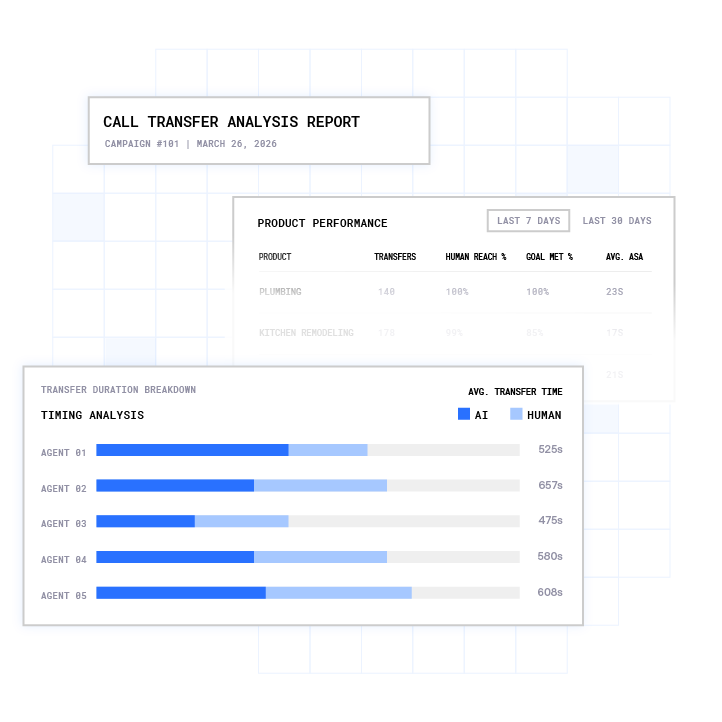
Plura Conversation Intelligence gives businesses AI-powered analytics, call transfer tracking, and customer interaction insights across every conversation.
Trade-offs: Transcript-driven refinement requires a platform that logs every call with full fidelity and makes transcripts searchable by outcome. Many Twilio-based API resellers hand off transcripts as flat files with no outcome tagging.4 Plura’s stateful conversation database keys every transcript to a customer token and outcome label, which turns refinement into a repeatable process instead of a manual audit.
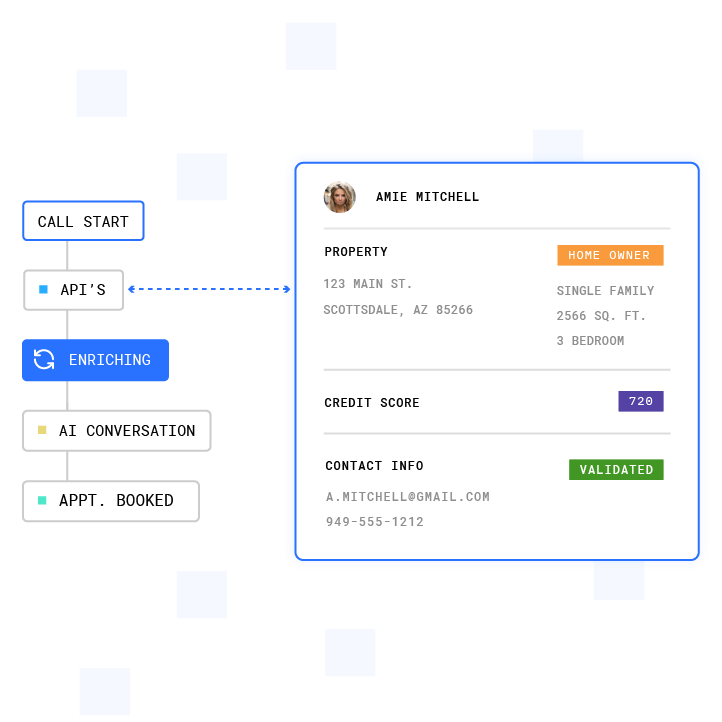
Plura’s lead enrichment, which pulls from data sources in real time during the call, can increase conversion rates by 30% or more by giving the AI the context it needs to handle objections before they arise.3
4. Personalize Conversations in Real Time
Objective: Deliver a conversation that reflects what the AI already knows about the caller, including prior interactions, qualification status, offers made, and objections raised, without requiring the caller to repeat themselves.
Plura Lead Intelligence enriches customer data with AI-powered insights, validation, and lead qualification to improve conversion performance.
Measurement method: Track first-call resolution (FCR, the percentage of calls resolved without a callback or escalation) and conversion rate, segmented by whether the AI had prior context on the caller versus no context. The delta between these cohorts quantifies the personalization lift.
Trade-offs: Real-time personalization requires a stateful conversation database that persists context across channels. A caller who texted at 9 a.m. and calls at noon should not have to re-explain their situation. Plura’s AI Voice, AI SMS, and AI webchat all share a single stateful database, so every channel inherits the full memory of every prior touchpoint.
Book a live demo with Plura to see stateful cross-channel memory in action. Schedule your demo here.
5. Run Voice-Specific A/B Tests
Objective: Run controlled experiments on individual voice agent variables to identify which configurations produce the highest conversion rate, then ship winners as the new baseline.
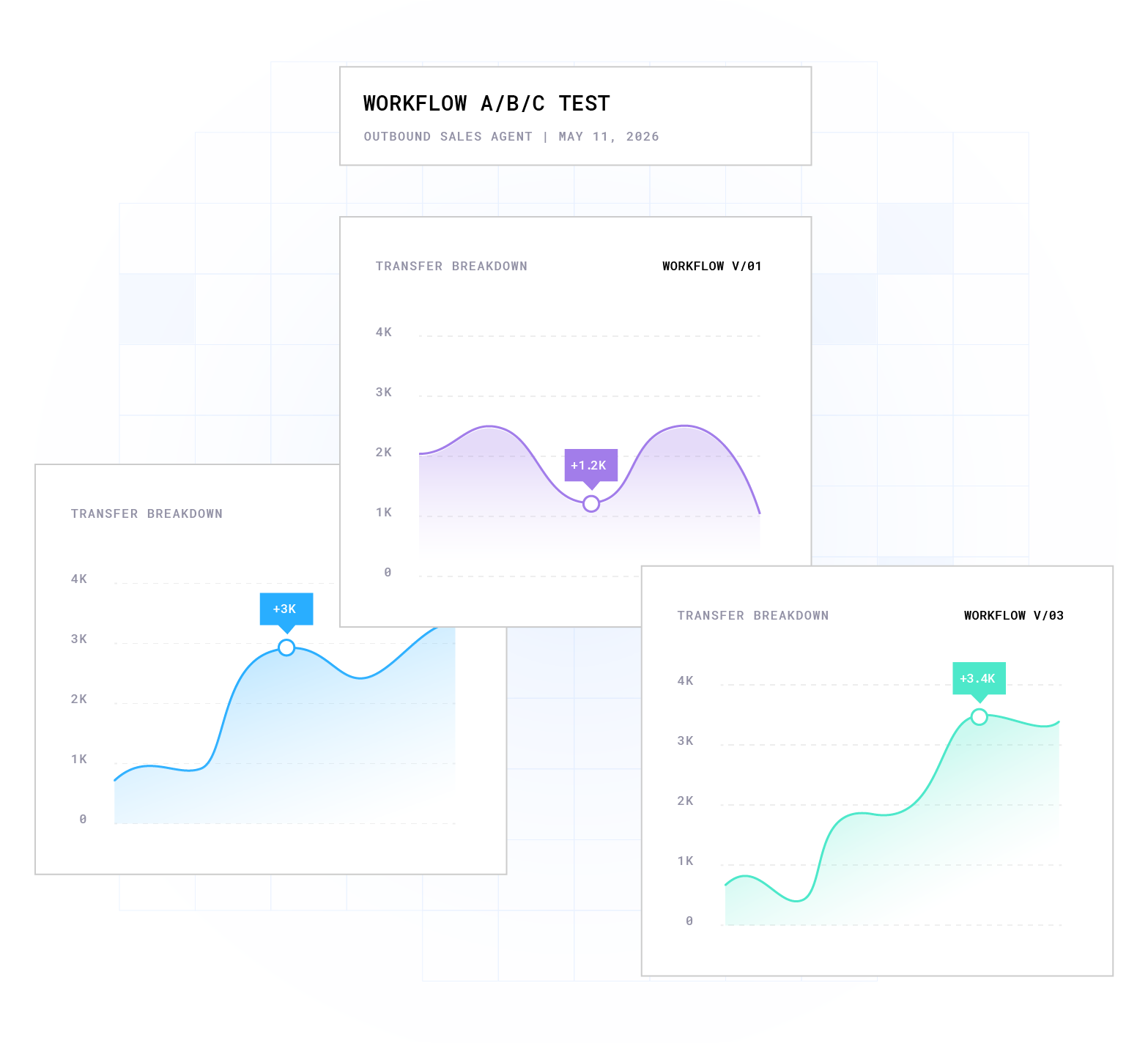
Plura Conversation Optimization improves AI workflow performance with A/B testing, analytics, and real-time conversation tuning.
The table below maps the four highest-yield A/B test variables to their measurement approach and expected signal strength.
Variable
What to Test
Primary Metric
Minimum Calls per Variant
Greeting length
Short (under 10 seconds) vs. long (15+ seconds) opener
Call completion rate
500
Pause cadence
Natural 300 ms pause vs. 600 ms pause after questions
Talk ratio, interruption rate
500
Objection-handling phrasing
Acknowledge-then-redirect vs. direct reframe
Qualification rate
1,000
Transfer timing
Transfer after 1st confirmed pain point vs. 2nd
Live-transfer conversion rate
1,000
Measurement method: Pre-register exactly one primary outcome label before the test begins. A minimum of several hundred calls per variant is typically needed to detect a meaningful difference with statistical confidence. A variant wins only if the primary metric improves and all guardrails, including P95 turn latency, escalation rate, and compliance event rate, remain inside written bounds.
Objective: Replace dashboard metrics that measure activity, such as calls made, AHT, and containment rate, with metrics that measure revenue outcomes and regulatory exposure.
The KPI dashboard below maps outcome metrics to measurement targets and the payroll or regulatory exposure each metric controls.
KPI
Definition
Production Target
What It Controls
First-ring pickup rate
% of inbound calls answered within 2 rings
96–99%
Missed-call revenue leak
Average handle time
Mean call duration from greeting to close
2–4 minutes for qualification flows
Talk-time utilization, payroll
Call-to-conversion rate
% of answered calls producing a booked meeting, qualified lead, or sale
21–40% post-AI deployment
Revenue per dial
Cost per qualified lead
Total platform cost divided by SQL (sales-qualified lead) volume
$25–$60 with AI vs. $200 human baseline
CAC, payroll efficiency
Compliance event rate
Disclosure failures, DNC violations, consent gaps per call type
Below 0.1% per call type
Regulatory exposure, TCPA compliance
Measurement method: Calculate effective resolution rate as containment rate multiplied by outcome rate. A 70% containment rate with a 15% booking rate yields only 10.5% effective resolution. A 45% containment rate with a 40% booking rate yields 18%, which is a materially better result from a lower containment number. When teams optimize for this combined metric rather than containment alone, properly deployed voice AI lifts net inbound-to-meeting conversion from a pre-AI baseline of 5–15% to 21–40% post-AI,3 across 40+ inbound-sales deployments analyzed in 2026.
Trade-offs: Outcome metrics require integrations that close the loop between the call and the downstream CRM (Customer Relationship Management) record. Absence of deep CRM integration causes conversion to drop 30–50%.3 Plura’s integrations with HubSpot, Salesforce, and Zoho close this loop automatically.
ROI Calculator for Payroll and Revenue Impact
These outcome metrics translate directly into measurable financial impact. The seven levers above map to both payroll savings and revenue lift. A 15-agent operation paying $20 per hour with a 40% talk-utilization rate costs $60,000 per month. Replacing that team with Plura at $15 per hour and 100% talk utilization drops the monthly cost to $14,400, a $45,600 first-month saving that compounds to $547,200 over 12 months (per Plura’s ROI calculator).3
Run your numbers through Plura’s calculator to check your ROI in real time. Check your ROI now.
7. Use a 90-Day Optimization Cadence
Objective: Treat every AI voice deployment as a conversion rate optimization (CRO) program with a structured 90-day iteration cycle, not a one-time build.
Decision criteria: Many AI vendors deliver a build, hand off the keys, and leave the customer to optimize a black box. Conversation quality drifts, compliance gaps appear, and conversion rates flatten. A 90-day cadence structures the iteration. Weeks 1–4 establish baseline KPIs and identify the highest-yield friction point. Weeks 5–8 run A/B tests on that friction point. Weeks 9–12 ship the winner, measure lift, and identify the next bottleneck.
Trade-offs: A 90-day cadence requires a platform that surfaces actionable signals, not just call logs. Plura’s conversation intelligence layer analyzes every interaction across voice, SMS, RCS, and webchat to surface patterns, including which scripts close, which objections recur, and which conversion paths win. Every annual contract includes a 90-day opt-out window. If the deployment is not delivering, customers are not held to the year.
Plura customers using this cadence report outcomes including a solar company that increased conversion rates from 6% to 18% with the same leads and offer.3 Solar and home services operators also achieve 2x to 3x improvements in appointment set rates using AI agents with real-time property data enrichment.
Book a live demo with Plura to walk through the 90-day optimization framework for your operation. Schedule here.
Frequently Asked Questions
Latency thresholds that prevent AI voice call abandonment
The practical threshold for conversational feel in production AI voice deployments is end-to-end response latency under 800 ms, measured from the caller finishing a turn to the first audible agent response. Latency under 500 ms feels like normal conversation. Between 500 ms and 800 ms, callers begin to hesitate and may talk over the agent. Above 800 ms, callers frequently assume the call dropped or that no one is listening, and abandonment rates climb sharply. Plura owns its FCC-licensed carrier stack, which removes the third-party CPaaS hop that adds latency in many AI voice platforms and keeps response times within the sub-800 ms window at scale.
Recommended cadence for A/B testing voice agent scripts
A weekly test cadence functions as the operational standard for contact centers running systematic voice AI optimization. The recommended cycle is four weeks per bottleneck. One week identifies the highest-yield friction point from failed call transcripts. One week designs and launches a two-variant test with at least 500 calls per variant. One week compares metrics and segments results. One week ships the winner and identifies the next bottleneck. Contact centers running this cadence consistently report 15–25% improvement in containment rate within the first quarter. Plura’s conversation intelligence layer surfaces the friction points automatically, so teams spend time on decisions rather than manual transcript audits.
Compliance frameworks that shape AI voice optimization in U.S. contact centers
AI voice deployments in U.S. contact centers operate within several overlapping frameworks. The FCC’s February 8, 2024 Declaratory Ruling (FCC 24-17) classifies AI-generated voices as “artificial voices” under the Telephone Consumer Protection Act (TCPA, 47 U.S.C. Section 227), which subjects outbound AI voice calls to the same consent framework as prerecorded messages.2 The Do Not Call (DNC) registry requires outbound contact lists to be scrubbed against federal and state registries. HIPAA (Health Insurance Portability and Accountability Act, 45 CFR Parts 160, 162, 164) applies where calls involve protected health information. SHAKEN/STIR caller ID verification applies to outbound call authentication. Eleven U.S. states require all-party consent for call recording. Operators should consult qualified counsel regarding their specific obligations under each framework. Plura supports compliance with SOC 2, HIPAA, ISO certification, GDPR, SHAKEN/STIR caller ID verification, TCPA compliance, and DNC compliance through platform-level enforcement, including real-time DNC scrubbing, immutable consent logging, automated quiet-hours enforcement, and one-click audit exports.1 Customers remain responsible for their own regulatory obligations and certifications.
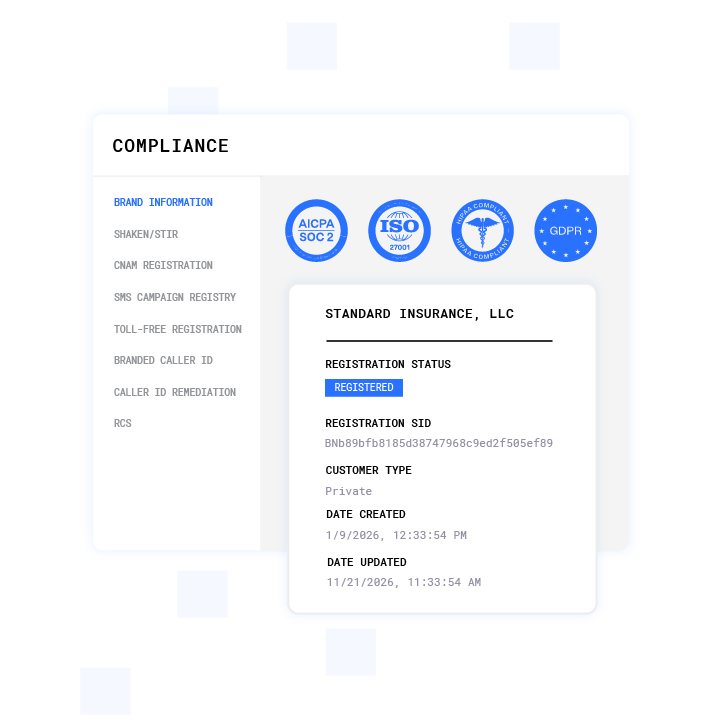
Plura Security & Compliance supports SOC 2, ISO, and GDPR standards with trust registration, verification management, and secure AI communications.
CRM and calendar integrations that close the conversion loop
Plura integrates with HubSpot, Salesforce, and Zoho on the CRM side, and with Cal.com, Calendly, and Google Calendar for appointment booking.4 These integrations close the loop between the AI voice call and the downstream record that sales and marketing teams use to measure conversion. When a call produces a qualified lead or a booked meeting, the outcome writes back to the CRM automatically, with no manual entry and no data lag. Plura also integrates with attribution platforms including Ringba and Retreaver, and with automation tools including Zapier and Make,4 for teams that need to fire post-call events into broader marketing stacks. The full integration directory is at plura.ai/integrations.
Expected outcomes from a 90-day AI voice optimization program
Plura’s 90-day optimization cadence is structured around four KPI layers: outcome (call-to-conversion rate, intent resolution rate), economic (cost per qualified lead, talk-time utilization), conversational quality (talk ratio, instruction adherence, sentiment trajectory), and risk (compliance event rate, escalation precision). Plura customers typically see the outcomes detailed in Section 7 above, including meaningful improvements in ROI, pipeline growth, and lead-response time within the first 90 days. The 90-day opt-out window in every annual contract puts the iteration commitment on the line. If the deployment is not delivering against agreed KPIs, customers are not held to the year. Run your specific numbers through Plura’s ROI calculator to model the outcome for your operation’s call volume, payroll structure, and talk-time utilization rate.
Missed-call recovery and after-hours coverage in voice conversion programs
Missed calls create a direct conversion loss. Invoca’s Lead Conversion Benchmarks Report 2026 for business services, based on an analysis of 70 million voice and SMS conversations, found that 44% of callers never reach a person.3,4 Plura’s AI voice agent answers every inbound call on the first ring, 24/7, including after hours, weekends, and peak-volume periods when human staffing gaps are widest. For missed-call recovery, Plura’s AI SMS layer contacts callers who did not connect, re-engages them with a personalized outreach sequence, and routes qualified callbacks to the voice agent or a live transfer. Multi-unit franchise operators using this model have reported moving from a 40% missed-call rate across 12 locations to answering 100% of calls, with booking rates doubling without adding receptionist headcount. Plura’s healthcare deployments also support up to 40% improvement in no-show rates through AI-driven confirmation sequences. Learn more about Plura’s healthcare solutions.
Compare Plans at Plura AI Pricing
Plura’s platform is available across three tiers, including an Enterprise tier with custom configuration for high-volume operations. Every plan runs on Plura’s FCC-licensed carrier stack with sub-800 ms latency, stateful cross-channel memory, and the full compliance framework detailed in Section 7 built in. Annual contracts include a 90-day opt-out window.
1 Plura AI maintains SOC 2, HIPAA, ISO, and GDPR posture as part of its platform infrastructure. References to compliance frameworks in this article describe Plura’s platform capabilities and do not constitute a guarantee that any customer using Plura will themselves be compliant with applicable laws or standards. Customers remain solely responsible for their own regulatory obligations, certifications, consent management, recordkeeping, and the claims they make to their own end users. Consult qualified legal counsel for guidance specific to your use case.
2 This article describes regulatory frameworks at a general level and does not constitute legal advice. Laws and regulations vary by jurisdiction, change over time, and apply differently depending on facts and circumstances. Readers should consult qualified legal counsel before making compliance decisions.
3 Performance figures, customer outcomes, and industry statistics referenced in this article are drawn from cited third-party sources or Plura customer case studies. Individual results vary based on implementation, use case, industry, audience, and execution. Past or aggregate performance is not a guarantee of future results.
4 References to third-party products, services, companies, or research are made for informational and comparative purposes only. Plura AI is not affiliated with, endorsed by, or sponsored by any third party named in this article unless explicitly stated. Trademarks and product names referenced remain the property of their respective owners.
This article is provided for informational purposes only and reflects Plura AI’s understanding at the time of publication. Product capabilities, integrations, and specifications are subject to change. For the most current information, visit plura.ai.
This article was produced with the assistance of AI tools and reviewed by Plura AI prior to publication.