AI Answering Service ROI: Costs, Savings, and Payback
ON THIS PAGE
Written by: Matt Beucler, CEO, Plura AI
Key Takeaways
Traditional contact-center TCO of $4M–$7M can drop to $300K–$700K with Plura AI on equivalent volume, driven by labor savings and elimination of turnover costs.3
Missed-call recovery creates a direct revenue lift, with 62% of inbound calls going unanswered in many operations and each recovered call often worth hundreds of dollars in converted revenue.
Compliance risk exposure from TCPA violations and state onshoring requirements can reach $15M for a 10,000-call campaign, so FCC, HIPAA, and SOC 2 support becomes a material ROI factor.1
Operators replacing 15+ seats typically achieve 3× average ROI within 90 days, and IDC research shows a 2.8-month median payback period for enterprise voice AI deployments.3
This ROI model follows five steps: establish your TCO baseline, quantify missed-call revenue, add a compliance risk adjustment, project a 90-day proof window, and apply per-vertical benchmarks. Every statistic below links to a primary source so finance and legal stakeholders can audit the numbers instead of relying on a marketing estimate.
The TCO gap from $4M–$7M down to $300K–$700K on equivalent volume comes from labor structure, not headcount alone. Plura AI replaces hourly labor with a fixed platform fee that covers high-volume conversations.
In-house U.S. call center operations carry a fully loaded cost of $28–$48 per agent hour in 2026, derived from a BLS median wage for customer service representatives (SOC 43-4051) plus benefits, supervision, facilities, and technology overhead. Labor accounts for 60-75% of the typical contact center budget. Contact center attrition averages between 30% and 45% annually (with Metrigy research citing 31.2% as of year-end 2024), and replacing a single agent costs $10,000–$20,000 once recruiting, onboarding, training, and ramp-up are counted. The table below breaks down how these cost categories compare between traditional contact centers and Plura’s platform across a 100-seat equivalent operation.
At the 15-agent scale modeled in Plura’s ROI calculator, 15 human agents at $20/hour with 25% taxes, benefits, and commissions at 40% talk utilization cost $60,000/month. Six Plura agents handling the same 2,400 hours at 100% talk utilization cost $14,400/month. That creates a $45,600 monthly difference.
Step 2: Quantify Missed-Call Recovery Economics at Scale
Plura’s AI voice agent answers every inbound call within seconds, 24/7, with no concurrency limit. That eliminates the after-hours and peak-volume miss rates that drive the revenue leakage above. Beyond revenue recovery, operators also need to factor in regulatory exposure, which forms the third component of a complete ROI model.
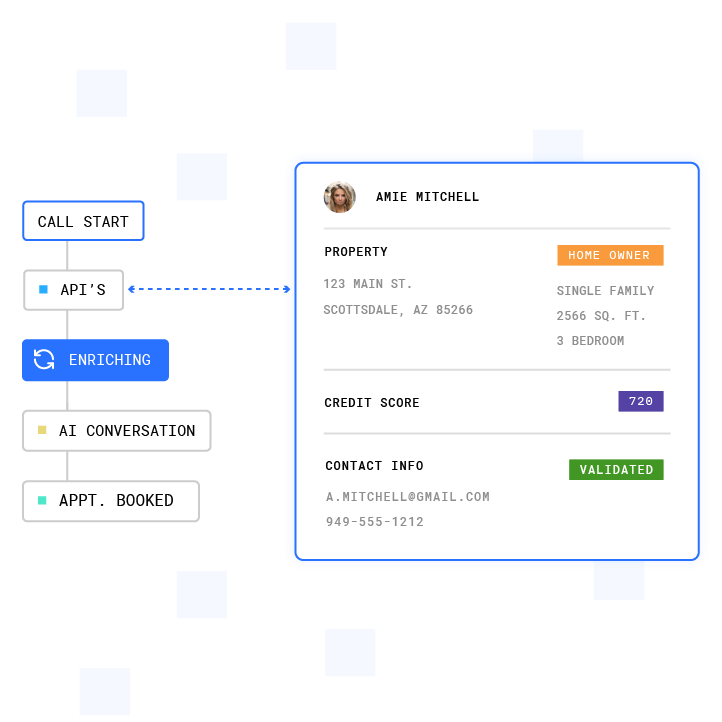
Plura Lead Intelligence enriches customer data with AI-powered insights, validation, and lead qualification to improve conversion performance.
Step 3: Add a Compliance Risk Adjustment Line for FCC NPRM and State Onshoring Exposure
State exposure layers on top of federal rules. According to the National Conference of State Legislatures, over 1,000 AI measures were introduced in 2025. The FCC’s NPRM (CG Docket No. 26-52) proposes capping offshore customer-service calls at 30% and limiting offshore handling of sensitive consumer data.2 State laws in New York, New Jersey, Connecticut, Missouri, and Florida already restrict offshore handling of medical, financial, and consumer data.
Plura runs on 100% U.S. infrastructure by architecture, which directly addresses the FCC’s proposed offshore restrictions. Voice origination, model hosting, data storage, and call recording all sit on domestic infrastructure, which removes the data-repatriation risk that offshore BPO contracts now carry. The platform supports compliance with TCPA, DNC, HIPAA, SOC 2, and SHAKEN/STIR caller ID verification, frameworks that often require dedicated compliance staff and external audits.1 Organizations running traditional CCaaS typically allocate 13% of operating costs to compliance, the sector-wide average cited earlier. Plura’s compliance infrastructure is included in the platform fee rather than billed as an add-on, which shifts that 13% cost line from variable to fixed.
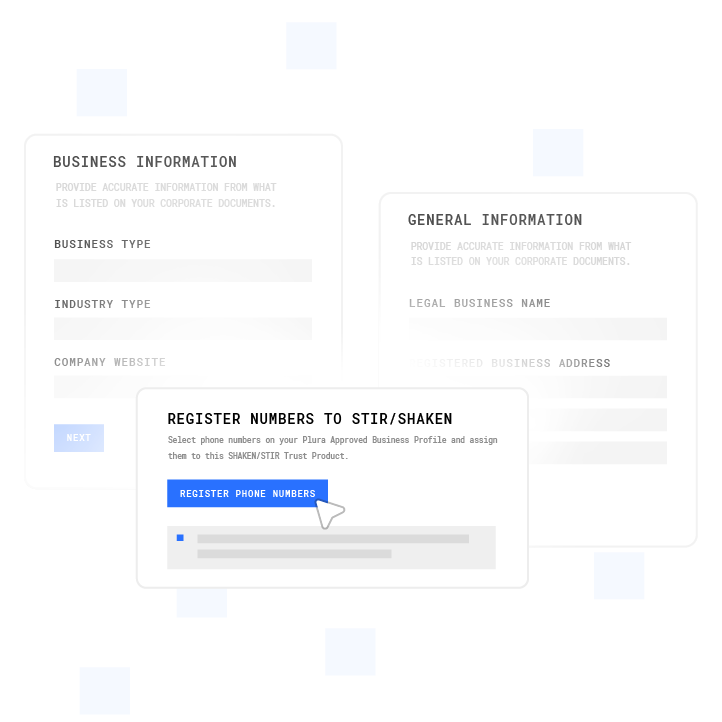
Plura’s FCC-licensed AI communications platform simplifies compliant business registration and phone number provisioning for AI Voice, SMS, RCS, and Webchat workflows.
Consult qualified legal counsel to assess your organization’s specific obligations under applicable federal and state frameworks.
Step 4: Apply the 90-Day ROI Proof with Opt-Out Clause
With TCO baseline, missed-call recovery, and compliance risk quantified, the next step is to project these savings over a realistic proof window. Using the Plura ROI calculator defaults for a 15-agent operation:
Plura’s annual contracts include a 90-day opt-out window. If the deployment is not delivering measurable results within that window, operators are not held to the annual term. Compare plans and rates to see how Plura’s pricing scales with your operation.
Step 5: Per-Vertical Worked Examples
Home Services: A contractor handling 500 inbound calls/month misses 74% (370 calls). At a $1,200 average job value and 40% close rate on recovered calls, that equals $177,600 in annual recovered revenue. The contractor also gains $60,000+ in annual labor savings from replacing two full-time dispatchers. Total first-year impact exceeds $237,000 against a platform cost well inside the $300K–$700K TCO range. After-hours call answering captures the jobs competitors take when your phones go unanswered.
Legal: Mass-tort intake operations running 1,000+ inbound leads per month at a $5,000 average case value and 15% qualification rate generate $750,000 in qualified pipeline per month. Reducing the missed-call rate from 60% to near zero with a 24/7 AI voice agent captures a material share of that pipeline that previously went to competing firms.
Agencies: An agency managing 10 clients, each running 200 inbound leads/month, contacts every lead within 60 seconds via AI SMS and voice. Account-manager capacity expands from 5–8 clients to 15–20. Agency margins shift from a 15–25% industry baseline toward 35–50%.
For operators currently running offshore BPO contracts, the FCC NPRM (CG Docket No. 26-52) adds a separate exposure line: the cost of contract restructuring, data repatriation, and potential penalties under state onshoring laws. That line item does not appear in most current ROI models but belongs in any honest 24-month projection. The five components described above can be expressed as a unified calculation framework.
Numbered ROI Formula Block
Labor savings = (Human cost per contact – AI cost per contact) × monthly volume × containment rate
Revenue recovery = Missed calls captured × average value × close rate
How much do AI answering services cost at contact-center scale?
At contact-center scale, AI answering service costs depend on call volume, channel mix, and platform architecture. Plura’s pricing tiers start at $5,000/month for the Multi plan, $7,500/month for Agency, and custom pricing for Enterprise, all on annual contracts billed monthly with a 90-day opt-out window. Agent build fees run $2,500–$2,750 per agent. Traditional contact-center TCO is $4M–$7M while Plura platform TCO is $300K–$700K on equivalent volume. Per-conversation costs for AI voice agents are substantially lower than for offshore human agents. See current plan details and volume-based pricing.
What is the payback period for enterprise AI voice deployments?
IDC’s 2025 research places the median enterprise payback period for inbound voice AI at 2.8 months.4 Forrester’s Total Economic Impact analysis of enterprise voice AI found a median time to ROI breakeven of 3.2 months. Plura targets 3× average ROI in 90 days for operators replacing 15+ seats, and industry research supports that 90-day target. Payback accelerates when deployments start with high-volume, well-defined intents such as inbound qualification, appointment scheduling, and after-hours call capture, because containment rates on those flows are highest and the labor savings arrive immediately. Complex multi-department rollouts with deep CRM integrations typically run 6–12 months to full payback.
How do FCC rules affect AI answering service ROI?
The FCC’s February 2024 declaratory ruling classified AI-generated voices as artificial or prerecorded voice under the TCPA, which affects consent management, disclosure scripting, and audit-log requirements for outbound AI voice programs. The FCC’s NPRM (CG Docket No. 26-52) proposes additional restrictions on offshore call handling and sensitive data processing. These regulatory developments add compliance infrastructure costs to any AI voice deployment. Operators should model those costs explicitly in their ROI calculations and consult qualified legal counsel to assess their specific obligations. Plura’s compliance engine supports TCPA, DNC, SHAKEN/STIR caller ID verification, HIPAA, and SOC 2 infrastructure as part of the platform fee rather than as add-ons, which affects the compliance cost line in the TCO comparison.
What containment rate should I use in my AI answering service ROI model?
Containment rate is the share of calls handled end-to-end by the AI without a human transfer. Gartner does not provide 2025 containment rate benchmarks by complexity, and its March 2025 release instead predicts agentic AI will autonomously resolve 80% of common customer service issues by 2029.4 Because current-state benchmarks vary widely by use case, a blended rate weighted against your actual call mix is the correct input. Plura recommends modeling at pessimistic, expected, and optimistic containment rates because this is the most sensitive variable in the ROI calculation, and small changes in containment assumptions can swing projected ROI by 50% or more. Well-configured deployments targeting high-volume, repeatable intents such as inbound qualification, scheduling, and FAQ handling typically reach 60–75% automation within 6–12 months through continuous optimization. Month-one containment should be modeled at 60–70% of steady-state levels to account for the ramp period.
What hidden costs should I include in an AI answering service TCO model?
Standard TCO models for AI answering services should include platform and model usage fees, telephony costs, implementation and integration expenses, ongoing conversation engineering and maintenance, human monitoring and compliance oversight, and a contingency line for concurrency spikes and escalation handling. IDC research indicates that many AI projects exceed budgeted TCO, primarily due to underestimated integration and maintenance costs. Implementation costs for enterprise deployments can be a multiple of the platform fee, with ongoing maintenance adding further to the total. Plura’s onboarding includes discovery, build, pilot, and go-live as part of the engagement, and the 90-day opt-out clause limits downside exposure if the deployment underperforms.
1 Plura AI maintains SOC 2, HIPAA, ISO, and GDPR posture as part of its platform infrastructure. References to compliance frameworks in this article describe Plura’s platform capabilities and do not constitute a guarantee that any customer using Plura will themselves be compliant with applicable laws or standards. Customers remain solely responsible for their own regulatory obligations, certifications, consent management, recordkeeping, and the claims they make to their own end users. Consult qualified legal counsel for guidance specific to your use case.
2 This article describes regulatory frameworks at a general level and does not constitute legal advice. Laws and regulations vary by jurisdiction, change over time, and apply differently depending on facts and circumstances. Readers should consult qualified legal counsel before making compliance decisions.
3 Performance figures, customer outcomes, and industry statistics referenced in this article are drawn from cited third-party sources or Plura customer case studies. Individual results vary based on implementation, use case, industry, audience, and execution. Past or aggregate performance is not a guarantee of future results.
4 References to third-party products, services, companies, or research are made for informational and comparative purposes only. Plura AI is not affiliated with, endorsed by, or sponsored by any third party named in this article unless explicitly stated. Trademarks and product names referenced remain the property of their respective owners.
This article is provided for informational purposes only and reflects Plura AI’s understanding at the time of publication. Product capabilities, integrations, and specifications are subject to change. For the most current information, visit plura.ai.
This article was produced with the assistance of AI tools and reviewed by Plura AI prior to publication.