How to Handle Voicemail in AI Voice Agents: A Complete Guide
ON THIS PAGE
Written by: Matt Beucler, CEO, Plura AI
Key Takeaways
AI voicemail handling splits into two workflows: inbound receptionist flows and outbound answering machine detection, each with different goals.
Most outbound sales calls reach voicemail, so accurate detection and routing protect budget and caller reputation.
Effective voicemail delivery depends on AMD, a generous beep-wait window, short messages, and conservative handling of uncertain call states.
Production setups log every voicemail outcome into the CRM and track delivery, callbacks, and accuracy as weekly KPIs.
The Problem: Why Voicemail Handling Matters in AI Voice Agents
RingDNA’s 2025 research found that 72% of outbound sales calls go to voicemail, so voicemail becomes the default outcome for most B2B dials.3 At 30% voicemail pickup on a 10,000-call campaign, poor detection can create 3,000 confused messages and a fast-degrading sender reputation.
The operational costs of mishandled voicemail compound quickly. A misdropped message that starts mid-greeting signals to the recipient that the call is automated and poorly configured. Carriers flag numbers that generate complaint patterns, which degrades deliverability for every subsequent call in the campaign. A well-crafted AI voicemail achieves 3-5x higher callback rates than a generic recorded message, so voicemail quality directly affects pipeline.
Pairing voicemail with immediate email follow-up also drives performance. Analysis of over 300 million cold calls found that pairing voicemails with immediate follow-up emails improved email reply rates from 2.73% to 5.87%, more than doubling email engagement.3 The same analysis found that leaving three or more voicemails for the same prospect drops the email reply rate to 2.2%, below the baseline achieved with no voicemails at all.
Inbound vs. Outbound Voicemail Handling: Two Different Problems
Voicemail handling in AI voice agent deployments splits into two scenarios with different goals, configurations, and failure modes.
Inbound: The AI voice agent acts as an AI receptionist, answering calls 24/7 and taking structured messages when a human is unavailable. The agent collects name, phone number, company, and reason for calling, then syncs the record to a CRM via webhooks. The goal is capturing information and booking follow-up actions without losing the caller. Plura AI’s AI voice agent handles inbound flows with stateful conversation memory, so every message is logged and routed with full context.
Outbound: The AI agent must detect whether the call was answered by a human or a voicemail system, then decide whether to hang up or leave a message. The goal is maximizing live conversations and minimizing wasted contact attempts. Every second of dead air on a human pickup, and every message left on a live line, burns budget and damages brand perception.
These two scenarios require separate configuration logic. Treating them as the same problem creates avoidable voicemail-related campaign failures.
How to Handle Voicemail in AI Voice Agents
Enable voicemail detection (AMD) on your AI voice agent platform. AMD must be active on every outbound call before any other configuration has value.
Configure the beep-wait timeout so the message starts after the beep. Most voicemail greetings play 10-20 seconds before the beep, so the wait window must accommodate longer greetings.
Choose the hang-up vs. leave-message strategy based on campaign goals. High-value campaigns often benefit from leaving a message, while high-volume top-of-funnel campaigns may benefit from silent retry.
If you decide to leave a message, craft a concise, conversion-focused voicemail template of 15-25 seconds. Front-load the value proposition into the first 8-10 seconds, because mobile lock-screen transcriptions show the first line.
Handle false positives and call screening with clear fallback behaviors. When AMD confidence is low or the call state is UNKNOWN, route to the human branch.
Log voicemail outcomes to your CRM via webhooks. Persist call ID, outcome, AMD label, confidence, message template ID, and timestamp on every call.
Monitor voicemail performance metrics and iterate. Review detection accuracy, drop completion rate, and callback rate weekly, then adjust parameters based on those trends.
Configuration details vary across major platforms. The table below summarizes the primary AMD method, beep-wait default, and a key configuration parameter for each.4
For Twilio, use DetectMessageEnd mode when the goal is leaving a message. This mode waits for the greeting to finish and returns machine_end_beep, machine_end_silence, or machine_end_other. Use Enable mode when speed is the priority, because it returns human, machine_start, fax, or unknown as soon as a determination is made. Set asyncAmd: 'true' to decouple detection from the call lifecycle and avoid dead air on human pickups.
For Vapi, the Twilio AMD path is now marked as legacy. The current recommended path uses LLM-based detection via function calling, with a 2.5-second minimum retry frequency and a 30-second beep wait default.
For Retell, enable the Voicemail Detection toggle in agent settings, set detection duration starting at 30 seconds, and lower response eagerness to 0.5-0.6 to give the agent more time before committing to a response.
Plura’s AI predictive dialer includes built-in voicemail detection as part of its carrier-grade infrastructure, running on Plura’s own FCC-licensed audio bridging carrier rather than a third-party CPaaS.
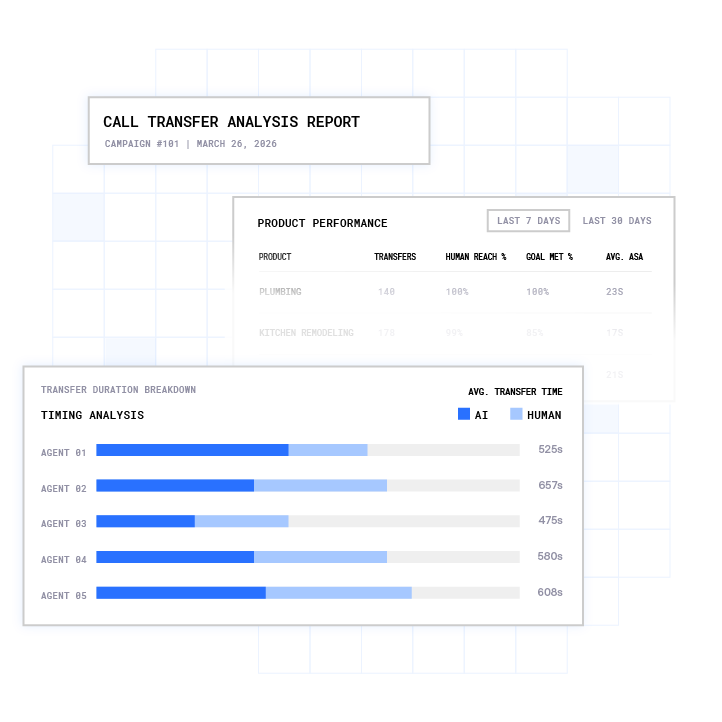
Plura Predictive Dialer automates outbound calling with AI-powered pacing, transfer optimization, and real-time performance analytics.
Waiting for the Beep: Timeout Configuration and Why It Matters
Most voicemail greetings play 10-20 seconds before the beep, so the beep-wait window must accommodate longer greetings to avoid cutting off the opening words of the message. The beepMaxAwaitSeconds parameter is configurable from 0 to 60 seconds, with 25-30 seconds as typical defaults.
Detection timeout typically ranges from 15-30 seconds. Shorter timeouts between 10 and 15 seconds suit business lines with brief greetings. Longer timeouts between 20 and 30 seconds work better for consumer campaigns where personal voicemail messages vary widely.
Using DetectMessageEnd mode prevents the message from starting mid-greeting, which is a common cause of truncated or awkward voicemail drops. Some voicemail systems use silence or verbal prompts instead of a beep tone, so a no-beep fallback should be configured for campaigns that include consumer lines.
Three ready-to-use templates for common scenarios:
Sales follow-up:
“Hi [First Name], this is [Rep Name] from [Company]. I am calling because you recently [requested a demo / asked for pricing] about [product]. We reviewed your request and can help with the next step. Call me back at [Number]. Again, that is [Number]. Thanks, and I look forward to connecting.”
Appointment reminder:
“Hi [First Name], this is [Company] calling about your [Appointment Type] on [Day] at [Time]. We are looking forward to seeing you. To confirm, please [press 1 / call us at Number]. If you need to reschedule, call us at [Number]. Again, this is [Company] regarding your [Appointment Type] on [Day] at [Time].”
Customer service callback:
“Hi [First Name], this is [Agent Name] from [Company] returning your call from earlier today. I understand you had a question about [issue]. You can reach me directly at [Number], or reply to the text I just sent. Again, this is [Agent Name] from [Company], and my number is [Number].”
Plura’s AI voice agents generate dynamic, context-aware voicemail messages using conversation memory from the Stateful Conversation Database, so every drop reflects the full history of prior touchpoints with that contact.
Handling False Positives and Call Screening: The UNKNOWN State
AMD returns human, but a voicemail greeting plays: The agent should recognize the greeting pattern and switch to voicemail delivery. Late detection handling, as implemented in Deepgram’s outbound telephony reference implementation, tears down the live agent connection mid-call and switches to voicemail delivery.
AMD returns machine, but a human answered: Increase machineDetectionSpeechThreshold to 3000-4000ms and increase startAtSeconds to 3-4 seconds to reduce false machine detections for verbose human greetings.
Call screening detected (iOS 26, Google Pixel screener, Truecaller): Either hang up or leave a message based on campaign goals. Plura’s AI voice agents communicate with iOS 26 call screening to present branded caller ID, which reduces screening incidents at the carrier level.
Every voicemail event should be persisted with enough detail to support weekly accuracy reviews and CRM sync. A production-grade voicemail outcome log:
Sync this record to your CRM via webhooks on every call. Plura’s platform automatically logs all interactions and integrates with 50+ tools across CRM, calendar, and attribution categories.
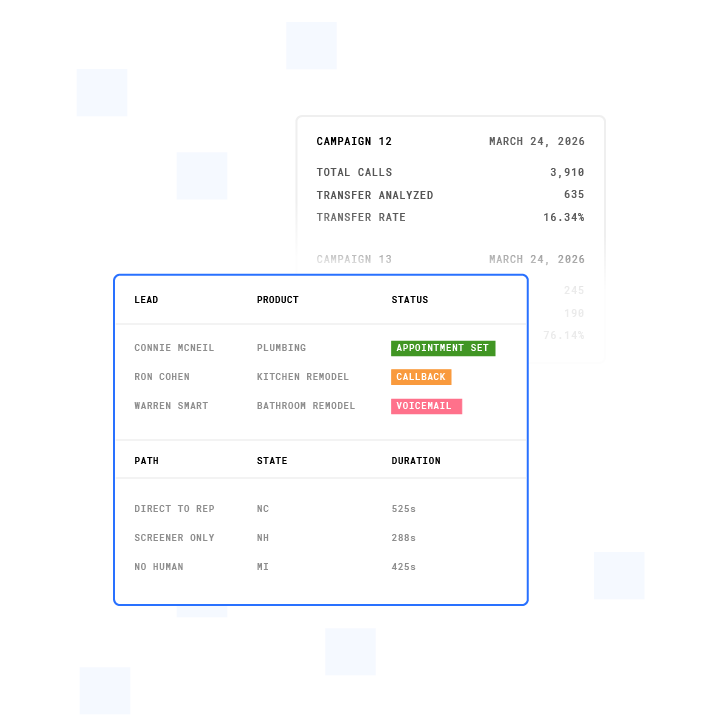
Plura Conversation Intelligence gives businesses AI-powered analytics, call transfer tracking, and customer interaction insights across every conversation.
Production Architecture for Reliable Voicemail Handling
The voicemail handling flow as a state diagram:
Dial -> AMD -> Live / Unknown / Voicemail (if voicemail) Wait for beep -> Play message -> Log outcome (if unknown) Default to human branch -> Begin conversation
The architecture in plain language: enable AMD on every outbound call, wait for the beep or greeting end, play a pre-rendered message, and log the outcome with AMD details. UNKNOWN states route to a human branch so real buyers do not get dropped.
Plura’s AI predictive dialer provides this architecture out of the box, with carrier-level AMD and stateful conversation memory across every channel.
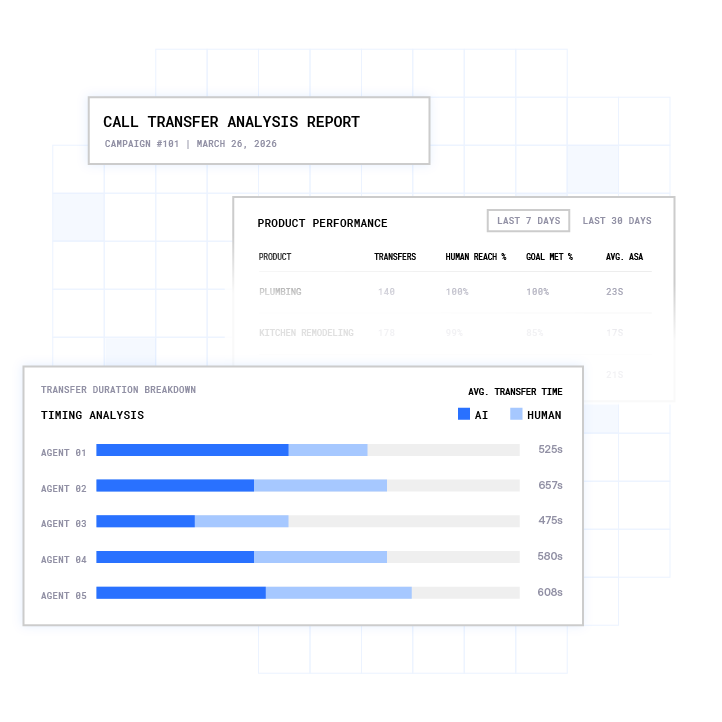
Plura Predictive Dialer uses AI-powered outbound dialing, intelligent routing, and real-time analytics to maximize call performance.
Beep detection failures: These issues often appear when greetings run long or use silence instead of a tone. Increase beepMaxAwaitSeconds to 30 seconds, enable beep detection if available, or switch to DetectMessageEnd mode so the system keys off greeting completion instead of a single beep.
Message truncation: Gaps in streamed TTS audio cause many truncation problems. Pre-render voicemail audio instead of streaming TTS. Carrier voicemail systems expect a continuous audio stream, and any sub-second gap can truncate the recording.
Call screening: Screening tools treat unknown numbers cautiously, so identity matters. Use branded caller ID and STIR/SHAKEN authentication to pass iOS 26 screening. If screened, hang up or leave a message based on campaign goals. Plura issues branded caller ID directly through its FCC-licensed carrier and enforces STIR/SHAKEN authentication on every outbound call.1
Compliance considerations (TCPA, DNC): The FCC’s February 2024 Declaratory Ruling describes AI-generated voices under TCPA’s “artificial or prerecorded voice” category.2 The framework addresses prior express consent, caller identification, and a working opt-out mechanism. Consult qualified counsel for your specific campaign. Plura’s platform includes real-time DNC scrubbing and features that support compliance, and customers remain responsible for their own obligations.1
1
Measuring Success: Voicemail Handling KPIs
Teams should track a focused set of metrics to evaluate voicemail handling effectiveness.
Live connect rate: Track the share of dials that reached a human, separated from voicemail outcomes.
Callback rate: Measure with a 7-day attribution window on unique contacts. The average B2B voicemail callback rate is 4.8%, and a strong AI voicemail program should exceed this baseline.3
AMD accuracy (F1 score): Sample 1-2% of calls for human review weekly and alert when campaign F1 drops below 0.92.
Cost per voicemail delivered: Track total campaign cost against delivered messages to understand unit economics.
Plura’s conversation intelligence provides outcome-based metrics across every channel, including voicemail delivery rate, connect rate, and callback attribution.
Advanced Orchestration and Next Steps
Cross-channel orchestration compounds voicemail performance. A voicemail followed within 15 minutes by an email referencing the voicemail improves response rates by 22%. Following up a voicemail with an SMS within the same window adds a second channel that reaches prospects who read texts before checking voicemail.
For even richer follow-ups, RCS (Rich Communication Services) enables branded sender ID, in-message documents, and in-message payments inside the message thread. Plura’s omnichannel platform covers voice, AI SMS, RCS, and webchat on a single stateful conversation database, so the agent that left a voicemail at 9 a.m. picks up the inbound callback at noon already knowing what was said.
Operators ready to move from basic setup to advanced refinement can integrate voicemail outcome data with lead scoring, use attempt-number sequencing with different messages on later attempts, and run a permanent holdout cohort of 5-10% of volume to measure whether voicemail contributes incremental lift.
To see how carrier-grade voicemail detection runs in a real environment, schedule a live walkthrough of an outbound campaign configuration with Plura.
Frequently Asked Questions
How do you enable voicemail detection in AI voice agents?
Enable AMD in your platform settings. For Twilio, set machineDetection to DetectMessageEnd for leaving messages or Enable for speed, and configure machineDetectionTimeout starting at 30 seconds. For Vapi, use the LLM-based voicemail tool rather than the legacy Twilio AMD path. For Retell, toggle Voicemail Detection in agent settings and set detection duration to 30 seconds. For LiveKit, no built-in detector exists, so use a community plugin or build a custom ASR-plus-LLM classifier. On every platform, set asyncAmd: 'true' to avoid dead air on human pickups.
What is a good voicemail script for AI agents?
Keep the message under 20-25 seconds, roughly 45-65 spoken words. Identify yourself and your company in the first sentence. State the specific reason for the call rather than a vague “important matter.” Give one clear call to action. State the callback number twice: once mid-message and once at the end, slowed down. Front-load the value proposition into the first 8-10 seconds because mobile lock-screen transcriptions show the first line. Avoid sensitive information such as account numbers, medical details, or financial specifics, because the voicemail may be heard by someone other than the intended contact.
How do you handle call screening vs. voicemail?
Call screening tools such as iOS 26, Google Pixel screener, and Truecaller create a distinct call state that requires different handling from voicemail. If AMD detects screening, either hang up or leave a message based on campaign goals. Branded caller ID reduces screening incidents by presenting a recognizable identity to the screening system before the call rings through. If AMD returns UNKNOWN and the audio pattern suggests screening rather than voicemail, default to the human branch. Plura issues branded caller ID at the carrier level and communicates with iOS 26 call screening to present company name and call reason, which converts many screened calls into pickups rather than voicemails.
How do you avoid false positives in voicemail detection?
Increase machineDetectionSpeechThreshold to 3000-4000ms to reduce false machine detections for verbose human greetings. Increase startAtSeconds to 3-4 seconds to give the system more audio before classifying. Use a secondary acoustic or LLM-based classifier for consensus on ambiguous calls. Default to the human branch on UNKNOWN rather than guessing. Review AMD accuracy weekly by sampling 1-2% of calls for human verification, and alert when campaign F1 drops below 0.92. Accuracy drifts by list, region, and time of day, so ongoing monitoring works better than a one-time configuration.
What are the compliance considerations for leaving AI-generated voicemails?
The FCC’s February 2024 Declaratory Ruling describes AI-generated voices as artificial or prerecorded under TCPA, which places them in the same regulatory category as traditional robocalls. The framework covers topics such as prior express consent, caller identification that includes name, business, and callback number, and a working opt-out mechanism. California AB 2905, effective January 2025, describes a disclosure requirement at the start of a call when a robocall uses a voice generated or significantly altered by generative AI, with a $500 fine per undisclosed call.2 Calling hours under 47 CFR § 64.1200 describe limits for automated calls between 8:00 a.m. and 9:00 p.m. in the recipient’s local time zone.2 These descriptions do not constitute legal advice. Consult qualified counsel for your specific campaign, jurisdiction, and consent records before deploying outbound AI voicemail at scale.
Conclusion
Mishandled voicemail quietly erodes connect rates, campaign ROI, and brand perception. Every misdropped message burns a contact attempt, every awkward greeting damages the sender’s reputation, and every false positive on a human pickup wastes a real sales opportunity. Treating voicemail as a separate call state, with proper AMD configuration, beep-waiting, message templating, and edge-case fallbacks, separates campaigns that convert from campaigns that burn budget.
Plura is built for high-volume operators who need voicemail handled at the infrastructure level instead of configured manually on every campaign. Carrier-grade voicemail detection, stateful conversation memory, branded caller ID issued through Plura’s own FCC-licensed carrier, and real-time DNC scrubbing all ship as part of the platform.
1 Plura AI maintains SOC 2, HIPAA, ISO, and GDPR posture as part of its platform infrastructure. References to compliance frameworks in this article describe Plura’s platform capabilities and do not constitute a guarantee that any customer using Plura will themselves be compliant with applicable laws or standards. Customers remain solely responsible for their own regulatory obligations, certifications, consent management, recordkeeping, and the claims they make to their own end users. Consult qualified legal counsel for guidance specific to your use case.
2 This article describes regulatory frameworks at a general level and does not constitute legal advice. Laws and regulations vary by jurisdiction, change over time, and apply differently depending on facts and circumstances. Readers should consult qualified legal counsel before making compliance decisions.
3 Performance figures, customer outcomes, and industry statistics referenced in this article are drawn from cited third-party sources or Plura customer case studies. Individual results vary based on implementation, use case, industry, audience, and execution. Past or aggregate performance is not a guarantee of future results.
4 References to third-party products, services, companies, or research are made for informational and comparative purposes only. Plura AI is not affiliated with, endorsed by, or sponsored by any third party named in this article unless explicitly stated. Trademarks and product names referenced remain the property of their respective owners.
This article is provided for informational purposes only and reflects Plura AI’s understanding at the time of publication. Product capabilities, integrations, and specifications are subject to change. For the most current information, visit plura.ai.
This article was produced with the assistance of AI tools and reviewed by Plura AI prior to publication.

1