
Written by: Matt Beucler, CEO, Plura AI
Updated: September 2026
AI predictive dialers help high-volume teams turn more dials into real conversations, revenue, and reliable compliance controls. This guide walks through how they work, where they fit, and what to evaluate before you buy.
Key Takeaways
- AI predictive dialers use machine learning to analyze call data and time dials precisely, often reaching up to 57 minutes of talk time per agent hour compared to 15-20 minutes with manual dialing.3
- Core outcomes include 42% productivity gains, 30%+ connect rates, less idle time, and stronger lead prioritization through real-time CRM integration and conversion scoring.
- Compared with power or traditional predictive dialers, AI predictive dialers keep learning from outcomes, handle qualification conversations, and support compliance at the carrier level with branded caller ID and STIR/SHAKEN authentication.
- Critical evaluation points include AI-powered answer machine detection, native CRM integrations, real-time DNC scrubbing, TCPA-focused controls, and fast deployment timelines.1
- Plura AI delivers these capabilities on its own FCC-licensed carrier infrastructure with typical 48-hour go-live times so leaders can see measurable ROI in call center operations.1
How Does an AI Predictive Dialer Work?
Understanding how an AI predictive dialer operates helps you forecast impact on talk time, staffing, and compliance risk. The core engine combines pacing algorithms with real-time machine learning.
An AI predictive dialer uses machine learning models to analyze historical data such as answer rates, call duration, agent performance, and conversion outcomes to time dials precisely. The system monitors three live inputs: number of free agents, average conversation length, and the percentage of dialed numbers that connect to a human. Based on these inputs, it calculates a dial ratio and adjusts in real time.
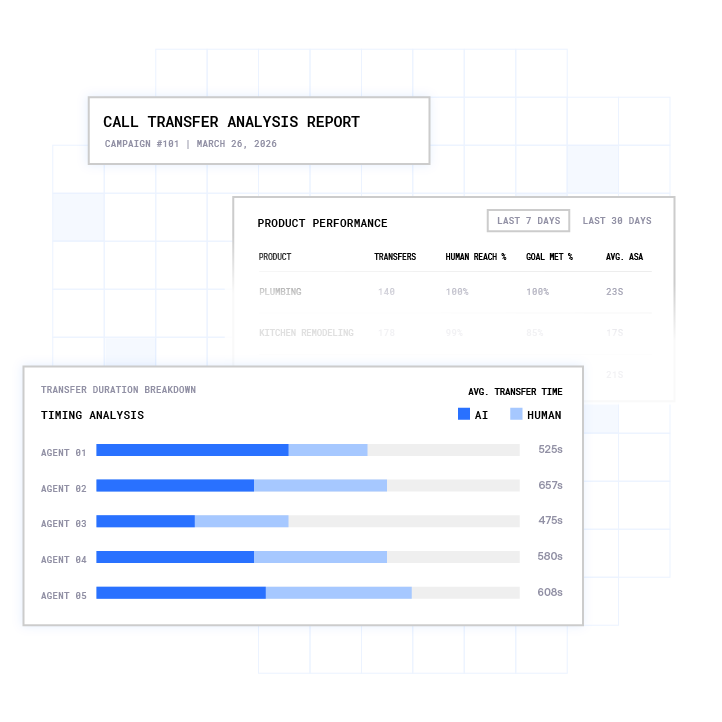
When a call connects, the AI uses speech recognition and call progress analysis to detect whether a live person or an answering machine picked up, typically within one to two seconds. Only live answers route to agents. Advanced AI predictive dialers add several layers of intelligence:
- Answer Machine Detection (AMD) with AI accuracy achieves false positive rates of 1-3%, compared to 15-25% for default Asterisk AMD.
- Stateful conversation memory tracks every prior interaction with a contact, including what was offered, what was declined, and what objections appeared. The system uses that context to prioritize who to call next and how to approach the conversation.
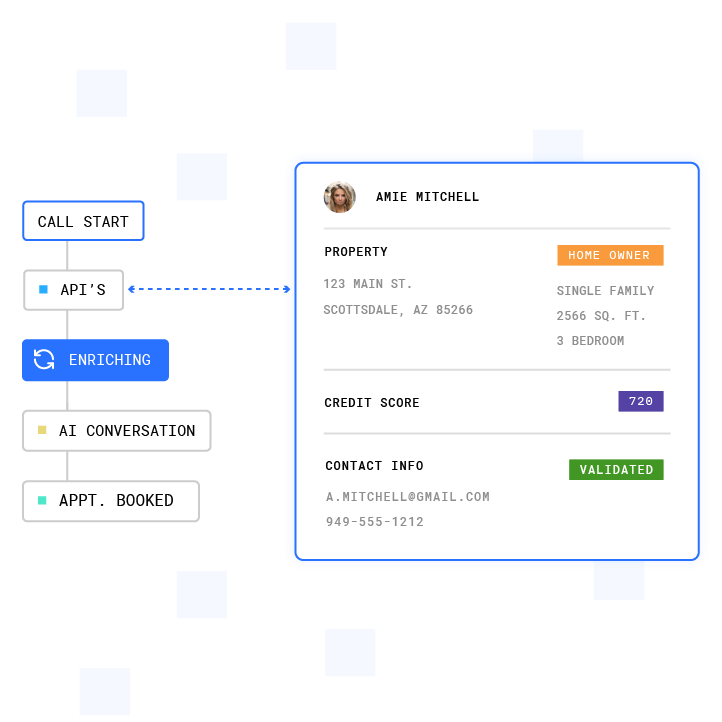
- Real-time lead scoring connects to CRM data and enrichment sources to rank contacts by likelihood to convert.
Plura AI’s AI predictive dialer runs on Plura’s own FCC-licensed carrier infrastructure. Calls originate with branded caller ID and authenticate through STIR/SHAKEN at the carrier level instead of a third-party reseller.
See the AI predictive dialer in a live walkthrough with the Plura team.
Key Benefits of an AI Predictive Dialer
AI predictive dialing delivers value through higher talk time, better connect rates, and more efficient staffing.
Increased Talk Time
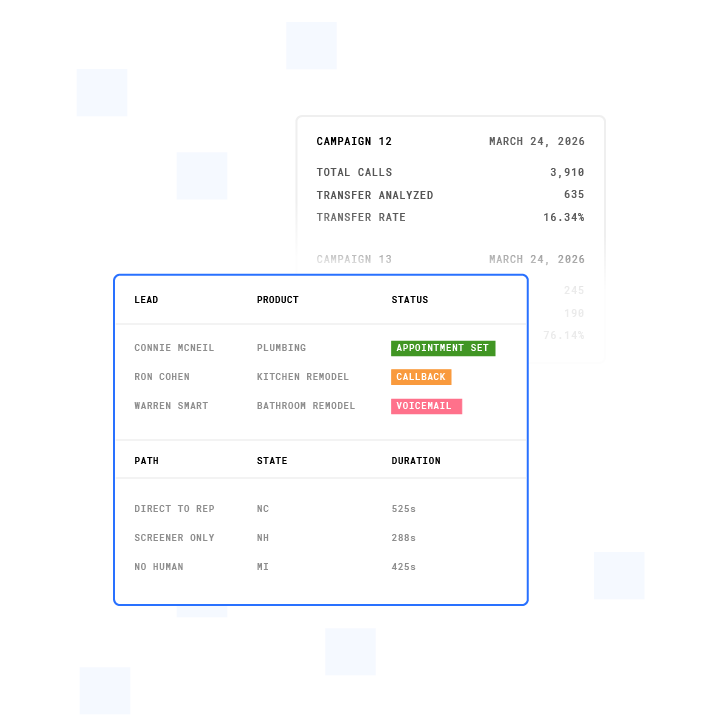
Manual or click-to-dial agents typically spend just 15-20 minutes per hour actually talking, according to industry data compiled by Callin. Predictive dialers can lift agent talk time from about 40 minutes per hour to roughly 57 minutes per hour, a 42% productivity gain. Some optimized deployments reach 50+ minutes of pure conversation time per agent hour. For a 15-agent operation, that jump translates into the difference between 300 and 750 conversation minutes per hour.
Higher Connect Rates
A predictive dialer can cycle through 200-400 records per agent per day, compared to 60-100 for manual dialing. Combined with time-of-day targeting and AI-powered AMD, right-party contact rates can climb from a typical 15% to over 30%.
Reduced Idle Time
Predictive dialers remove the dead air between calls. Agents move from one live conversation to the next without manual dialing, call progress analysis, or voicemail navigation. This shift directly reduces payroll waste.
Better Lead Prioritization
AI predictive dialers use historical conversion data and CRM signals to prioritize contacts most likely to convert. McKinsey’s 2025 B2B Sales report found that AI-prioritized call lists improve connect rates by 28% compared to static lists.4
Scalability
Cloud-based AI predictive dialers scale from 4 to 400 agents without new infrastructure. Human staffing often requires 6-8 weeks of training before handling live calls. AI deployment typically completes in days.
Cost Efficiency
The economics are straightforward. Plura’s ROI calculator estimates monthly human agent costs at $60,000 for 15 agents working 2,400 total hours at $20/hour including 25% taxes, benefits, and commissions with 40% talk utilization. An AI predictive dialer achieving 100% talk utilization can handle equivalent volume with 6 AI agents at $14,400 per month.
Once you understand the benefits, the next step is to see how AI predictive dialers compare with other dialing approaches.
AI Predictive Dialer vs. Power Dialer: What’s the Difference?
Power dialers and AI predictive dialers address different operational needs, from small teams to large outbound programs.
Power dialers dial one number per agent sequentially. The system waits for the current call to end before dialing the next number. This setup maintains a 1:1 agent-to-prospect ratio and keeps abandonment at zero. Power dialers typically achieve 30-38 minutes of talk time per hour. They fit teams with fewer than 10 agents where predictive pacing lacks statistical stability, or high-context conversations like renewals and warm referrals.
Traditional predictive dialers dial multiple numbers simultaneously using pacing algorithms that predict agent availability. They route only live answers to agents, achieving 45-50 minutes of talk time per hour. Aggressive pacing can push abandoned calls past the 3% regulatory threshold, which creates exposure under the FTC Telemarketing Sales Rule 16 C.F.R. § 310.4(b)(1)(iv).
AI predictive dialers add machine learning to the predictive model. They keep learning from conversation outcomes to improve dial timing and lead prioritization. AI predictive dialers can also handle parts of the conversation, qualify leads, detect voicemail with 95%+ accuracy, and in advanced systems like Plura, conduct entire conversations through AI voice agents.
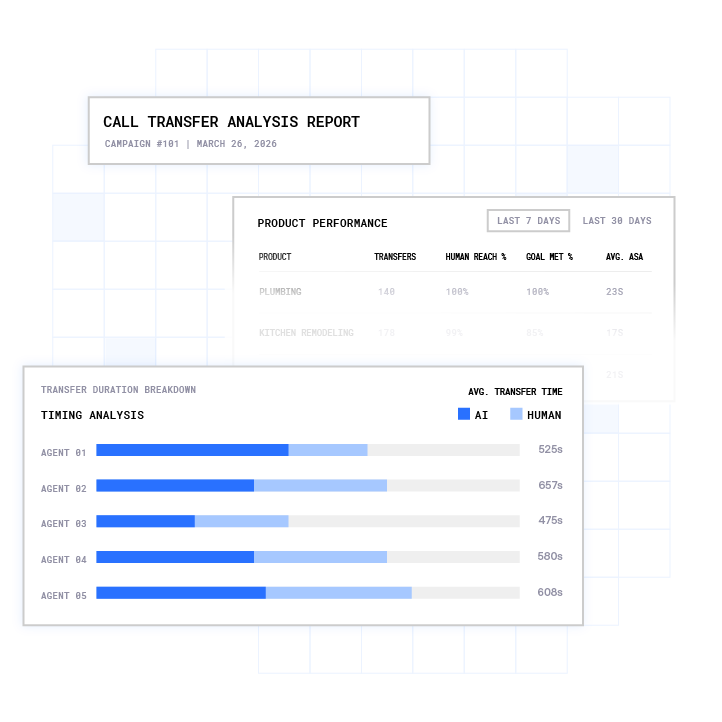
The practical distinction is clear. A power dialer focuses on agent efficiency on every call. An AI predictive dialer focuses on revenue by steering agents toward the highest-value calls and handling routine qualification automatically.
Critical Features to Look For
Use this checklist when you evaluate AI predictive dialers for your operation.
- Answer Machine Detection (AMD) with AI accuracy: AMD accuracy affects every outbound KPI. AI-powered AMD achieves false positive rates of 1-3%, compared to 15-25% for default Asterisk AMD. Ask vendors for AMD benchmarks and how they handle edge cases such as partial greetings or call screening services.
- CRM integration: The dialer should integrate natively with your CRM. Look for automatic call logging, disposition tracking, and screen pops with customer context. Native connectors usually outperform webhook-based setups. Confirm whether the integration is bidirectional and real-time.
- Branded caller ID and spam label remediation: Calls showing “Spam Likely” answer 40-70% less. The dialer should support branded caller ID issued at the carrier level and STIR/SHAKEN authentication on every call. Plura issues branded caller ID directly through its FCC-licensed carrier and addresses spam labels at the carrier level.
- Compliance-focused controls: Look for real-time DNC scrubbing against federal and state registries, TCPA consent management with immutable audit trails, quiet-hours enforcement based on the called party’s time zone, and abandoned call rate monitoring below the 3% threshold. These controls work best when enforced by the platform instead of manual processes.
- Analytics and reporting: Dashboards should track talk time ratio, connect rates, abandonment by hour, conversion per dial-hour, and cost per qualified outcome. Look for conversation intelligence that highlights which scripts close and which objections recur.
- Scalability and migration: Confirm that the vendor can migrate from legacy systems like Vici Dial without long downtime. Ask for a deployment timeline. Plura’s AI predictive dialer can go live in 48 hours with browser-based access and no hardware, while more complex deployments may take days to weeks.
Now that you know which features matter, you can approach vendor selection with a clear evaluation plan.
How to Choose an AI Predictive Dialer for Your Call Center
Step 1: Assess your volume and agent count
Predictive dialing depends on statistical stability. Teams under 10 agents may find progressive or power dialing more effective. Above 20 agents, and especially above 50, predictive pacing algorithms have enough data to dominate. Calculate daily dial volume and agent count before you compare vendors.
Step 2: Define your compliance requirements
Map calling types against TCPA, DNC, and state frameworks. Determine whether you need HIPAA-aligned infrastructure for healthcare or financial data handling. Document consent capture processes and audit trail expectations. Consult qualified legal counsel for guidance on your specific obligations.
Step 3: Evaluate integration needs
List the tools agents use daily, including CRM, calendar, disposition codes, and analytics. Confirm that native integrations exist. Ask about the integration model, whether native connector, API, or middleware. Plura connects with 50+ tools across CRM, calendar, and data enrichment categories via its integrations page.
Step 4: Calculate total cost of ownership
Model the full cost, including per-seat licenses, telephony minutes, compliance add-ons, implementation fees, and potential overages. For example, a 15-agent operation costing $60,000/month in human labor can be replaced by Plura at $14,400/month, yielding $45,600 in savings within 30 days. This scenario is illustrative, not a guarantee. Run your own numbers using Plura’s ROI calculator.
Step 5: Ask for a pilot
Reputable vendors support proof-of-concept deployments. Run a 4-week pilot on 20% of one campaign’s volume. Evaluate performance on unit economics and compliance defensibility alongside demo quality.
Step 6: Check for hidden costs
Ask about per-minute fees beyond the seat license, data storage costs for recordings, DNC registry access fees, and migration or build charges.
Key questions to ask vendors include:
- How do you support TCPA-focused controls, and is DNC scrubbing real-time and platform-enforced?
- Can you migrate from Vici Dial, and what timeline do you commit to?
- What is your uptime SLA?
- How does your AMD handle call screening services and partial greetings?
- Do you own your carrier infrastructure or resell through a CPaaS such as Twilio?4
- What abandoned call rate target do you design for, and how do you maintain it?
Get vendor-specific answers in a working session with Plura.
Compliance Considerations
Compliance carries the highest risk in outbound dialing, especially at scale. Financial exposure can grow quickly.
Under 47 U.S.C. § 227, TCPA statutory damages can reach $500 per call for negligent violations and $1,500 per call for willful violations, with no cap on class action damages.2 The FTC can seek civil penalties up to $53,088 per violation for DNC violations under the Telemarketing Sales Rule (2024 inflation-adjusted figure).
The regulatory landscape
- TCPA (47 U.S.C. § 227): Describes rules for autodialed or prerecorded marketing calls to cell phones. The FCC’s February 2024 Declaratory Ruling classified AI-generated voices as “artificial voices” under the TCPA, so AI voice agents making outbound calls fall under the same consent framework.2
- National DNC Registry: Telemarketers scrub calling lists against the Registry at least every 31 days. The Registry contains over 250 million phone numbers.
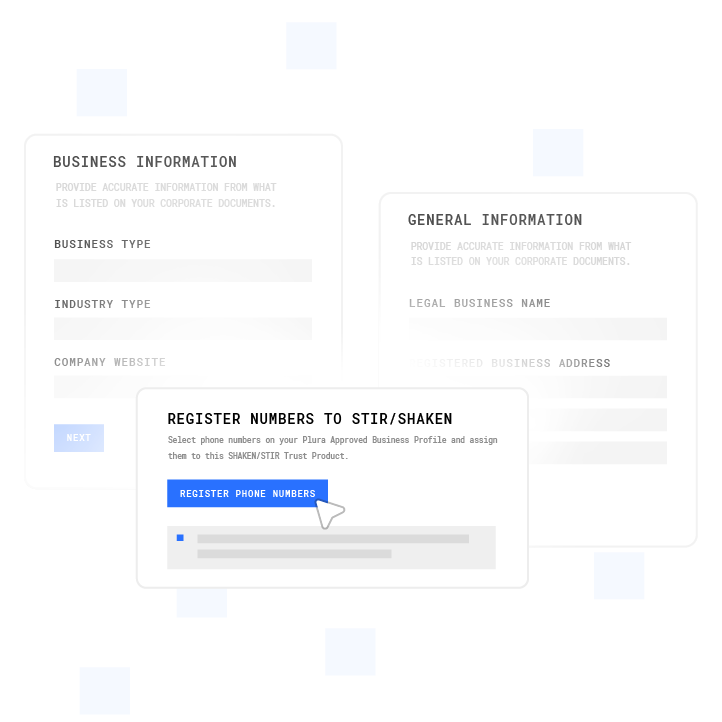
- STIR/SHAKEN: Caller ID authentication framework described by the FCC. Calls running on unsigned or low-attestation numbers see answer rates 30-50% below signed numbers on the same lists.
- State mini-TCPA laws: States such as Florida, Oklahoma, and Washington maintain stricter requirements, including broader autodialer definitions and tighter calling windows.
What a compliant-focused dialer should handle
A dialer that supports compliance should enforce key controls automatically instead of relying on manual steps.
- Real-time DNC scrubbing against federal and state registries before every dial
- Consent record storage with timestamps, IP addresses, and exact consent language
- Calling-hour enforcement based on the called party’s time zone (8 AM – 9 PM local)
- Abandoned call rate monitoring below the 3% threshold with automatic pace adjustment
- Immutable, tamper-evident audit logs covering every dial attempt
- Real-time opt-out processing with immediate number suppression
Plura supports TCPA and DNC-focused programs and enforces many of these controls at the carrier level, including real-time DNC scrubbing, automated quiet hours, and immutable consent logging as platform features. Compliance remains a shared responsibility. Consult legal counsel for your specific obligations. Using any platform, including Plura, does not automatically make campaigns compliant, because consent capture, list sourcing, and calling practices remain under your control.
Real-World Use Cases and ROI
Industry deployment patterns
- Healthcare: Appointment confirmations, patient intake, and prescription reminders. AI predictive dialers handle high-complexity eligibility surveys and route qualified patients to scheduling. HIPAA-aligned encryption and audit logging can be configured as part of the environment. Plura supports up to 40% improvement in no-shows for healthcare operators.
- Insurance: Instant quote follow-ups and policy renewal reminders. 78% of prospects choose to buy from the first responder who contacts them. AI handles qualification and warm-transfers to licensed agents.
- Financial services: Account alerts and loan follow-ups. Sensitive data handling stays on domestic infrastructure aligned with FCC NPRM and state onshoring expectations.
- Legal: Mass-tort and personal-injury intake. AI conducts intake interviews, captures PII with field-level redaction, qualifies claimants, and routes valid cases to counsel.
Illustrative ROI scenario
The default scenario on Plura’s ROI calculator shows a 15-agent operation paying $20/hour with standard taxes, benefits, and commissions, and a 40% talk utilization rate, costing $60,000 per month. Replacing that team with Plura at $15/hour, 100% talk utilization, and 6 AI agents doing the work of 15 humans drops the monthly cost to $14,400. Savings stack to $45,600 in the first 30 days, $547,200 over 12 months, and $2,736,000 over 60 months. This example uses Plura’s calculator defaults. Actual results vary by labor costs, volume, and utilization.
Plura reports that customers achieve 3x average ROI in 90 days, 47% average pipeline growth, and 90% faster lead-response time (per Plura’s published data).3 These figures reflect Plura’s internal reporting from customer deployments.
For higher-volume operations, a $700,000 TCO with Plura replaces traditional contact-center economics of $7 million annually.
Model your own ROI with the Plura team in a tailored session.
Frequently Asked Questions
What is the best AI predictive dialer for call centers?
The best AI predictive dialer for a high-volume call center owns its carrier infrastructure and enforces controls at the platform level. It also uses machine learning to prioritize leads by conversion likelihood. Plura operates on its own FCC-licensed carrier, which means branded caller ID is issued at the carrier level, STIR/SHAKEN authentication runs on every outbound call, and DNC scrubbing happens before each dial instead of in batches. The platform integrates natively with Salesforce, HubSpot, Zoho, and 50+ other tools, and its AI predictive dialer can go live in 48 hours, while more complex deployments may take days to weeks. For teams comparing vendors, carrier ownership often becomes a key differentiator because vendors that rent the carrier layer cannot issue branded caller ID under their own identity or enforce controls before the call leaves the network.
How does an AI predictive dialer differ from a traditional predictive dialer?
A traditional predictive dialer uses a fixed statistical algorithm to calculate how many simultaneous calls to place per available agent, based on historical answer rates and average call duration. It routes live answers to agents but does not learn from conversation outcomes. An AI predictive dialer adds machine learning on top of that pacing model. It updates dial timing based on real-time conversion data, prioritizes contacts by likelihood to convert, and can handle parts of the conversation, including voicemail detection, lead qualification, and objection handling. The practical impact appears in talk time, lead quality, and cost per qualified outcome. AI predictive dialers also connect to stateful conversation databases, so the system knows what was said on every prior touchpoint before the next call.
Is an AI predictive dialer TCPA compliant?
A dialer platform can include controls that support TCPA-focused programs, but compliance responsibility sits with the operator. Platform-level controls that support compliance include real-time DNC scrubbing against federal and state registries before every dial, consent record storage with timestamps and IP addresses, calling-hour enforcement based on the called party’s time zone, abandoned call rate monitoring below the 3% threshold, and immutable audit logs. Plura supports TCPA and DNC-focused programs and enforces these controls at the carrier level as platform features. Your consent capture process, list sourcing, and calling practices remain your responsibility. The FCC’s February 2024 Declaratory Ruling classified AI-generated voices as artificial voices under the TCPA, so AI voice agents making outbound calls fall under the same consent framework. Consult qualified legal counsel for your specific obligations before deploying any outbound dialing program.
What is the difference between a predictive dialer and a power dialer?
A power dialer dials one number per agent sequentially and waits for the current call to end before dialing the next. This approach maintains a 1:1 agent-to-prospect ratio with zero abandonment risk. Power dialers typically achieve 30-38 minutes of talk time per hour and fit smaller teams or high-context conversations such as renewals and warm referrals. A predictive dialer dials multiple numbers simultaneously using pacing algorithms and routes only live answers to agents. This approach achieves 45-50 minutes of talk time per hour but introduces abandonment risk if pacing runs too aggressively. The FTC references a 3% cap on abandoned calls as a share of answered calls per campaign over a 30-day period. An AI predictive dialer adds machine learning to the predictive model, improves lead prioritization, and can handle qualification conversations automatically, which removes abandonment for AI-handled calls.
How long does it take to migrate from Vici Dial to an AI predictive dialer?
Plura’s AI predictive dialer can go live in 48 hours, including CRM integration and campaign configuration, while more complex deployments may take days to weeks. Browser-based access avoids hardware installation. Complex multi-step workflows may extend timelines, but most migrations from legacy systems like Vici Dial complete within days instead of months. The onboarding process includes a discovery audit of call economics, intake of sample calls and existing scripts, a workflow build, a pilot test on a subset of real calls, and full go-live. Every annual contract includes a 90-day opt-out window, so if the deployment does not deliver, customers are not locked into the annual term.
1 Plura AI maintains SOC 2, HIPAA, ISO, and GDPR posture as part of its platform infrastructure. References to compliance frameworks in this article describe Plura’s platform capabilities and do not constitute a guarantee that any customer using Plura will themselves be compliant with applicable laws or standards. Customers remain solely responsible for their own regulatory obligations, certifications, consent management, recordkeeping, and the claims they make to their own end users. Consult qualified legal counsel for guidance specific to your use case.
2 This article describes regulatory frameworks at a general level and does not constitute legal advice. Laws and regulations vary by jurisdiction, change over time, and apply differently depending on facts and circumstances. Readers should consult qualified legal counsel before making compliance decisions.
3 Performance figures, customer outcomes, and industry statistics referenced in this article are drawn from cited third-party sources or Plura customer case studies. Individual results vary based on implementation, use case, industry, audience, and execution. Past or aggregate performance is not a guarantee of future results.
4 References to third-party products, services, companies, or research are made for informational and comparative purposes only. Plura AI is not affiliated with, endorsed by, or sponsored by any third party named in this article unless explicitly stated. Trademarks and product names referenced remain the property of their respective owners.
This article is provided for informational purposes only and reflects Plura AI’s understanding at the time of publication. Product capabilities, integrations, and specifications are subject to change. For the most current information, visit plura.ai.
This article was produced with the assistance of AI tools and reviewed by Plura AI prior to publication.