
Written by: Matt Beucler, CEO, Plura AI
Key Takeaways for 2026 AI Predictive Dialers
- High-volume U.S. operators in 2026 need predictive pacing, accurate answering-machine detection, real-time TCPA/DNC automation, and domestic carrier ownership to protect revenue and reduce risk.
- Power, parallel, and predictive dialers trade off volume and call quality in different ways, and AI predictive models deliver the highest throughput while staying within the FCC’s 3 percent abandoned-call limit.
- Legacy per-seat CCaaS platforms often add 30 to 50 percent in hidden fees, while AI voice platforms price per conversation; Plura’s conversation-based model can cut annual TCO from $4–7 million to roughly $300–700k at scale.
- Carrier ownership is critical because only FCC-licensed carriers can control full A-level STIR/SHAKEN attestation, branded caller ID, and real-time spam remediation, which most API resellers cannot provide natively.
- Plura AI owns its end-to-end telecom infrastructure and enforces compliance at the network level; start a live demo today to see how its stateful, multi-channel platform can change your outbound economics.
Dialer Types for High-Volume Teams: Predictive, Power, and Parallel
These three dialer types support different volume and quality strategies, so teams should match the tool to their outbound goals.
A power dialer dials one number per agent at a time and automatically moves to the next number when a call ends or goes unanswered. Agents complete 80 to 100 dials per day on a power dialer.3 Connect quality stays high because there is no bridging pause, but throughput remains capped by headcount.
A parallel dialer dials multiple lines simultaneously per agent, typically three to five, and bridges the first answered call to the rep. Parallel dialers can reach 150 to 200+ dials per agent per day. Connect rates on generic lists sit around 8 to 12 percent, and number health degrades faster as caller IDs pick up spam flags.
A predictive dialer uses an algorithm to forecast agent availability and dial ahead of it, which reduces idle time between live conversations. The FCC’s abandoned-call rule caps abandoned calls at 3 percent of answered calls per campaign over a 30-day period, where an abandoned call occurs when a live person answers but no agent connects within two seconds. AI predictive dialers add stateful conversion signals on top of pacing and prioritize contacts by historical answer rates and prior negotiation outcomes instead of treating every number the same.
2026 Cost Benchmarks for AI Predictive Dialers
Headline per-seat pricing often understates total cost of ownership, so leaders should model the full cost stack before committing.
Legacy cloud CCaaS platforms price per agent seat. Five9 ranges from $119 to custom quotes per seat in 2026, Convoso starts around $90 per seat with higher custom tiers, and Genesys Cloud CX tiers list at $75 (CX1), $115 (CX2), $155 (CX3), and $240 (CX4) per user per month billed annually.4 Implementation fees of $5,000 to $50,000+ and separate carrier surcharges often add 30 to 50 percent to those headline rates.
AI voice agent platforms follow a different model. All-in usage costs for AI voice agents typically run $0.11 to $0.45 per connected minute across 2026 platforms, covering telephony, speech-to-text, LLM, and text-to-speech components. That range translates to roughly $0.33 to $1.35 per completed call on an average three-minute conversation.
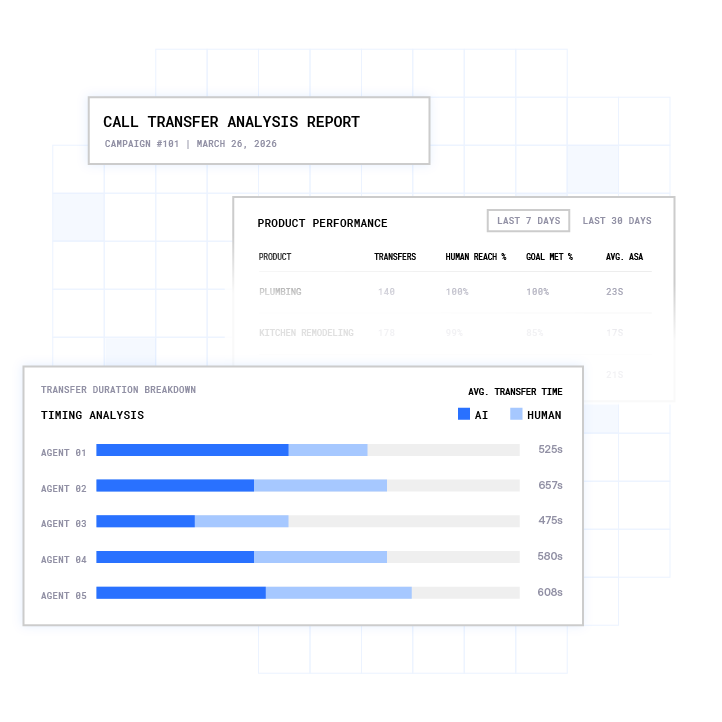
Plura AI prices per conversation instead of per agent seat and scales with AI volume rather than human headcount. Agency Plan pricing starts at $15 per hour. In a modeled 15-agent scenario, replacing a $60,000 per month human team with Plura at 100 percent talk utilization drops monthly cost to $14,400, which produces a 30-day saving of $45,600 and a 12-month saving of $547,200.3 At scale, TCO often lands between $300,000 and $700,000 annually compared with a traditional contact-center benchmark of $4 million to $7 million.3
Use Plura’s calculator to model your own ROI in real time.
Regulatory Landscape for Predictive Dialers Under 2026 FCC Rules
AI predictive dialers operate within a layered federal and state framework, so operators should align campaigns with current guidance from qualified counsel.
The FCC ruled in February 2024 that AI-generated voices qualify as artificial voices under the TCPA, which means they require the same prior express written consent as other prerecorded messages for marketing calls to wireless numbers.2 The FCC’s April 2025 Consent Revocation Rule allows consumers to revoke prior express consent in any reasonable manner and delays only the cross-channel revocation requirement until April 11, 2026.
After the Supreme Court’s 2021 decision in Facebook v. Duguid, predictive dialers calling from pre-uploaded stored lists generally do not qualify as an ATDS under the federal standard.2 The artificial-voice prohibition still applies to AI-generated speech regardless of dialer classification. State-level mini-TCPAs in Florida, Washington, and Oklahoma use broader definitions that can cover any system that dials from a list without human intervention.
STIR/SHAKEN caller ID authentication functions as a practical requirement in 2026. Lack of full attestation increases the risk of downstream carriers labeling calls as spam, which directly harms connect rates. The FCC’s Third-Party Authentication Order, effective September 18, 2025, requires voice service providers with STIR/SHAKEN obligations to obtain their own Service Provider Code token and certificate instead of relying solely on an upstream carrier.
AI Predictive Dialer Compliance Checklist for Operators
This checklist summarizes elements described in publicly available regulatory sources and does not replace legal advice. Operators should confirm requirements with qualified counsel.
- Scrub calling lists against the National DNC Registry at least every 31 days per FTC Telemarketing Sales Rule requirements, and scrub against separate state DNC lists such as those in Florida, Indiana, and Texas.
- Obtain prior express written consent for AI-generated voice marketing calls to wireless numbers, based on the FCC’s February 2024 declaratory ruling.
- Maintain an internal DNC list and honor opt-out requests within 10 business days through any reasonable channel.
- Keep the abandoned-call rate below 3 percent of answered calls per 30-day campaign period.
- Limit outbound marketing calls to 8:00 a.m. to 9:00 p.m. in the recipient’s local time zone under federal rules and apply stricter state windows where they exist.
- Disclose AI agent identity at the start of calls in line with Texas SB 140 and pending FCC NPRM proposals.
- Register A2P SMS campaigns via 10DLC through The Campaign Registry based on carrier requirements.
- Retain consent records for at least five years, including timestamp, IP address, exact disclosure language, and phone number, consistent with TCPA litigation burden-of-proof standards.
- Seek STIR/SHAKEN full A-level attestation, since providers that do not control the originating network typically cannot assign full A-level attestation, which raises spam-labeling risk.
Platform Comparison: AI Predictive Dialers on Core Capabilities
The table below compares platforms on four attributes that matter for high-volume U.S. operators. Pricing and feature data come from published sources as of July 2026, and teams should confirm current details with each vendor.
| Platform | Predictive Pacing + AMD | Real-Time TCPA/DNC Automation | Carrier Ownership + U.S. Infrastructure |
|---|---|---|---|
| Plura AI | Built-in AI predictive dialer with dynamic pacing, timezone logic, and answer-rate targeting | Real-time DNC scrubbing via The Blacklist Alliance’s TCPA Litigation Firewall; supports SOC 2, HIPAA, ISO certification, GDPR, SHAKEN/STIR caller ID verification, TCPA compliance, and DNC compliance1 | FCC carrier license with owned telecom infrastructure and 100% U.S. footprint |
| Five9 | Predictive dialer included, with AMD available as a feature | DNC scrubbing available with documented compliance tools | Cloud CCaaS with per-seat pricing and no published FCC carrier license |
| Convoso | Predictive and power dialer modes with AMD included | DNC scrubbing and TCPA tools documented | Cloud CCaaS starting around $90 per seat and relying on third-party carrier infrastructure |
| Genesys Cloud CX | Predictive dialer available with AMD support | Compliance tools and DNC list management documented | Cloud CCaaS with tiered per-user pricing and no published FCC carrier license |
| Vapi | API-based voice with no native predictive dialer documented | Compliance handled by the operator with no native DNC automation documented | Developer-first API wrapper with a $0.05 per minute platform fee and no published FCC carrier license |
| Synthflow | No AI predictive dialer documented | No native real-time DNC automation documented | Runs on Twilio as a software layer without a carrier license |
| Bland AI | Voice-only product with no native predictive dialer documented | No native real-time DNC automation documented | API-based voice platform with no published FCC carrier license |
| VICIdial + ViciStack | Open-source predictive dialer with AMD available as an add-on | DNC scrubbing requires configuration and remains operator-managed | Self-hosted stack where operators select their own SIP carrier, with $40,800–$73,200 annual TCO at 100 agents |
AMD = answering-machine detection. TCO figures come from third-party analyses and vendor documentation as of July 2026. Verify current specifications with each vendor.
Decision Framework for Selecting an AI Predictive Dialer
Total cost of ownership. Per-seat pricing represents a floor rather than a ceiling because implementation fees, carrier surcharges, compliance add-ons, and WEM modules often add 30 to 50 percent to headline rates. To capture these additional expenses, model TCO across a 12-month horizon before comparing platforms.
Real-time TCPA and DNC enforcement. Bolted-on compliance creates a delay between when a number hits a DNC list and when your dialer stops calling it. Platforms that enforce DNC scrubbing at the infrastructure layer, before the dial attempt, shrink that delay to near zero. TCPA statutory damages sit at $500 per negligent violation and $1,500 per willful violation with no per-campaign cap, and class action settlements frequently range from $1 million to $50 million.
Carrier ownership. Providers that do not control the originating network typically cannot assign full A-level STIR/SHAKEN attestation, which raises spam-labeling risk. Branded caller ID issued through a reseller carries the reseller’s reputation, not the brand’s own. An FCC-licensed carrier that originates traffic on its own network controls attestation level, caller ID issuance, and spam-label remediation.
Cross-channel memory. Most AI voice and SMS tools operate as separate products from different vendors with separate data stores. A contact who texted at 9 a.m. often has to repeat context when the call lands at noon. Platforms built on a stateful conversation database remove that friction because every channel reads from and writes to the same customer record.
How Plura AI’s Owned Carrier Stack Changes Outbound Economics
Most platforms in this category resell APIs and wrap third-party CPaaS infrastructure, which means they pay a markup on every minute and inherit the upstream carrier’s caller ID reputation and STIR/SHAKEN attestation level. Compliance often sits as an add-on, and the operator absorbs the gap between list changes and dialer behavior.
Plura AI follows a different model. Plura owns its telecom infrastructure and holds an FCC carrier license, so voice originates on Plura’s domestic network instead of a third-party CPaaS. Branded caller ID is issued at the carrier level. STIR/SHAKEN caller ID verification runs on every outbound call with full A-level attestation. Real-time DNC and TCPA enforcement, including integration with The Blacklist Alliance’s TCPA Litigation Firewall for litigation-risk scrubbing, sits inside the core platform.
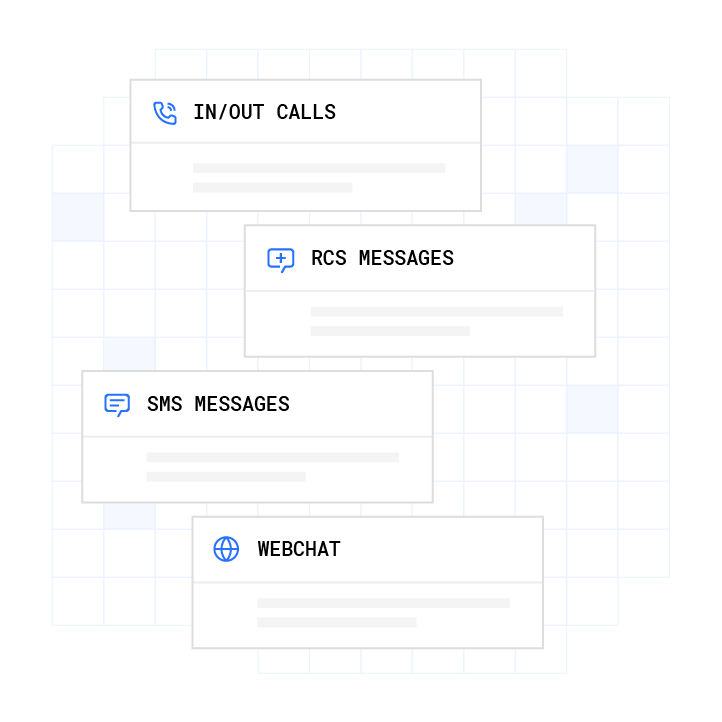
The AI Predictive Dialer uses stateful conversion signals to prioritize contacts by historical answer rates and prior negotiation outcomes. All four channels, voice, AI SMS, AI RCS, and AI webchat, share a single Stateful Conversation Database, so context follows the customer across every touchpoint. The no-code workflow builder lets operations teams adjust pacing, qualification gates, and transfer rules without engineering tickets.
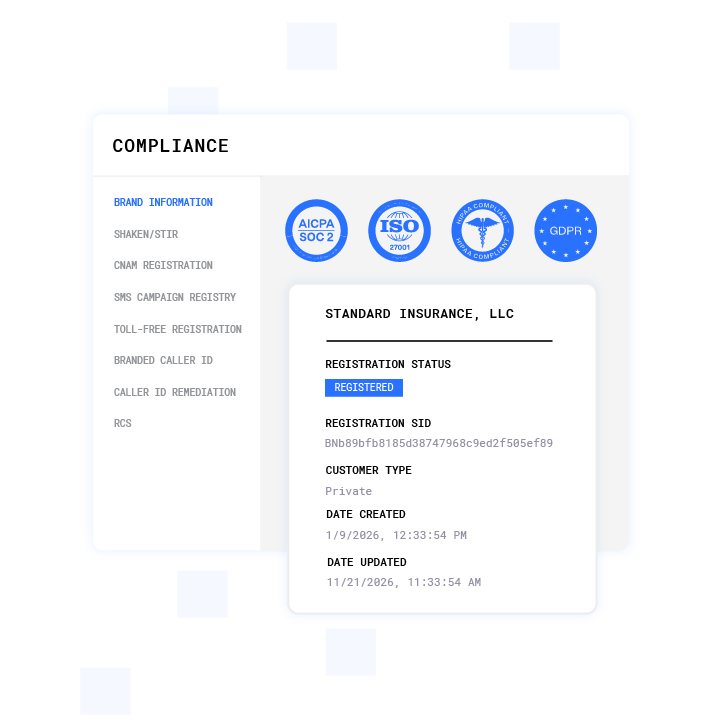
Plura supports SOC 2, HIPAA, ISO certification, GDPR, SHAKEN/STIR caller ID verification, TCPA compliance, and DNC compliance across all channels.1 Every outbound contact is checked against federal and state DNC registries in real time before the dial. Consent records are timestamped, immutable, and audit-ready. Quiet-hours rules apply automatically through time-zone detection. Customers remain responsible for their own regulatory obligations, and Plura provides infrastructure that supports compliance workflows.
The platform runs on 100 percent U.S. infrastructure by design, which addresses FCC NPRM (CG Docket No. 26-52) offshore-infrastructure exposure and state onshoring laws in New York, New Jersey, Connecticut, Missouri, and Florida without contract changes.
Annual contracts include a 90-day opt-out window, so customers are not locked into a full term if the deployment does not deliver.
Conclusion: Applying the Decision Framework to Your Stack
For high-volume U.S. operators in 2026, the decision framework centers on four points: carrier ownership, real-time TCPA and DNC enforcement, cross-channel conversation memory, and TCO at your volume.
Platforms built on third-party CPaaS infrastructure generally cannot control carrier-level attestation or network-level enforcement. Platforms without a stateful conversation database cannot maintain full cross-channel memory. Legacy per-seat CCaaS platforms often struggle to produce favorable TCO once AI agents scale.
Plura AI is an FCC-licensed carrier that owns the full stack end to end, enforces compliance at origination, and runs all four channels on a single stateful database. The comparison pages and pricing provide detailed breakdowns for direct review.
Use Plura’s calculator to see projected ROI for your own volumes.
Review Plura plans and rates side by side on the pricing page.
Frequently Asked Questions
What is the difference between an AI predictive dialer and a power dialer?
A power dialer places one call per agent at a time and automatically advances to the next number when a call ends or goes unanswered. It maximizes call quality and removes bridging pauses but caps throughput at available headcount. A predictive dialer uses an algorithm to forecast agent availability and dials ahead of that forecast, which reduces idle time between live conversations. An AI predictive dialer adds stateful intelligence on top of pacing and uses historical answer rates, prior conversation outcomes, and contact-level signals to decide which numbers to dial next and when. That approach produces more live conversations per agent hour without a matching increase in staff.
How does Plura AI support TCPA and DNC compliance automatically?
Plura’s compliance engine operates as a core layer of the platform rather than a bolt-on module. Every outbound contact is checked against federal and state DNC registries in real time before the dial attempt. Numbers that appear on those registries are blocked before the first call. Consent records are timestamped, immutable, and audit-ready, with express written consent tracked per contact. Quiet-hours rules apply automatically through time-zone detection and reflect federal and state calling windows. The compliance dashboard exports audit-ready reports in one click. Plura also integrates with The Blacklist Alliance’s TCPA Litigation Firewall for real-time litigation-risk scrubbing. Customers remain responsible for their own regulatory obligations and should consult qualified counsel for campaign-specific guidance.
Why does carrier ownership matter for an AI predictive dialer?
Carrier ownership controls three levers that shape outbound performance: STIR/SHAKEN attestation level, branded caller ID issuance, and spam-label remediation. Providers that do not control the originating network often rely on partial attestation, which increases the chance that downstream carriers label calls as spam. Branded caller ID issued through a third-party reseller carries the reseller’s number reputation instead of the brand’s own. Spam-label remediation also requires direct carrier-level access that many API resellers lack. An FCC-licensed carrier that originates traffic on its own network manages all three levers by architecture, while most AI voice platforms built as API wrappers cannot provide that control natively.
What does cross-channel memory mean in practice for outbound operations?
Cross-channel memory means every interaction a contact has with AI agents, whether by voice, SMS, RCS, or webchat, is stored in a single shared database tied to that contact’s identifiers. When the AI places an outbound call to a contact who texted earlier that day, it already knows what was said, what was offered, what objections came up, and the contact’s qualification status. Without cross-channel memory, each channel runs in isolation and contacts repeat the same information every time they switch channels. For high-volume outbound operations, cross-channel memory removes redundant qualification steps, supports more precise negotiation, and produces transcripts that reflect the full relationship history instead of a single session.
What are the 2026 pricing tiers for Plura AI?
Plura offers three main pricing tiers in 2026: Multi at $5,000 per month, Agency at $7,500 per month, and Enterprise at custom pricing. All tiers use annual contracts billed monthly, and each annual contract includes a 90-day opt-out window so customers are not locked in if results do not materialize. Agent build fees typically range from $2,500 to $2,750 per agent. The ROI calculator at plura.ai/calculator models cost savings against a human-agent baseline using your specific volume and hourly rate inputs, and full plan details appear at plura.ai/pricing.
1 Plura AI maintains SOC 2, HIPAA, ISO, and GDPR posture as part of its platform infrastructure. References to compliance frameworks in this article describe Plura’s platform capabilities and do not constitute a guarantee that any customer using Plura will themselves be compliant with applicable laws or standards. Customers remain solely responsible for their own regulatory obligations, certifications, consent management, recordkeeping, and the claims they make to their own end users. Consult qualified legal counsel for guidance specific to your use case.
2 This article describes regulatory frameworks at a general level and does not constitute legal advice. Laws and regulations vary by jurisdiction, change over time, and apply differently depending on facts and circumstances. Readers should consult qualified legal counsel before making compliance decisions.
3 Performance figures, customer outcomes, and industry statistics referenced in this article are drawn from cited third-party sources or Plura customer case studies. Individual results vary based on implementation, use case, industry, audience, and execution. Past or aggregate performance is not a guarantee of future results.
4 References to third-party products, services, companies, or research are made for informational and comparative purposes only. Plura AI is not affiliated with, endorsed by, or sponsored by any third party named in this article unless explicitly stated. Trademarks and product names referenced remain the property of their respective owners.
This article is provided for informational purposes only and reflects Plura AI’s understanding at the time of publication. Product capabilities, integrations, and specifications are subject to change. For the most current information, visit plura.ai.
This article was produced with the assistance of AI tools and reviewed by Plura AI prior to publication.