
Written by: Matt Beucler, CEO, Plura AI
Updated September 2026
Key Takeaways
- Voicemail detection accuracy claims of 95-99% rarely hold in production, where real-world performance often lands between 60-85%.
- Apple’s iOS 26 Call Screening creates a new failure mode that standard AMD cannot reliably separate from live human answers.
- False positives on live humans directly reduce conversion rates, while false negatives waste agent time but preserve the opportunity.
- Carrier-level tactics like branded caller ID and STIR/SHAKEN authentication reduce screening interception before AMD runs.
- Plura AI’s AI Predictive Dialer combines carrier-grade AMD, branded caller ID, and AI agent integration in a single platform, learn more.
Why Voicemail Detection Accuracy Claims Fall Apart
The 95-99% Myth
Vendor-published AMD accuracy figures range from 94.7% to 98.5%, each measured on the vendor’s own audio.3 Bland reported 98.5% accuracy for a fine-tuned Wave2Vec model. LiveKit reported 97.0% macro F1 across human, voicemail, and IVR classes. These figures do not transfer directly to your traffic.
As Lavish Gulati, Founding Engineer at Cekura, notes: “Published accuracy tops out at 98.5% on the vendor’s own dataset. That means at 50,000 dials a month, at least 750 calls land in the wrong branch, regardless of which provider you choose. Design that path on purpose, because it is going to run either way.”
The gap between benchmark and production is structural. Stock timing-based AMD in VICIdial and Asterisk typically achieves 70-85% accuracy in production environments3, not the 95%+ figures that appear in vendor marketing. Legacy rule-based systems often top out around 60-75% in real-world conditions, while ML-based systems reach 93-99% under controlled conditions that rarely match live campaign traffic.
Common Voicemail Detection Failure Modes
AMD systems fail in predictable patterns. Roark’s testing guide identifies six common AMD failure modes:
- False positive on humans (live person flagged as voicemail, call dropped)
- False negative on voicemail (machine greeting flagged as human, agent wastes time)
- Slow detection on humans, introducing multiple seconds of dead air
- IVR menus misclassified as voicemail
- Call screeners misclassified as human (iOS 26 Call Screening, Google Pixel screener)
- Language and accent bias
Short voicemail greetings under about three seconds may be misclassified as human responses, while verbose human greetings from business receptionists may be misclassified as voicemail. Genesys publishes a failure case in its own documentation: “Hello, this is John Smith” reads as human, while “Hello, this is John Smith. Thank you for calling Widgets Inc, how can I assist you today?” reads as voicemail. A talkative receptionist can defeat the rule entirely.
The Cost Of False Positives
These failure modes are not equally costly. False positives in voicemail detection directly reduce conversion rates and can significantly impact revenue even at a 2-3% rate. A live human who gets hung up on represents a conversion that rarely returns. False negatives waste agent time and AI runtime but do not remove the opportunity, so many operations tolerate higher false negative rates to protect against false positives.
The tradeoff rarely disappears through tuning alone. Twilio’s documentation acknowledges the AMD tradeoff directly: tuning parameters to reduce false-human results tends to increase false-machine results, and vice versa. Default Asterisk/VICIdial AMD settings can produce 15-25% false positive rates, meaning roughly 1 in 5 connected live humans never reaches an agent.
Carrier strategy changes the economics of this problem. Plura AI’s AI Predictive Dialer pairs AMD with branded caller ID and STIR/SHAKEN authentication, which improves answer rates before AMD even engages. Explore how Plura’s carrier-grade AMD reduces false positives.
The iOS Live Voicemail Blind Spot
Apple’s Call Screening, introduced in iOS 26, automatically answers calls from unknown numbers, asks the caller for a name and reason, and transcribes the reply before the phone rings. This behavior inflates answer rates while connect rates stay flat. A call registers as “answered” in your dialer, but no human ever heard it ring.
Standard AMD cannot reliably distinguish an iOS screening prompt from a live person. Current voicemail detection cannot reliably separate an AI call screener from a live person because screeners behave like humans by every acoustic and lexical measure. AMD often classifies the screening prompt as “human” and connects an agent to a bot, which wastes agent time and AI runtime on a call that will not convert.
A LiveKit Agents user running thousands of answered calls per day reports that around 30% of their calls are voicemail or iOS 26 Call Screening bots, a share that has been climbing as more callers enable screening. As James Zammit, Co-founder and CEO of Roark, states: “Outbound voice agents live and die on the first three seconds of the called-party audio. If your test coverage for that window is ‘we tried a couple of voicemails once’, the current wave of Call Screening rollouts, custom greetings, and multilingual voicemail systems is going to eat your connect rate quietly and expensively.”
Several providers have moved to address this. Telnyx released Premium AMD in May 2026 that detects iOS Call Screening, including iOS Live Voicemail, in real time during outbound calls.4 TCN launched SmartAMD in June 2026 with a dual-engine approach that automatically recognizes iOS, Android, and third-party mobile screening systems.4 Genesys classifies Apple’s iOS call screening prompt as a Live Voice by default and takes the associated action, with Phase 1 support introduced in June 2026.
Plura addresses screening at the carrier level. By issuing branded caller ID directly through its own FCC-licensed carrier and authenticating every call with STIR/SHAKEN, calls present with the company’s name and reason for calling. This presentation reduces the likelihood of interception by screening before AMD runs. Learn how Plura’s branded caller ID prevents iOS screening interception.
Top Voicemail Detection Providers Compared
The following comparison is based on each provider’s published documentation and release notes.4
| Provider | AMD Type | iOS Screening Support | Key Notes |
|---|---|---|---|
| Twilio | Timing-based and async AMD via Voice API | Supports iOS Call Screening via AMD + Real-Time Transcriptions | Configurable parameters such as machineDetection, amdSpeechThresholdMs, and amdSilenceTimeoutMs |
| Telnyx | Premium ML-based AMD | Detects iOS Call Screening and Live Voicemail in real time | Results delivered via webhook for dialer or AI agent routing |
| Sinch | Advanced AMD v2 | Not publicly documented | Part of programmable voice; no independent real-world benchmarks published |
| Plivo | Asynchronous machine detection | Not publicly documented | Configurable detection parameters; no iOS-specific screening notes |
| Bandwidth | Programmable machine detection | Not publicly documented | Customizable timeout and speech thresholds for outbound operations |
| SignalWire, Vonage, Bird | Standard AMD in voice APIs | Not publicly documented | AMD included as part of programmable voice; limited iOS detail in release notes |
Across providers, only those with explicit screening detection address iOS Live Voicemail directly. For most teams, the carrier layer matters more than the AMD algorithm, because a call flagged as “Spam Likely” or intercepted by screening never reaches AMD.
What To Look For In A Voicemail Detection Provider
Selection criteria differ by use case, and the right questions separate marketing claims from operational reality.
For AI outbound agents: Asynchronous AMD is critical because it lets the call flow continue while analysis runs in the background, which minimizes awkward silence and supports smooth mid-conversation transitions when voicemail is detected. Asynchronous detection allows call flow to continue immediately while analysis runs in the background, minimizing awkward silence and enabling graceful mid-conversation transitions when voicemail is detected, which is critical for AI voice agents. Detection should complete in under two seconds. LiveKit’s AMD reports a median time-to-detection of 840 milliseconds, measured from session start to verdict readiness. Production voice AI latency budgets target sub-250ms at p50 and sub-800ms at p95 for individual pipeline components, so AMD cannot act as a blocking step in the agent’s main loop.
For high-volume predictive dialing: False positive rate matters more than headline accuracy. As noted earlier, that false positive rate means roughly 1 in 5 live humans never reaches an agent. At 500 connected calls per hour, this pattern can translate into 100 lost live conversations every hour. AI-powered AMD reduces false positive rates to 1-3%, which recovers most of those conversations.
For compliance-sensitive teams: TCPA compliance, DNC compliance, and STIR/SHAKEN authentication work best when supported directly in the platform rather than added as third-party bolt-ons. On telemarketing campaigns, 47 CFR 64.1200(a)(7) treats a call as abandoned if it is not connected to a live sales representative within two seconds of the called person’s completed greeting, which sets a hard detect-and-route budget. Because these rules are complex, teams should consult qualified counsel on their specific obligations under TCPA and applicable state rules.2
Questions to ask any AMD vendor before signing:
- How do you handle iOS Live Voicemail and Call Screening specifically?
- What is your false positive rate on live production traffic, not your test set?
- Do you support asynchronous AMD for AI agents?
- What is your p95 detection latency under production load?
- Does AMD accuracy degrade under high CPU utilization or parallel dialing?
See Plura’s AI Predictive Dialer in action for high-volume outbound. The answers to these questions show whether a provider’s accuracy claims survive contact with your traffic.
Plura AI’s AI Predictive Dialer For High-Volume Outbound
Plura AI’s AI Predictive Dialer is built for the 2026 outbound reality. It runs on Plura’s own FCC-licensed carrier, which changes what is possible at every layer of the stack.
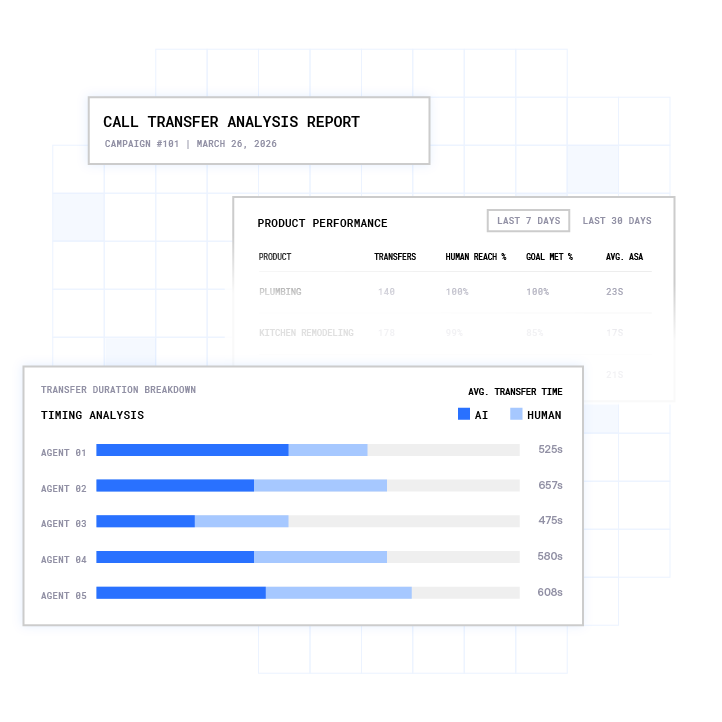
Carrier-grade AMD: Detection runs on Plura’s own infrastructure, not a third-party CPaaS wrapper. Many AI voice tools route calls through Twilio or another CPaaS and inherit that provider’s AMD capabilities and limitations. Plura owns the carrier layer, so AMD decisions occur on infrastructure Plura controls end to end.
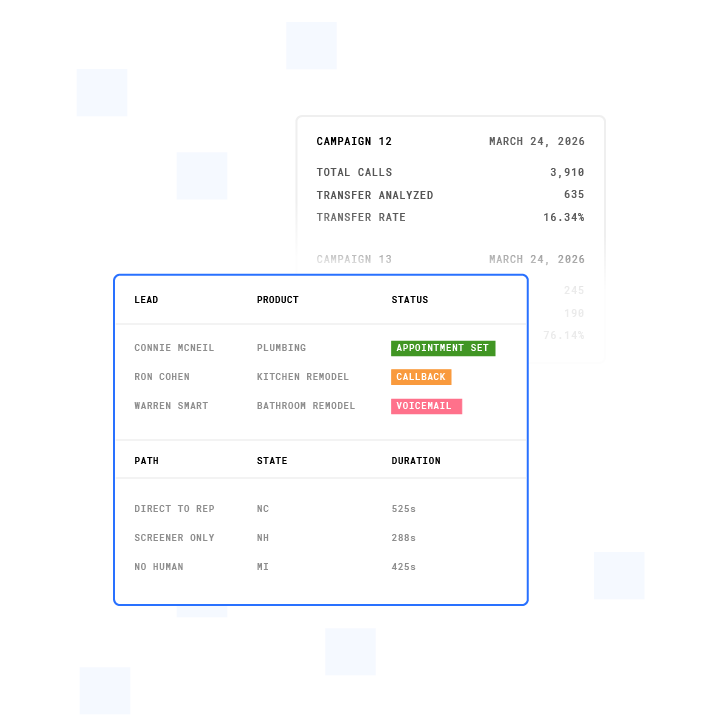
Branded Caller ID and STIR/SHAKEN: Plura issues branded caller ID directly through its FCC-licensed carrier and authenticates every outbound call with STIR/SHAKEN. Calls present with your company’s name, which reduces screening interception and spam labels before AMD runs. STIR/SHAKEN A-level versus B-level attestation can swing answer rates 10-20% before a single call connects.3 Plura addresses this at origination.
AI Agent Integration: Plura’s AI Predictive Dialer is designed for AI outbound agents with low-latency, async-friendly AMD that avoids wasting AI runtime on voicemail. The dialer uses stateful conversion signals to decide who to call next, and the AI agent inherits full context from the Stateful Conversation Database across every prior touchpoint.
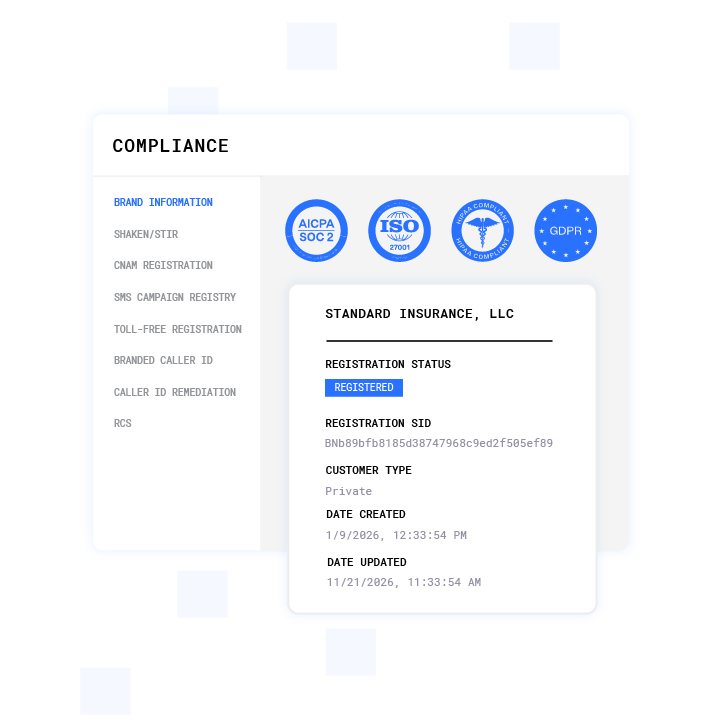
Compliance Infrastructure: Plura supports SOC 2, HIPAA, ISO certification, GDPR, SHAKEN/STIR caller ID verification, TCPA compliance, and DNC compliance, enforced at the carrier level on every outbound contact.1 Real-time DNC scrubbing checks every number before dial. Consent records are timestamped and immutable. Quiet-hours rules enforce automatically through time-zone detection. Customers remain responsible for their own compliance obligations; Plura provides infrastructure that supports those obligations.
Predictive Intelligence: The dialer decides who to call next using stateful conversion signals, including historical answer rates, prior negotiation outcomes, and prior offer-acceptance bands. Unlike a static list dialer with AMD bolted on, this system learns from every call and prioritizes the contacts most likely to convert.
Review Plura’s AI Predictive Dialer features and pricing. Compare plans and rates at plura.ai/pricing.
Frequently Asked Questions
What Is The Difference Between Voicemail Detection And Ringless Voicemail?
Voicemail detection (AMD) analyzes audio in real time after a call is answered to determine whether a human or a machine picked up, then routes the call accordingly. The call rings normally and AMD runs during the live connection. Ringless voicemail bypasses the phone’s ring entirely and deposits a pre-recorded message directly into the voicemail inbox via a carrier pathway, without the phone ever ringing. AMD is interactive and bidirectional. Ringless voicemail is one-way message delivery. The two approaches operate at different points in the call flow and serve different operational purposes.
Is Voicemail Detection Legal?
AMD functions as a call-routing technology and does not, by itself, define a campaign’s legal posture. What happens after AMD makes a detection decision falls under regulatory frameworks including the Telephone Consumer Protection Act (TCPA) and applicable state rules.2 How a system handles a detected voicemail, what it says, whether it identifies the caller, whether it logs the outcome, and whether the original call required prior express consent are all questions that touch TCPA and related regulations. Teams should consult qualified legal counsel on their specific outbound calling practices. Plura’s platform supports TCPA compliance and DNC compliance infrastructure, including real-time DNC scrubbing, immutable consent logging, and automated quiet-hours enforcement, but customers are responsible for their own compliance obligations and legal posture.
How Does Voicemail Detection Handle iOS Live Voicemail?
Most AMD systems misclassify iOS Live Voicemail as a human answer because the screening prompt behaves like a live person by acoustic and lexical measures. The screening system answers the call, asks the caller for a name and reason, and transcribes the reply before the phone rings. Standard AMD sees speech patterns consistent with a human and routes accordingly, which connects an agent or AI to a screening bot. As detailed earlier, Telnyx, TCN, and Genesys each added iOS screening detection in 2026. Plura addresses screening at the carrier level: branded caller ID and STIR/SHAKEN authentication cause calls to present with the company’s name and reason for calling, which reduces the likelihood of interception by screening before AMD runs.
What Is The Best Voicemail Detection For AI Outbound Calling?
The most effective AMD for AI outbound agents is asynchronous, low-latency, and integrated with the agent framework so the agent can branch to a voicemail drop or disconnect without wasting AI runtime. Synchronous AMD blocks call progression until analysis completes, which can cause 2-5 seconds of awkward silence for human responders and increases hang-up risk. Asynchronous AMD allows the call flow to continue while detection runs in the background, enabling graceful mid-conversation transitions. Detection should complete in under two seconds for most use cases, with sub-second performance preferred for high-tempo outbound campaigns. The AMD system also needs to handle iOS Call Screening as a distinct outcome, not just human versus voicemail. Plura’s AI Predictive Dialer is built for this use case, with carrier-grade AMD on Plura’s own FCC-licensed infrastructure and async-friendly integration for AI outbound agents.
Can Voicemail Detection Transcribe Messages?
AMD classifies the call as human or machine but does not transcribe the voicemail greeting or any message left after the beep. Transcription is a separate capability, typically handled by a speech-to-text engine after detection. Some platforms combine AMD with transcription as part of a broader call intelligence layer, but these functions remain distinct. AMD makes a routing decision in real time. Transcription processes audio after the fact for logging, analysis, or compliance purposes. If voicemail transcription is a requirement for your operation, confirm with any vendor whether it is included in their AMD offering or requires a separate integration.
1 Plura AI maintains SOC 2, HIPAA, ISO, and GDPR posture as part of its platform infrastructure. References to compliance frameworks in this article describe Plura’s platform capabilities and do not constitute a guarantee that any customer using Plura will themselves be compliant with applicable laws or standards. Customers remain solely responsible for their own regulatory obligations, certifications, consent management, recordkeeping, and the claims they make to their own end users. Consult qualified legal counsel for guidance specific to your use case.
2 This article describes regulatory frameworks at a general level and does not constitute legal advice. Laws and regulations vary by jurisdiction, change over time, and apply differently depending on facts and circumstances. Readers should consult qualified legal counsel before making compliance decisions.
3 Performance figures, customer outcomes, and industry statistics referenced in this article are drawn from cited third-party sources or Plura customer case studies. Individual results vary based on implementation, use case, industry, audience, and execution. Past or aggregate performance is not a guarantee of future results.
4 References to third-party products, services, companies, or research are made for informational and comparative purposes only. Plura AI is not affiliated with, endorsed by, or sponsored by any third party named in this article unless explicitly stated. Trademarks and product names referenced remain the property of their respective owners.
This article is provided for informational purposes only and reflects Plura AI’s understanding at the time of publication. Product capabilities, integrations, and specifications are subject to change. For the most current information, visit plura.ai.
This article was produced with the assistance of AI tools and reviewed by Plura AI prior to publication.