

Written by: Matt Beucler, CEO, Plura AI | Last updated: August 27, 2026
Carrier-Layer Compliance: Key Takeaways
- Carrier-grade compliance executes TCPA, DNC, STIR/SHAKEN, and audit logging at the originating carrier layer before any call leaves the network.
- Real-time consent checks, DNC scrubbing, and quiet-hours enforcement run on every dial attempt, not just at list import.
- Plura AI’s FCC-licensed carrier signs calls under its own STI certificate, which supports A-level attestation and branded caller ID at the network level.
- Cross-channel opt-outs and immutable audit records live in a single Stateful Conversation Database shared across voice, SMS, and RCS.
- See carrier-layer enforcement in practice and talk with Plura AI about how these controls fit into your contact center.
Carrier-Grade Compliance at the Carrier Layer
Carrier-grade compliance executes TCPA (Telephone Consumer Protection Act), DNC, STIR/SHAKEN, SOC 2, HIPAA, ISO, and GDPR controls at the originating carrier layer instead of as a post-dial add-on.2 Enforcement occurs before the call leaves the network.
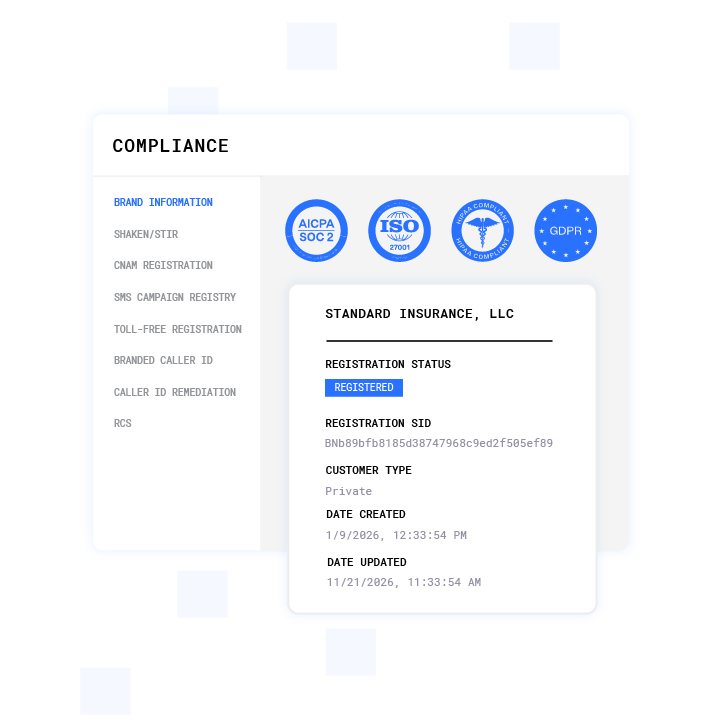
Most AI voice platforms resell APIs from third-party CPaaS providers.4 They sit above the carrier and cannot enforce compliance at the network layer because they do not own the carrier. Plura AI is its own FCC-licensed audio bridging carrier. That structure turns compliance into a first-class enforcement layer instead of a checkbox applied after the fact.
The following sections walk through six carrier-layer enforcement workflows that execute before any call originates.
Book a live demo with Plura to see carrier-layer enforcement in action.
1. Real-Time Consent Verification at Dial Time
Consent verification must run at the moment of each dial attempt, not during list import. A compliant outbound AI system queries a live consent registry on every dial, with the dialing engine sending a consent lookup request using the target phone number and campaign ID as parameters. The registry returns a consent status of valid, revoked, or absent, and only a valid status releases the dial.
Plura’s Compliance Engine executes this gate before any call originates on its FCC-licensed carrier. The workflow follows this sequence:
- T+0 ms: Dial request enters the Stateful Conversation Database with contact token (phone number, email, or ID) and campaign ID.
- T+5 ms: Compliance Engine queries the consent ledger for a valid, named-seller consent record. The FCC announced an effective date of January 27, 2025, for its one-to-one consent rule, but the rule was vacated by the Eleventh Circuit on January 24, 2025, and later removed by the FCC.
- T+10 ms: Revocation log is checked. The FCC’s consent-revocation rule, effective April 2025, describes how consumers may revoke consent by reasonable means, including during a call.
- T+20 ms: If consent is absent or revoked, the call is blocked at the carrier layer. The contact is flagged in the Unified Inbox for review.
- T+50 ms: If consent is valid, the call proceeds to DNC and TCPA litigator scrubbing. The consent record ID is written to the call detail record for immutable retention.
Outbound voice AI compliance relies on four independent architectural layers: consent capture, consent proof, call-time enforcement, and suppression. Each layer contains failures so a single issue does not create exposure across an entire campaign. Plura’s Compliance Engine implements all four as a single pre-dial gate.
An audit-ready consent record captures the phone number, specific campaign purpose, named seller, disclosure version shown at opt-in, UTC timestamp, IP or device metadata, and full status history, including any revocation events. Litigation playbooks often recommend retaining these records for at least four years.
2. Carrier-Level DNC and TCPA Litigator Scrubbing
DNC scrubbing at list import alone leaves gaps. Numbers port between carriers, consumers register after list pull, and professional TCPA plaintiffs maintain litigator databases that static lists miss. Under the FTC’s Telemarketing Sales Rule (TSR), lists for automated calling must be scrubbed against the National Do Not Call Registry at least every 31 days, and numbers remain registered permanently, so older scrubs become stale.2
Plura’s Compliance Engine performs carrier-level DNC and litigator scrubbing on every outbound contact before the call originates. The workflow operates as follows:
- T+0 ms: Contact token enters the pre-dial gate after consent validation.
- T+10 ms: National DNC Registry check executes in real time. A fail-closed DNC screening posture means that if the screening check errors or times out, the call does not proceed.
- T+15 ms: State-specific DNC registries are checked against the contact’s area code or stated address. Texas SB140, effective September 1, 2025, extends certain telemarketing rules to text messages, with quiet hours from 9 a.m. to 9 p.m. recipient local time. Oregon HB 3865, effective January 1, 2026, narrows the calling window to 8 a.m. to 8 p.m. with a cap of three solicitations per 24 hours.
- T+20 ms: Internal suppression list and TCPA litigator database are checked. Any match blocks the call at the carrier layer before origination.
- T+30 ms: Scrub result, timestamp, and suppression status are written to the immutable call detail record in the Stateful Conversation Database.
Skipping this step creates material financial exposure. At a 1% error rate in high-volume AI calling operations with 5,000 daily calls, 50 violations occur per day. At $1,500 per willful violation, that exposure reaches $75,000 per day and roughly $525,000 per week.3 TCPA violations can carry statutory damages of $500 to $1,500 per text or call.
3. STIR/SHAKEN and Branded Caller ID at Origination
STIR/SHAKEN is a call authentication framework that operates at the carrier and SIP (Session Initiation Protocol) layer. The originating service provider signs outbound calls and inserts a PASSporT (Personal Assertion Token) or Identity header into the SIP INVITE before the call leaves the network through an SBC (Session Border Controller) acting as a B2BUA (Back-to-Back User Agent).
Because Plura is its own FCC-licensed carrier, it signs calls under its own STI (Secure Telephone Identity) certificate instead of inheriting a third-party reseller’s attestation. The workflow follows this sequence:
- T+0 ms: Outbound call passes consent and DNC gates. Carrier origination sequence begins.
- T+5 ms: STI-AS (Secure Telephone Identity Authentication Service) signs the PASSporT token with five core claims: orig (calling number), dest (called number), iat (issued-at timestamp), origid (unique call identifier), and attest (attestation level A, B, or C). Under the FCC’s own-certificate rule effective September 18, 2025, providers sign calls with their own STI certificate obtained via an SPC token from iconectiv.
- T+10 ms: Branded caller ID data (business name, logo, call reason) attaches to the outbound call path at the carrier level. A TNS survey found that 78% of consumers are more willing to answer calls when caller ID displays the logo and name of a brand they recognize.3
- T+15 ms: Signed SIP INVITE with Identity header is forwarded to the terminating network. The terminating carrier validates attestation level and renders branded display where supported.
- T+20 ms: Attestation level and signing timestamp are logged to the call detail record for audit purposes.
Platforms that rent carrier access from a CPaaS cannot achieve A-level attestation under their own identity. Outbound numbers require A-level STIR/SHAKEN attestation from a carrier that has verified the institution owns the number. B- or C-level attestation often triggers carrier blocking or spam labeling. Plura’s AI Predictive Dialer originates calls under Plura’s own carrier identity.
4. Immutable Audit-Ready Consent Records
Audit readiness functions as an architectural requirement, not a reporting add-on. Every call event writes a structured log entry that captures the consent record ID, disclosure version played, opt-out signals detected, and suppression status at dial time.
Plura’s Stateful Conversation Database operates as the immutable consent ledger. The workflow proceeds as follows:
- T+0 ms: Pre-dial gate writes consent record ID, DNC scrub result, STIR/SHAKEN attestation level, and calling-hour eligibility to the call detail record.
- T+call start: AI disclosure plays within the first 30 seconds of the call. The FCC’s February 2024 declaratory ruling explains that AI-generated voices are treated as “artificial” under the TCPA, so robocalls using them involve prior express consent considerations.
- T+call end: Full conversation transcript, opt-out signals detected, and transfer events are written to the Stateful Conversation Database keyed to the customer token.
- T+post-call: Record is locked as immutable. No field can change without a new timestamped audit entry.
- T+on demand: Compliance dashboard exports audit-ready reports in one click for legal review, carrier requests, or regulatory inquiries.
The FTC’s amended Telemarketing Sales Rule describes retention of consent evidence and do-not-call requests for five years, including provenance details such as when, how, and from where consent was captured. Plura’s consent ledger records these provenance fields at the moment of each interaction.
Book a live demo with Plura to review the audit export workflow firsthand.
5. Cross-Channel Opt-Out Propagation Across Voice, SMS, and RCS
Opt-outs received on one channel must suppress the contact across all active channels before the next dial or message attempt. Starting April 11, 2025, the TCPA revocation rule describes honoring opt-outs received by reasonable means.
Plura’s Stateful Conversation Database and Compliance Engine handle cross-channel propagation as a single transaction. The workflow operates as follows:
- T+0 ms: Opt-out signal is detected. On voice, a natural language detection layer identifies phrases such as “stop calling,” “take me off your list,” or “do not call me.” On SMS or RCS, a STOP keyword or equivalent is received.
- T+1 ms: Revocation event is written to the consent ledger with UTC timestamp, channel, and detection method.
- T+2 ms: Contact token is flagged as suppressed across all active campaign queues in the Stateful Conversation Database. No further dials or messages originate for this token until the suppression is reviewed.
- T+5 ms: Suppression status propagates to connected CRM and campaign lists through Plura’s integrations layer. HubSpot, Salesforce, Zoho, and Go High Level receive the update in the same transaction.4
- T+10 ms: Unified Inbox flags the contact for human review. The suppression event, timestamp, and channel appear to the CX team in a single screen.
Plura’s AI SMS and AI RCS channels share the same Stateful Conversation Database as AI Voice. An opt-out received on a voice call suppresses the SMS queue before the next scheduled message sends. Platforms that treat voice and SMS as separate products with separate data stores cannot support this real-time cross-channel behavior.
6. Quiet-Hours and Pacing Enforcement at the Network Gate
Quiet-hours enforcement works best at the carrier layer, not only in the CRM or campaign scheduler. A campaign scheduler can be overridden, while a carrier-layer gate cannot be bypassed by a misconfigured setting.
Outbound voice AI compliance under 47 CFR § 64.1200 sets the calling window for certain automated calls to residential lines at 8 a.m. to 9 p.m. local time.2 Many states define narrower windows. Plura’s Compliance Engine enforces both federal and state windows through time-zone detection on the contact’s area code or stated address. The workflow runs as follows:
- T+0 ms: Dial request enters the pre-dial gate. Contact’s time zone is resolved from area code or address field.
- T+5 ms: Current local time is checked against the federal calling window and the applicable state window. State rules are mapped in a lookup table keyed to area code.
- T+10 ms: If the contact is outside the permitted window, the dial is blocked at the carrier layer and queued for the next eligible window. The block event is logged to the call detail record.
- T+15 ms: Pacing check executes. Under the TSR, an outbound call is treated as abandoned if a live sales representative does not connect within two seconds of the recipient’s completed greeting, and a safe harbor references a maximum 3% abandonment rate. Plura’s pacing engine evaluates this threshold at the carrier layer before the call originates.
- T+20 ms: If all checks pass, the call proceeds. Window eligibility, pacing status, and state rule version applied are written to the immutable call detail record.
Four-Layer Governance Across Data, Policy, Network, and Review
Plura’s platform architecture enforces compliance from data capture through human review. Each of the four layers below functions as an enforcement point, not just a reporting view.
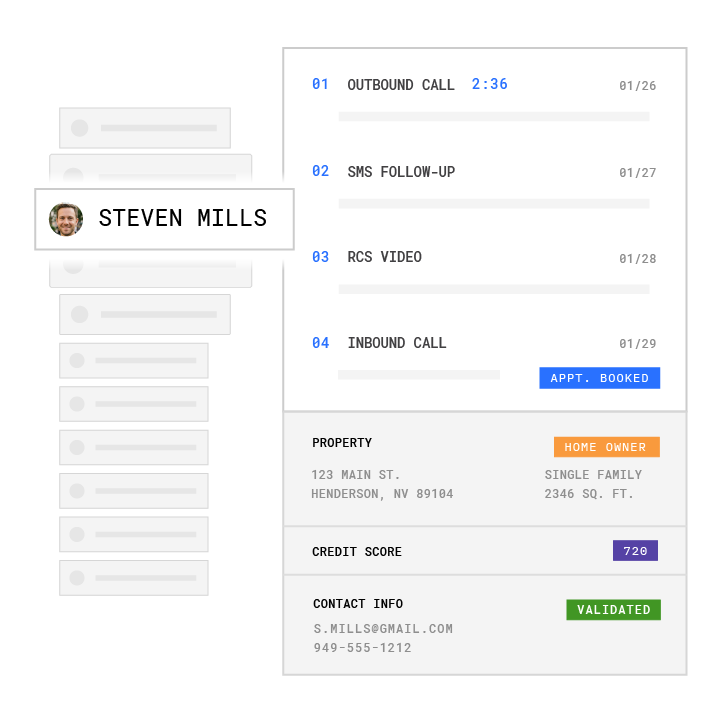
- Stateful Conversation Database: This is the immutable data layer. Every interaction across voice, SMS, RCS, and webchat is keyed to a customer token and stored in one place. Consent records, revocation events, DNC scrub results, STIR/SHAKEN attestation levels, and call detail records are all written here. No field can change without a new timestamped audit entry.
- Compliance Engine: This is the pre-dial enforcement layer. Consent verification, DNC and litigator scrubbing, quiet-hours eligibility, pacing limits, and state-specific disclosure rules are all evaluated here before any call originates. A fail-closed posture means that if any check errors or times out, the call does not proceed.
- FCC-Licensed Carrier: This is the origination enforcement layer. STIR/SHAKEN authentication, branded caller ID issuance, and A-level attestation are applied here under Plura’s own STI certificate. No third-party CPaaS sits in the path. Compliance decisions made by the Compliance Engine are enforced at the network level before the call leaves the infrastructure.
- Unified Inbox: This is the human-facing review layer. CX and compliance teams see every voice transcript, SMS thread, RCS exchange, and webchat session per customer in a single screen. Suppression flags, opt-out events, and escalation triggers appear in the same view the AI reads from. One-click audit exports surface the full call detail record for legal review.
Conclusion: Carrier-Layer Enforcement as the Control Point
Twilio-based and similar platforms keep compliance enforcement outside the carrier layer.4 That architecture creates audit and litigation exposure because the enforcement point lives in software settings instead of a network gate. Plura AI’s compliance framework includes SOC 2 infrastructure, TCPA and STIR/SHAKEN controls, DNC screening, and caller ID reputation management.1
Plura’s FCC-licensed carrier performs real-time consent verification, DNC scrubbing, STIR/SHAKEN authentication, cross-channel opt-out propagation, quiet-hours enforcement, and immutable audit logging before any call leaves the network. Customers remain responsible for their own compliance obligations and should consult qualified counsel on their specific regulatory requirements.
The six workflows above are designed for direct use by engineering and legal teams. Each timestamped step maps to a specific enforcement layer in Plura’s four-layer governance model. Compare plans and rates side by side at plura.ai/pricing.
Frequently Asked Questions
What does carrier-grade compliance mean for an AI dialer contact center?
Carrier-grade compliance means TCPA, DNC, STIR/SHAKEN, SOC 2, HIPAA, ISO, and GDPR controls are enforced at the originating carrier layer, not applied as a post-dial software setting. For an AI dialer contact center, this structure ensures that consent verification, DNC scrubbing, and quiet-hours enforcement occur before the call leaves the network. Platforms that rent carrier access from a third-party CPaaS cannot enforce compliance at this layer because they do not control the origination point. Plura is its own FCC-licensed audio bridging carrier, so every pre-dial check functions as a network-level gate instead of a campaign configuration that can be misconfigured or overridden.
How does Plura handle TCPA consent verification in real time?
Plura’s Compliance Engine queries the consent ledger on every individual dial attempt using the contact’s phone number and campaign ID as parameters. The ledger returns a consent status of valid, revoked, or absent, and only a valid status releases the call to the carrier origination sequence. If the status is absent or revoked, the call is blocked at the carrier layer and the contact is flagged in the Unified Inbox. The consent record ID, disclosure version, and check timestamp are written to an immutable call detail record in the Stateful Conversation Database. This real-time check supports alignment with current consent requirements and prevents calls to contacts who revoked consent after a list was loaded. Organizations should work with qualified counsel to ensure their consent collection practices meet applicable legal standards for their specific use cases.
What is the difference between STIR/SHAKEN authentication and branded caller ID?
STIR/SHAKEN is a call authentication framework that verifies the originating carrier has the right to use the calling number. It works by inserting a signed PASSporT token into the SIP INVITE before the call leaves the originating network. The terminating carrier validates the signature and assigns an attestation level of A (full), B (partial), or C (gateway). Branded caller ID is a separate layer that attaches business name, logo, and call reason to the outbound call path so the recipient sees a recognizable identity instead of an unknown number. The two layers work together. STIR/SHAKEN provides the authentication signal that helps prevent the call from being labeled as spam, and branded caller ID provides the display content that can increase answer rates. Because Plura is its own FCC-licensed carrier, it signs calls under its own STI certificate and issues branded caller ID at the carrier level, not through a third-party reseller.
How does cross-channel opt-out propagation work across voice, SMS, and RCS?
When a contact opts out on any channel, Plura’s Stateful Conversation Database writes a revocation event with a UTC timestamp, channel, and detection method in the same transaction. The contact token is immediately flagged as suppressed across all active campaign queues. No further dials or messages originate for that token until the suppression is reviewed. Connected CRM platforms receive the suppression update through Plura’s integrations layer in the same transaction, not in a nightly batch job. This cross-channel propagation works because Plura’s AI Voice, AI SMS, and AI RCS channels all share the same Stateful Conversation Database. Platforms that treat voice and SMS as separate products with separate memories cannot propagate opt-outs across channels in real time. Customers should consult qualified counsel on the specific opt-out honoring timelines that apply to their campaigns under federal and state rules.
What audit exports does Plura provide for compliance reviews and regulatory inquiries?
Plura’s compliance dashboard exports audit-ready reports in one click. Each report surfaces the full call detail record for every outbound contact, including the consent record ID, DNC scrub result and timestamp, STIR/SHAKEN attestation level, state rule version applied, quiet-hours eligibility check, disclosure version played, opt-out signals detected, and suppression status at dial time. Records are stored in the Stateful Conversation Database as immutable entries, and no field can change without a new timestamped audit entry. The Unified Inbox gives compliance and legal teams a single-screen view of every voice transcript, SMS thread, RCS exchange, and webchat session per customer, with suppression flags and escalation triggers visible in the same view. These exports support legal review, carrier requirements, and regulatory inquiries. Customers are responsible for determining which records and retention periods apply to their specific regulatory obligations.
1 Plura AI maintains SOC 2, HIPAA, ISO, and GDPR posture as part of its platform infrastructure. References to compliance frameworks in this article describe Plura’s platform capabilities and do not constitute a guarantee that any customer using Plura will themselves be compliant with applicable laws or standards. Customers remain solely responsible for their own regulatory obligations, certifications, consent management, recordkeeping, and the claims they make to their own end users. Consult qualified legal counsel for guidance specific to your use case.
2 This article describes regulatory frameworks at a general level and does not constitute legal advice. Laws and regulations vary by jurisdiction, change over time, and apply differently depending on facts and circumstances. Readers should consult qualified legal counsel before making compliance decisions.
3 Performance figures, customer outcomes, and industry statistics referenced in this article are drawn from cited third-party sources or Plura customer case studies. Individual results vary based on implementation, use case, industry, audience, and execution. Past or aggregate performance is not a guarantee of future results.
4 References to third-party products, services, companies, or research are made for informational and comparative purposes only. Plura AI is not affiliated with, endorsed by, or sponsored by any third party named in this article unless explicitly stated. Trademarks and product names referenced remain the property of their respective owners.
This article is provided for informational purposes only and reflects Plura AI’s understanding at the time of publication. Product capabilities, integrations, and specifications are subject to change. For the most current information, visit plura.ai.
This article was produced with the assistance of AI tools and reviewed by Plura AI prior to publication.