
Written by: Matt Beucler, CEO, Plura AI
Key Takeaways
- A B2B operator replaced slow manual lead qualification with a fit-and-engagement scoring model, threshold-based routing, and signal-specific decay. The change cut unqualified handoffs and reclaimed SDR time within 90 days.
- The scoring model uses a 100-point scale, with 40 points for fit and 60 points for engagement. Negative scoring handles disqualifiers. MQL starts at 65 points and SQL at 85 points for precise routing.
- Automation triggers route leads scoring 80 or higher to Tier A with a 5-minute SDR SLA. Lower tiers enter nurture sequences or suppression based on score thresholds.
- Exponential decay logic removes stale leads from the queue. Behavioral signals lose value over 30 to 90 days, and fresh engagement resets the scoring process.
- Plura AI powers sub-5-second lead response across voice, SMS, RCS, and webchat, with real-time enrichment and routing that turns scoring models into immediate sales action.
The Company and the Lead Qualification Problem
The anonymized B2B services company in the BiViSee case study averaged 146 marketing-generated inbound leads per month before the engagement. After the build, inbound volume rose to 158 leads per month. The CRM is HubSpot. Firmographic enrichment runs through a third-party data provider at the moment each lead enters the system. The sales organization includes 35 quota-carrying account executives, roughly 30 SDRs and BDRs across continents, and a 4-person global enterprise account team.
Before the build, SDRs spent 60% of their time on leads that never qualified. The root cause was the manual review step. Marketing reviewed each form submission within 24 to 48 hours before assigning it to a sales development rep, and that delay let unqualified leads reach the AE queue regularly. The result was that the sales team had lost confidence in marketing’s handoffs.
The timing problem compounded the qualification problem. The 2007 MIT/InsideSales.com Lead Response Management Study, led by Dr. James Oldroyd of MIT’s Sloan School of Management, found that the odds of qualifying a lead if called in 5 minutes versus 30 minutes drop 21 times, and the odds of contacting a lead by phone drop 100x when the first call happens at 30 minutes instead of 5 minutes. A Harvard Business Review audit of 2,241 US companies found that 37% responded within an hour, 24% took more than 24 hours, and 23% never responded at all. This operator sat in the 24-to-48-hour cohort.
The fix combined three components. The team needed a scoring model that separated fit from engagement, automation triggers that routed leads the moment they crossed a threshold, and decay logic that kept the queue clean over time.
The Scoring Model Design
The model follows a 100-point scale split into 40 points for demographic and firmographic fit and 60 points for behavioral engagement. Negative scoring handles disqualifiers such as personal email domains, student or intern titles, and competitor domains. The RevOps Report’s lead scoring model template, published April 2, 2026, uses this same 40/60 split and recommends setting the MQL threshold at 65 points initially, then analyzing 30 days of data before adjusting.
Fit Criteria (40 points max):
- VP or C-level decision maker: +15 points
- Director: +10 points
- Manager: +6 points
- Individual contributor: +4 points
- Student or intern: 0 points
- Company size in target range: +10 points
- Adjacent company size: +6 points
- Target industry match: +15 points
- Adjacent industry: +5 points
- Serviceable geography: +5 points
Engagement Criteria (60 points max):
- Requested demo: +15 points (automatic MQL)
- Pricing page visit: +10 points, based on Abmatic AI’s 2026 visitor engagement scoring model for B2B sales2
- Product demo page visit: +8 points
- Comparison page visit: +6 points
- Case study download: +8 points, informed by Saber’s engagement scoring model2
- Bottom-of-funnel content download: +8 points
- Other content download: +5 points, per Abmatic AI’s Account Engagement Scoring Playbook
- Top-of-funnel content download: +2 points, capped at 15 points total
- Clicked email link: +5 points for a standard link, with higher values reserved for priority links
- Replied to sales email: +10 points
- Opened email 3 or more times in 7 days: +5 points
Negative Scoring:
- Personal email domain (gmail, yahoo): -5 points
- Job title contains “student,” “intern,” or “professor”: -10 points
- No engagement in 30 days: -10 points
- After 60 days of no engagement, the score may drop to -20 points, or the system can apply smaller monthly penalties such as -2 points per month of inactivity.
- In U.S. B2B lead scoring models, unsubscribing from emails is a strong negative signal. It typically deducts −15 to −30 points, with −20 to −25 as the default range.
- Competitor company domain: -40 points, flagged and not routed to sales
On this 100-point scale, the MQL threshold starts at 65 points and the SQL threshold sits near 85 points.
Data Legion’s enrichment-driven scoring method recommends exporting 6 to 12 months of historical leads with enrichment attributes and conversion outcomes, calculating the conversion rate for each attribute value, then assigning points proportional to how much each value lifts conversion above the baseline rate. That calibration method informed the point values above.
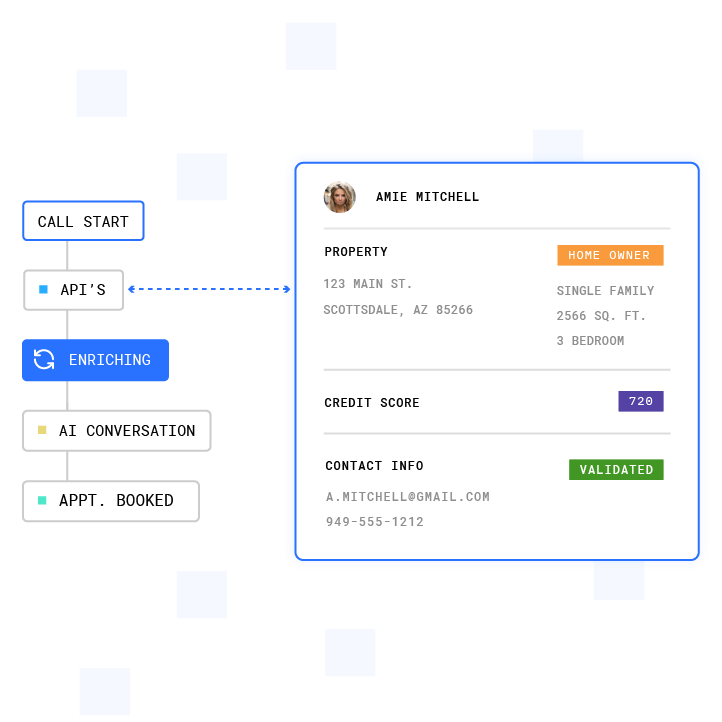
See the scoring and enrichment layer in action with a live Plura demo.
The Automation Workflow
Once the scoring model is calibrated, the next step is wiring each score band to a specific routing action. The trigger logic below maps every threshold to a queue, a response SLA, and a follow-up sequence.
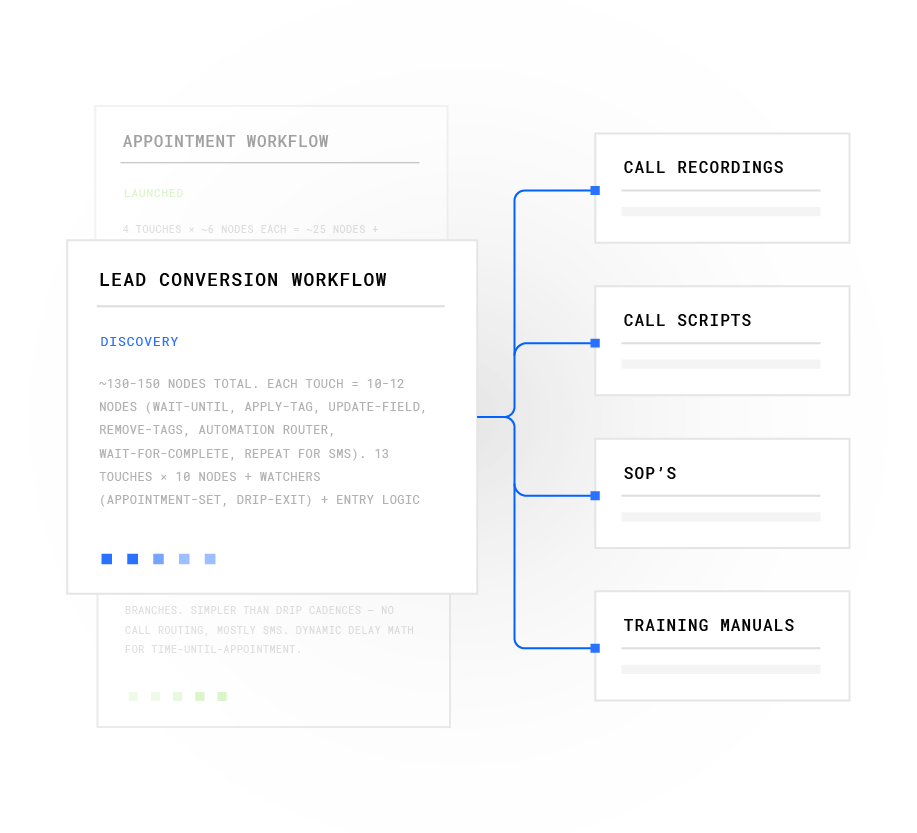
Trigger Logic:
- Leads scoring 80 or above map to Tier A and receive a 5-minute SDR response SLA during business hours, with 15 minutes after hours.
- Leads scoring 65 to 79 route to the SDR queue with a 24-hour response SLA.
- Leads scoring 40 to 64 are classified as Marketing Qualified Leads and are assigned to an SDR for outreach within 24 hours with a personalized email sequence.
- Leads scoring 0 to 39 are classified as Disqualified and suppressed from outreach and archived. Re-engagement resets the decay clock and adds new intent points.
Text-Based Workflow Diagram:
- Lead enters system
- Enrichment fires (firmographic and behavioral data)
- Fit score calculated
- Engagement score calculated
- Total score compared to thresholds
- If 80 or higher: route to P0 queue, alert rep, trigger demo sequence
- If 65 to 79: route to P1 queue, enroll in nurture
- If 40 to 64: enroll in broad nurture, re-score monthly
- If below 40: suppress from active campaigns
- Score decay applied every 7 days
- Re-score on new signal
- Re-evaluate routing
Handoff Trigger: A Salesforce record-triggered Flow on Lead fires when Total_Lead_Score__c changes. When a lead scores 80 or higher, the Flow sets Lead_Tier__c to “Hot” and Status to “SQL”. It then triggers the “Hot Lead Round-Robin to AE” assignment rule and posts a Slack alert.
Plura enables lead response times under 60 seconds, with AI agents responding in under 5 seconds across voice, SMS, RCS, and webchat, real-time AI lead scoring, 7 to 12 follow-up touches, full conversation transcripts, and cost per qualified lead of $25 to $60.1 The automation workflow above connects directly to Plura’s routing layer, so a lead crossing a score threshold, commonly 75 to 80 out of 100, triggers an automated outreach sequence within minutes, typically under 5 minutes.
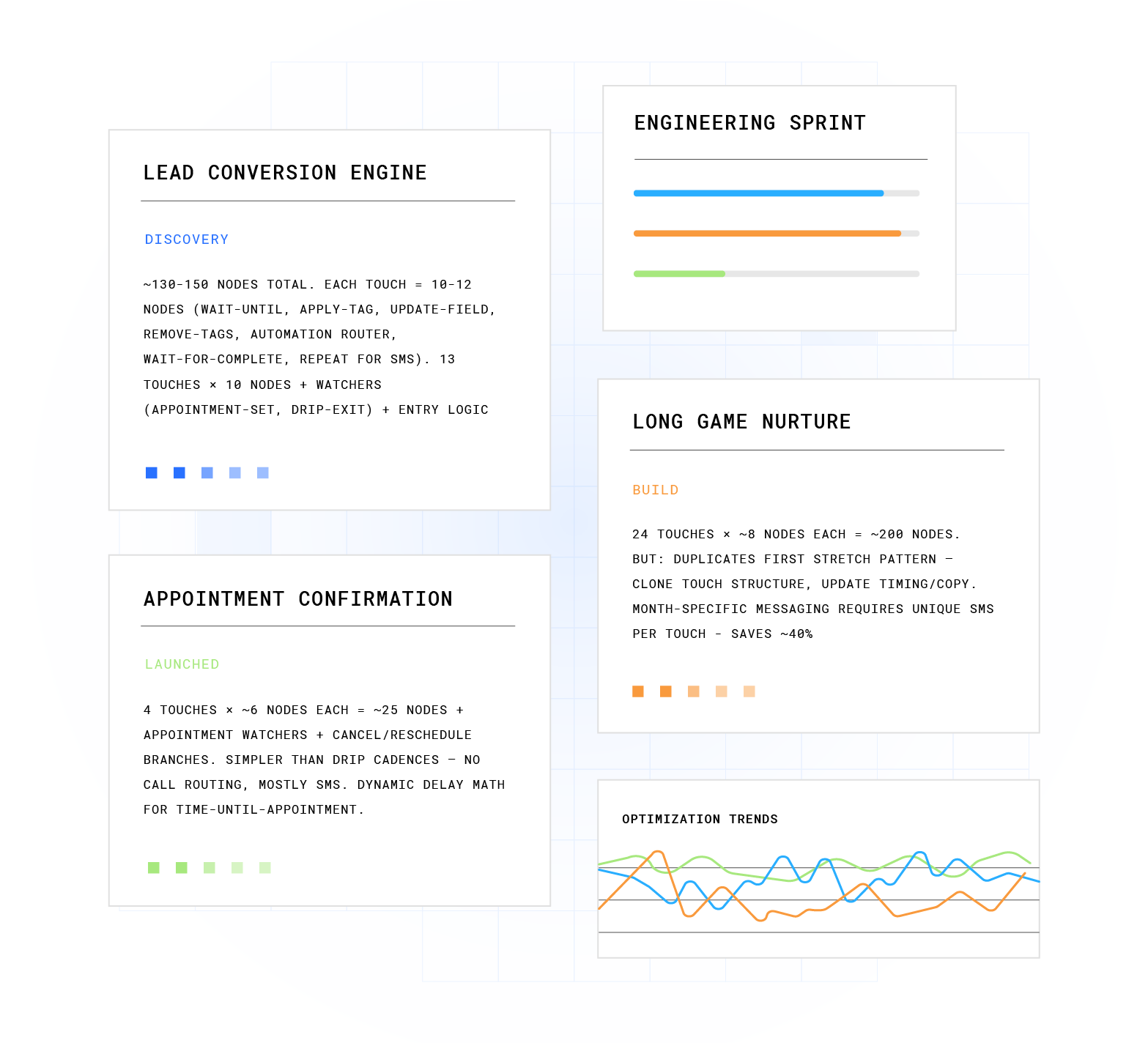
Score Decay and Re-Nurture
The routing workflow above assumes scores stay accurate, but a scoring model without decay logic is a queue that fills with stale leads. The half-life of a pricing-page visit is approximately 24 hours, meaning roughly 50% of the booked-meeting probability is consumed within the first day. For US VP and C-suite marketing contacts, roughly 14.1% change roles over twelve months and about 25.7% over twenty-four months, implying a role half-life of approximately two years, though this rate varies by function and country. Breadcrumbs’ 2026 lead scoring best practices guide recommends setting decay windows by signal type: page visits and email opens decay to zero over 30 to 60 days, while demo requests and trial signups hold value for 90 to 180 days.
This implementation applies exponential recency decay to behavioral signals:
- In Ortto’s CDP score calculation, activities from the more recent half of the half-life period contribute full points while activities from the older half contribute half the points. For example, with a 30-day half-life, a Clicked email activity from 2 days ago is worth 250 points, whereas one from 3 weeks ago is worth 125 points. Filter criteria retain full points throughout the half-life period.2
- 60% weight for events 31 to 60 days old
- 30% weight for events 61 to 90 days old
- Minimal value for events older than 90 days without refreshed engagement
Re-nurture logic keeps low-intent leads from clogging active queues. When a lead’s score drops below 40 due to decay, the workflow suppresses the lead from active campaigns and enrolls in a re-engagement sequence. If the lead re-engages by opening an email, visiting a pricing page, or replying to a text, the score recalculates and the lead re-enters the routing workflow from the appropriate threshold.
Plura treats every interaction as a data point for Lead Intelligence and Conversation Intelligence, so decay and re-engagement signals feed back into the scoring model continuously rather than in weekly batch jobs.
Rules-Based vs Predictive Lead Scoring
This team started with rules-based scoring because they had fewer than 1,000 historical leads with clean closed-won and closed-lost labels. That data threshold matters. A 2026 industry analysis (PepperEffect, 29 April 2026) found that pure rules-based lead scoring models cap at 65 to 75% accuracy while deploying quickly compared to predictive ML models, and that pure predictive ML models can hit 78 to 88% accuracy but take 8 to 12 months to deploy. The table below compares the three approaches across the dimensions that matter most for a build decision: accuracy, time to deploy, data requirements, AE adoption, and annual maintenance cost.
The graduation criteria for moving to pure predictive scoring are 5,000 or more historical leads, 100 or more converted deals, cleanly labeled closed-won and closed-lost outcomes over the last 12 to 24 months, and a stable ICP. Below that threshold, a well-maintained rules engine consistently outperforms a predictive model trained on insufficient data. The 2026 hybrid lead scoring pattern, a transparent rule-based base layer plus a predictive ML re-ranker on top, achieves 80 to 85% accuracy with 80 to 85% AE adoption.
This team’s plan was straightforward. They would run rules-based scoring for 12 months, collect clean closed-won and closed-lost data, then run a shadow predictive model alongside the rules engine for one quarter before cutting over. In predictive lead scoring deployments, shadow scoring is a recommended de-risking phase in which the model runs alongside the existing process or human-defined rules without influencing lead routing, so teams can compare the model’s outputs against current decisions and review disagreements before the model takes the wheel.
Results
With the scoring model, routing triggers, and decay logic in place, the company tracked its first clean set of qualification metrics. The sales-accepted rate rose from 34% to a higher, stable band that aligned with the new MQL threshold. SDR time on unqualified leads dropped sharply from the original 60% figure, and the team began tracking cost per qualified lead as a core KPI for the first time.
Before the build, the commonly cited 13% figure came from Implisit’s 2014 study and referred to lead-to-opportunity conversion, not a true MQL-to-SQL benchmark. Benchmarks place average MQL-to-SQL conversion at 13%, with an average conversion time of 84 days, while website leads convert at 31.3%. Intelegencia’s ChatGPT Ads campaigns started at about 3.2x their Google Search benchmark for cost per approved lead in month one and reached roughly 35% below that benchmark by month six; at 90 days they were still behind search.
B2B organizations using lead scoring report a 77% increase in lead-generation ROI versus those without systematic scoring, according to statistics attributed to LLCBuddy. Predictive lead scoring delivers 2.1x higher MQL-to-SQL conversion, 31% versus 15%, versus rules-based scoring, per Marketo and Adobe Engagement Economy research.
A solar company using Plura’s AI Lead Intelligence increased conversion rates from 6% to 18% with the same leads and offer.1 A legal marketing firm using Plura’s AI Conversation Intelligence found 23% of engaged leads lacked sufficient case value, adjusted qualification criteria, and reduced wasted attorney time by 31%.1
Those outcomes are consistent with what Plura deployments report more broadly: 3x average ROI in 90 days, 47% pipeline growth, and 90% faster lead-response time.1 One Marketing Director at a SaaS company stated: “We went from spending 60% of our time trying to contact leads to spending 90% of our time closing them. AI handles the first 5 to 7 touches and only passes us prospects who are actually ready to talk.”
Put your own pipeline numbers into the Plura ROI calculator to see what faster qualification is worth at your volume.
What Broke and What We Would Do Differently
Every implementation has failure modes. These are the ones that surfaced in the first 90 days.
Data quality. The CRM had 30% bounced emails, stale titles, and missing firmographics. The first scoring model confidently ranked low-probability leads at the top. The fix was a 30-day data cleanup before training any model. Predictive models trained on dirty CRM data do not degrade gracefully; they rank low-probability leads at the top with full confidence.
Workflow design. The first workflow routed leads to sales too aggressively. Sales rejected 44% of MQLs as unqualified or out-of-ICP on first review, a figure that typically points to qualification-criteria misalignment between demand generation and sales. The fix was to raise the MQL threshold by 10 points and add negative scoring for personal email domains and competitor domains.
Internal adoption. Sales did not trust the scoring model because they could not see why a lead scored 87 instead of 64. Reason codes are critical for adoption. Reason codes solve this. When reps can see the top signals driving a score, they act on it instead of falling back on gut feel. The fix was to add reason codes to every lead record showing the top two to three signals driving the score.
Threshold tuning. The team set the MQL threshold at 65 points initially, then analyzed 30 days of data. Sales acceptance was below 50%, so they raised the threshold to 75 points. The RevOps Report recommends that if sales acceptance drops below 50%, teams should raise the threshold by 10 points, targeting a 65 to 80% sales acceptance rate.
Escalation handling. The AI escalated too many calls to human agents because the workflow lacked clear guardrails. The fix was to add BATNA-style negotiation guardrails, defining the floor and ceiling within which the AI could negotiate, and explicit escalation criteria.
Model recalibration. According to a 2016 Demand Gen Report survey, 23% of companies using lead scoring do not review or update their scoring models at all, while 26% do so yearly and 28% quarterly. A scoring model that is not maintained creates false confidence in bad data. The team built a quarterly recalibration cadence into the RevOps calendar from day one.
Frequently Asked Questions
How Does This Differ from Traditional Lead Scoring?
This implementation treats the score as a routing engine, not just a ranking. Traditional lead scoring ranks leads on fit and engagement but often stops at the score. Here, the score wires directly to automation triggers that route leads, fire nurture sequences, and enforce response SLAs. The score is the prioritization layer, and the automation is the conversion lever. A lead that crosses 80 points does not sit in a queue waiting for a rep to notice. The workflow fires immediately with a status change, rep assignment, notification, and timestamp logged for speed-to-lead tracking.
What Automation Triggers Fire at Each Threshold?
At 80 or more points, the workflow changes lead status to MQL, routes the lead to the appropriate sales rep, sends a notification, and logs the timestamp for speed-to-lead tracking. At 65 to 79 points, the lead enters a nurturing workflow with weekly re-scoring. At 40 to 64 points, the lead enters broad nurturing with monthly re-scoring. Below 40 points, the lead is suppressed from active campaigns and enrolled in a re-engagement sequence that fires when a new behavioral signal appears.
How Does Score Decay Work?
Scores decay on signal-specific windows, as described in the Score Decay and Re-Nurture section. The key distinction is that behavioral signals decay aggressively while firmographic signals are refreshed via enrichment rather than decayed.
When Should a Team Graduate from Rules-Based to Predictive Lead Scoring?
Teams should graduate when they have 5,000 or more clean historical leads, 100 or more converted deals, and a stable ICP, as covered in the comparison section above. The practical test is whether the rules engine has stopped improving. If sales acceptance is stable and the model is recalibrated quarterly, there is no urgency to switch.
What Integration and Deployment Requirements Does This Need?
The implementation requires a CRM such as HubSpot or Salesforce, a data-enrichment provider, and an automation platform. Plura connects to HubSpot, Salesforce, and 50 or more other tools via its integrations layer. Deployment takes days to weeks depending on conversation complexity. A simple inbound qualification flow is typically built in days. A complex multi-step intake runs closer to one to two months because the workflow logic itself takes time to design and validate.
How Does Plura AI Fit into This Workflow?
Plura responds to and qualifies leads in under 5 seconds across voice, SMS, RCS, and webchat, as described earlier. Its AI Lead Intelligence enriches every lead with 30+ data sources in real time during the conversation. The Stateful Conversation Database keeps conversation context across every channel, so a lead that texted at 9 a.m. is recognized with full memory when the call comes at noon. When a lead crosses the hot threshold, with a score of 80 or above and a confirmed ICP match, Plura’s routing layer routes the lead by tier and triggers the relevant sequence enrollment automatically, without manual sorting.
What Is the Single Biggest Mistake Teams Make with Lead Scoring Automation?
The single biggest mistake is never recalibrating the model. 68% of companies that implement lead scoring never recalibrate, leaving stale scoring logic deciding which leads sales works. The recommended cadence for lead scoring model recalibration is weekly monitoring of score distributions and MQL volume, monthly tracking of rejection rates and comparison of scored MQLs to actual opportunity creation, and a mandatory quarterly full model review with point value and threshold adjustments, known as the “90-Day Decay Audit”.
Conclusion: Turning Scores into Revenue
Lead scoring automation gives contact center and marketing teams a structural fix for slow qualification and wasted SDR time. A fit-and-engagement scoring model, threshold-based routing triggers, signal-specific decay, and re-nurture logic keep the queue focused on real buying intent instead of stale records.
The evaluation criteria for teams starting this build are clear. Begin with rules-based scoring, set the MQL threshold at 65 points, analyze 30 days of data, add negative scoring for personal email domains and competitor domains, and graduate to predictive scoring only when you have 5,000 or more clean historical leads, 100 or more converted deals, and a stable ICP.
Plura responds to and qualifies leads in under 5 seconds across voice, SMS, RCS, and webchat, with real-time enrichment from 30+ data sources and a Stateful Conversation Database that keeps conversation context across every channel. The platform’s integrations layer connects to HubSpot, Salesforce, and 50+ other tools, so the scoring model and routing automation wire directly into the stack you already run.
See how the scoring and routing layer works on your own lead flow with a live Plura demo. Then model your cost per qualified lead and review plan tiers before you commit.
1 Performance figures, customer outcomes, and industry statistics referenced in this article are drawn from cited third-party sources or Plura customer case studies. Individual results vary based on implementation, use case, industry, audience, and execution. Past or aggregate performance is not a guarantee of future results.
2 References to third-party products, services, companies, or research are made for informational and comparative purposes only. Plura AI is not affiliated with, endorsed by, or sponsored by any third party named in this article unless explicitly stated. Trademarks and product names referenced remain the property of their respective owners.
This article is provided for informational purposes only and reflects Plura AI’s understanding at the time of publication. Product capabilities, integrations, and specifications are subject to change. For the most current information, visit plura.ai.
This article was produced with the assistance of AI tools and reviewed by Plura AI prior to publication.