

Written by: Matt Beucler, CEO, Plura AI
Key Takeaways
-
Lead scoring criteria automation assigns real-time Fit and Engagement points so only qualified leads trigger immediate AI outreach across channels.
-
Hot leads scoring 71+ route to AI Voice within five seconds, warm leads (46-70) receive AI SMS, and cold leads (0-45) enter nurture sequences.
-
Plura AI performs scoring inside live conversations using its Stateful Conversation Database and AI Lead Intelligence for instant prioritization.
-
Negative signals like unsubscribes, spam complaints, and DNC matches trigger immediate suppression to support compliance and protect efficiency.
-
Discover how Plura AI can automate your lead scoring and routing by visiting Plura AI today.
Fit and Engagement: The Two Pillars of Lead Scoring Criteria
Every lead scoring criteria template rests on two dimensions: Fit and Engagement. Fit measures whether a lead matches the profile of a buyer who can and should purchase. Engagement measures whether that lead has demonstrated intent through behavior. Neither dimension alone is sufficient. A high-Fit lead who never responds is not a hot lead. A highly engaged lead who cannot afford the product is not a qualified one.
The table below provides a practical lead scoring criteria automation template with positive signals, negative signals, and inactivity decay rules. Point values are illustrative starting thresholds. Operators should calibrate them against their own conversion data during quarterly reviews.
|
Signal Category |
Signal |
Points |
Notes |
|---|---|---|---|
|
Fit – Positive |
Target industry match |
+15 |
Verified via firmographic enrichment |
|
Fit – Positive |
Decision-maker title confirmed |
+15 |
VP, Director, Owner, C-Suite |
|
Fit – Positive |
Company size in target range |
+10 |
500+ daily interactions threshold |
|
Fit – Positive |
Geographic match |
+5 |
State or region alignment |
|
Engagement – Positive |
Inbound form submission |
+20 |
Highest-intent signal |
|
Engagement – Positive |
Replied to AI SMS within 5 minutes |
+15 |
Real-time behavioral signal |
|
Engagement – Positive |
Answered AI Voice call |
+15 |
Confirmed live contact |
|
Engagement – Positive |
Requested pricing or demo |
+20 |
Commercial intent confirmed |
|
Engagement – Positive |
Opened and clicked RCS message |
+10 |
Rich Communication Services interaction |
|
Negative Signal |
Unsubscribe request |
-50 |
Triggers immediate suppression |
|
Negative Signal |
Spam complaint filed |
-75 |
Triggers immediate suppression |
|
Negative Signal |
Reassigned number detected |
-100 |
Contact suppressed pending re-verification |
|
Negative Signal |
DNC (Do Not Call) registry match |
-100 |
Blocked before outreach attempt |
|
Decay Rule |
No engagement for 14 days |
-10 |
Applied per 14-day inactivity window |
|
Decay Rule |
No engagement for 30 days |
-20 |
Cumulative, lead moves to cold tier |
Plura’s AI marketing automation infrastructure applies this scoring logic during the first AI conversation, not after the fact in a CRM batch job. That distinction removes hours-long delays.
Ready to see what this scoring model means for your pipeline economics? Run your numbers through Plura’s calculator to check your ROI in real time.
Understanding the scoring components is one step. Seeing them execute in real time during a live conversation shows their full impact on speed to lead and conversion.
Real-Time Lead Scoring Inside the First AI Conversation
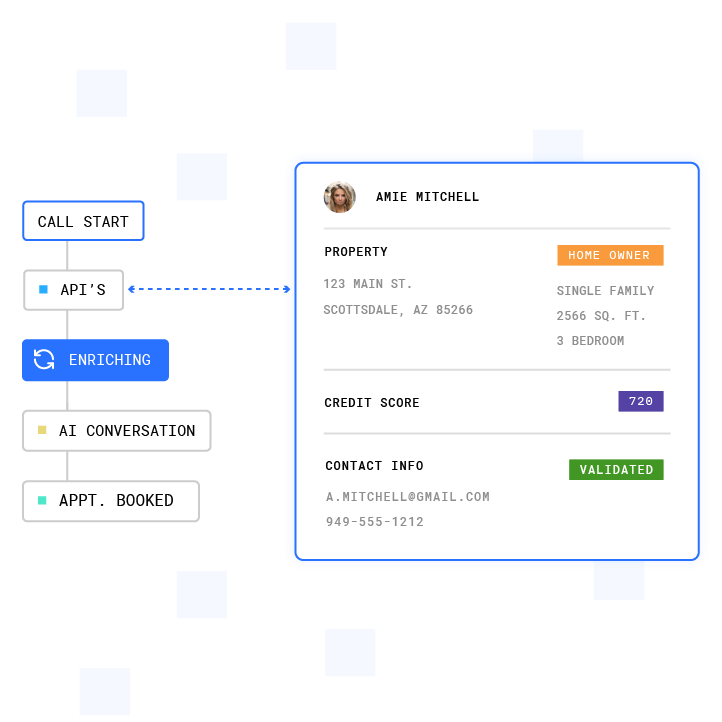
Traditional CRM scoring runs after a lead is ingested, often hours after the initial contact attempt. Plura treats every interaction as a data point for Lead Intelligence, scoring before and during the call rather than after it. The following workflow describes how lead scoring criteria automation executes inside a live AI conversation.
-
Lead enters the system. A form submission, inbound call, or webchat session triggers the workflow. Plura’s AI Lead Intelligence immediately pings 30+ enrichment sources, including IP data, firmographics, email validation, and intent signals, to build a pre-conversation Fit score.
-
Conversation begins. The AI agent opens the conversation across the appropriate channel. Voice, SMS, RCS (Rich Communication Services), or webchat. The Stateful Conversation Database carries any prior context from previous touchpoints.
-
Engagement signals accumulate in real time. As the lead responds, each signal updates the running score. A live answer adds points. A pricing question adds more. A request to be removed subtracts immediately and triggers suppression logic.
-
Score threshold is crossed. When the cumulative Fit plus Engagement score crosses a defined threshold, the routing rule fires automatically. No human review is required.
-
Outreach routes in under five seconds. Hot leads (71+) transfer to AI Voice. Warm leads (46-70) receive an AI SMS follow-up. Cold leads (0-45) enter a nurture sequence. Organizations deploying AI for speed to lead see connection rates increase compared to delayed manual outreach.
-
Cross-channel memory persists. Every scored interaction writes back to the Stateful Conversation Database. If the lead texts at 9 a.m. and calls at noon, the AI picks up the call already knowing the score, the prior exchange, and any objections raised.
A solar company using Plura’s AI Lead Intelligence increased conversion rates from 6% to 18% with the same leads and offer3. This result shows what happens when scoring and outreach operate inside the same real-time conversation layer rather than in disconnected systems.
High-Risk Negative Signals That Require Immediate Suppression
Not all negative signals carry the same weight. Some reduce a lead’s score gradually. Others require immediate suppression before any further outreach attempt. This distinction affects both conversion efficiency and compliance posture.
Three signal categories warrant automatic suppression rather than score reduction.
Unsubscribe requests. Any opt-out signal, whether verbal during a voice call, a reply of “STOP” to an SMS, or a webchat opt-out, should halt outreach immediately across all channels. Plura’s platform applies suppression at the contact level, not the campaign level, so the same lead is not re-contacted through a parallel channel.
Spam complaints. A spam report filed through a carrier or email provider is a high-severity signal. It indicates not just disinterest but active objection. Contacts generating spam complaints are suppressed and flagged for review before any re-engagement workflow can activate.
Reassigned numbers. A number that has been reassigned to a new person is not the same contact. Plura checks against the Reassigned Numbers Database (RND) to detect reassignment before outreach. Contacting a reassigned number without verification can create compliance exposure under the Telephone Consumer Protection Act (TCPA, 47 U.S.C. § 227)2. Plura’s platform flags these contacts for re-verification rather than suppressing them permanently, since the original lead may still be reachable through a different contact method.
DNC registry matches. Every outbound contact is checked against federal and state Do Not Call (DNC) registries in real time before dial2. Numbers matching the DNC registry are blocked before the first outreach attempt. This check runs at the carrier level on Plura’s FCC-licensed infrastructure, not as a post-dial filter.
Quarterly Reviews: Keeping Lead Scoring Thresholds Aligned With Reality
Lead scoring criteria automation requires ongoing review rather than a set-and-forget configuration. Thresholds that reflect conversion patterns in Q1 may not reflect them in Q3, particularly in seasonal verticals like insurance, healthcare, or e-commerce. Because conversion patterns shift with seasonality, product launches, and lead source changes, a quarterly review cadence aligns threshold adjustments with these natural business cycles and supports consistent performance for high-volume operators.
Each quarterly review should address four questions.
-
Are hot leads converting at the expected rate? If leads scoring 71+ are not closing at a materially higher rate than warm leads, the threshold is too low or the Fit criteria are too broad.
-
Are warm leads being under-worked? If the 46-70 tier has a high volume of leads that eventually convert after extended nurture, the SMS follow-up cadence may need to be more aggressive or the threshold may need to shift downward.
-
Has the lead source mix changed? New paid-media channels, new landing pages, or new referral sources introduce leads with different behavioral patterns. Scoring weights calibrated for one source may misclassify leads from another.
-
What are the conversation intelligence signals showing? A legal marketing firm using Plura’s AI Conversation Intelligence found 23% of engaged leads lacked sufficient case value, adjusted qualification criteria, and reduced wasted attorney time3. Conversation-level data is the most direct input for threshold recalibration.
Plura’s no-code workflow canvas allows threshold adjustments to deploy without engineering involvement. Quarterly reviews translate directly into production changes within the same session.
Rule-Based and Predictive Scoring Models in One Strategy
Both rule-based and predictive models play a role in a mature lead scoring criteria automation strategy. The right mix depends on data volume, team capacity, and how quickly the lead population changes.
|
Dimension |
Rule-Based Scoring |
Predictive (AI-Driven) Scoring |
|---|---|---|
|
How it works |
Fixed point values assigned to predefined criteria by a human operator |
Machine learning model trained on historical conversion data to weight signals dynamically |
|
Setup requirement |
Low, configurable in a no-code workflow builder |
Higher, requires sufficient historical data and model training |
|
Transparency |
High, every point assignment is visible and auditable |
Lower, model weights may not be directly interpretable |
|
Adaptability |
Manual, requires human review to update thresholds |
Automatic, model reweights as new conversion data accumulates |
|
Best fit |
Operators with clear buyer profiles and stable lead sources |
High-volume operators with diverse lead sources and sufficient closed-won data |
Plura’s AI Lead Intelligence layer supports both approaches. Operators can begin with rule-based criteria defined in the workflow canvas and layer in predictive intent modeling as conversation data accumulates across voice, SMS, RCS, and webchat interactions.
Run your numbers through Plura’s calculator to check your ROI in real time and see how scoring-driven routing affects your cost per qualified lead.
Pre-Outreach Controls for TCPA, DNC, and HIPAA Frameworks
Compliance checks in Plura’s platform run before any outreach attempt, not after. The sequence is enforced at the carrier level on Plura’s FCC-licensed infrastructure, which means suppression happens at origination rather than as a downstream filter.
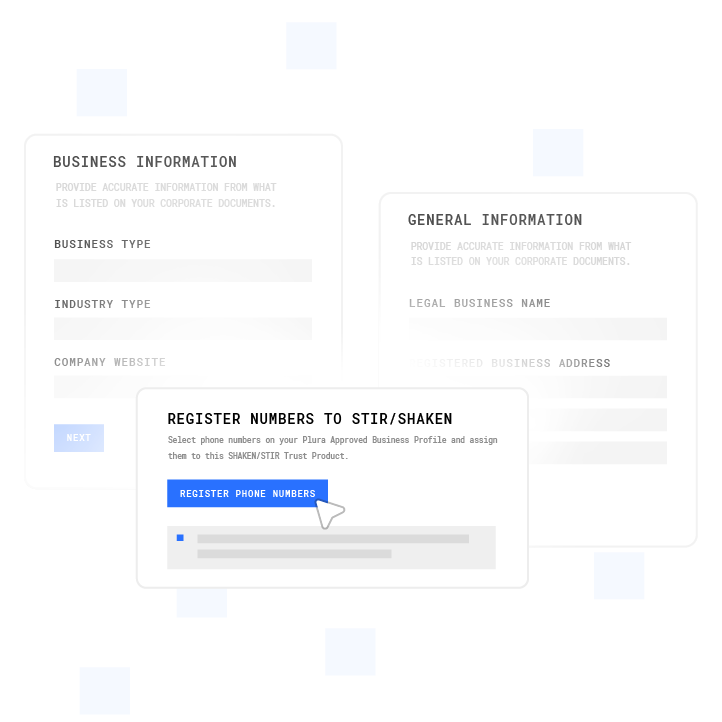
Plura’s Compliance Engine covers the following frameworks as part of its platform infrastructure:1
-
TCPA (Telephone Consumer Protection Act, 47 U.S.C. § 227). Consent records are timestamped, immutable, and audit-ready. Quiet-hours rules apply automatically through time-zone detection on the contact’s location.
-
DNC (Do Not Call) registries. Every outbound contact is checked against federal and state DNC registries in real time before dial. Numbers that do not meet DNC requirements are blocked before the first attempt.
-
HIPAA (Health Insurance Portability and Accountability Act, 45 CFR Parts 160, 162, 164). End-to-end encryption, access controls, and audit logging cover protected health information (PHI) across all four channels. Sensitive data fields are redacted at the field level.
-
SOC 2 Type II. Continuous monitoring, penetration testing, and third-party audits cover the underlying infrastructure.
-
50+ state rule sets. State-specific calling windows, disclosure requirements, and data-handling restrictions are pre-loaded and applied automatically.
Plura supports customer compliance with these frameworks. Customers remain responsible for their own regulatory obligations, certifications, and the claims they make to their end users. Operators with specific questions about their obligations under TCPA, HIPAA, or applicable state law should consult qualified legal counsel.
The compliance dashboard exports audit-ready reports in one click for legal review, carrier requirements, or regulatory inquiries.
Conclusion and Next Step
Lead scoring criteria automation delivers value only when the scoring happens inside the conversation, not hours later in a CRM batch job. The implementation path is direct. Teams define Fit and Engagement criteria in a scoring template, configure positive and negative signals with decay rules, set tier thresholds that map to routing actions, and enforce compliance checks at the carrier level before any outreach fires.
Plura’s Stateful Conversation Database and AI Lead Intelligence execute this entire sequence inside the first AI conversation, routing hot leads to AI Voice in under five seconds and preserving full cross-channel context for every subsequent touchpoint. Real-time AI lead scoring combined with multichannel automation brings cost per qualified lead from the $85-$200 range typical of traditional outreach down to $25-$603. As noted earlier, this reduction compounds across every lead tier when scoring and routing operate in real time.
The quarterly review cadence, the negative suppression logic, and the rule-based-to-predictive progression described in this guide are all configurable inside Plura’s no-code workflow canvas without engineering involvement.
Run your numbers through Plura’s calculator to check your ROI in real time and model what scoring-driven automation means for your specific lead volume and cost structure.
Frequently Asked Questions
What is the difference between lead scoring criteria automation and standard CRM lead scoring?
Standard CRM lead scoring runs as a batch process after a lead is ingested into the system. A lead submits a form, the CRM assigns points based on field values, and a sales rep reviews the score hours later. Lead scoring criteria automation runs in real time, during the first AI conversation, before any human reviews the record. Signals like a live answer, a pricing question, or an opt-out request update the score as the conversation unfolds, and routing fires automatically when a threshold is crossed. The practical difference is the gap between a five-second response to a hot lead and a five-hour delay while the lead cools in a queue.
How many scoring criteria should a lead scoring template include?
Most high-performing templates include between eight and fifteen active criteria across Fit and Engagement dimensions. Fewer than eight criteria tend to produce flat score distributions where most leads cluster in the same tier. More than fifteen criteria introduce noise, particularly when low-weight signals are given the same operational weight as high-intent signals like a pricing request or a live call answer.
The more important design decision is the ratio between Fit and Engagement signals. Operators in regulated verticals like healthcare and insurance typically weight Fit more heavily because a highly engaged lead who does not meet eligibility criteria cannot be converted regardless of intent. E-commerce and agency operators often weight Engagement more heavily because the buyer profile is broader.
What happens to leads that score below the cold tier threshold?
Leads scoring below 45 points enter a nurture sequence rather than receiving immediate AI Voice or AI SMS outreach. The nurture sequence typically includes lower-frequency touchpoints, educational content, and re-engagement triggers tied to specific behavioral signals. If a cold lead takes a high-intent action, such as revisiting a pricing page or replying to a nurture SMS, the scoring engine recalculates in real time and can promote the lead to the warm or hot tier without manual intervention.
Inactivity decay rules apply during the nurture period, so leads that remain unresponsive over 30 days continue to lose points and may eventually be suppressed from active outreach entirely.
Can lead scoring criteria automation work across voice, SMS, RCS, and webchat simultaneously?
Lead scoring criteria automation can work across channels when the scoring engine reads from and writes to a single shared data layer. When voice, SMS, RCS, and webchat operate as separate products from separate vendors, each channel maintains its own record of the lead. A lead who opts out via SMS may still receive a voice call because the voice system has no visibility into the SMS suppression.
Plura’s Stateful Conversation Database keys every interaction to a single customer token, so a score update in one channel is immediately visible to every other channel. Suppression applied in SMS applies to voice. A pricing signal captured in webchat raises the score before the follow-up call is placed.
How long does it take to implement lead scoring criteria automation with Plura?
A straightforward inbound qualification flow with a defined scoring template can be built and deployed in days using Plura’s no-code workflow canvas. More complex implementations, such as multi-step intake flows with branching qualification logic across several channels, run closer to one to two months because the conversation design and threshold calibration require validation against real call data.
Plura’s onboarding sequence includes a discovery audit, intake of existing scripts and SOPs, an overnight build of a conversation mockup, a review session, engineering build of the production workflow, a pilot test on a subset of real contacts, and full go-live. Every annual contract includes a 90-day opt-out window if the deployment is not delivering against the agreed metrics.
1 Plura AI maintains SOC 2, HIPAA, ISO, and GDPR posture as part of its platform infrastructure. References to compliance frameworks in this article describe Plura’s platform capabilities and do not constitute a guarantee that any customer using Plura will themselves be compliant with applicable laws or standards. Customers remain solely responsible for their own regulatory obligations, certifications, consent management, recordkeeping, and the claims they make to their own end users. Consult qualified legal counsel for guidance specific to your use case.
2 This article describes regulatory frameworks at a general level and does not constitute legal advice. Laws and regulations vary by jurisdiction, change over time, and apply differently depending on facts and circumstances. Readers should consult qualified legal counsel before making compliance decisions.
3 Performance figures, customer outcomes, and industry statistics referenced in this article are drawn from cited third-party sources or Plura customer case studies. Individual results vary based on implementation, use case, industry, audience, and execution. Past or aggregate performance is not a guarantee of future results.
This article is provided for informational purposes only and reflects Plura AI’s understanding at the time of publication. Product capabilities, integrations, and specifications are subject to change. For the most current information, visit plura.ai.
This article was produced with the assistance of AI tools and reviewed by Plura AI prior to publication.