
Written by: Matt Beucler, CEO, Plura AI
Key Takeaways
- The Foreign Robocall Elimination Act (S.2666/H.R.6152) is a bipartisan bill that targets foreign-origin illegal robocalls through an interagency task force, extended traceback requirements, and FCC authority over high-risk providers in the Robocall Mitigation Database.
- As of September 2026, the bill has passed the Senate by unanimous consent and awaits further action in the House.
- The legislation builds on the TRACED Act by lengthening traceback consortium designation intervals, granting immunity for traceback information sharing, and authorizing financial bonds for high-risk providers.
- The bill focuses on provider infrastructure and foreign-origin traffic rather than consumer phone tools or new penalties for individual callers, so its impact will depend on future FCC rulemaking.
- High-volume operators that rely on U.S.-based calling infrastructure can use Plura AI’s solutions to align operations with evolving robocall regulations.
The Problem: Why Foreign Robocalls Matter
In April 2026, U.S. consumers received 4.2 billion robocalls, according to YouMail’s Robocall Index.3 That volume works out to roughly 13 calls per person and about 1,600 calls every second. The scale is high enough that the FCC reports unwanted calls as its “top consumer complaint” annually (approximately 135,000 in 2023) and its “top consumer protection priority.”
The harm extends well beyond annoyance. In 2025, reported losses to imposter scams in the United States exceeded $3.5 billion, and robotexts were the most common contact method for these scams, according to the FTC Consumer Sentinel Network.3
The origin of many unlawful calls adds another layer of complexity. Although about 90% of all robocalls appear to originate from within the United States, research indicates that a significant share of illegal robocalls originate overseas, according to the FTC. Foreign-origin calls typically enter U.S. networks through gateway providers, which makes them harder to trace and block under existing tools.
The Foreign Robocall Elimination Act is one of four robocall-related bills introduced in the 119th Congress that focus on this cross-border problem.
Core Provisions Of The Foreign Robocall Elimination Act
S.2666 was introduced in the Senate on August 1, 2025 by Sen. Ted Budd (R-N.C.) and referred to the Senate Committee on Commerce, Science, and Transportation. The House companion, H.R.6152, came from Rep. Addison McDowell (R-N.C.) and Rep. Kelly Morrison (D-Minn.). The bill’s stated purpose is “To direct the Federal Communications Commission to establish a taskforce on unlawful robocalls, and for other purposes.”
The bill has three main provisions:
- Interagency Task Force: The FCC must, within 270 days of enactment and after consulting the FTC and the Attorney General, establish an interagency task force on unlawful robocalls. The task force would include representatives from appropriate federal agencies plus seven private-sector representatives: three with expertise in combating unlawful robocalls, one from the registered traceback consortium, one from a telephone marketing business, one from a non-marketing telephone communications business or nonprofit, and one from a consumer advocacy organization. The task force would study several questions: how many foreign-origin unlawful robocalls enter U.S. networks, where they originate, and how much financial loss and identity theft they cause. It would also assess whether STIR/SHAKEN (Secure Telephone Identity Revisited/Signature-based Handling of Asserted information using toKENs) adequately handles foreign-originated calls and whether the Attorney General needs a dedicated DOJ office for robocall enforcement. The task force would report to Congress within 360 days and terminate 90 days after submitting that report.
- Extension of Traceback Requirements: The bill amends Section 13(d)(2) of the Pallone-Thune TRACED Act to change the FCC’s notice requirement from “annually” to “once every 3 years,” which lengthens the interval for the FCC’s designation of an industry-led consortium to trace the origin of suspected unlawful robocalls. It also grants the registered consortium immunity from any cause of action for receiving, sharing, or publishing covered traceback information, and authorizes the FCC or the consortium to publish a list of voice service providers that refuse to participate in traceback efforts or that originate or transmit substantial amounts of unlawful robocalls.
- FCC Authority Over High-Risk Providers in the Robocall Mitigation Database: The bill directs the FCC to issue rules requiring a provider to post a bond of not more than $100,000 before filing a certification to the RMD, if the FCC determines the bond is necessary to preserve the database’s integrity. The FCC must also establish criteria exempting providers from the bond requirement where it is not necessary to deter unlawful robocall activity, considering factors such as FCC registration and Universal Service Fund contributions under section 254(d), state public utility commission authority or licensing, listing on a national securities exchange, or other indicia of being a bona fide established communications service provider.
The Senate and House versions differ on one key point. S.2666 mandates a $100,000 bond, while H.R.6152 would authorize the FCC to require a bond through rulemaking if necessary. The table below summarizes how each chamber’s version handles the bill’s three main provisions.
| Provision | S.2666 (Senate) | H.R.6152 (House) |
|---|---|---|
| Interagency Task Force | Requires FCC to establish within 270 days | Requires FCC to establish |
| Bond Authority | Mandates bond up to $100,000 | Authorizes FCC to require bond through rulemaking |
Who Introduced The Foreign Robocall Elimination Act?
The bill’s bipartisan sponsorship helps explain its progress in both chambers. Sen. Ted Budd (R-N.C.) introduced S.2666 in the Senate, with Sen. Peter Welch (D-Vt.) among its cosponsors, along with Sen. Jon Husted (R-Ohio) and Sen. Raphael G. Warnock (D-Ga.). Rep. Addison McDowell (R-N.C.) and Rep. Kelly Morrison (D-Minn.) sponsored the House companion H.R.6152.
The bill passed the Senate by unanimous consent, which signals broad bipartisan support for its core approach.
Current Status Of The Foreign Robocall Elimination Act
As of September 2026, the Foreign Robocall Elimination Act has passed the Senate but has not yet completed the remaining steps in the legislative process.
The Senate passed S.2666 by unanimous consent with an amendment on August 3, 2026, and the bill was held at the desk in the House as of August 10, 2026. On the House side, H.R.6152 advanced out of the House Communications and Technology Subcommittee by voice vote on September 1, 2026 and now awaits full Committee action before any House floor vote.
How This Bill Relates To The TRACED Act
The Foreign Robocall Elimination Act builds on the framework established by the TRACED Act (Pallone-Thune Telephone Robocall Abuse Criminal Enforcement and Deterrence Act). The TRACED Act, signed into law on December 30, 2019, amended the TCPA (Telephone Consumer Protection Act) to expand FCC enforcement actions against illegal robocalls, increase monetary forfeitures for TCPA violations, and require the FCC to initiate rulemaking to protect subscribers from unauthenticated calls. It required the FCC to initiate rulemaking that led to the STIR/SHAKEN caller-ID authentication framework and the Robocall Mitigation Database.2
The Foreign Robocall Elimination Act extends that structure by lengthening the traceback consortium designation interval, granting the consortium immunity for publishing traceback information, and authorizing the FCC to consider financial bonds for high-risk providers listed in the RMD. The underlying TRACED Act enforcement framework remains in place.
As of early 2026, large U.S. carriers have achieved over 95% STIR/SHAKEN implementation, but only about 21% of calls from smaller, non-facilities-based providers are made on IP-based networks, which contributes to only about 45% of total call traffic being fully signed. The Foreign Robocall Elimination Act’s task force is specifically directed to assess whether STIR/SHAKEN adequately handles foreign-originated calls routed through U.S. gateway providers.
What The Foreign Robocall Elimination Act Actually Targets
Many readers expect this bill to directly stop robocalls on consumer phones, but the legislative text focuses on infrastructure and enforcement coordination. The mechanisms sit with agencies and providers rather than with end users.
The bill narrows its scope to unlawful robocalls that violate existing TCPA provisions and travel over provider networks. It directs attention to gateway providers, traceback participation, and financial incentives for high-risk operators. Consumer-facing call-blocking tools, Do Not Call Registry protections, and carrier-level spam labeling remain governed by existing rules and programs.
The Congressional Budget Office’s May 26, 2026 cost estimate for S.2666 projects that any increase in revenues from forfeited bonds would be insignificant over the 2026-2036 period, because the number of affected providers would be small and the likelihood of forfeiture would be low. The effect on the calls consumers actually receive will depend on how the FCC implements its provisions through rulemaking and what the task force recommends to Congress.
Frequently Asked Questions
What Makes A Robocall Illegal?
A robocall becomes unlawful when it violates the Telephone Consumer Protection Act (TCPA).2 Examples include calls made without prior express consent, calls to numbers on the National Do Not Call Registry, or calls that use artificial or prerecorded voices without proper disclosure. The Foreign Robocall Elimination Act defines “unlawful robocall” by reference to violations of subsection (b) or (e) of section 227 of the Communications Act of 1934 (47 U.S.C. 227).2 Readers with questions about whether specific calling practices comply with the TCPA should consult qualified legal counsel and review the statute directly.
Will The Foreign Robocall Elimination Act Reduce The Robocalls I Get?
The bill operates indirectly for consumers. It would create an interagency task force, extend traceback requirements, and give the FCC authority to consider financial bonds for high-risk providers. Its impact on the calls consumers receive will depend on FCC rulemaking and the task force’s recommendations to Congress. Consumers seeking immediate relief can register numbers on the National Do Not Call Registry and use carrier-provided call-blocking tools.
The Solution For High-Volume Operators: Compliant, U.S.-Based Calling With Plura AI
The bill’s focus on provider accountability and foreign-origin calls reflects a broader shift in how regulators view calling infrastructure. For high-volume operators, that shift turns compliant, U.S.-based outbound and inbound calling into a present-day requirement rather than a future one.
Plura AI is its own FCC-licensed audio bridging carrier. Voice originates on Plura’s domestic infrastructure rather than a third-party CPaaS (Communications Platform as a Service). That structure allows Plura to issue branded caller ID at the carrier level and run STIR/SHAKEN authentication on every outbound call. The platform enforces real-time DNC (Do Not Call) scrubbing, TCPA-litigator screening, automated quiet hours, and immutable consent logging on every outbound contact before dial.
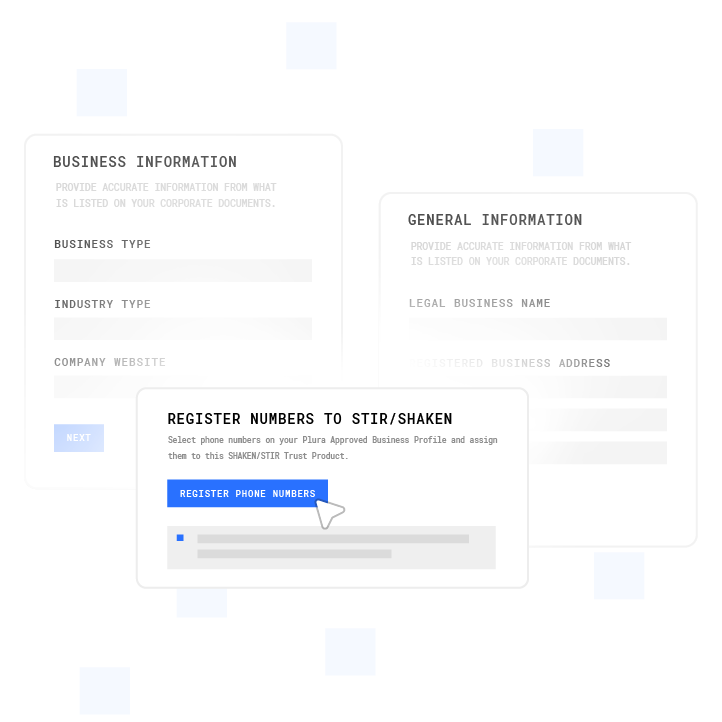
Plura runs on 100% U.S. infrastructure by architecture. Voice origination, model hosting, data storage, and call recording all sit on domestic infrastructure. That design aligns with the direction of the FCC NPRM (Notice of Proposed Rulemaking, CG Docket No. 26-52), the Keep Call Centers in America Act (S.2495), and the Foreign Robocall Elimination Act (S.2666), which extend the federal regulatory perimeter around foreign-origin calls and offshore handling of consumer data.
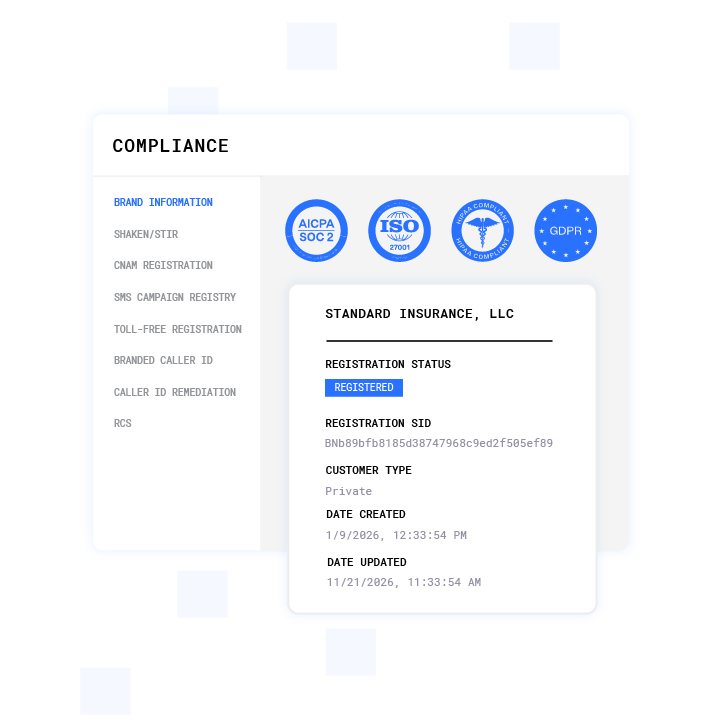
Plura’s AI voice agent, AI SMS, AI RCS, and AI webchat share a Stateful Conversation Database, so context carries across channels. An AI predictive dialer routes outbound calls over Plura’s own carrier with branded caller ID and STIR/SHAKEN on every dial. Plura supports compliance with SOC 2, HIPAA, ISO certification, GDPR, SHAKEN/STIR caller ID verification, TCPA compliance, and DNC compliance across all channels.1 Customers remain responsible for their own regulatory obligations and certifications.
Compare plans and rates side by side to see which tier fits your call volume and compliance requirements.
Conclusion: What Contact Leaders Should Watch Next
The Foreign Robocall Elimination Act targets foreign-origin illegal robocalls through an interagency task force, extended traceback requirements, and FCC authority over high-risk providers in the Robocall Mitigation Database. Its practical effect will depend on FCC rulemaking, task force findings, and final House action on S.2666 and H.R.6152.
For contact center leaders, marketing directors, agencies, franchises, and executives, the direction is clear. Infrastructure choices around carrier stack, caller ID authentication, DNC scrubbing, and data residency will shape risk exposure as these provisions move forward.
See which tier fits your call volume and compliance requirements. Run your numbers through Plura’s ROI calculator to model the financial impact of consolidating outbound and inbound calling on a U.S.-based platform.
1 Plura AI maintains SOC 2, HIPAA, ISO, and GDPR posture as part of its platform infrastructure. References to compliance frameworks in this article describe Plura’s platform capabilities and do not constitute a guarantee that any customer using Plura will themselves be compliant with applicable laws or standards. Customers remain solely responsible for their own regulatory obligations, certifications, consent management, recordkeeping, and the claims they make to their own end users. Consult qualified legal counsel for guidance specific to your use case.
2 This article describes regulatory frameworks at a general level and does not constitute legal advice. Laws and regulations vary by jurisdiction, change over time, and apply differently depending on facts and circumstances. Readers should consult qualified legal counsel before making compliance decisions.
3 Performance figures, customer outcomes, and industry statistics referenced in this article are drawn from cited third-party sources or Plura customer case studies. Individual results vary based on implementation, use case, industry, audience, and execution. Past or aggregate performance is not a guarantee of future results.
This article is provided for informational purposes only and reflects Plura AI’s understanding at the time of publication. Product capabilities, integrations, and specifications are subject to change. For the most current information, visit plura.ai.
This article was produced with the assistance of AI tools and reviewed by Plura AI prior to publication.