
Written by: Matt Beucler, CEO, Plura AI
Updated September 13, 2026
Key Takeaways
- Multi-line (parallel) dialing calls several numbers at once and connects an agent only to the first live human who answers.
- The 5-step dial cycle covers list pull, simultaneous dialing, call-progress analysis, instant agent connection, and repeat dialing.
- Parallel dialing keeps the agent ready at connection time, which reduces abandoned-call exposure compared to predictive dialing.
- Compliance controls rely on pre-dial DNC scrubbing, consent checks, abandoned-call monitoring, and STIR/SHAKEN caller ID authentication.
- Plura AI runs multi-line dialing on its own FCC-licensed carrier with branded caller ID and real-time compliance; schedule a live Plura walkthrough to see the dial cycle in action.
How a Multi-Line Phone System Places and Connects Calls
A multi-line phone system lets one agent handle several outbound calls at once. The dialer loads a contact list and applies pre-dial filters such as DNC scrubbing and consent checks. It then places multiple calls at once and listens for a live human answer using voice activity detection and call-progress analysis. When a live person answers, the agent connects only to that call. The unanswered lines drop before the recipient hears anything.
How Multi-Line Dialing Works: The 5-Step Dial Cycle
- Pull Contacts from the List. The dialer loads phone numbers from a CRM or contact database and applies pre-dial filters before the first call leaves the system. Those filters include DNC scrubbing against the National Do Not Call Registry, which contains over 250 million phone numbers and must be refreshed no more than 31 days before any call is placed under 47 CFR 64.1200(c)(2)(i)(D). The system also checks internal DNC lists and verifies consent status.
- Dial Multiple Lines Simultaneously. When the agent starts a session, the system dials several numbers at once, typically two to five, rather than one at a time. Skipcall’s 2026 analysis reports that parallel dialers reach 150 to 300 dials per hour compared to 30 to 40 dials per hour for power dialers.3 The agent stays available to take the first live connection.
- Run Call-Progress Detection. The system analyzes the audio on each active line to classify what answered. Voice Activity Detection (VAD) runs first as a binary classifier that labels each short window of audio as speech or non-speech, as described by Cekura’s VAD documentation. VAD alone cannot tell a live human from a recording. It feeds a higher-level classifier called Call-Progress Analysis (CPA), also known as Answering Machine Detection (AMD). CPA combines speech timing, greeting length, and telephony tones to distinguish a live human from an answering machine, voicemail, busy signal, or no-answer. CompanyView’s CPA glossary notes that CPA classification typically completes within roughly 500 milliseconds to 2 seconds after connection. Leading CPA engines report above 95% overall classification accuracy, with live-answer detection accuracy above 98% in domestic U.S. calling scenarios.
- Connect the Live Human and Drop the Rest. As soon as CPA confirms a real person has spoken, the system bridges that call to the agent. It immediately drops the remaining lines that are still ringing or that went to voicemail. Skipcall’s 2026 analysis reports that modern parallel dialers drop unwanted lines within 200 to 400 milliseconds of the agent connection event, well before the recipient’s phone completes the pickup sequence.
- Repeat with the Next Batch. When the live conversation ends, the software starts dialing the next batch of numbers. This keeps the agent in near-continuous talk time. Skipcall’s 2026 analysis reports 8 to 12 live conversations per hour on a parallel dialer versus 3 to 4 on a power dialer.
See a live Plura dial cycle running on Plura’s FCC-licensed carrier. Compare plans and rates side by side.
Abandoned Calls When Two People Answer at Once
When more live humans answer than there are agents available, the extra calls are dropped. Under 47 CFR 64.1200(a)(7), a call is considered abandoned if it is not connected to a live sales representative within two seconds of the called person’s completed greeting. The same regulation caps the abandoned-call rate at no more than 3% of all telemarketing calls answered live by a person, measured over a 30-day period for a single calling campaign.
When no agent is available within that two-second window, 47 CFR 64.1200(a)(7)(i) describes a prerecorded identification and opt-out message. That message discloses that the call was for telemarketing purposes, states the name of the business on whose behalf the call was placed, and provides a telephone number that permits the called person to make a do-not-call request. The message also includes an automated, interactive opt-out mechanism that records the person’s number to the seller’s do-not-call list and immediately terminates the call when the person elects to opt out.
Regulators and carriers focus closely on abandoned-call rate. AL Performance’s 2026 benchmark, which analyzed more than 35 million outbound dials across U.S. consumer-dialing operations, found a median abandon rate around 2.5% of live answered calls, with the best-run floors holding it near 1%.3 Operators and their counsel should consult the regulation directly and seek qualified legal advice on how the framework applies to their specific campaigns.
In a parallel dialing model, the abandoned-call dynamic differs from predictive dialing. Skipcall’s 2026 analysis notes that parallel dialers drop unconnected lines before the recipient picks up, so the recipient never hears a click or dead air. No abandoned call in the regulatory definition is produced in that scenario. The FCC’s 3% abandoned-call rule applies when a live person answers and no agent is connected within two seconds. Parallel dialing is designed so the agent is always available at the moment of connection.
Dialing Modes for High-Volume Outbound Teams
The terms “multi-line dialing” and “parallel dialing” refer to the same mode: a fixed number of simultaneous lines per available agent, with the agent always ready to take the first live connection. Every data point is sourced inline.
Parallel, or multi-line, dialing sets the dial ratio by the operator, typically 2 to 5 lines per agent. The system places multiple calls per agent at once while the agent stays available, which drives abandon risk toward very low levels by design.
Predictive dialing sets the ratio from live answer-rate and agent-availability data using an algorithm. The typical ratio is 2:1 to 5:1 or higher depending on answer rate, team size, and campaign settings. The system places multiple calls per agent and paces ahead of agent availability. It accepts some abandoned calls as part of the model. WFM Labs reports agent utilization of 75 to 90%.
Progressive dialing fixes the ratio at one call per available agent. The system dials only when an agent is confirmed ready. One call per available agent keeps abandon risk very low by design. WFM Labs reports agent utilization of 55 to 70%.
Predictive dialing uses abandoned calls as a tradeoff for higher talk time because it dials ahead of agent availability. Progressive dialing minimizes abandoned calls because it never dials until an agent is free. Parallel dialing sits between them operationally. It dials more than one line per agent but keeps the agent available at the moment of connection, so abandoned-call exposure stays structurally lower than predictive dialing.
Setting Line Counts for Multi-Line Dialing
Line count directly affects both volume and abandoned-call risk. As line count rises, the probability that more than one live human answers at once rises with it, which produces abandoned calls and regulatory exposure.
Line count needs tuning against agent availability and the abandonment ceiling. Skipcall’s 2026 analysis reports that above roughly five concurrent lines, conversation quality can degrade because the cognitive cost of simultaneous pickups exceeds the volume gain. The same analysis notes that Skipcall ships 2 to 4 line concurrency by default and that parallel dialing fits teams making at least 50 dials per day per agent and list-based motions with modest pre-call preparation.
WFM Labs’ Outbound Contact Center Operations wiki describes the predictive dialer’s overdial ratio as a closed-loop control system. When agents free up faster than expected, the dialer dials more aggressively. When calls connect faster than expected, it dials less. The same principle guides parallel dialing configuration. The right line count keeps the agent in continuous conversation without pushing the abandoned-call rate toward the regulatory ceiling.
AL Performance’s 2026 benchmark identifies number hygiene, campaign waterfall structure, pacing, list segmentation, and dialing-window discipline as proven levers for improving connect rates. The median contact center in that dataset connected just under 7% of dials, with the best floor connecting above 20% over the same 90-day window.
Compliance Mechanics for Multi-Line Dialing
Multi-line dialing compliance mechanics operate at three layers: pre-dial list scrubbing, consent verification, and real-time abandoned-call rate monitoring. This section describes the regulatory framework neutrally. Operators should consult the applicable regulations and qualified legal counsel for guidance on their specific obligations.

DNC Scrubbing. Under 47 CFR 64.1200(c)(2)(i)(D), callers relying on the error-defense safe harbor use a version of the National Do Not Call Registry obtained no more than 31 days prior to the date any call is made.2 The FTC’s Telemarketing Sales Rule at 16 CFR 310.4(b)(3)(iv) mirrors this 31-day window. Internal DNC lists, which cover consumers who have requested not to be called by a specific company, must be maintained separately. Under 47 CFR 64.1200(d)(6) a do-not-call request is honored for 5 years from the time the request is made.
Consent. The TCPA (Telephone Consumer Protection Act, 47 U.S.C. § 227) describes prior express written consent for certain autodialed or prerecorded marketing calls and texts to wireless numbers.2 The FCC’s one-to-one consent rule, which took effect January 27, 2025, requires consent to be obtained separately for each seller, which changes how blanket consent covering multiple sellers or affiliates is treated. Consent records typically include the specific language the consumer agreed to, the date, and the method of capture.
Abandoned-Call Cap. Under 47 CFR 64.1200(a)(7), the 3% abandoned-call rate is calculated over a 30-day period for a single calling campaign. If a campaign exceeds 30 days, the rate is calculated separately for each successive 30-day period. Sellers and telemarketers maintain records that establish how they address these requirements under 47 CFR 64.1200(a)(7)(iii).
Plura supports compliance with TCPA, DNC, SOC 2, HIPAA, ISO certification, GDPR, and SHAKEN/STIR (Secure Telephone Identity Revisited/Signature-based Handling of Asserted information using toKENs) caller ID verification.1 Plura provides the infrastructure. Customers remain responsible for their own certifications, regulatory obligations, and the claims they make to their end users. Operators should direct compliance questions to qualified counsel.
How Plura AI Runs Multi-Line Dialing
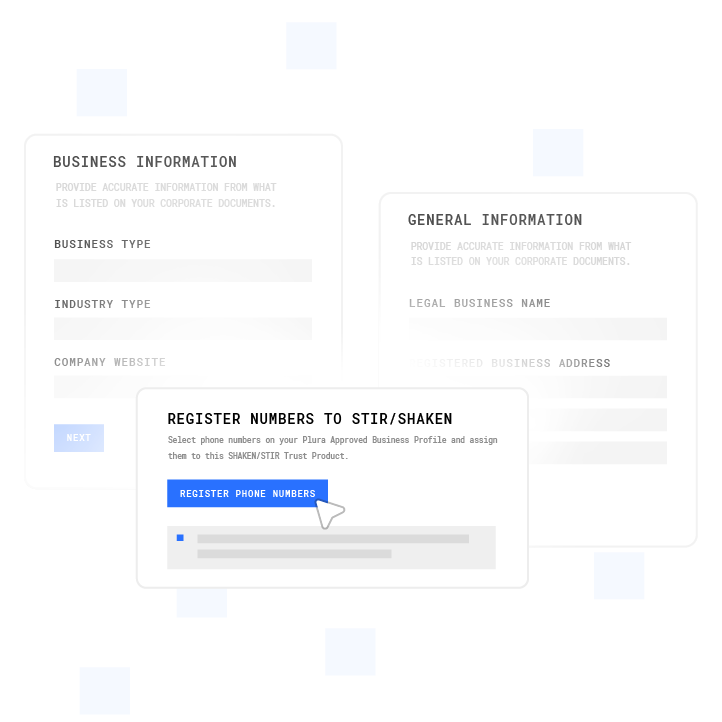
Plura AI operates as its own FCC-licensed audio bridging carrier. Voice traffic does not route through a third-party CPaaS provider. Plura holds its own operating company number and runs STIR/SHAKEN authentication on every outbound call. The platform issues branded caller ID at the carrier level and applies real-time DNC scrubbing, TCPA-litigator screening, automated quiet hours, and immutable consent logging on every outbound contact.
Plura’s AI Predictive Dialer decides who to call next using stateful conversion signals such as historical answer rates, prior negotiation outcomes, and prior offer-acceptance bands. It then runs multi-line dialing over Plura’s carrier. Every conversation is logged to a Stateful Conversation Database that spans voice, AI SMS, AI RCS, and AI Webchat. That shared memory means an agent who texted a lead at 9 a.m. can pick up the call at noon already knowing what was said. CRM integration connects the dialer to HubSpot, Salesforce, and Zoho, and Plura integrates with more than 50 tools so contact records, consent status, and DNC flags stay current across systems.
Because Plura owns the carrier stack, branded caller ID is issued under Plura’s carrier identity rather than a reseller’s identity. Voiso’s 2026 outbound benchmark guide cites case studies showing branded calling can produce answer-rate increases of 21% to 25% or more.3 The same guide notes that when a business number receives a spam label, answer rates can drop by 40% to 60%. Plura addresses spam labels at the carrier level instead of through a third-party reseller.
Talk with the Plura team to see how the carrier layer and stateful dialing engine perform on a live campaign. Compare plans and rates side by side. Run your numbers through Plura’s ROI calculator.
1 Plura AI maintains SOC 2, HIPAA, ISO, and GDPR posture as part of its platform infrastructure. References to compliance frameworks in this article describe Plura’s platform capabilities and do not constitute a guarantee that any customer using Plura will themselves be compliant with applicable laws or standards. Customers remain solely responsible for their own regulatory obligations, certifications, consent management, recordkeeping, and the claims they make to their own end users. Consult qualified legal counsel for guidance specific to your use case.
2 This article describes regulatory frameworks at a general level and does not constitute legal advice. Laws and regulations vary by jurisdiction, change over time, and apply differently depending on facts and circumstances. Readers should consult qualified legal counsel before making compliance decisions.
3 Performance figures, customer outcomes, and industry statistics referenced in this article are drawn from cited third-party sources or Plura customer case studies. Individual results vary based on implementation, use case, industry, audience, and execution. Past or aggregate performance is not a guarantee of future results.
4 References to third-party products, services, companies, or research are made for informational and comparative purposes only. Plura AI is not affiliated with, endorsed by, or sponsored by any third party named in this article unless explicitly stated. Trademarks and product names referenced remain the property of their respective owners.
This article is provided for informational purposes only and reflects Plura AI’s understanding at the time of publication. Product capabilities, integrations, and specifications are subject to change. For the most current information, visit plura.ai.
This article was produced with the assistance of AI tools and reviewed by Plura AI prior to publication.