
Written by: Matt Beucler, CEO, Plura AI
Key Takeaways
- Auto dialing is the parent category. Multi-line (parallel) dialing is one mode within it that dials multiple numbers at once for a single agent.
- Multi-line and predictive dialers increase live conversations per hour. They also create abandoned-call risk when multiple people answer at once and only one agent is available.
- The FCC caps abandoned calls at three percent of live-answered telemarketing calls over a 30-day period. Line count and list answer rate become critical compliance variables.
- Power and progressive dialers deliver zero abandoned calls by design. They remain the lower-risk choice for B2B floors and teams under eight agents.
- Operators running multi-line dialing at volume can book a live demo with Plura AI to evaluate a carrier-grade platform that screens against DNC and TCPA litigators before dial.
Multi Line Dialing vs Auto Dialing: Correcting the Premise
The query “multi line dialing vs auto dialing” frames the two as competing categories. They sit in a parent-child relationship instead. Auto dialing is the parent category. Multi-line dialing is one mode within it. The decision that matters for an outbound floor is which dialing mode to run. That answer depends on list size, answer rate, agent count, B2B vs B2C, and tolerance for dropped calls.
Operators choose between four dialing modes. The table below maps each one to its core mechanics, abandoned-call exposure, and typical deployment context. Dials-per-hour ranges come from JustCall’s outbound call center benchmark guide and Skipcall’s 2026 auto dialer guide.3
| Dialing Method | Calls Per Agent Per Hour | Abandoned-Call Risk | Typical Use Case |
|---|---|---|---|
| Power dialer | 40-80 | None by design | B2B sales, lists under a few thousand rows |
| Progressive dialer | 100-150 | None by design | Teams above 3 reps scaling up |
| Predictive dialer | 60-150 | Higher, over-dials ahead of the team | Full-time consumer call floors, 10+ agents |
| Multi-line / parallel dialer | 70-120 | Higher, simultaneous pickups | Large, low-connect lists |
How Each Mode Dials
The table shows what each mode produces. To understand why abandoned-call risk varies so widely, it helps to look at how each mode actually places calls.
A power dialer places one call per available agent. The agent hears ringing. When the call connects, the agent is already on the line. When it does not connect, the dialer advances to the next number. No call goes out without a free agent behind it, so there is no structural mechanism for an abandoned call.
A progressive dialer works the same way, one call per agent. It places the next call automatically the instant the previous one ends, without requiring the agent to trigger it. The compliance profile matches a power dialer and delivers zero abandoned calls by design.
A multi-line dialing setup works differently. Two to ten numbers are dialed simultaneously for a single agent. The first line that connects a live human is routed to that agent. The other lines, if they also connect, are dropped. That drop is the abandoned call. Higher line counts create more moments where two people answer at once, which produces more abandoned calls.
A predictive dialer operates at the team level rather than the agent level. An algorithm forecasts when agents across the floor will become available and dials ahead of that moment. Answered calls are routed to whoever is free. When the pacing math is off and more live answers arrive than agents are available, the result is the same: an answered call with no agent to take it.
Abandoned Calls and What Causes Them
The mechanics described above explain why abandoned calls happen. The more lines dialed per available agent, the more often multiple people answer simultaneously. When that happens and only one agent is free, the other answered calls have no one to receive them. The caller hears silence or a click. That event is a dropped call, a wasted live conversation, and a burned lead.
Operators running multi-line and predictive dialers describe this in plain terms: “burning through leads,” “dropped calls,” “is it worth it.” The tradeoff is real. JustCall’s benchmark data puts talk-time percentage at 40-55% for power dialing and 50-70% for parallel and predictive modes.3 Floors gain more live conversations per hour and accept more abandoned-call exposure alongside that gain.
The answer-rate environment makes this tradeoff sharper. Apten’s May 2026 analysis puts average cold call connect rates at approximately 2.3% in 2025, down from 4.82% the prior year.3 On a list where fewer than 1 in 10 dials reaches a live person, every abandoned call represents a live conversation that cost multiple dials to produce and then was wasted.
List burn compounds the problem. A contact who picks up and hears silence is less likely to answer the next attempt. The abandoned call wastes the conversation and degrades the list.
What TCPA and FCC Rules Say About Autodialers and Abandoned Calls
The Telephone Consumer Protection Act (TCPA), codified at 47 U.S.C. § 227, describes restrictions on the use of automatic telephone dialing systems (ATDS), prerecorded voices, and artificial voices in outbound calling.2 The FCC’s implementing regulations appear at 47 C.F.R. § 64.1200.
On abandoned calls specifically, 47 C.F.R. § 64.1200(a)(7) describes a prohibition on abandoning more than three percent of all telemarketing calls answered live by a person, measured over a 30-day period for a single calling campaign.2 Under § 64.1200(a)(7)(ii), a call delivering an artificial or prerecorded voice message with prior express written consent is not considered abandoned if the message begins within two seconds of the called person’s completed greeting.
The three percent threshold and the two-second connect rule are the two figures operators most often cite when evaluating dialing mode risk. DialSheet’s 2026 compliance guide notes that at two lines the abandoned-call rate stays well under one percent on most lists. At three lines it remains comfortably under three percent for most lists. At five lines on a high-answer list, simultaneous pickups can push the rate toward or over the three percent ceiling.
Nothing in this article constitutes legal advice. Operators with questions about how these rules apply to their specific dialing configuration, list type, or consent records should consult qualified counsel.
What Qualifies as an Autodialer
The statutory definition of an ATDS under 47 U.S.C. § 227(a) describes equipment with the capacity to store or produce telephone numbers to be called using a random or sequential number generator and to dial such numbers.2
In Facebook, Inc. v. Duguid, 592 U.S. 395 (2021), the Supreme Court held unanimously that the random-or-sequential-number-generator requirement modifies both storing and producing numbers.4 A system that stores a list of specific numbers and dials them automatically, without random or sequential number generation, does not meet the statutory ATDS definition under that reading.
Post-Duguid, parallel dialers that dial from a user-uploaded list rather than generating numbers randomly or sequentially sit in a different position under the federal ATDS definition than predictive dialers. Plaintiff attorneys often argue that predictive dialers carry higher ATDS risk because the pacing algorithm itself may constitute the random or sequential element. Circuit courts have applied the Duguid standard differently depending on the facts, and several states, including Florida under the FTSA, define autodialers more broadly than the post-Duguid federal standard.
The definition shapes which rules apply. Operators should review their dialer classification and consent practices with qualified counsel, particularly given ongoing FCC rulemaking and state-level legislative activity.
The Operator’s Decision Framework
The right dialing mode is an operational decision, not a product feature decision. It is keyed to five variables: list size, answer rate, agent count, B2B vs B2C, and tolerance for dropped calls.
Skipcall’s 2026 decision grid maps these variables to mode recommendations:
- 1-2 concurrent agents, high-value targets, connect rate above 20%: preview or power dialer
- 2-7 agents scaling up, 10-20% connect rate: power dialer
- 2-10 agents on cold lists, below 10% connect rate: parallel dialer at 3 lines with voicemail detection
- 10+ agents in B2C mass campaigns, 15-30% connect rate: predictive dialer with abandoned-call monitoring
The scenario many operators on a 15-50 agent floor actually face: an 80% unanswered list, a mix of B2B and B2C contacts, and a legal team that has already asked one uncomfortable question about TCPA. That scenario does not automatically point to multi-line dialing. It points to a conversation about what the floor can absorb in terms of abandoned-call exposure before the compliance math breaks.
A floor with 10 agents and a 6% connect rate on a cold B2B list can run 2-3 parallel lines per agent and stay well under the three percent abandoned-call threshold on most days. But the same floor running 5-10 lines per agent on a consumer list with a 20% connect rate will breach that threshold regularly. The difference shows that the line count that is operationally safe depends on the answer rate of the specific list being dialed.
Skipcall’s CEO Charles Baldet puts it directly: “below 8 agents, take a power dialer, keep your drop rate at zero, and put the budget difference into training your reps. Predictive can wait until your team is big enough to deserve it.”
For B2B floors where each conversation matters and lists run under a few thousand rows, a power dialer is the lower-risk default. For high-volume consumer floors with large, low-connect lists and a dedicated compliance function, multi-line or predictive dialing produces more live conversations per hour, at the cost of higher abandoned-call and compliance exposure that must be actively managed.
How Plura AI Supports Multi-Line Dialing Floors
For operators running multi-line dialing at volume, the platform choice matters more than it does in single-line modes. Multi-line dialing carries the highest abandoned-call exposure and the widest compliance surface area. Carrier-level enforcement, rather than bolt-on compliance tools, drives the operational difference in that environment.
Plura AI’s AI Predictive Dialer runs on Plura’s own FCC-licensed audio bridging carrier, which is different from the third-party CPaaS layer most providers use. That distinction matters specifically in multi-line dialing. Because Plura owns the carrier, branded caller ID is issued at the carrier level, STIR/SHAKEN (Secure Telephone Identity Revisited / Signature-based Handling of Asserted information using toKENs) authentication runs on every outbound call, and real-time DNC (Do Not Call) scrubbing and TCPA-litigator screening happen inside the platform before dial. These safeguards are not third-party add-ons applied after the call has left the network.
Many Twilio-based API resellers rent the carrier layer and inherit that carrier’s caller ID reputation.4 Plura owns the carrier, so enforcement happens at origination.
Plura’s AI Voice, AI SMS, AI RCS, and AI Webchat share a Stateful Conversation Database, so context carries across channels. An agent who texted a lead at 9 a.m. can pick up the call at noon already knowing what was said. That cross-channel memory matters on multi-line dialing floors because contacts who do not connect on a dial attempt can be re-engaged via SMS or RCS without losing prior conversation context.
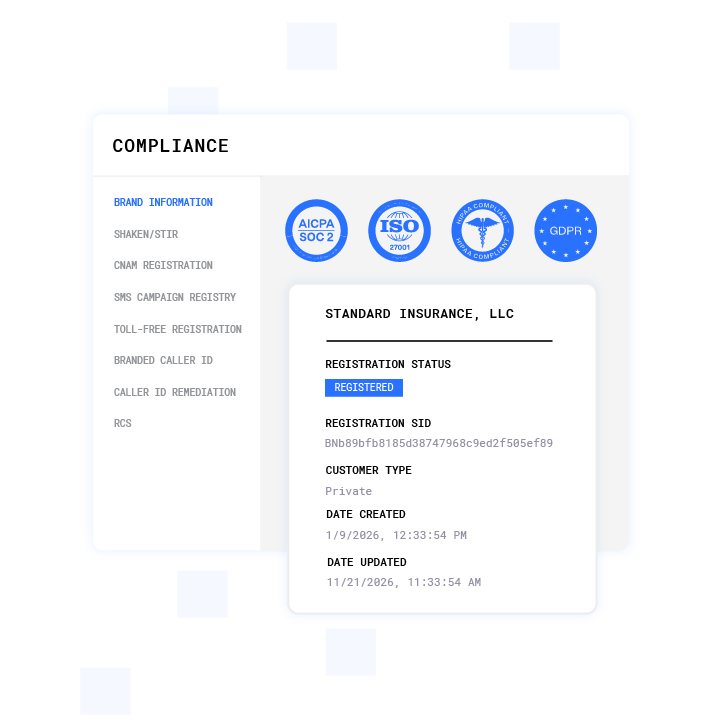
Plura supports TCPA compliance, DNC compliance, SOC 2, HIPAA, ISO certification, GDPR, and STIR/SHAKEN caller ID verification.1 Customers remain responsible for their own regulatory obligations. Plura provides the infrastructure and enforcement layer that supports compliance operations.
See the AI Predictive Dialer in action to understand how it runs multi-line dialing on a carrier-grade, compliance-enforced stack.
Compare Plura’s plans and rates side by side. Run your numbers through Plura’s ROI calculator to check your ROI in real time.
Common Problems With Auto Dialers
Operators running auto dialers at volume encounter a consistent set of failure modes regardless of dialing mode:
- Voicemail detection failures. A well-tuned answering machine detection system runs at 85-95% accuracy, analyzing the first 0.5 to 2 seconds after pickup. Misclassifications waste agent time or produce abandoned calls when a live answer is treated as voicemail.
- Spam labeling and “Spam Likely” flags. 95% of recipients decline calls labeled “Spam Likely” without answering. Carrier analytics engines flag numbers based on call volume, call duration, complaint rates, and dialing patterns, not just authentication status.
- List burn. High-volume dialing on a low-quality list degrades the list faster than it generates pipeline. B2B contact data decays at roughly 30% per year, meaning a list purchased and dialed six months later has nearly a third of records out of date before the first call.
- Pacing errors that cause abandoned calls. Predictive and multi-line dialers require active monitoring. A pacing algorithm that over-dials relative to agent availability produces abandoned calls that accumulate toward the three percent regulatory threshold.
- Agent idle time. Under-dialing, or too conservative a pacing ratio, leaves agents waiting between calls. The efficiency gain that justifies the compliance exposure disappears. That happens when the dialer is not calibrated to the list’s actual answer rate.
Frequently Asked Questions
What Is the Main Difference Between a Predictive Dialer and an Auto Dialer?
An auto dialer is the umbrella term for any system that dials numbers automatically. A predictive dialer is one specific type of auto dialer. It uses an algorithm to forecast agent availability and dials multiple numbers ahead of that moment, routing answered calls to whoever is free. The defining characteristic of a predictive dialer within the auto dialer category is that it over-dials relative to available agents, which produces abandoned calls when the pacing math is off.
What Is a 3-Line Dialer?
A 3-line dialer is a parallel dialer configured to dial three numbers simultaneously for a single agent. The first line that connects a live person is routed to the agent. The other two lines are dropped if they also connect. Three simultaneous lines are common on cold B2B lists with low connect rates because they increase live conversations per hour while usually keeping the abandoned-call rate below the FCC’s three percent threshold on most list types.
How Does the ATDS Definition Apply to My Dialer?
Under 47 U.S.C. § 227(a), an automatic telephone dialing system (ATDS) is equipment with the capacity to store or produce telephone numbers using a random or sequential number generator and to dial those numbers. The Supreme Court’s 2021 decision in Facebook, Inc. v. Duguid narrowed this definition. A system that dials from a stored list of specific numbers without random or sequential number generation does not meet the statutory ATDS definition under that reading. The definition shapes which TCPA consent requirements apply. Operators should consult qualified counsel on how the definition applies to their specific dialing system, particularly given ongoing FCC rulemaking and state-level laws that define autodialers more broadly than the post-Duguid federal standard.
Is an Autodialer Illegal?
Auto dialers are not categorically prohibited. The TCPA and its implementing regulations at 47 C.F.R. § 64.1200 describe specific restrictions on how autodialers may be used, including consent requirements for calls to wireless numbers, calling-hour restrictions, DNC registry obligations, and the three percent abandoned-call threshold for telemarketing campaigns. Whether a specific dialing configuration and calling program operates within those parameters is a legal question. Operators should consult qualified counsel before deploying any auto dialing system for telemarketing purposes.
What Are the Common Problems With Auto Dialers?
The most common operational problems are voicemail detection failures, spam labeling that collapses connect rates, list burn from high-volume dialing on low-quality data, pacing errors that push abandoned-call rates toward regulatory thresholds, and agent idle time from under-dialing. Compliance exposure, particularly abandoned-call rate management and consent record-keeping, carries the most financial risk, given TCPA statutory damages of $500 per violation and up to $1,500 per willful or knowing violation with no aggregate cap.
How Does Multi-Line Dialing Affect Abandoned-Call Rates?
Multi-line dialing raises abandoned-call rates because it dials more numbers simultaneously than there are agents available to take calls. When two or more lines connect live answers at the same moment and only one agent is free, the other answered calls are dropped. The abandoned-call rate is driven primarily by line count and the list’s actual answer rate. At two to three lines on a low-connect B2B list, the rate typically stays well under the FCC’s three percent threshold. At five or more lines on a high-answer consumer list, simultaneous pickups can push the rate toward or over that ceiling.
Which Dialing Mode Should My Call Center Run?
The answer depends on the same five variables discussed earlier. Power and progressive dialers produce zero abandoned calls and are the lower-risk default for B2B floors and teams under eight agents. Multi-line and predictive dialers produce more live conversations per hour on large, low-connect lists but require active abandoned-call monitoring and a compliance function capable of managing the exposure. Floors running multi-line dialing at volume should evaluate whether their dialing platform enforces DNC scrubbing and TCPA-litigator screening at the carrier level before dial.
Conclusion: Choosing the Right Dialing Mode for Your Floor
Multi-line dialing is a type of auto dialing, not a separate category. It sits alongside three other modes that operators choose between based on their specific floor variables. This hierarchy correction reframes the decision. The question becomes which dialing mode fits the list, the team size, the answer rate, and the compliance exposure the floor can absorb.
Power and progressive dialers are the zero-abandoned-call default for B2B floors and smaller teams. Multi-line and predictive dialers produce more live conversations per hour on large, low-connect lists, at the cost of abandoned-call exposure that must be actively managed against the FCC threshold mentioned earlier.
For operators running multi-line dialing at volume, Plura AI is built for that operating environment. The AI Predictive Dialer runs on Plura’s own FCC-licensed audio bridging carrier, issues branded caller ID at the carrier level, runs STIR/SHAKEN authentication on every outbound call, and enforces real-time DNC scrubbing and TCPA-litigator screening inside the platform before dial. That enforcement happens at origination, before the call leaves the network. This distinction matters most in the dialing mode with the highest compliance surface area.
Book a live demo with Plura to see the AI Predictive Dialer in operation on a carrier-grade stack.
Compare Plura’s plans and rates side by side. Run your numbers through Plura’s ROI calculator to check your ROI in real time.
1 Plura AI maintains SOC 2, HIPAA, ISO, and GDPR posture as part of its platform infrastructure. References to compliance frameworks in this article describe Plura’s platform capabilities and do not constitute a guarantee that any customer using Plura will themselves be compliant with applicable laws or standards. Customers remain solely responsible for their own regulatory obligations, certifications, consent management, recordkeeping, and the claims they make to their own end users. Consult qualified legal counsel for guidance specific to your use case.
2 This article describes regulatory frameworks at a general level and does not constitute legal advice. Laws and regulations vary by jurisdiction, change over time, and apply differently depending on facts and circumstances. Readers should consult qualified legal counsel before making compliance decisions.
3 Performance figures, customer outcomes, and industry statistics referenced in this article are drawn from cited third-party sources or Plura customer case studies. Individual results vary based on implementation, use case, industry, audience, and execution. Past or aggregate performance is not a guarantee of future results.
4 References to third-party products, services, companies, or research are made for informational and comparative purposes only. Plura AI is not affiliated with, endorsed by, or sponsored by any third party named in this article unless explicitly stated. Trademarks and product names referenced remain the property of their respective owners.
This article is provided for informational purposes only and reflects Plura AI’s understanding at the time of publication. Product capabilities, integrations, and specifications are subject to change. For the most current information, visit plura.ai.
This article was produced with the assistance of AI tools and reviewed by Plura AI prior to publication.