

Written by: Matt Beucler, CEO, Plura AI
Updated September 2026
Key Takeaways
- Predictive dialer agent utilization measures productive time against total paid hours. Occupancy uses logged-in available time as the denominator.
- Three mechanisms, dial-ahead pacing, non-live call filtering, and talk-time capture, convert idle time into conversation time and raise utilization.
- Dial ratio is the primary pacing control, and the 3% abandonment ceiling (measured over a 30-day rolling window) limits how far operators can push it.
- Industry benchmarks often reference 75–85% occupancy. Exceeding 85% can increase burnout risk, while staying under the abandonment ceiling preserves compliance margin.3
- Plura AI’s AI Predictive Dialer improves effective utilization by using stateful conversion signals instead of a fixed ratio. Talk to an expert to see how it fits your campaigns.
How a Predictive Dialer Raises Agent Utilization
A predictive dialer raises utilization through three compounding mechanisms. Each one turns dead time into live conversation time.
Dial-ahead pacing places calls before agents are free. At a 3:1 dial ratio and 25% live-answer rate, the dialer places 3 calls per available agent to statistically deliver 0.75 live answers per agent slot. At a 4:1 ratio, that rises to 1.0 live answer per agent slot. The algorithm recalculates this ratio every few seconds based on current answer rate, average handle time (AHT), and agent availability, per EaseDial’s predictive dialer documentation.4
Non-live call filtering removes voicemail, busy signals, and dead numbers before an agent hears anything. On a list where 50% of answered calls reach voicemail, filtering removes those before agent connection, recovering 15-25 seconds per occurrence. Answering machine detection (AMD) analyzes the first 1-3 seconds of audio after a call connects to make that classification.
Talk-time capture converts dialing and waiting time into conversation time. Manual dialing yields roughly 10-15 minutes of talk time per agent hour. A tuned predictive campaign can exceed 40 minutes per agent hour.3
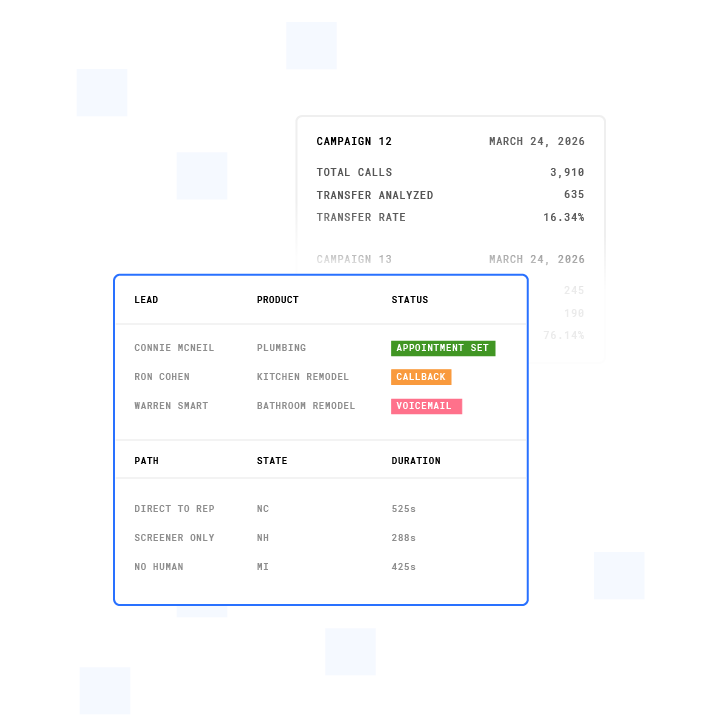
These mechanisms create trade-offs that operators manage in parallel.
- Dropped calls. Over-pacing produces live answers with no agent available. The prospect hears silence and hangs up.
- Agent fatigue. Zero idle time means agents move instantly from one intense conversation to the next. WFM Labs associates sustained occupancy above 85-90% with burnout, increased errors, and higher attrition.4
- Abandonment exposure. Every dropped call counts against the campaign’s abandonment ceiling, which becomes the practical cap on dial ratio.
The Math: Occupancy Formula and Utilization Approximation
Those three mechanisms all move the same underlying number, so it helps to define that number clearly. Most vendor explainer pages omit the formulas. This section puts them in one place.
Occupancy formula:
Occupancy = (talk time + hold time + after-call work) ÷ logged-in available time
Utilization formula:
Agent utilization = (productive time ÷ total paid time) × 100, where productive time is time handling contacts (talk + hold + wrap-up) plus available/ready time, and total paid time is the full paid shift including shrinkage such as breaks, training, and meetings.
Worked example using round numbers:
An agent logs an 8-hour shift (480 minutes) with this breakdown.
- 290 minutes handle time
- 70 minutes idle (available, waiting for calls)
- 60 minutes scheduled breaks and lunch
- 30 minutes team meeting
- 30 minutes unplanned absence
Occupancy = 290 ÷ (290 + 70) = 290 ÷ 360 = 80.6%
Utilization = (290 + 70 + 60 + 30) ÷ 480 = 450 ÷ 480 = 93.8%
The same agent and the same shift produce two very different numbers. The dialer reports a figure close to occupancy. The WFM platform reports a figure close to utilization. Both measure different things with different denominators. A commonly cited industry benchmark occupancy range for contact centers is 75–85%, with rates above 85% often considered a burnout risk. Where your campaign should sit within that range depends on team size, AHT, list quality, and the abandonment ceiling discussed below.
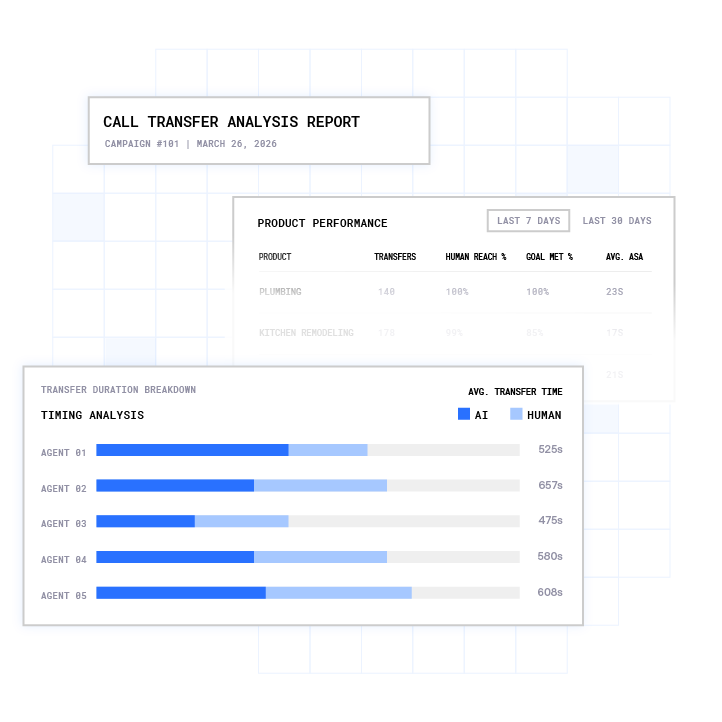
See how your occupancy and utilization numbers translate into cost per conversation.
Dial Ratio as the Control Lever
Dial ratio is the number of simultaneous outbound calls initiated per available agent slot. If five agents are in ready state and the dial ratio is 3.0, the dialer initiates 15 calls simultaneously. That single setting is the primary control lever for predictive dialer agent utilization.
The relationship between dial ratio and utilization changes with list behavior. A fresh, warm lead list may answer at 20-30%. A cold purchased list may answer at only 8-12%. At a fixed dial ratio, a lower answer rate produces fewer live conversations per agent hour and lower utilization. The dialer places the same number of calls, but fewer reach a human.
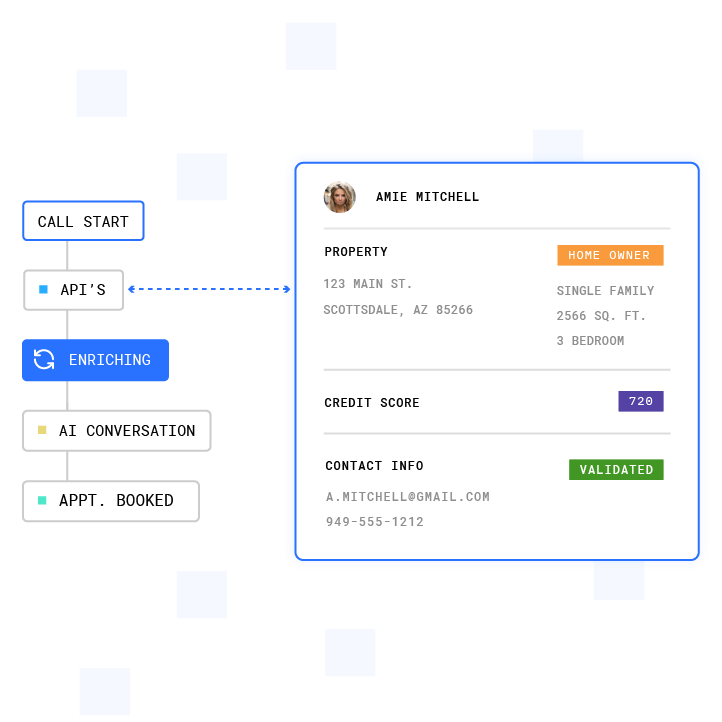
This configuration lever is what operators actually control. Raising the dial ratio lifts utilization until abandonment approaches the ceiling. Lowering it reduces abandonment but increases idle time. The algorithm manages this trade-off in real time within the constraints the operator sets.
Plura AI’s AI Predictive Dialer approaches this differently from a standard ratio-based system. Instead of applying a uniform dial ratio across a list, it decides who to call next using stateful conversion signals. Those signals include historical answer rates, prior negotiation outcomes, and prior offer-acceptance bands. The dialer focuses on which contacts, at what time, are most likely to answer and convert. This raises effective utilization at a given abandonment rate because the system spends fewer dials on contacts with low answer probability.
Plura operates as its own FCC-licensed audio bridging carrier, so voice traffic does not route through a third-party CPaaS. Branded caller ID is issued at the carrier level. Real-time DNC scrubbing, TCPA litigator screening, automated quiet hours, and immutable consent logging run inside the platform before dial to support compliance workflows.1
The Abandonment Ceiling: The Constraint That Caps Utilization
The abandonment ceiling is a hard constraint that determines how aggressively dial ratio can be pushed and how high predictive dialer agent utilization can rise.
The framework describing abandoned calls in outbound telemarketing appears in 47 U.S.C. § 227 and in FCC implementing regulations at 47 C.F.R. § 64.1200. Operators and their counsel should consult those regulations directly for campaign-specific questions.2
The structure described there includes a cap where abandoned calls are limited to 3% of calls answered by a live person, measured per campaign over a 30-day rolling period. Within that framework, a call is abandoned when a live person answers, no agent is available within 2 seconds of the completed greeting, and no automated message is transferred within that 2-second window. The 2-second clock starts when the called party finishes their opening greeting, not when the call technically connects.
This framework often prompts the question about predictive dialer legality. Predictive dialers operate in the United States and many other markets within regulated structures. Consent, calling hours, caller identification, abandoned-call handling, and do-not-call suppression all involve rules that differ by jurisdiction. Regulatory texts or qualified counsel can clarify how those rules apply to specific campaigns.
For utilization planning, the implication is straightforward. Every percentage point of dial ratio increase that pushes abandonment closer to the ceiling represents utilization gain that cannot be sustained if a variance spike occurs. Treating the 3% figure as a hard boundary preserves room for bad hours without breaching the cap.
Predictive vs. Progressive vs. Auto Dialer: Utilization and Risk Profile
The table below compares dialer types on occupancy behavior, abandonment exposure, and best-fit campaign type. Occupancy ranges are attributed to WFM Labs’ outbound contact center operations documentation. This table compares dialer types, not vendors.
| Dialer Type | Typical Occupancy Range | Abandonment Exposure | Best-Fit Campaign Type |
|---|---|---|---|
| Predictive | 75-90% occupancy | High, structurally present in pacing model | High-volume B2C, large lists, 15+ agents |
| Progressive | 55-70% occupancy | Near-zero, one call per available agent | Warm leads, compliance-sensitive, small teams |
| Auto (Power) | 60-80% occupancy | Low to moderate, fixed ratio can produce abandons | B2B sales, curated lists, 50-300 dials/day/rep |
Compare plans and rates side by side.
What a Good Predictive Dialer Agent Utilization Number Looks Like
A “good” utilization number depends on the campaign. The 75–85% occupancy benchmark noted earlier provides a reference point, but individual campaigns land above or below that range based on several variables.
- List quality. Fresh, warm leads often answer at 20-30%. Cold purchased lists often answer at 8-12%. At a fixed dial ratio, lower answer rates reduce utilization.
- Time of day. Answer rates usually peak in late morning and early evening in the prospect’s local time zone. Campaigns outside those windows see lower effective utilization at the same dial ratio.
- Average handle time. Longer calls keep agents occupied longer per contact. That reduces contacts per hour but raises talk time per hour.
- Agent count. Predictive dialing is statistically less reliable below approximately 7-10 simultaneously logged-in agents because pacing accuracy improves as the agent pool grows.
- Dial ratio. Higher ratios push utilization up until abandonment approaches the ceiling.
The central point is simple. The practical target is the highest utilization that stays under the campaign’s abandonment ceiling. A campaign running at 88% occupancy and 2.9% abandonment carries far less structural margin than one running at 82% occupancy and 0.8% abandonment, even if the first appears more productive on a single report.
A Note for Operators Under 10 Seats
Teams with fewer than 10 simultaneously logged-in agents often see limited benefit from predictive pacing. Predictive dialing is statistically less reliable below approximately 7-10 agents because the pacing algorithm’s predictions improve as the agent pool grows. With a small agent pool, variance increases and the algorithm may over-correct, causing abandoned call spikes or agent idle time.
Progressive dialing places exactly one call per available agent, producing zero abandoned calls by design. For teams under 10 seats, progressive dialing often delivers better results. Leaders see lower abandonment rates, a more predictable compliance posture, and utilization levels only modestly below what predictive would achieve on a small floor.
The break-even point often sits around 15 consistently active agents per campaign, per AL Performance’s Five9 campaign configuration documentation. Below that threshold, the utilization gain from predictive pacing can be outweighed by volatility and compliance risk.
Frequently Asked Questions
What Is the Difference Between a Predictive Dialer and an Auto Dialer?
Auto dialer is the umbrella term for any system that places calls without a person pressing digits. Predictive dialer is a specific type of auto dialer that uses statistical algorithms to dial multiple numbers simultaneously and adjust pacing based on live answer rate, average handle time, and agent availability. All predictive dialers are auto dialers, and predictive represents one subtype within that broader category.
Are Predictive Dialers Illegal?
The regulatory framework for predictive dialing and abandoned calls appears in 47 U.S.C. § 227 and 47 C.F.R. § 64.1200, as outlined in the abandonment ceiling section above.2 Those texts, along with qualified counsel, provide the authoritative guidance for specific campaigns.
How Is Agent Utilization Calculated in a Predictive Dialer?
Agent utilization = (productive time ÷ total paid time) × 100, where productive time is time handling contacts (talk + hold + wrap-up) plus available/ready time, and total paid time is the full paid shift including shrinkage such as breaks, training, and meetings. The denominator uses total paid or scheduled time, which separates utilization from occupancy and explains why the two metrics diverge for the same shift.
What Is a Good Agent Utilization Rate for Outbound?
The right utilization rate is campaign-dependent. A commonly cited industry benchmark for contact center occupancy is 75–85% for general customer service centers, per COPC research cited by ACXPA, with sector variations such as healthcare 70–80%, retail/e-commerce 80–90%, and outbound BPO 85–95%. For outbound teams using predictive dialing, the practical target is the highest utilization that remains under the campaign’s abandonment ceiling, with enough margin to absorb variance.
Predictive Dialer vs. Progressive Dialer Utilization: What Changes?
Predictive dialing often yields high utilization (75-90% occupancy) with structurally present abandonment exposure because the pacing model intentionally dials ahead of agent availability. Progressive dialing often yields moderate utilization (55-70% occupancy) with near-zero abandonment exposure because it places exactly one call per available agent. On small teams, the utilization gap narrows because predictive pacing cannot stabilize.
How to Set Dial Ratio Without Exceeding Abandonment Limits?
Start conservatively at 1.5-2 calls per available agent, then increase incrementally while watching abandonment in real time. Because the regulatory cap is measured over a rolling window, a single bad hour can push a campaign over it. Set an internal abandonment ceiling below the regulatory cap and let the dialer throttle itself to stay under that internal figure. That internal ceiling turns the regulatory number into a wall rather than a target. It also requires monitoring the rolling abandonment rate during the campaign, not only in post-campaign reports.
Model the utilization impact of different dial ratios against your current abandonment rate.
Conclusion: Target Sustainable, Compliant Utilization
Predictive dialer agent utilization and occupancy use different denominators, so their numbers diverge. Leaders need clarity on which metric each platform reports before comparing performance.
The practical goal is sustainable utilization under the abandonment ceiling described earlier. That ceiling is defined in regulation, measured per campaign over a 30-day rolling window, and it sets the outer boundary for dial ratio. List quality, agent count, AHT, and time-of-day all shift where a campaign lands under that boundary.
Plura’s AI Predictive Dialer is built around this constraint. It operates on an FCC-licensed carrier, supports compliance controls inside the platform before dial, and decides who to call next using stateful conversion signals rather than a uniform ratio. This design focuses utilization gains on contacts with higher answer and conversion probability.
Model your utilization, abandonment, and ROI with Plura’s calculator.
Compare plans and rates side by side.
1 Plura AI maintains SOC 2, HIPAA, ISO, and GDPR posture as part of its platform infrastructure. References to compliance frameworks in this article describe Plura’s platform capabilities and do not constitute a guarantee that any customer using Plura will themselves be compliant with applicable laws or standards. Customers remain solely responsible for their own regulatory obligations, certifications, consent management, recordkeeping, and the claims they make to their own end users. Consult qualified legal counsel for guidance specific to your use case.
2 This article describes regulatory frameworks at a general level and does not constitute legal advice. Laws and regulations vary by jurisdiction, change over time, and apply differently depending on facts and circumstances. Readers should consult qualified legal counsel before making compliance decisions.
3 Performance figures, customer outcomes, and industry statistics referenced in this article are drawn from cited third-party sources or Plura customer case studies. Individual results vary based on implementation, use case, industry, audience, and execution. Past or aggregate performance is not a guarantee of future results.
4 References to third-party products, services, companies, or research are made for informational and comparative purposes only. Plura AI is not affiliated with, endorsed by, or sponsored by any third party named in this article unless explicitly stated. Trademarks and product names referenced remain the property of their respective owners.
This article is provided for informational purposes only and reflects Plura AI’s understanding at the time of publication. Product capabilities, integrations, and specifications are subject to change. For the most current information, visit plura.ai.
This article was produced with the assistance of AI tools and reviewed by Plura AI prior to publication.