

Written by: Matt Beucler, CEO, Plura AI | Last updated: August 29, 2026
Key Takeaways for High-Volume Lead Teams
- Conversational AI replaces the first five minutes of manual lead qualification with instant, compliant conversations that qualify, score, and route leads in under five seconds across voice, SMS, RCS, and webchat.
- Companies responding within five minutes are 100 times more likely to connect with prospects, yet only 23% of B2B companies meet this critical window, with average response times at 47 hours.3
- The seven-step workflow covers defining qualification criteria, mapping channels with stateful memory, configuring real-time lead scoring, building routing rules, enforcing carrier-grade compliance, integrating CRM systems, and measuring revenue per conversation.
- Plura AI delivers branded caller ID, real-time DNC and TCPA compliance support, and cross-channel stateful memory that maintains conversation context when leads switch between voice, SMS, RCS, and webchat.
- Ready to transform your lead conversion? See the workflow in action on your leads and watch Plura qualify, score, and route in real time.
Why the First Five Minutes Define the Deal
Harvard Business Review research confirms the five-minute window is critical for connection rates.4 The advantage over slower responses is dramatic. A 60-second response lifts conversions by 391%.3 Most B2B teams still miss this window entirely, with average response times sitting at 47 hours.
Manual SDR queues, time-zone gaps, and channel fragmentation create these delays. Conversational AI replaces that lag with instant outreach on every lead, across every channel, at any hour. The seven-step workflow below shows exactly how to implement this approach as the first five minutes of every salesperson’s day.
Seven-Step Workflow for Conversational AI Lead Conversion
Step 1: Define Qualification Criteria and Decision Inputs
Objective: Establish the exact signals that separate a sales-ready lead from a nurture candidate before a single conversation runs.
Criteria to define:
- Ideal customer profile (ICP) attributes: industry, company size, role, geography
- BANT signals (Budget, Authority, Need, Timeline) or equivalent framework such as MEDDIC or CHAMP
- Disqualifying conditions: wrong geography, no budget, competitor employee
- Escalation triggers: pricing questions, legal or contractual requests, expressed urgency
Trade-off: Narrow criteria reduce volume but improve handoff quality, which matters more than maximizing raw lead flow. When criteria are specific, AI qualification systems can achieve higher accuracy than manual processes, with the largest gains in budget verification and authority identification. Vague criteria are the most common cause of qualification failures because the AI has no clear decision boundary.
Step 2: Map Channels and Stateful Memory Requirements
Objective: Identify which channels your leads use at each stage and confirm that conversation context carries across all of them.
Criteria to map:
- Inbound entry points: web form, phone call, SMS opt-in, RCS message
- Preferred follow-up channel by lead segment or vertical
- Channel escalation path: SMS to voice for high-intent signals, webchat to voice for complex objections
- Stateful memory requirements: what context must transfer when a lead switches channels
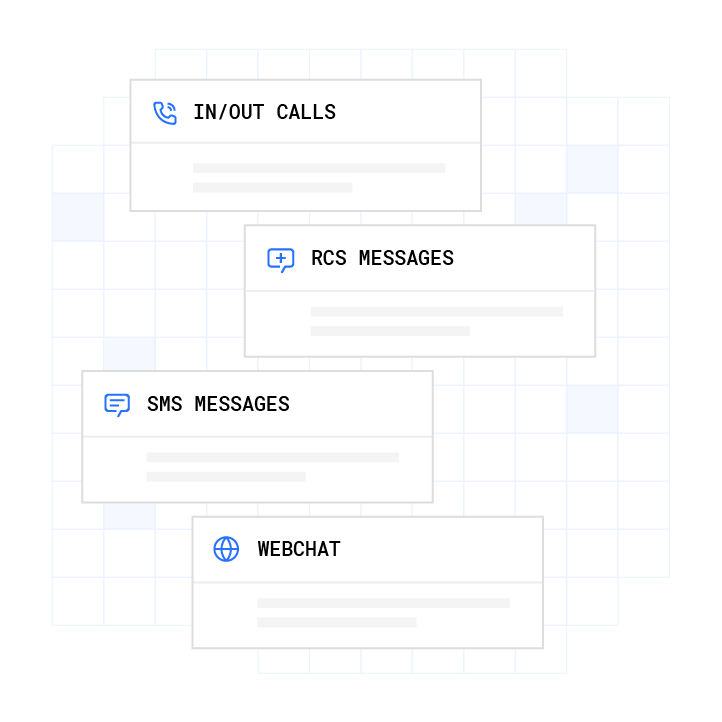
Trade-off: True omnichannel continuity requires a channel-agnostic context store. Cross-channel AI must maintain a shared conversation identity and a channel-agnostic state store that both chat and voice systems read from and write to in real time. Plura’s Stateful Conversation Database keys every interaction to a customer token across voice, AI SMS, AI RCS, and AI webchat, so an agent that texted a lead at 9 a.m. picks up the call at noon already knowing what was said.
Step 3: Configure Real-Time Lead Scoring with a Buying-Signal Table
Objective: Assign weighted scores to qualification signals during the live conversation so routing decisions stay data-driven, not subjective.
Production AI qualification systems use three composite scores: a Fit Score based on ICP alignment, an Intent Score based on expressed pain and timeline, and an Engagement Score based on call duration and sentiment.4 The table below maps common buying signals to score impact and recommended action.
| Buying Signal | Score Impact | Channel Trigger | Recommended Action |
|---|---|---|---|
| Budget confirmed for current period | +30 points | Voice, SMS, webchat | Immediate warm transfer to AE |
| Decision-maker on the line | +25 points | Voice | Escalate to senior rep or direct calendar booking |
| Timeline under 90 days | +20 points | Voice, SMS, RCS | Schedule meeting within 24-48 hours |
| Specific pain point identified | +15 points | All channels | Continue qualification, log to CRM |
| No budget or “just browsing” | -20 points | All channels | Enter 30-day reactivation nurture sequence |
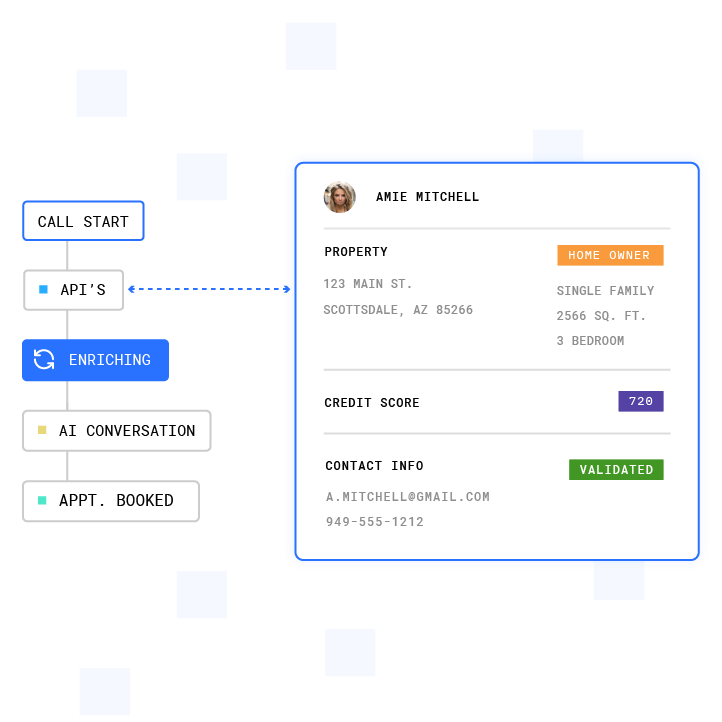
Plura’s AI Lead Intelligence scores and prioritizes leads in real time using behavioral signals, conversation context, and predictive intent modeling. A solar company using this approach increased conversion rates from 6% to 18% with the same leads and offer.3
Step 4: Build Routing and Escalation Rules
Objective: Define the exact conditions that move a lead from AI to human, and the path that handoff takes.
Criteria to configure:
- Score thresholds: leads scoring 180 or above route to immediate warm transfer, while 120-179 enter targeted nurture
- Trigger phrases: pricing questions, legal requests, competitor mentions, or expressed urgency escalate immediately
- Territory and product-line routing rules: round-robin, deal-size-based, or performance-based assignment
- Handoff object contents: active intent, key facts collected, sentiment flag, and a one-line summary for the receiving rep
Trade-off: Routing rules that are too broad send unqualified leads to reps and erode trust in the system. Rules that are too narrow create bottlenecks and leave revenue on the table. High-performing deployments achieve strong transfer rates for qualified leads via CRM integration when routing logic is built against explicit criteria rather than confidence thresholds alone.
Step 5: Enforce Carrier-Grade Compliance at Origination
Objective: Apply DNC, TCPA, and channel-specific compliance controls before any outbound contact leaves the platform.
Criteria to configure:
- Real-time DNC scrubbing against federal and state registries on every outbound contact before dial
- TCPA consent records: timestamped, immutable, and audit-ready per contact
- Quiet-hours enforcement via automatic time-zone detection
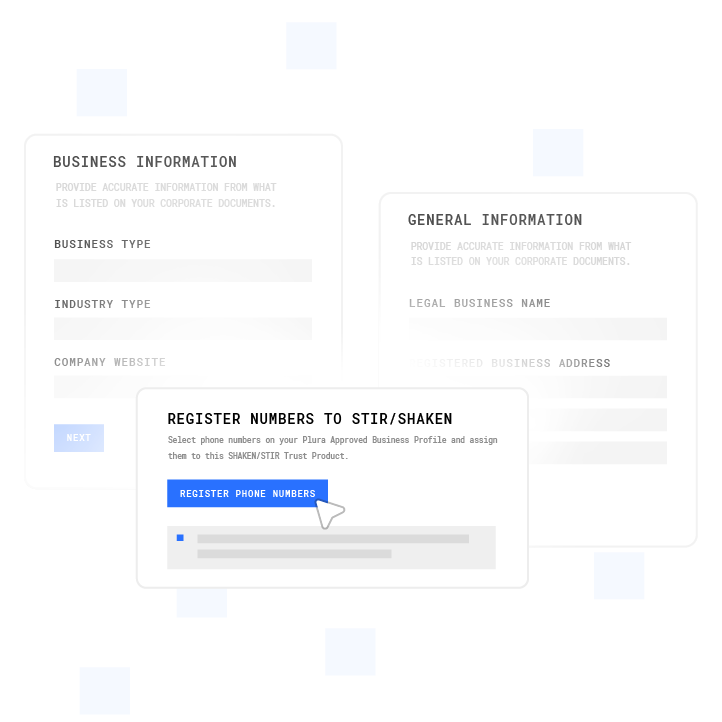
- STIR/SHAKEN (Secure Telephone Identity Revisited/Signature-based Handling of Asserted information using toKENs) caller ID authentication on every outbound voice call
- 10DLC (10-digit long code) registration for A2P SMS campaigns
Trade-off: Many Twilio-based API resellers bolt compliance controls on after the fact, which leaves gaps. Plura enforces controls at the carrier level so checks run before any call or text leaves the platform. Branded caller ID is issued directly, so calls present with the company’s name instead of “Spam Likely.” Plura supports compliance with TCPA, DNC, HIPAA, SOC 2, ISO certification, GDPR, and SHAKEN/STIR caller ID verification.1 Customers remain responsible for their own regulatory obligations and downstream compliance posture.
Step 6: Integrate CRM, Calendars, and Downstream Systems
Objective: Ensure every qualified lead, conversation transcript, and scoring field writes automatically to the systems your team already uses.
Criteria to configure:
- CRM write: create contact, update deal stage, log full transcript as activity, populate custom qualification fields
- Calendar integration: check real-time rep availability, present slots by territory or deal size, send invites to both parties
- Post-conversation triggers: SMS confirmation, RCS follow-up with rich media, or automated nurture enrollment
- Attribution: attach conversation ID to downstream revenue events for revenue-per-conversation tracking
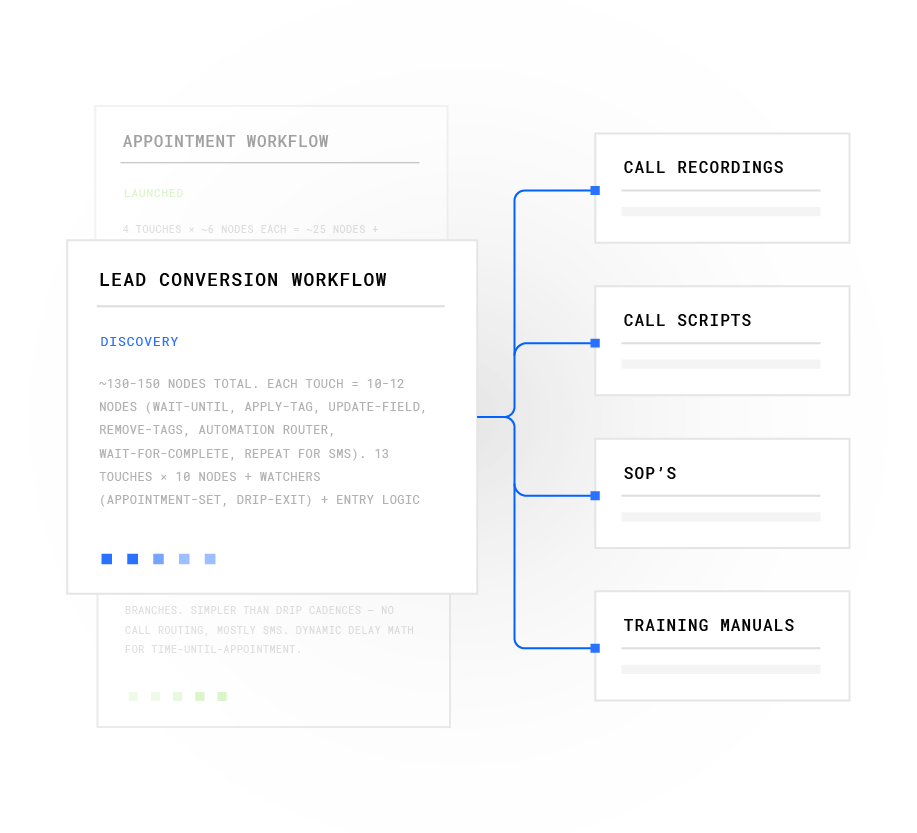
Trade-off: Successful conversational AI requires full read/write integration depth with backend systems so the AI can complete workflows rather than leaving manual follow-up steps. Plura’s integrations cover 50+ tools across CRM (HubSpot, Salesforce, Zoho), calendars (Calendly, Google Calendar, Cal.com), and payment processors, with no-code configuration via the managed workflows canvas.
Step 7: Measure Revenue Per Conversation with a Concrete Example
Objective: Replace engagement metrics with outcome-based revenue tracking tied directly to AI conversation activity.
Revenue-per-conversation calculation:
| Input | Example Value | Notes |
|---|---|---|
| Monthly AI conversations | 2,000 | All channels combined |
| Qualification rate | 38% | Salesforce State of Marketing 8th Edition median for B2B tech |
| Qualified leads per month | 760 | 2,000 × 38% |
| Lead-to-close rate | 24.6% | Salesforce State of Sales 2024 median for chatbot-sourced pipeline |
| Closed deals per month | 187 | 760 × 24.6% |
| Average deal value | $5,000 | Operator-specific input |
| Monthly revenue attributed | $935,000 | 187 × $5,000 |
| Revenue per conversation | $467.50 | $935,000 / 2,000 |
This model uses four attribution buckets: direct revenue from transactions completed in the same session, influenced revenue where the conversation accelerated the path, assisted pipeline for qualified meetings originated through AI, and retention revenue preserved through service and renewal conversations. Executives lose the ROI argument when they report activity instead of outcomes, because vanity metrics like “calls answered” describe workload but not value.
Run Your Numbers Through Plura’s ROI Calculator
The default scenario on Plura’s calculator uses a 15-agent operation at $20 per hour with standard taxes, benefits, and a 40% talk-utilization rate, costing $60,000 per month. Replacing that team with Plura at $15 per hour, 100% talk utilization, and 6 Plura agents drops the monthly cost to $14,400, with savings stacking to $547,200 over 12 months.
Measurement and Optimization for Ongoing Performance
Four metrics determine whether a conversational AI lead qualification workflow is performing or drifting:
- Speed-to-lead by channel: Time from lead submission to first AI contact. Target under 60 seconds across all channels.
- Qualification accuracy: Percentage of AI-qualified leads rated as sales-accepted by reps after handoff. Top-performing deployments can achieve high qualification accuracy.
- Handoff success rate: Percentage of escalated conversations where the rep receives a complete transcript, structured qualification fields, and a booked next step.
- Revenue per conversation: Monthly revenue attributed to AI-sourced pipeline divided by total AI conversations, tracked weekly against the baseline established before deployment.
Plura’s AI Conversation Intelligence extracts insights from voice, SMS, and webchat interactions, surfacing trends, sentiment, and performance patterns. Workflow iteration runs on a weekly cadence: review which qualification questions correlate with closed deals, adjust scoring weights, and redeploy without touching the underlying AI. Iterating scoring rules every two to four weeks based on call analytics is the recommended cadence for high-volume operators. Use the calculator referenced above to track how scoring adjustments change your revenue-per-conversation baseline over time.
Frequently Asked Questions
Deployment Timelines for Plura Conversational AI
Deployment timelines depend on conversation complexity. A straightforward inbound qualification flow typically goes live within days. A multi-step intake, such as a 25-question health-history survey for a healthcare operator, runs closer to one to two months because the workflow logic requires design, validation, and pilot testing on real calls before full go-live. Plura’s onboarding sequence covers a discovery audit, intake of existing scripts and sample calls, an overnight build of a conversation mockup, a review session, engineering build, pilot on a subset of real contacts, and full launch. Every annual contract includes a 90-day opt-out window if the deployment is not delivering measurable results.
Compliance Frameworks Supported by Plura
Plura supports the compliance frameworks outlined in Step 5, with every outbound contact checked against federal and state DNC registries before dial. Consent records are timestamped and immutable. Quiet-hours rules enforce automatically through time-zone detection. STIR/SHAKEN authentication runs on every outbound voice call. The compliance dashboard exports audit-ready reports in one click. Customers remain responsible for their own regulatory obligations, certifications, and the claims they make to their own end users. Plura provides the infrastructure, and downstream compliance posture remains the customer’s responsibility. Operators in regulated verticals should consult qualified legal counsel on their specific obligations under TCPA, HIPAA, and applicable state rules.
How Stateful Memory Works Across Voice, SMS, RCS, and Webchat
Plura’s Stateful Conversation Database keys every interaction to a customer token, which can be a phone number, email address, or contact ID. Every channel reads from and writes to the same database. When a lead texts at 9 a.m. and calls at noon, the AI voice agent already knows what was discussed, what offers were made, what objections were raised, and what qualification status was assigned. Most AI voice or SMS tools do not preserve this context across channels by default because many are built as separate products from separate vendors with separate memories. Plura’s four channels share one stateful layer by architecture, not by integration patch.
CRM and Calendar Integrations Available with Plura
Plura integrates with HubSpot, Salesforce, and Zoho on the CRM side, and with Calendly, Google Calendar, and Cal.com for meeting scheduling. The platform also connects with automation tools including Zapier, Make, and Go High Level, as well as attribution platforms, document signers, payment processors, and data enrichment providers. The full directory covers 50+ tools across 10+ categories. Every integration is configured through Plura’s no-code workflow builder, so operators can adjust routing rules, CRM field mappings, and post-conversation triggers without engineering support.
Measuring Revenue Impact Instead of Engagement Only
The distinction between engagement metrics and revenue metrics is the most common measurement failure in conversational AI deployments. Engagement metrics, such as messages handled or calls answered, describe workload. Revenue metrics describe outcomes. The four buckets that matter are direct revenue from transactions completed in the same session after an AI conversation, influenced revenue where the conversation materially changed the path but did not immediately close the sale, assisted pipeline revenue for qualified meetings or opportunities originated through AI, and retention and expansion revenue preserved or grown through service, support, and renewal conversations. Tracking requires a persistent conversation ID that follows the lead across channels and connects to downstream CRM and revenue records. Plura’s AI Conversation Intelligence surfaces these outcome-based metrics automatically, including revenue per conversation, qualified conversation rate, and handoff success rate, so operators can report pipeline lift to leadership with data rather than dashboard summaries.
Conclusion: Turning the First Five Minutes into Revenue
The first five minutes of every lead interaction now represent the highest-leverage window in the sales process. Manual qualification at 47-hour average response times leaves that window empty. Conversational AI that qualifies, scores, and route in under five seconds across voice, SMS, RCS, and webchat fills it with measurable pipeline.
The seven-step workflow above gives high-volume operators a clear sequence: define criteria, map channels and stateful memory, configure real-time scoring, build routing rules, enforce carrier-grade compliance at origination, integrate downstream systems, and measure revenue per conversation. Each step has a clear objective, decision criteria, and trade-off. The workflow is repeatable across verticals, scalable across volume, and auditable by design.
Plura provides carrier-grade infrastructure enabling branded caller ID, real-time DNC and TCPA compliance support, and cross-channel stateful memory that many solutions cannot replicate. A Marketing Director using the platform reported, “We went from spending 60% of our time trying to contact leads to spending 90% of our time closing them. AI handles the first 5 to 7 touches and only passes us prospects who are actually ready to talk.”
Compare plans and rates side by side at plura.ai/pricing.
1 Plura AI maintains SOC 2, HIPAA, ISO, and GDPR posture as part of its platform infrastructure. References to compliance frameworks in this article describe Plura’s platform capabilities and do not constitute a guarantee that any customer using Plura will themselves be compliant with applicable laws or standards. Customers remain solely responsible for their own regulatory obligations, certifications, consent management, recordkeeping, and the claims they make to their own end users. Consult qualified legal counsel for guidance specific to your use case.
2 This article describes regulatory frameworks at a general level and does not constitute legal advice. Laws and regulations vary by jurisdiction, change over time, and apply differently depending on facts and circumstances. Readers should consult qualified legal counsel before making compliance decisions.
3 Performance figures, customer outcomes, and industry statistics referenced in this article are drawn from cited third-party sources or Plura customer case studies. Individual results vary based on implementation, use case, industry, audience, and execution. Past or aggregate performance is not a guarantee of future results.
4 References to third-party products, services, companies, or research are made for informational and comparative purposes only. Plura AI is not affiliated with, endorsed by, or sponsored by any third party named in this article unless explicitly stated. Trademarks and product names referenced remain the property of their respective owners.
This article is provided for informational purposes only and reflects Plura AI’s understanding at the time of publication. Product capabilities, integrations, and specifications are subject to change. For the most current information, visit plura.ai.
This article was produced with the assistance of AI tools and reviewed by Plura AI prior to publication.