

Written by: Matt Beucler, CEO, Plura AI
Key Takeaways for Contact Center and Revenue Leaders
-
Advanced call center AI strategies in 2026 deliver 3× average ROI in 90 days when the platform owns an FCC-licensed carrier, runs on 100% U.S. infrastructure, and preserves stateful cross-channel memory across voice, SMS, RCS, and webchat.3
-
Plura AI replaces $4M–$7M traditional contact-center economics with $300K–$700K total cost of ownership while supporting compliance with TCPA, DNC, HIPAA, SOC 2, and 50+ state rule sets.
-
A 7-step implementation roadmap guides operators from assessment and workflow design through carrier integration, compliance configuration, pilot testing, measurement, and continuous iteration.5
-
Key capabilities include predictive analytics and routing, real-time sentiment analysis, agent augmentation, and omnichannel stateful memory that eliminates repeated qualification across channels.
-
Book a live demo with Plura to see how the platform delivers measurable ROI, compliance automation, and stateful omnichannel performance on your use case.
7-Step Implementation Roadmap for Advanced Call Center AI
-
Assessment. Audit current contact volume, cost per contact, agent utilization, talk-time utilization, and offshore vendor exposure. Map every workflow against the FCC NPRM (Notice of Proposed Rulemaking, CG Docket No. 26-52) and applicable state onshoring laws to identify compliance liability before selecting a platform.2
-
Workflow design. Map high-volume, repeatable conversation flows, such as intake, qualification, appointment confirmation, and follow-up cadences, as the first automation targets. Identify escalation gates where human judgment is required and define BATNA (best alternative to a negotiated agreement) guardrails for any negotiation nodes.
-
Carrier integration. Select a platform that owns its FCC-licensed audio bridging carrier. Platforms built on third-party CPaaS (Communications Platform as a Service) layers, such as Twilio-based API resellers, cannot issue branded caller ID at the carrier level, cannot enforce SHAKEN/STIR (Secure Telephone Identity Revisited/Signature-based Handling of Asserted information using toKENs) authentication natively, and inherit the carrier’s compliance posture rather than their own.4
-
Compliance configuration. Pre-load federal and state DNC registries, configure TCPA consent logging, set quiet-hours rules by time zone, and enable SHAKEN/STIR authentication on every outbound call. Confirm that all data, including voice origination, model hosting, and call recording, sits on domestic infrastructure to address FCC NPRM exposure.
-
Pilot. Deploy on a defined subset of real calls, typically 2–5% of volume, with full transcript logging and human-in-the-loop review. Measure contact rate, conversion rate, and compliance adherence against the baseline before scaling.
-
Measurement. Track cost per completed conversation, talk-time utilization, speed-to-lead, pipeline growth, and audit-export completeness. Contacting a lead within 5 minutes makes them up to 100× more likely to connect; a 60-second response lifts conversions by 391%.
-
Iteration. Treat every conversation workflow as a CRO (conversion rate optimization) test. Review objection patterns, escalation triggers, and conversion gaps weekly. Deploy workflow updates without redeploying the underlying AI model.
Book a live demo with Plura to walk through this roadmap against your current contact-center economics.
Predictive Analytics and Routing for Faster Resolution
Legacy skill-based queues route calls based on agent availability and a single declared skill tag. Advanced AI routing in 2026 incorporates real-time intent signals, sentiment scores, interaction history, and enrichment data from 30+ sources, matching each contact to the resource most likely to convert or resolve on the first attempt.
Organizations using predictive analytics in contact centers can achieve improvements in workforce efficiency and reduced wait times through more accurate demand forecasting. The table below contrasts legacy skill-based routing with Plura’s AI predictive routing across routing inputs, efficiency, wait times, and cross-channel context so operators can see where stateful memory creates measurable gains.
|
Attribute |
Legacy Skill-Based Routing |
AI Predictive Routing (Plura) |
|---|---|---|
|
Routing inputs |
Agent availability, single skill tag |
Intent, sentiment, interaction history, enrichment data from 30+ sources |
|
Workforce efficiency improvement |
Baseline |
Significant gains |
|
Average wait-time reduction |
Baseline |
Significant reduction |
|
Cross-channel context |
None, channel-siloed |
Full stateful memory across voice, SMS, RCS, webchat |
Plura’s AI Predictive Dialer uses stateful conversion signals, including historical answer rates, prior negotiation outcomes, and prior offer-acceptance bands, to decide who to call next. Calls originate on Plura’s own FCC-licensed carrier with branded caller ID and SHAKEN/STIR authentication, not on a rented CPaaS layer.
Real-Time Sentiment Analysis and Agent Augmentation
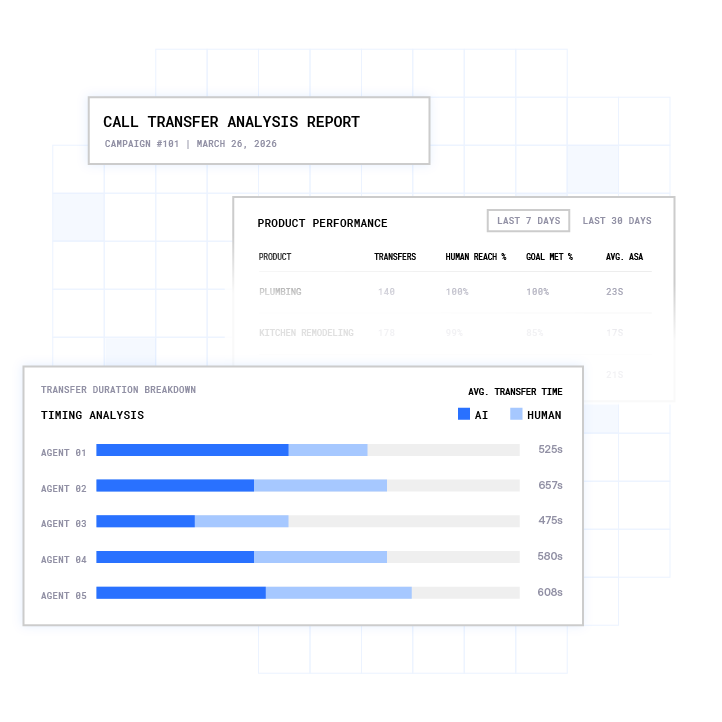
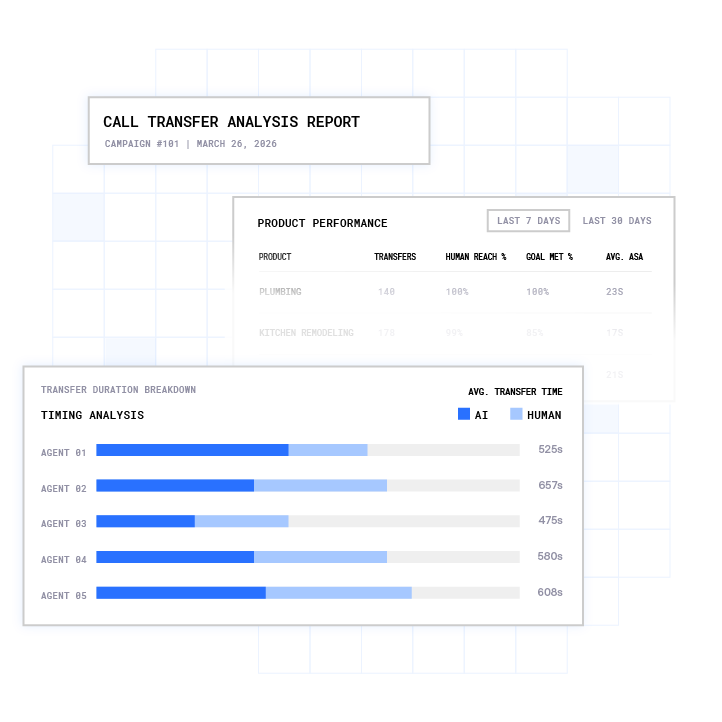
In Plura’s architecture, sentiment detection operates as a first-class layer of the conversation workflow. When a contact’s language or tone crosses a defined frustration threshold, the workflow triggers a warm transfer to a U.S.-based agent, with the full conversation transcript and stateful context already loaded in the Unified Inbox. The agent does not start from zero.
Agent augmentation use cases in 2026 include live transcription that eliminates after-call note-taking (saving agents 2–3 minutes of after-call work per interaction), next-best-action suggestions surfaced during the call, root-cause analysis that identifies which objection patterns recur across a campaign, and automated conversation summaries pushed to CRM records. AI-driven virtual assistants can help reduce average handle times and training requirements.
Plura’s AI Conversation Intelligence layer analyzes every interaction across all four channels to surface what scripts close, what objections recur, and what conversion paths win. The platform then feeds these findings back into the workflow tuning loop automatically.
Omnichannel Stateful Memory Across Voice, SMS, RCS, and Webchat
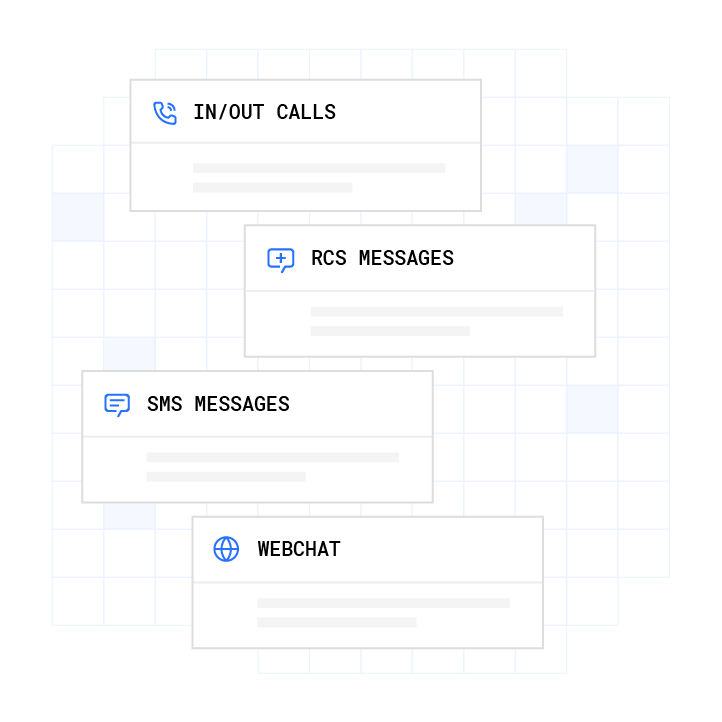
Modern consumers regularly use as many as 9 discrete communication channels, and omnichannel workflow automation maintains a unified view of customer interactions to enable seamless transitions without requiring customers to repeat information. Many platforms claim omnichannel delivery but operate channel-siloed databases underneath, so the SMS agent and the voice agent function as different products with different memories.
Plura’s AI Voice, AI SMS, AI RCS, and AI Webchat all share a single Stateful Conversation Database. Every interaction is tokenized to the customer by phone number, email, or ID. When an AI agent that texted a lead at 9 a.m. places a call at noon, it already knows what was offered, what was declined, and what is still open. No re-introduction. No repeated qualification.
Additional infrastructure advantages matter for contact rates and trust. Plura issues branded caller ID directly through its FCC-licensed carrier, so calls present with the company’s name rather than “Spam Likely.” The platform communicates with Apple’s iOS 26 call-screening layer, converting screened calls into pickups. Under-5-second response time on every lead, 24/7, across all four channels simultaneously, contrasts with an industry standard of 47+ hours for first contact.
Compliance Automation Under FCC NPRM and State Onshoring Laws
The FCC NPRM (CG Docket No. 26-52), published April 23, 2026, describes a framework that caps offshore customer-service calls at 30% and restricts offshore handling of sensitive consumer data, including passwords, multi-factor authentication, Social Security numbers, banking, and card data, for providers of telecommunications, CMRS (Commercial Mobile Radio Service), interconnected VoIP, cable, and DBS services. The proposal also describes disclosure at the start of each call handled by a foreign call center and tracking of English proficiency, offshore call percentages, and transfer metrics.
Companion federal legislation includes the Keep Call Centers in America Act (S.2495) and the Foreign Robocall Elimination Act (S.2666). At the state level, New York’s Call Center Jobs Act carries penalties up to $10,000 per day, and New Jersey, Connecticut, Missouri, and Florida have enacted or proposed parallel restrictions on offshore handling of medical, financial, and consumer data.
Plura’s compliance engine operates as a first-class layer of the platform, not a bolt-on. Every outbound contact is checked against federal and state DNC registries in real time before dial. Consent records are timestamped, immutable, and audit-ready. Quiet-hours rules apply automatically through time-zone detection. The compliance dashboard exports audit-ready reports in one click. Plura supports customer compliance with SOC 2, HIPAA, ISO certification, GDPR, SHAKEN/STIR caller ID verification, TCPA compliance, and DNC compliance.1 Customers remain responsible for their own regulatory obligations and should consult qualified counsel on their specific compliance posture.
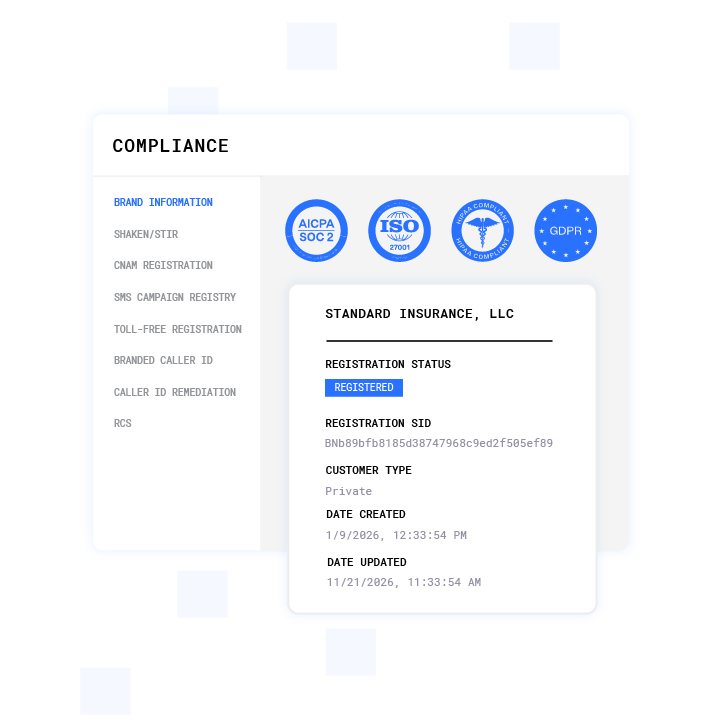
Plura runs on 100% U.S. infrastructure by architecture. Voice origination, model hosting, data storage, and call recording all sit on domestic infrastructure.
The 80/20 Rule in Call Centers and How AI Changes It
That reallocation of human capacity is possible because of an underlying structural imbalance in traditional contact centers. Roughly 80% of inbound volume consists of routine, repeatable interactions, such as appointment confirmations, status checks, basic qualification, and payment reminders, handled by agents whose time and cost are identical to agents handling the 20% of complex, high-value cases. The 80/20 imbalance means operators pay senior-agent economics for junior-agent work at scale.
In operator deployments, Plura handles the routine 80%, including qualification, follow-up, intake, and confirmation, at a fraction of the cost per completed conversation, versus offshore call centers. Human agents receive only the escalated 20%, already contextualized and qualified, with the full conversation history in the Unified Inbox.
Which Jobs Survive AI in the Contact Center?
The roles that survive and grow are those requiring judgment that cannot be encoded into a workflow node. Four categories are durable in 2026 and beyond.
Complex judgment and negotiation. Cases involving ambiguous facts, multi-party disputes, or high-stakes outcomes where a wrong decision carries legal or financial consequence. AI flags these and routes them, and humans resolve them.
Compliance oversight. In regulated verticals such as healthcare, insurance, and financial services, AI can handle routine tasks but human judgment remains necessary for ambiguous or case-specific compliance decisions, as AI can flag compliance risks but cannot exercise the nuanced judgment required. Compliance officers, QA analysts, and legal reviewers who audit AI outputs are in demand, not at risk.
Escalation handling. Frustrated customers, sensitive disclosures, and high-value retention conversations require human empathy and authority. AI warm-transfers these with full context, and the human closes them.
Conversation engineering and AI oversight. Data literacy, QA and debugging of AI outputs, and cross-functional communication are rising in value. Operators need people who can read conversation transcripts, identify objection patterns, and tune workflow logic, a role that did not exist in legacy call centers.
Big 4 and Big 7 AI Agents: Practical Mapping for Operators
The “Big 4” and “Big 7” AI agent frameworks describe capability tiers emerging in enterprise AI deployments. These tiers range from single-task automation agents that answer FAQs or book appointments through multi-step orchestration agents that run full intake interviews and execute negotiation flows, to agentic systems that manage entire customer relationship lifecycles autonomously. Many organizations are using or planning to deploy AI agents in customer service, which signals rapid adoption of agentic AI capable of handling entire customer relationship lifecycles.
For operators, the practical mapping stays straightforward. Plura’s four channels, AI Voice, AI SMS, AI RCS, and AI Webchat, each represent a distinct agent surface. Layered on top are two intelligence layers: AI Lead Intelligence, which provides real-time enrichment from 30+ data sources during the live conversation, and AI Conversation Intelligence, which performs post-interaction pattern analysis and workflow tuning. Together, these six capability layers cover the full spectrum from single-task automation through multi-step agentic orchestration without requiring the operator to integrate separate vendors for each tier.
In 2026, generative and conversational AI enables advanced AI agents to handle customer inquiries end-to-end using real-time language understanding, predictive insights, root-cause analysis, and sentiment-aware escalation. Plura’s Workflows feature, a no-code visual canvas, allows operators to design these multi-step conversation pathways without engineering, with BATNA guardrails on every negotiation node and hard escalation rules for sensitive disclosures.
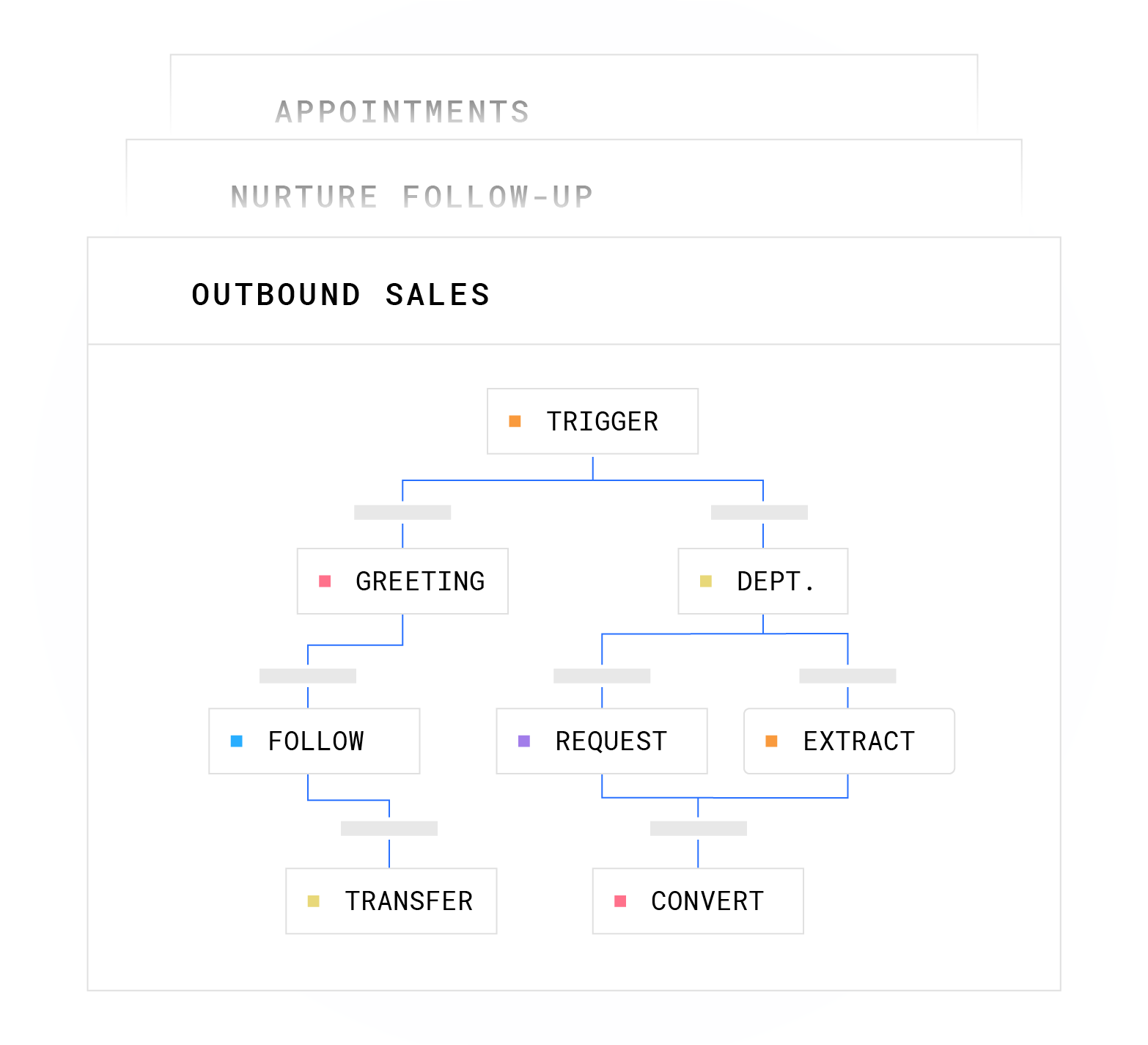
Schedule a demo to see all four channels and both intelligence layers operating on a single stateful database.
Legacy vs. Advanced AI Strategies: Side-by-Side Comparison
Legacy contact-center models, whether offshore BPO or onshore human, share a structural problem: cost scales linearly with volume. Every additional conversation requires a proportional increase in headcount, training, and infrastructure. Advanced AI strategies break that relationship.
For a 100-seat contact center, traditional operations cost $4M–$7M annually, while AI-powered communications using platforms like Plura cost $300K–$700K. A 50-seat offshore team costs approximately $1.2M annually fully loaded in the insurance industry, while Plura handling equivalent volume costs $180K–$300K annually with higher quality scores and zero turnover.
The table below compares offshore BPO, onshore human teams, and Plura’s advanced AI across total cost of ownership, speed to first contact, FCC NPRM posture, and cross-channel memory so leaders can see where each model creates risk or advantage.
|
Attribute |
Legacy Offshore BPO |
Legacy Onshore Human |
Advanced AI (Plura) |
|---|---|---|---|
|
Annual TCO (100-seat equivalent) |
|||
|
Speed to first contact |
Hours, time-zone gaps |
||
|
FCC NPRM compliance posture |
High exposure, offshore data handling |
Low exposure, domestic |
Zero exposure, 100% U.S. infrastructure by architecture |
|
Cross-channel memory |
None, channel-siloed |
CRM-dependent, manual |
Stateful across voice, SMS, RCS, webchat by default |
Twilio-based API resellers occupy a fourth category not shown above. They carry the speed and memory advantages of AI but inherit a third-party carrier’s compliance posture, cannot issue branded caller ID natively, and face the same FCC NPRM foreign-infrastructure exposure as offshore BPOs if their model hosting or data storage sits outside the U.S.
No-Show Reduction and Healthcare-Specific Results
Healthcare operators face a compounding cost problem. No-shows consume scheduled capacity, trigger rebooking labor, and reduce revenue per available slot. AI-driven appointment confirmation and reminder workflows address this directly. Plura achieves up to 40% improvement in no-show rates for healthcare operators through automated confirmation sequences across voice, SMS, and RCS, with each channel inheriting the full stateful context of prior patient interactions.
Healthcare deployments on Plura inherit HIPAA-aligned encryption, sensitive-data redaction, and audit-ready logging by default. The platform supports 25-question health-history intakes that route only qualified patients to scheduling, and all protected health information (PHI) handling occurs on 100% U.S. infrastructure. Customers remain responsible for their own HIPAA compliance obligations and should consult qualified counsel.
Plura AI ROI Math and Total Cost of Ownership
The default scenario on Plura’s ROI calculator describes a 15-agent operation at $20/hour with standard taxes, benefits, and commissions, and a 40% talk-utilization rate typical of human contact-center work, which costs $60,000/month. Replacing that team with Plura at $15/hour, 100% talk utilization, and 6 Plura agents doing the work of 15 humans drops the monthly cost to $14,400. Savings stack to $45,600 in the first 30 days, $547,200 over 12 months, and $2,736,000 over 60 months.
The 3× average ROI in 90 days comes from three compounding factors: talk-utilization improvement from 40% human to 100% AI, elimination of taxes, benefits, and commissions overhead, and the speed-to-lead conversion lift mentioned earlier, 391% from sub-60-second response. At scale, solar and home services companies using AI agents with property data, energy usage estimates, and home valuations achieved 2×–3× improvements in appointment set rates.
Plura’s three pricing tiers, Multi ($5,000/month), Agency ($7,500/month), and Enterprise (custom), are on annual contracts billed monthly, with a 90-day opt-out window. Agent build fees run $2,500–$2,750 per agent. Full details at plura.ai/pricing.
Frequently Asked Questions
What does the FCC NPRM mean for operators currently using offshore call centers?
The FCC’s Notice of Proposed Rulemaking (CG Docket No. 26-52), published April 23, 2026, describes limits on offshore customer-service calls at 30% of total volume for covered providers and restrictions on offshore handling of sensitive consumer data including passwords, Social Security numbers, banking credentials, and card data. It also describes disclosure at the start of each offshore-handled call and tracking for English proficiency, offshore call percentages, and transfer metrics. Companion federal legislation, the Keep Call Centers in America Act (S.2495) and the Foreign Robocall Elimination Act (S.2666), extends the regulatory perimeter. State laws in New York, New Jersey, Connecticut, Missouri, and Florida already describe restrictions on offshore handling of medical, financial, and consumer data. Operators should consult qualified legal counsel to assess their specific exposure under these frameworks. Plura supports customer compliance by running on 100% U.S. infrastructure by architecture, so voice origination, model hosting, data storage, and call recording all sit on domestic infrastructure.
How does stateful omnichannel AI memory work in practice?
Stateful omnichannel memory means every customer interaction, regardless of channel, is written to and read from a single shared database keyed to the customer’s phone number, email, or ID. When a customer receives an SMS at 9 a.m. and a voice call at noon, the AI agent on the call already knows what was offered in the text, what the customer said in response, and what is still unresolved. No re-introduction. No repeated qualification. Plura’s Stateful Conversation Database is the architectural backbone underneath AI Voice, AI SMS, AI RCS, and AI Webchat. Every pricing offer made, objection raised, qualification status assigned, and sensitive-data redaction applied is persisted in one place and available to every channel in real time. The Unified Inbox gives human agents the same view, so when an escalation triggers, the agent picks up exactly where the AI left off.
Which contact center roles are most affected by AI deployment, and how should operators plan for the transition?
The roles most affected are those handling high-volume, repeatable interactions, including inbound qualification, outbound follow-up, appointment confirmation, and basic intake. AI handles these at scale, at 100% talk utilization, 24/7. The roles that grow in value are compliance oversight, escalation handling, conversation engineering, and AI output QA, functions that require judgment, data literacy, and cross-functional communication. Operators who have deployed Plura report that marketing and sales teams reallocate 20–30% of capacity from manual outreach to strategy and creative within the first 90 days. The recommended transition approach identifies the high-volume repeatable workflows first, pilots AI on those, measures contact rate and conversion against baseline, and uses the freed human capacity for complex cases and oversight rather than eliminating headcount before the data supports it.
What compliance frameworks does Plura support, and who is responsible for regulatory obligations?
Plura supports customer compliance with the frameworks detailed in the Compliance Automation section above: SOC 2, HIPAA, ISO, GDPR, SHAKEN/STIR, TCPA, and DNC. Every outbound contact is checked against federal and state DNC registries in real time before dial. Consent records are timestamped, immutable, and audit-ready. Quiet-hours rules apply automatically through time-zone detection. HIPAA-aligned encryption, access controls, and audit logging cover protected health information across all four channels. The compliance dashboard exports audit-ready reports in one click. Customers are responsible for their own certifications, regulatory obligations, and the claims they make to their own end users. Plura provides the infrastructure, and compliance posture downstream of that remains the customer’s responsibility. Operators should consult qualified legal counsel on their specific obligations under TCPA, HIPAA, state onshoring laws, and the FCC NPRM.
Conclusion and Next Steps for 2026 Operators
The 2026 operator playbook for advanced call center AI has three non-negotiable requirements: a platform that owns its FCC-licensed carrier, stateful cross-channel memory that preserves context across voice, SMS, RCS, and webchat, and 100% U.S. infrastructure by architecture. Without all three, the economics do not close and the regulatory exposure does not materially change.
Plura delivers 3× average ROI in 90 days by breaking the linear cost-scaling model that defines traditional contact centers. The platform contacts leads in under 5 seconds and supports compliance with SOC 2, HIPAA, ISO certification, GDPR, SHAKEN/STIR caller ID verification, TCPA compliance, and DNC compliance, on an architecture built by people with 28 collective years inside call centers, telecom infrastructure, and software development.
Run your numbers at plura.ai/calculator to model your specific cost and ROI scenario. Compare plans and capability tiers at plura.ai/pricing.
See Plura in action to view the full stack, including carrier, stateful memory, compliance engine, and all four channels, operating on your use case.
1 Plura AI maintains SOC 2, HIPAA, ISO, and GDPR posture as part of its platform infrastructure. References to compliance frameworks in this article describe Plura’s platform capabilities and do not constitute a guarantee that any customer using Plura will themselves be compliant with applicable laws or standards. Customers remain solely responsible for their own regulatory obligations, certifications, consent management, recordkeeping, and the claims they make to their own end users. Consult qualified legal counsel for guidance specific to your use case.
2 This article describes regulatory frameworks at a general level and does not constitute legal advice. Laws and regulations vary by jurisdiction, change over time, and apply differently depending on facts and circumstances. Readers should consult qualified legal counsel before making compliance decisions.
3 Performance figures, customer outcomes, and industry statistics referenced in this article are drawn from cited third-party sources or Plura customer case studies. Individual results vary based on implementation, use case, industry, audience, and execution. Past or aggregate performance is not a guarantee of future results.
4 References to third-party products, services, companies, or research are made for informational and comparative purposes only. Plura AI is not affiliated with, endorsed by, or sponsored by any third party named in this article unless explicitly stated. Trademarks and product names referenced remain the property of their respective owners.
5 This article contains forward-looking statements regarding industry trends, technology adoption, and future capabilities. These statements reflect current expectations and are subject to change. Plura AI undertakes no obligation to update forward-looking statements except as required.
This article is provided for informational purposes only and reflects Plura AI’s understanding at the time of publication. Product capabilities, integrations, and specifications are subject to change. For the most current information, visit plura.ai.
This article was produced with the assistance of AI tools and reviewed by Plura AI prior to publication.