
Written by: Matt Beucler, CEO, Plura AI
Key Takeaways for High-Volume Teams
- High-volume operators with 500 or more daily interactions face unpredictable TCO when they rely on per-minute SMB AI answering tools.
- Third-party carrier dependency blocks carrier-level branded caller ID, real-time DNC enforcement, and introduces FCC offshore infrastructure exposure.
- Single-channel AI tools force customers to repeat context at every handoff, which erodes conversion rates as volume grows.
- Plura AI owns its FCC-licensed carrier, supports compliance at origination, and maintains stateful memory across voice, SMS, RCS, and webchat.
- Teams comparing AI answering services for scale, compliance posture, and predictable cost should start a conversation with Plura AI and model their 90-day ROI.
The Cost Problem for High-Volume AI Answering
SMB-oriented AI answering tools are priced for low-volume use. Dialzara’s Business Lite tier starts at $29 per month for 60 minutes, with overage at $0.48 per minute. Smith.ai offers tiers with per-call pricing and custom enterprise pricing for higher volumes.4 At 500 daily interactions, monthly volume can reach roughly 15,000 calls, and no published SMB plan covers that volume at a predictable rate.
High-volume deployments on developer platforms can cost several hundred to a few thousand dollars per month all-in, while enterprise call-center scale ranges higher. At 15,000 monthly calls, overage fees compound rapidly. Hidden fees including overage minutes, extra phone numbers, SMS charges, outbound call premiums, and HIPAA BAA tiers can substantially increase headline pricing. These compounding costs create unpredictable total cost of ownership (TCO) that scales against the operator, not with them.
Run your numbers through Plura’s calculator to check your 90-day ROI in real time.
Market Pricing Benchmarks for AI Answering
Pricing for AI answering services varies by deployment model and volume tier. The ranges below reflect published market data as of August 2026.
Entry-level SMB tools run $29 to $299 per month with minute or caller caps. Custom-built AI receptionist systems cost $3,000 to $10,000 one-time plus $100 to $300 per month in platform and call costs. Enterprise custom and managed-build pricing for AI voice agents typically starts in the six figures annually ($100k+) and can reach several hundred thousand dollars for high-volume or regulated operations.
At the enterprise end, Plura AI uses a TCO model that replaces the traditional contact-center cost structure. A 15-agent human operation at $20 per hour with standard taxes, benefits, and commissions at 40% talk utilization costs $60,000 per month. Six Plura agents running the same 2,400 hours at 100% talk utilization cost $14,400 per month, which produces a 30-day savings of $45,600.3 At scale, Plura’s TCO runs $300,000 to $700,000 per year, replacing traditional contact-center economics of $4 million to $7 million.
Why Plura’s Carrier-Owned Economics Change the Math
Most AI answering tools operate as API wrappers on top of third-party CPaaS (Communications Platform as a Service) providers. They pay a margin to the underlying carrier and pass that cost to the customer through per-minute rates. Synthflow, for example, depends on Twilio and operates as a software layer without a carrier license.4
Plura owns its FCC-licensed audio bridging carrier. Voice originates on Plura’s domestic infrastructure, which produces lower per-minute economics, direct issuance of branded caller ID, and compliance controls supported at the carrier level. Plura voice agents cost $0.35 to $0.85 per completed conversation including intelligence, versus $5 to $15 fully loaded for offshore call centers. This structure delivers cost that grows far more slowly than volume.
Compliance Risk from API-Wrapper Carrier Dependency
Third-party carrier dependency creates three compounding risks for high-volume operators.
First, branded caller ID cannot be issued at the carrier level when the platform does not own the carrier. Calls present with generic numbers or “Spam Likely” labels, which suppresses connect rates before the conversation begins.
Second, real-time DNC scrubbing often sits as an add-on instead of enforcing at origination. Active telemarketing campaigns must scrub outbound lists against the National DNC registry at least every 31 days, with state-administered DNC programs potentially imposing stricter cadence requirements.2 A platform that cannot support this at the carrier level increases operational exposure, so operators should review their approach with qualified counsel.
Third, offshore infrastructure exposure is a growing liability. The FCC’s Notice of Proposed Rulemaking (NPRM, CG Docket No. 26-52) describes potential caps on offshore customer-service calls and potential limits on offshore handling of sensitive consumer data. Any AI tool with foreign infrastructure dependencies inherits that exposure. Operators should consult qualified counsel regarding their specific obligations under applicable regulations.
How Plura’s FCC-Licensed Carrier Stack Supports Compliance
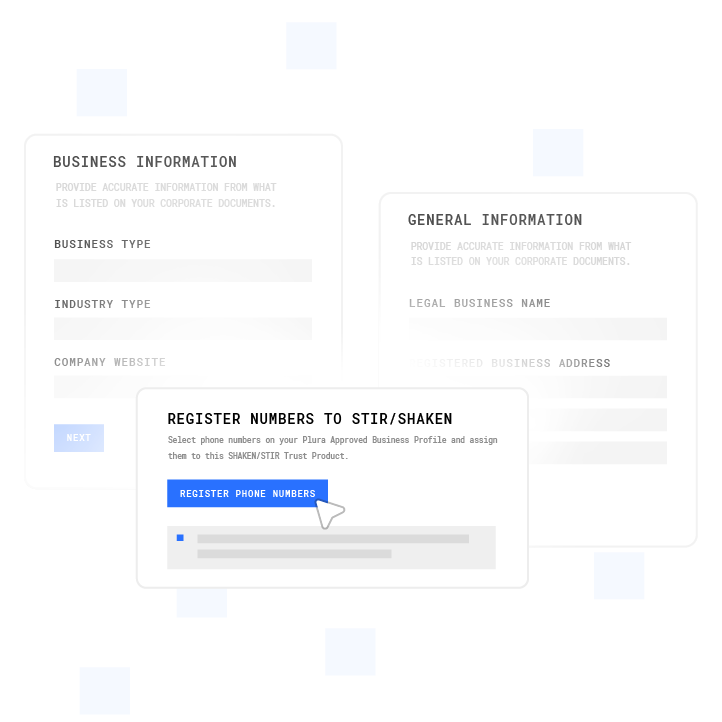
Plura’s compliance engine functions as a core layer of the platform and applies protections across the call lifecycle. Before any outbound contact is dialed, it is checked against federal and state DNC registries in real time. Once a call is authorized, consent records are timestamped and stored as immutable for audit purposes. During the call window, quiet-hours rules apply automatically through time-zone detection. At the moment of connection, STIR/SHAKEN (Secure Telephone Identity Revisited / Signature-based Handling of Asserted information using toKENs) caller ID authentication runs on every outbound call.
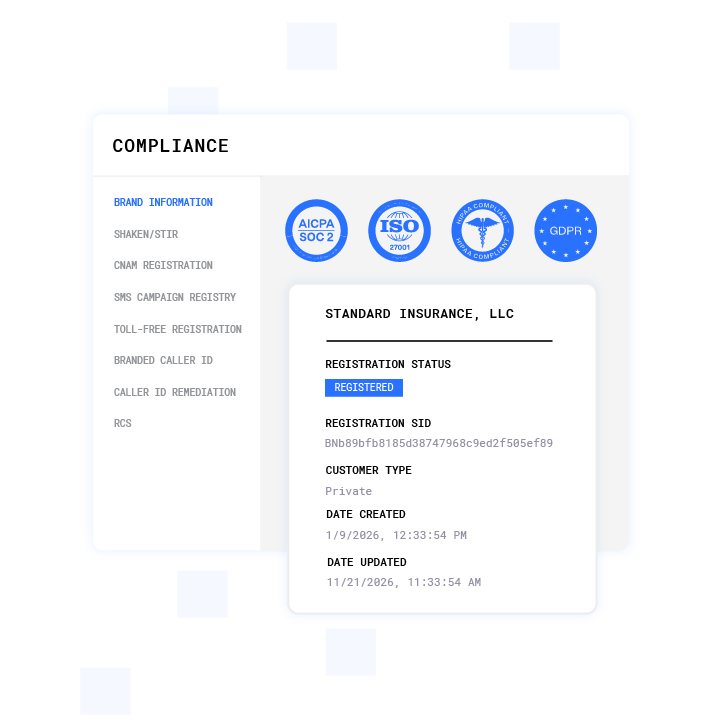
Plura supports HIPAA, SOC 2, and ISO certification, and integrates with The Blacklist Alliance’s TCPA Litigation Firewall for real-time Do Not Call scrubbing and litigation protection.1 All infrastructure is 100% U.S.-based by architecture, not by promise, which removes offshore infrastructure from the design under the FCC NPRM and companion state laws in New York, New Jersey, Connecticut, Missouri, and Florida.
Use the calculator to see your 90-day ROI benchmark.
Customer Experience Gaps from Single-Channel AI
Most AI answering tools operate on a single channel. A customer who receives an AI SMS at 9 a.m. and then calls at noon reaches a voice agent with no memory of the earlier exchange. The customer repeats their situation. The agent re-qualifies from scratch. Context disappears at every channel boundary.
Eighty-three percent of consumers report they still have to repeat themselves at least sometimes after an AI-to-human transfer. At 500 or more daily interactions, that friction compounds into measurable conversion loss and customer dissatisfaction.
Plura’s Stateful Conversation Database Across Channels
Plura’s AI voice agent, AI SMS, AI RCS (Rich Communication Services), and AI webchat all share a single Stateful Conversation Database. Every interaction is keyed to a customer token such as phone number, email, or ID and stored in one place. Plura provides omnichannel support for voice, SMS, webchat, and RCS within a unified stateful inbox that maintains full conversation history.
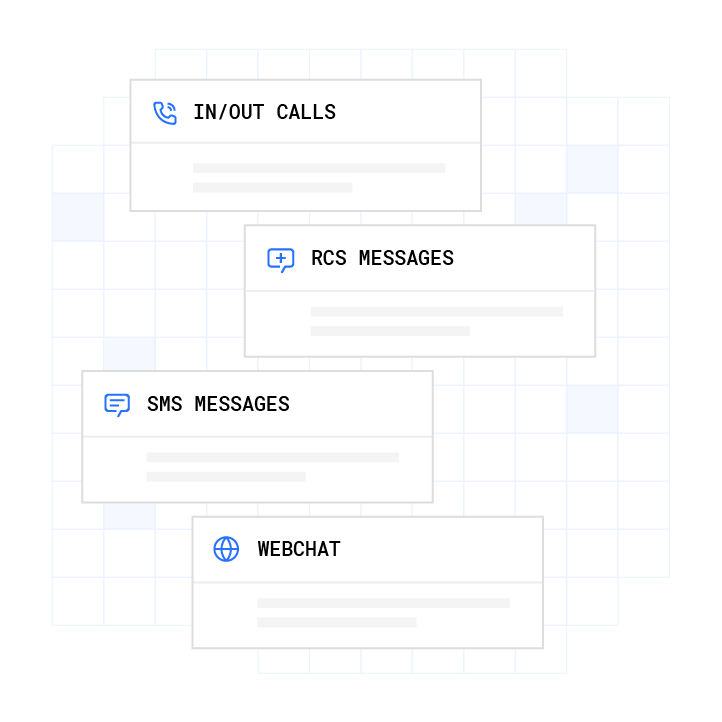
A customer who texted at 9 a.m. is recognized as the same customer when the call comes at noon. The agent already knows what was said, what was offered, and what remains open. The customer does not repeat details or re-qualify. Context stays continuous across every channel.
Spam Labeling Pressure on Outbound Connect Rates
Outbound connect rates have declined sharply as carrier spam-detection systems and smartphone screening intercept unfamiliar numbers. California’s Assembly Bill 2905, effective January 1, 2025, requires disclosure of AI-generated voice use during outbound calls.2 Apple’s iOS 26 call-screening layer intercepts unfamiliar numbers before they ring through, which further suppresses outbound effectiveness.
Platforms that rent from third-party carriers inherit the carrier’s caller ID reputation, not their own. They cannot remediate spam labels at the source because they do not control the source.
Carrier-Issued Branded Caller ID with Plura
Because Plura owns its carrier infrastructure, it can issue branded caller ID directly through its FCC-licensed carrier. Calls present with the company’s name and the reason for the call rather than an unfamiliar number. STIR/SHAKEN authentication runs on every outbound call, and the destination carrier uses that signal to verify legitimate origination. Plura’s AI also communicates with Apple’s iOS 26 call-screening layer, which converts many screened calls into live pickups rather than voicemails.
This approach addresses a carrier-level problem at the carrier layer. API wrappers cannot replicate that control.
Use the calculator to quantify the connect-rate impact on your 90-day ROI.
Where SMB AI Answering Tools Break at Scale
The 500-daily-interaction threshold is where SMB AI answering tools structurally break. The failure modes are consistent across tool categories.
- Per-minute and per-caller pricing models trigger overages that make TCO unpredictable at volume.
- Third-party carrier dependency prevents branded caller ID issuance and real-time DNC enforcement at origination.
- Single-channel memory forces customers to repeat context at every channel transition.
- No U.S. infrastructure guarantee creates regulatory exposure under the FCC NPRM and state onshoring laws.
- Build-and-forget deployment models leave operators managing a black box with no ongoing conversation engineering.
Voice support adoption lags because most available tools are not designed for the volume, compliance, and infrastructure requirements that enterprise operators manage every day.
Deployment Models at Scale: Neutral Comparison
| Criteria | SMB AI Answering Tools | Enterprise CCaaS Platforms | Plura AI |
|---|---|---|---|
| Infrastructure Ownership | Third-party CPaaS (e.g., Twilio), no carrier license | Cloud-native, vendor-managed, no FCC carrier license | FCC-licensed carrier, 100% U.S. infrastructure |
| Channel Support | Typically voice-only or voice plus basic SMS | Omnichannel, separate memory per channel common | Voice, SMS, RCS, webchat with unified stateful memory |
| Compliance Controls | Bolted-on, HIPAA BAA often a paid tier upgrade | SOC 2 and HIPAA available, DNC scrubbing varies by vendor | Real-time DNC scrubbing, TCPA Litigation Firewall, SOC 2, HIPAA, ISO certification |
| Scalability at 500+ Daily Interactions | Custom enterprise pricing required, overage exposure high | Scales by agent seat, per-seat pricing increases with volume | Scales instantly to 10x volume overnight, per-conversation pricing |
Headline Price vs. True Cost for “Cheapest” AI Answering
The lowest published headline prices belong to tools like Allo at $18 per month billed annually.4 At low volume, that price reflects actual spend. At 500 or more daily interactions, that model does not hold.
Businesses using Smith.ai AI mode at moderate volumes can face base costs plus substantial overage fees that raise the monthly total significantly. At 15,000 monthly calls, that overage math becomes untenable. High-volume or regulated operations using AI phone agents can reach thousands of dollars per month in total spend when all components including telephony, AI processing, and compliance are included.
The cheapest AI answering service for a high-volume operator is the one with the lowest TCO at scale, not the lowest headline price. Plura’s 12-month ROI on the 15-agent equivalent operation described earlier is $547,200,3 driven by 100% talk utilization, no overage exposure, and carrier-owned economics that do not scale against the operator.
Why High-Volume Teams Evaluate Plura First
For teams running 500 or more daily interactions, evaluation criteria differ from SMB buyers. Leaders focus on whether the platform owns its carrier, supports compliance at origination, maintains stateful memory across every channel, runs on 100% U.S. infrastructure, and delivers predictable TCO at volume.
Plura meets all five criteria. Plura deployment typically takes 2 to 4 weeks from contract to live AI conversations across all channels. Every annual contract includes a 90-day opt-out window. The platform’s track record includes 3x average ROI in 90 days, 47% average pipeline growth, and 90% faster lead-response time.3
For contact center leaders, agency owners, franchise operators, and C-suite executives evaluating AI answering service alternatives, Plura provides an enterprise-grade platform aligned to this volume, this compliance environment, and this cost structure.
Frequently Asked Questions
How long does it take to deploy Plura AI for a high-volume operation?
Deployment timelines range from days to weeks depending on conversation complexity. A straightforward inbound qualification flow typically goes live within days. A multi-step intake workflow, such as a 25-question health-history survey, runs closer to one to two months because the workflow logic requires design and validation.
Plura’s onboarding sequence covers a discovery audit, intake of sample calls and existing scripts, an overnight build of a conversation mockup, a review session, engineering build of the production workflow, a pilot test on a subset of real calls, and full go-live. Every annual contract includes a 90-day opt-out window if the deployment is not delivering.
How does Plura support compliance for regulated industries?
Plura’s compliance engine is built into the platform, not added as a bolt-on. Every outbound contact is checked against federal and state DNC registries in real time before dial. Consent records are timestamped, immutable, and audit-ready. Quiet-hours rules enforce automatically through time-zone detection.
HIPAA-aligned encryption, access controls, and audit logging apply to protected health information across all four channels. SOC 2 and ISO certification cover the underlying infrastructure. The compliance dashboard exports audit-ready reports in one click. Operators remain responsible for their own regulatory obligations and should consult qualified counsel regarding their specific compliance posture.
How does Plura handle human handoff when the AI reaches its limits?
Plura workflows include explicit escalation guardrails at every conversation node. When a customer’s response falls outside the defined workflow paths, the AI warm-transfers the call to a U.S. agent, flags the conversation in the Unified Inbox, or routes to a designated escalation queue.
The human agent receives the full conversation history from the Stateful Conversation Database, so no context is lost at handoff. Sensitive data including protected health information, payment data, and personally identifiable information is redacted at the field level and routed through HIPAA-aligned channels before any transfer.
What integration requirements does Plura have?
Plura connects to more than 50 tools across CRM, calendar, attribution, document signing, payment processing, data enrichment, and collaboration categories. Supported CRMs include HubSpot, Salesforce, and Zoho. Calendar integrations include Cal.com, Calendly, and Google Calendar.
Automation platforms include Go High Level, Make, and Zapier. The no-code workflow builder allows operators to adjust conversation logic, routing rules, and post-call actions without engineering involvement. The full integration directory is at plura.ai/integrations.
What does Plura AI cost for a high-volume operation?
Plura offers three pricing tiers: Multi at $5,000 per month, Agency at $7,500 per month, and Enterprise at custom pricing. All tiers are on annual contracts billed monthly with a 90-day opt-out window. Agent build fees run $2,500 to $2,750 per agent.
At scale, Plura delivers the TCO advantage described earlier, with annual spend in the $300,000 to $700,000 range versus a traditional $4 million to $7 million baseline on equivalent volume. Full plan details are at plura.ai/pricing. To model your specific operation, use the ROI calculator at plura.ai/calculator.
Conclusion: Platform Fit for 500+ Daily Interactions
SMB AI answering tools are built for a different problem. Per-minute pricing, third-party carrier dependency, single-channel memory, and weaker compliance posture are structural limitations, not configuration gaps. At higher volume, those constraints compound.
For teams running 500 or more daily interactions, platform requirements are specific. Leaders look for FCC-licensed carrier ownership, real-time DNC and TCPA controls, stateful conversation memory across voice, SMS, RCS, and webchat, 100% U.S. infrastructure, and predictable TCO at scale. Plura AI is built to that specification.
See your benchmark in the calculator and quantify your 90-day ROI.
1 Plura AI maintains SOC 2, HIPAA, ISO, and GDPR posture as part of its platform infrastructure. References to compliance frameworks in this article describe Plura’s platform capabilities and do not constitute a guarantee that any customer using Plura will themselves be compliant with applicable laws or standards. Customers remain solely responsible for their own regulatory obligations, certifications, consent management, recordkeeping, and the claims they make to their own end users. Consult qualified legal counsel for guidance specific to your use case.
2 This article describes regulatory frameworks at a general level and does not constitute legal advice. Laws and regulations vary by jurisdiction, change over time, and apply differently depending on facts and circumstances. Readers should consult qualified legal counsel before making compliance decisions.
3 Performance figures, customer outcomes, and industry statistics referenced in this article are drawn from cited third-party sources or Plura customer case studies. Individual results vary based on implementation, use case, industry, audience, and execution. Past or aggregate performance is not a guarantee of future results.
4 References to third-party products, services, companies, or research are made for informational and comparative purposes only. Plura AI is not affiliated with, endorsed by, or sponsored by any third party named in this article unless explicitly stated. Trademarks and product names referenced remain the property of their respective owners.
This article is provided for informational purposes only and reflects Plura AI’s understanding at the time of publication. Product capabilities, integrations, and specifications are subject to change. For the most current information, visit plura.ai.
This article was produced with the assistance of AI tools and reviewed by Plura AI prior to publication.