

Written by: Matt Beucler, CEO, Plura AI
Key Takeaways for Call Center and Revenue Leaders
-
Traditional onshore contact centers carry $4M–$7M annual TCO while Plura AI delivers the same volume for $300K–$700K, producing $547K+ in annual savings for a 15-agent operation.
-
Offshore BPOs face mounting regulatory risk from the FCC NPRM (CG Docket No. 26-52) and state laws that cap offshore volumes and restrict sensitive-data handling, which creates new compliance liabilities.
-
Plura’s 100% U.S. infrastructure, FCC-licensed carrier, and Stateful Conversation Database enable sub-5-second lead response, 47% average pipeline growth, and 3× ROI within 90 days.
-
AI agents remove 30–45% annual turnover costs, achieve 100% talk utilization, and apply consistent TCPA, DNC, HIPAA, SOC 2, and STIR/SHAKEN controls on every call.
-
Operators ready to replace legacy cost structures with compliant, high-conversion AI can schedule a savings analysis with Plura to model exact savings against their current volume.
The Problem: Cost Pressure and Compliance Risk in Human and Offshore Models
Traditional onshore contact centers carry a cost structure that makes the math difficult for most operators. Payroll, taxes, benefits, commissions, real estate, and 30–45% annual agent turnover with replacement costs of per agent stack quickly. That model cannot scale into peak seasons without burning hiring budgets months in advance.
Offshore BPOs (business process outsourcing providers) solved the cost problem for two decades through wage arbitrage, but that model now sits under regulatory pressure from multiple directions.
The FCC’s (Federal Communications Commission) Notice of Proposed Rulemaking, CG Docket No. 26-52, proposes capping offshore customer-service call volumes at 30% and prohibiting offshore handling of sensitive consumer data, including passwords, multi-factor authentication codes, Social Security numbers, and banking data. This federal proposal is reinforced by companion legislation, the Keep Call Centers in America Act (S.2495), which extends the regulatory perimeter further.
Meanwhile, state laws already enforce similar restrictions. New York, New Jersey, Connecticut, Missouri, and Florida restrict offshore handling of medical, financial, and consumer data, with New York’s Call Center Jobs Act carrying penalties up to $10,000 per day. The FCC offshore rules proposal is highly significant and “promises to really change a lot of the global economics” for countries that operate BPOs as a primary economic driver. Every offshore contract a covered entity currently holds becomes a compliance liability that leaders must price into the ROI model.
See how U.S-only infrastructure with Plura removes offshore exposure from your cost model.
AI Call Center Cost Savings Case Study: 15-Agent Baseline
The illustrative scenario on plura.ai/calculator uses a 15-agent operation as the baseline. At $20 per hour with 25% taxes, benefits, and commissions, and a 40% talk-utilization rate typical of human contact-center work, the monthly human agent cost is $60,000. Six Plura agents running at 100% talk utilization handle the equivalent volume at $14,400 per month, which creates a monthly saving of $45,600. Over 12 months, that stacks to $547,200. Over 60 months, the saving reaches $2,736,000.
For larger operations, a traditional contact center carries a TCO of $4M–$7M annually, while Plura’s TCO runs $300,000–$700,000, which represents a major reduction on equivalent volume.
A 50-seat offshore team costs approximately $1.2M annually fully loaded in the insurance industry, while Plura handling equivalent volume costs $180,000–$300,000 annually with higher quality scores and zero turnover. Per-conversation economics follow the same pattern: Plura AI voice agents cost $0.35–$0.85 per completed conversation, versus $5–$15 fully loaded for offshore call centers.
FCC-Focused ROI: U.S. Infrastructure and Compliance Support
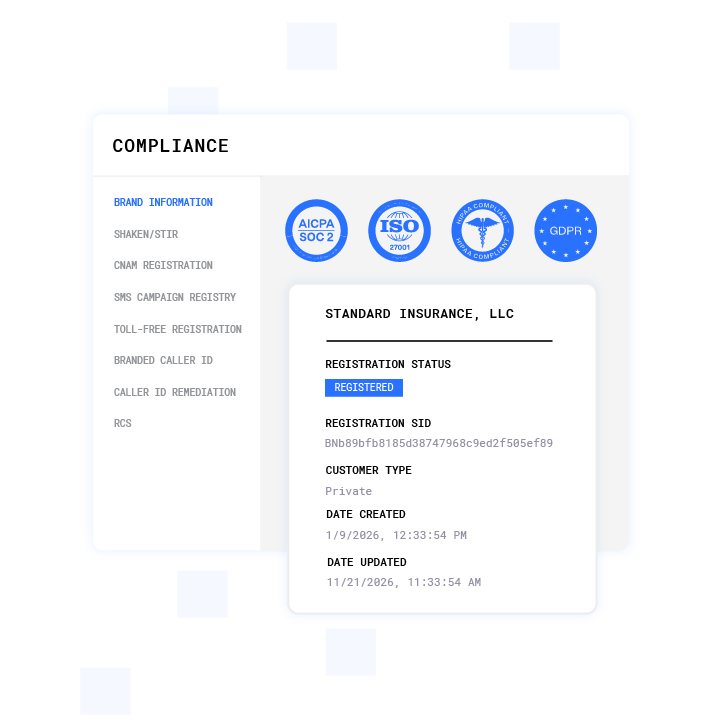
Regulatory cost avoidance belongs as a defined line item in modern ROI models. The FCC NPRM (CG Docket No. 26-52) and companion state laws create material liability for any operator whose AI voice infrastructure routes through foreign data centers or foreign-owned carriers. Plura runs on 100% U.S. infrastructure by architecture, so voice origination, model hosting, data storage, and call recording all sit on domestic infrastructure. Operators using Plura can report “100% U.S.-handled” in their broadband consumer label disclosures without qualification.
Plura’s platform supports compliance with TCPA (Telephone Consumer Protection Act, 47 U.S.C. § 227), DNC (Do Not Call) registry requirements, HIPAA (Health Insurance Portability and Accountability Act, 45 CFR Parts 160, 162, 164), SOC 2, and STIR/SHAKEN caller-ID authentication on every outbound call.1 Real-time DNC scrubbing checks every number before dial, consent records are timestamped and immutable, and quiet-hours rules enforce automatically through time-zone detection. Customers are responsible for their own regulatory obligations, and Plura provides the infrastructure that supports those obligations. Leaders should consult qualified counsel on their specific compliance posture.
U.S.-Based AI Call Center Payback Timeline
Customer service AI deployments often show payback periods of less than six months with strong ROI. Plura delivers 3× average ROI in 90 days across its customer base.3
The primary driver is the combination of labor cost replacement and conversion lift from sub-5-second lead response. As mentioned, a 15-agent operation switching to Plura saves $45,600 in the first 30 days under the default calculator scenario. For larger operations, the $300,000–$700,000 annual TCO replacing $4M–$7M in traditional contact-center costs produces payback that compounds quickly.
The 90-day opt-out window in every Plura annual contract means operators are not locked in if the deployment is not delivering, and the math is on the table before the contract is signed. The 90-day payback timeline Plura delivers is achievable because the platform replaces both the labor cost and the ramp time. AI deploys in days, while human contact centers often require 2–4 weeks of training per new hire.
AI Predictive Dialer ROI and Contact Rates
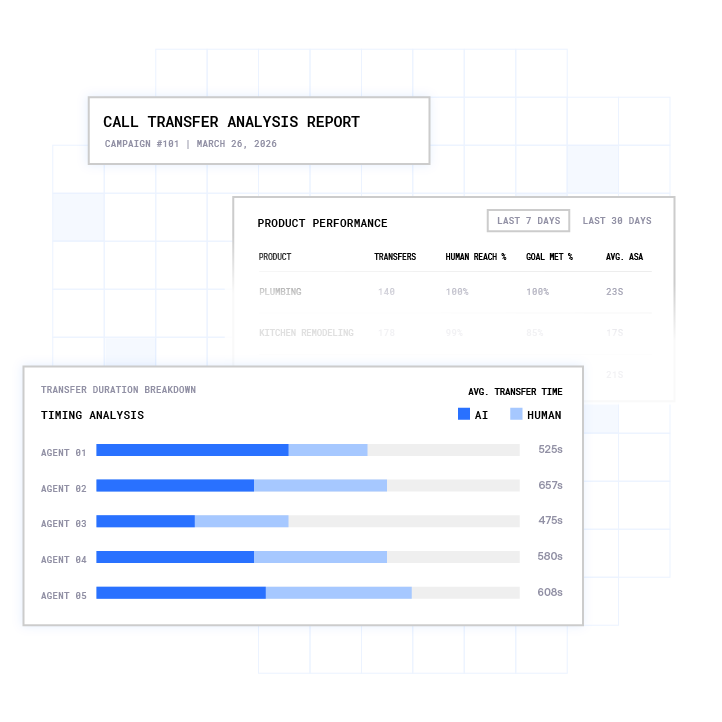
Most AI predictive dialers on the market are built on top of third-party CPaaS (Communications Platform as a Service) providers like Twilio.4 That architecture means branded caller ID is not issued at the carrier level, STIR/SHAKEN authentication is rented rather than owned, and real-time DNC scrubbing is bolted on after the fact. The result is calls that reach the prospect labeled “Spam Likely” and a compliance posture that lives outside the platform.
Plura’s AI Predictive Dialer runs on its own FCC-licensed audio bridging carrier. A branded caller ID is issued directly, and STIR/SHAKEN authentication runs on every outbound call. The dialer uses stateful conversion signals such as historical answer rates, prior negotiation outcomes, and prior offer-acceptance bands to decide who to call next, which maximizes talk time per dial. Plura also communicates with Apple’s iOS 26 call-screening layer, so calls present with the company’s name and the reason for the call, which turns screened calls into pickups instead of voicemails.
Watch the predictive dialer and branded caller ID in a live call walkthrough.
90-Day AI Agent ROI from Faster Lead Response
The conversion economics behind Plura’s 90-day ROI claim start with lead-response speed. Contacting a lead within 5 minutes makes them up to 100× more likely to connect, and a 60-second response lifts conversions by 391%. The industry standard for first contact on an inbound lead is 47+ hours. Plura contacts leads in under 5 seconds across voice, SMS, RCS (Rich Communication Services), and webchat, 24/7, on every channel, in parallel.
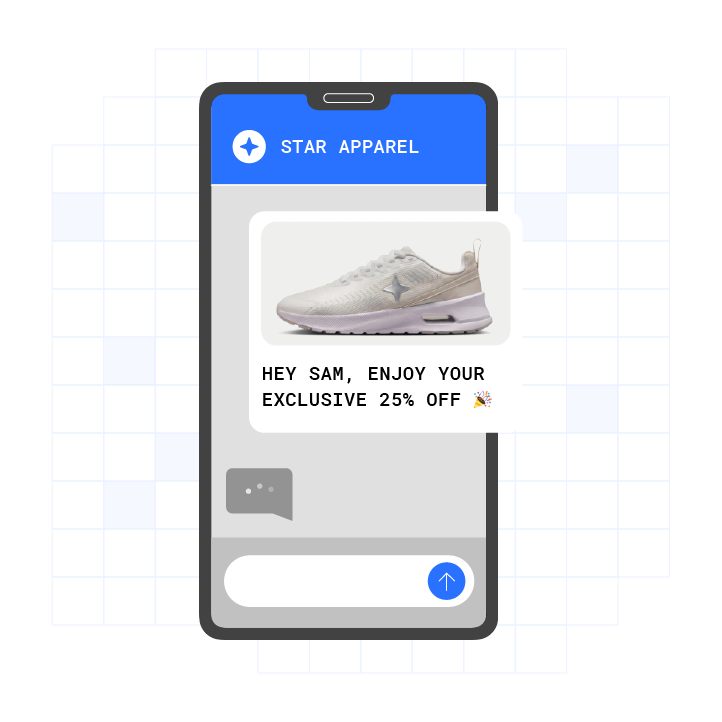
Operators running Plura report 47% average pipeline growth and 90% faster lead-response time versus baseline.3 Solar and home services companies using AI agents with property data, energy usage estimates, and home valuations achieved 2× to 3× improvements in appointment set rates.
Leaders can run their own numbers at plura.ai/calculator.
Comparison Table: Labor TCO and Performance Metrics
|
Metric |
Traditional Onshore |
Offshore BPO |
Plura AI |
|---|---|---|---|
|
Annual TCO (100-seat equivalent) |
|||
|
ROI timeline |
No defined payback |
Variable, could take months |
|
|
Lead-response time |
47+ hours (industry standard) |
Hours (time-zone gaps) |
|
|
Agent turnover cost |
$10K–$20K per agent, 30–45% annual rate |
$10K–$20K per agent, 30–45% annual rate |
$0 — no turnover |
|
Cost per completed conversation |
~$7.40 (human agent) |
||
|
Pipeline growth |
Baseline |
Baseline |
Vertical-Specific Outcomes for Key Industries
-
Healthcare: AI agents handle 25-question health-history intakes, appointment confirmations, and prescription reminders on HIPAA-aligned infrastructure. Plura achieves up to 40% improvement in no-shows across healthcare deployments.
-
Insurance: Sub-5-second response on inbound quotes keeps producers in front of buyers. The first responder closes 78% of deals in insurance, and Plura’s AI handles qualification and warm-transfers to a licensed agent for the bind.
-
Financial services: AI manages account alerts, loan follow-ups, and advisor scheduling on domestic infrastructure, with sensitive data remaining on U.S. servers.
-
Legal: Mass-tort and personal-injury intake uses field-level PII (personally identifiable information) redaction, claimant qualification, and routing to U.S. counsel.
-
Real estate and service networks: Solar and home services companies using AI agents with property data achieved 2× to 3× improvements in appointment set rates.
-
Franchise networks: AI answers 100% of calls within two rings across every location, closing the 3–5× performance gap between best and worst units. Booking rates double without adding front-desk headcount.
-
Agencies: Account-manager capacity expands from 5–8 clients to 15–20. Agency profit margins shift from a 15–25% industry baseline to 35–50% with AI deployment.
Stateful Conversation Database and Cross-Channel Memory
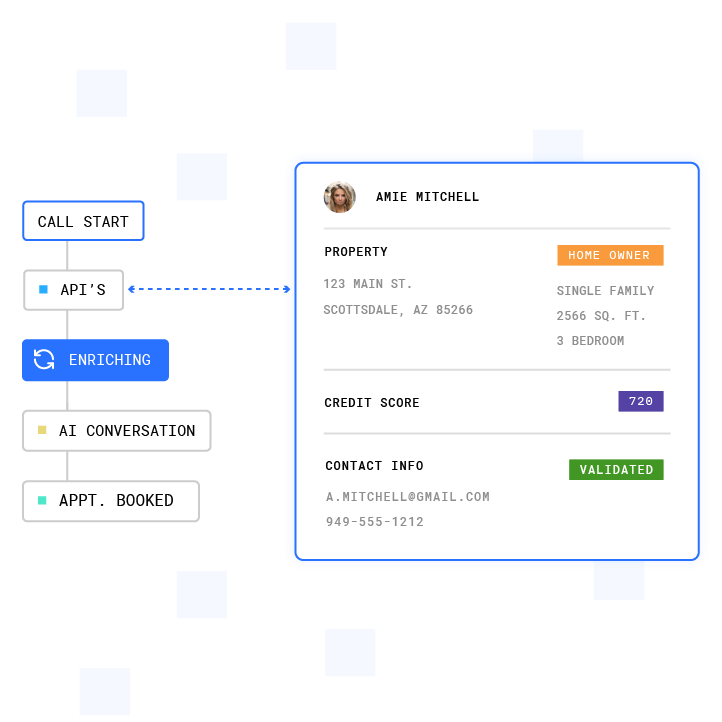
Most AI voice and SMS tools are separate products from separate vendors with separate memories. A customer who texted at 9 a.m. has to re-explain themselves when the call comes at noon. Plura’s AI Voice, AI SMS, AI RCS, and AI Webchat all share a single Stateful Conversation Database. Every interaction is keyed to the customer by phone number, email, or ID, and every channel inherits the full memory of every prior touchpoint, including pricing offers made, objections raised, qualification status, and sensitive-data redactions.
The operational impact is direct. A solar company using AI Lead Intelligence increased conversion rates from 6% to 18% with the same leads and the same offer. The difference was context, because the AI knew what had already been said before the next contact was made. Many customers use multiple channels while resolving a single issue, so cross-channel memory continuity becomes a conversion variable, not just a UX feature. Every conversation that feeds the stateful database increases the platform’s conversion advantage over time, which creates a compounding effect that point tools and Twilio-based API resellers cannot match.
Conclusion and Next Steps for Contact Center Leaders
The economics of traditional and offshore call centers are deteriorating at the same time. Onshore TCO of $4M–$7M conflicts with the conversion speed modern operators need. Offshore BPOs face mounting regulatory exposure under the FCC NPRM (CG Docket No. 26-52), the Keep Call Centers in America Act (S.2495), and active state laws in five jurisdictions. Twilio-based AI wrappers lack the carrier stack, stateful memory, and U.S. infrastructure required to operate cleanly in regulated verticals.
Plura AI’s 100% U.S. infrastructure, FCC-licensed carrier, and Stateful Conversation Database deliver 3× average ROI in 90 days, $300K–$700K TCO versus $4M–$7M traditional economics, and 47% average pipeline growth, with TCPA compliance support, DNC compliance support, HIPAA-aligned infrastructure, SOC 2, ISO certification, and STIR/SHAKEN caller-ID verification built into every deployment.
Leaders can run their specific numbers at plura.ai/calculator. They can compare plans and capabilities at plura.ai/pricing. Or they can walk through the ROI model with Plura against their actual call volume and cost structure.
Frequently Asked Questions
What is a realistic ROI timeline for AI call center automation?
Payback timelines vary by deployment size and volume, but the data points to fast returns. Plura delivers 3× average ROI in 90 days across its customer base. The primary driver is the combination of labor cost replacement and conversion lift from sub-5-second lead response. A 15-agent operation switching to Plura saves $45,600 in the first 30 days under the default calculator scenario. For larger operations, the $300,000–$700,000 annual TCO replacing $4M–$7M in traditional contact-center costs produces payback that compounds quickly. The 90-day opt-out window in every Plura annual contract means operators are not locked in if the deployment is not delivering, and the math is on the table before the contract is signed.
How does 100% U.S. infrastructure affect ROI for regulated industries?
For operators in healthcare, insurance, financial services, and legal, U.S. infrastructure functions as a risk management decision as much as a technology choice. The FCC NPRM (CG Docket No. 26-52) proposes prohibiting offshore handling of sensitive consumer data. State laws in New York, New Jersey, Connecticut, Missouri, and Florida already restrict offshore handling of medical, financial, and consumer data. Every offshore contract a covered entity holds becomes a potential liability that leaders must evaluate. Plura runs on 100% U.S. infrastructure by architecture, so voice origination, model hosting, data storage, and call recording all sit on domestic infrastructure. That design removes offshore exposure from the cost model and creates a cost-avoidance line item that many ROI models undercount. Operators should consult qualified legal counsel on their specific regulatory obligations.
What makes Plura’s AI Predictive Dialer different from other outbound dialers?
Most AI predictive dialers on the market are built on top of third-party CPaaS providers and rent their telecom infrastructure. That structure means branded caller ID is not issued at the carrier level, STIR/SHAKEN authentication is not owned end-to-end, and real-time DNC scrubbing is an add-on rather than a first-class platform layer. Plura is its own FCC-licensed audio bridging carrier, so branded caller ID is issued directly and STIR/SHAKEN runs on every outbound call. The dialer uses stateful conversion signals such as historical answer rates, prior negotiation outcomes, and prior offer-acceptance bands to prioritize contacts most likely to convert. Plura also communicates with Apple’s iOS 26 call-screening layer so calls present with the company’s name and reason for the call, which converts screened calls into pickups instead of voicemails. The result is a higher contact rate per dial and a lower cost per connected call, with no dependency on third-party predictive-dialer software.
How does the Stateful Conversation Database improve conversion rates?
Most AI voice and SMS platforms are separate products with separate memories. When a customer texts at 9 a.m. and receives a call at noon, they have to re-explain their situation from scratch. Plura’s AI Voice, AI SMS, AI RCS, and AI Webchat all share one Stateful Conversation Database. Every interaction is keyed to the customer by phone number, email, or ID, and every channel inherits the full memory of every prior touchpoint, including what was offered, what was accepted, what was declined, and what objections were raised.
This continuity directly affects conversion. A solar company using Plura’s AI Lead Intelligence increased conversion rates from 6% to 18% with the same leads and the same offer. The database also enables BATNA-style negotiation guardrails, because the AI remembers prior counter-offers and uses them to anchor the next outreach, which human dispatchers and SDR teams cannot maintain at scale across hundreds of simultaneous conversations.
What compliance frameworks does Plura support?
Plura’s platform supports compliance with TCPA, DNC registry requirements, HIPAA, SOC 2, ISO certification, GDPR, STIR/SHAKEN caller-ID verification, and 10DLC (Application-to-Person SMS registry compliance).1 Every outbound contact is checked against federal and state DNC registries in real time before dial. Consent records are timestamped, immutable, and audit-ready, and quiet-hours rules enforce automatically through time-zone detection. HIPAA-aligned encryption, access controls, and audit logging cover protected health information across all four channels. The compliance dashboard exports audit-ready reports in one click. Customers are responsible for their own certifications and regulatory obligations, and Plura provides the infrastructure that supports those obligations. Operators in regulated verticals should consult qualified legal counsel on their specific compliance posture and the applicability of any framework to their operations.
1 Plura AI maintains SOC 2, HIPAA, ISO, and GDPR posture as part of its platform infrastructure. References to compliance frameworks in this article describe Plura’s platform capabilities and do not constitute a guarantee that any customer using Plura will themselves be compliant with applicable laws or standards. Customers remain solely responsible for their own regulatory obligations, certifications, consent management, recordkeeping, and the claims they make to their own end users. Consult qualified legal counsel for guidance specific to your use case.
2 This article describes regulatory frameworks at a general level and does not constitute legal advice. Laws and regulations vary by jurisdiction, change over time, and apply differently depending on facts and circumstances. Readers should consult qualified legal counsel before making compliance decisions.
3 Performance figures, customer outcomes, and industry statistics referenced in this article are drawn from cited third-party sources or Plura customer case studies. Individual results vary based on implementation, use case, industry, audience, and execution. Past or aggregate performance is not a guarantee of future results.
4 References to third-party products, services, companies, or research are made for informational and comparative purposes only. Plura AI is not affiliated with, endorsed by, or sponsored by any third party named in this article unless explicitly stated. Trademarks and product names referenced remain the property of their respective owners.
This article is provided for informational purposes only and reflects Plura AI’s understanding at the time of publication. Product capabilities, integrations, and specifications are subject to change. For the most current information, visit plura.ai.
This article was produced with the assistance of AI tools and reviewed by Plura AI prior to publication.