

Written by: Matt Beucler, CEO, Plura AI
Updated May 2026
Key Takeaways
-
High-volume U.S. operators can cut annual contact-center TCO from $4M–$7M to $300K–$700K by shifting traditional labor to Plura AI’s carrier-owned platform.
-
AI agents run at full talk utilization while human agents average far lower utilization, which removes idle time and lowers per-interaction costs.
-
Plura’s 100% U.S. infrastructure and built-in compliance engine (TCPA, DNC, HIPAA, SHAKEN/STIR) reduce regulatory exposure compared to offshore and non-carrier platforms.1
-
Stateful conversations across voice, SMS, RCS, and webchat keep context, shorten handle times, and extend ROI beyond initial labor savings.
-
Operators can reach 3× average ROI in 90 days; start a conversation with Plura today to model savings for your operation.3
The Cost Squeeze on U.S. Contact Centers in 2026
Traditional contact-center economics still strain margins. Domestic contact-center agents cost $15–$25 per hour before benefits and overhead, and once taxes, commissions, real estate, and management are included, a 100-seat operation lands between $4M and $7M per year.
Talk utilization for human agents averages 40%, so operators pay for a large share of time with no live conversation. Scaling amplifies these pressures. Human contact centers scale linearly, so more volume requires proportional headcount, hiring cycles, and training ramps. Annual agent turnover runs 35–45%, which forces constant replacement and retraining that rarely appears clearly on a per-seat line item but accumulates across every planning cycle.
Compliance costs are rising at the same time. The FCC’s one-to-one consent rule was scheduled to take effect on January 27, 2025, but was vacated by the U.S. Court of Appeals for the Eleventh Circuit on January 24, 2025, preventing it from taking effect. The FCC NPRM (CG Docket No. 26-52) proposes capping offshore customer-service calls at 30% and limiting offshore handling of sensitive consumer data such as passwords, multi-factor authentication, social security numbers, banking, and card data. State laws in New York (penalties up to $10,000 per day), New Jersey, Connecticut, Missouri, and Florida already restrict offshore handling of medical, financial, and consumer data. Each offshore contract a covered entity holds now represents a potential compliance liability.
See how these pressures play out in your operation with Plura’s ROI calculator.
Why a Carrier-Owned AI Platform Changes the Math
These escalating labor and compliance costs call for a different infrastructure approach that addresses economics and regulatory exposure at the carrier level. Most AI voice tools on the market are API resellers built on top of third-party Communications Platform as a Service (CPaaS) providers like Twilio.4 They do not own the carrier, cannot issue branded caller ID at the origination level, and cannot enforce real-time Do Not Call (DNC) scrubbing as a first-class platform layer. Their compliance posture sits outside the platform.
Plura AI is its own FCC-licensed audio bridging carrier. Voice originates on Plura’s domestic infrastructure, not a third-party CPaaS, which produces lower per-minute economics, direct issuance of branded caller ID, and SHAKEN/STIR (Secure Telephone Identity Revisited / Signature-based Handling of Asserted information using toKENs) caller ID verification on every outbound call. Branded caller ID and spam-label remediation occur at the carrier level, not as after-market add-ons.
The platform’s Stateful Conversation Database keeps context across voice, SMS, RCS (Rich Communication Services), and webchat. A customer who texted at 9 a.m. is the same customer when the call arrives at noon, and the AI already knows what was said, what was offered, and what remains open. Competing tools rarely preserve that context across channels by default.
Plura’s compliance engine supports TCPA compliance, DNC compliance, HIPAA, SOC 2, ISO certification, GDPR, and SHAKEN/STIR caller ID verification as first-class platform layers. Every outbound contact is checked against federal and state DNC registries in real time before dial, consent records are timestamped, immutable, and audit-ready, and quiet-hours rules enforce automatically through time-zone detection. Customers are responsible for their own regulatory obligations, and Plura provides the infrastructure that supports that posture.
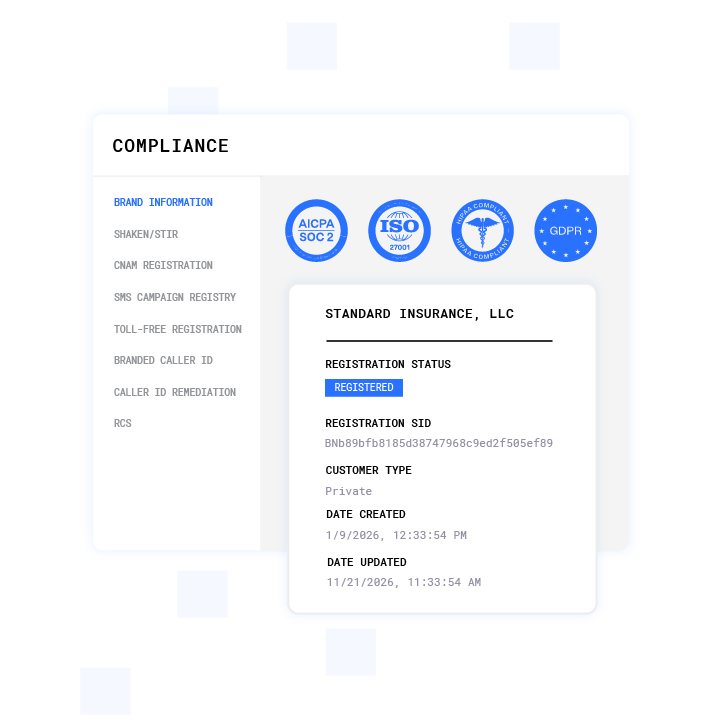
Plura’s 100% U.S. infrastructure by architecture means voice origination, model hosting, data storage, and call recording all sit on domestic infrastructure. Plura clients report “100% U.S.-handled” in their broadband consumer label disclosures and avoid offshore exposure under the FCC NPRM, state onshoring laws, and foreign-adversary-nation restrictions.
Side-by-Side TCO: Traditional vs. Plura
|
Cost Category |
Traditional 100-Seat Contact Center |
Plura AI Platform |
|---|---|---|
|
Annual TCO |
||
|
Per-interaction cost (voice) |
Significantly higher |
Significantly lower |
|
Talk utilization |
||
|
Monthly cost (15-agent equivalent) |
The default scenario on Plura’s ROI calculator shows a 15-agent operation at $20 per hour with standard taxes, benefits, and commissions at 40% talk utilization costing $60,000 per month. Six Plura agents handling equivalent volume at full utilization cost $14,400 per month, which creates a $45,600 monthly saving that compounds to $547,200 over 12 months and $2,736,000 over 60 months.
For offshore comparisons, a 50-seat offshore team costs approximately $1.2M annually fully loaded, while Plura handling equivalent volume costs $180K–$300K annually. The per-conversation gap is equally direct, as Plura AI voice agents cost $0.35–$0.85 per completed conversation versus $5–$15 fully loaded for offshore call centers.
See how these savings translate to your own volume and cost structure in Plura’s calculator.
Regulatory Cost Exposure and How Architecture Helps
Beyond direct labor savings, operators face a second cost category that traditional TCO models often underestimate: regulatory penalties and compliance infrastructure. The compliance cost of operating a non-domestic or non-carrier-owned contact center in 2026 is no longer theoretical. The $500–$1,500 per-call TCPA penalties mentioned earlier remain a central example. New York’s Call Center Jobs Act imposes penalties up to $10,000 per day for covered violations. Iowa’s privacy law, effective January 1, 2025, imposes fines of $7,500 per violation.
Operators using Twilio-based API resellers inherit Twilio’s carrier identity and compliance posture, not their own. Real-time DNC scrubbing, TCPA-litigator list filtering, and immutable consent logging often appear as add-ons in that model rather than as platform layers. When a violation occurs, the liability sits with the operator.
Plura’s architecture approaches this differently. Plura automatically enforces TCPA rules, DNC list checks, calling window restrictions, and consent requirements on every interaction. The platform’s compliance engine functions as a first-class layer rather than a checkbox feature. Operators using Plura’s infrastructure still carry their own regulatory obligations, and the platform is built to support that posture from origination through audit export.
The FCC NPRM (CG Docket No. 26-52), the Keep Call Centers in America Act (S.2495), and the Foreign Robocall Elimination Act (S.2666) extend the federal regulatory perimeter in ways that make offshore infrastructure a balance-sheet risk. Plura’s 100% U.S. infrastructure by architecture reduces that exposure at the foundation level by controlling where voice originates, where data is stored, and where models run.
90-Day ROI and Workflow Redesign in Practice
Plura’s deployment sequence moves from discovery audit to production go-live in days to weeks depending on conversation complexity. A simple inbound qualification flow typically builds in days. A complex multi-step intake usually runs closer to one to two months. Every annual contract includes a 90-day opt-out window, so if the deployment does not deliver, operators are not locked into the year.
The 90-day ROI case rests on two simultaneous mechanisms: labor displacement and workflow redesign. On labor displacement, the 15-agent scenario produces $45,600 in savings in the first 30 days, which often covers most upfront implementation costs within the first month. On workflow redesign, research on generative AI for customer service shows increases in issue resolution per hour and reductions in handle time through workflow changes alone, and these gains stack on top of headcount reduction to accelerate payback.
Organizations implementing contact center AI also report reductions in compliance and policy violations, which deliver operational risk reduction that does not appear in a headcount line but does appear on the balance sheet when violations are avoided. This creates a third ROI stream that extends the 90-day return beyond labor economics.
Plura’s Stateful Conversation Database sustains those savings beyond the initial deployment. Every interaction across voice, SMS, RCS, and webchat is keyed to a customer token and stored in one place. The AI reads and writes to that database on every conversation, referencing what was offered, what was accepted, and what objections were raised, so conversation quality improves over time instead of plateauing. Plura delivers 3× average ROI in 90 days, 47% pipeline growth, and 90% faster lead-response time across its customer base.
See the 90-day ROI model applied to your operation in Plura’s calculator, then book a demo to discuss deployment timing.
Frequently Asked Questions
How much does an AI call center agent cost in 2026?
AI call center agent costs in 2026 vary by platform architecture and volume tier. At the per-minute level, AI voice agents cost $0.07 to $0.40 per minute all-in depending on the platform and included components for routine calls, compared to $25–$45 per hour for U.S. onshore human agents. At the per-interaction level, AI-handled voice interactions can cost significantly less than human-only calls. For a 15-agent equivalent operation, Plura’s platform costs approximately $14,400 per month at full utilization, compared to $60,000 per month for the equivalent human team at standard utilization. At scale, Plura’s TCO lands at $300K–$700K annually for operations that would otherwise spend $4M–$7M on traditional contact-center infrastructure. The cost difference is driven primarily by the utilization gap discussed earlier and by the removal of taxes, benefits, commissions, real estate, and turnover-driven retraining costs.
What can AI do for a call center?
AI handles inbound and outbound conversations across voice, SMS, RCS, and webchat, including qualifying leads, conducting intake interviews, following up on open opportunities, confirming appointments, processing renewals, and routing complex cases to human agents. In high-volume operations, AI agents autonomously handle most routine interactions and escalate only those requiring judgment, empathy, or exception handling. Beyond conversation handling, AI delivers real-time lead enrichment during the call, post-call analytics that surface conversion patterns and objection trends, predictive dialing that prioritizes contacts most likely to convert, and stateful memory that carries context across every channel so customers do not repeat themselves. Workflow redesign gains such as shorter handle times, higher first-contact resolution, and reduced after-call work stack on top of headcount reduction to produce compounding savings over time. Plura’s AI agents respond in under 5 seconds across all channels, 24/7, without the hiring cycles, training ramps, or turnover costs that define human contact-center operations.
How do U.S. infrastructure requirements affect long-term savings sustainability?
U.S. infrastructure requirements affect long-term savings through regulatory exposure and compliance operating costs. On regulatory exposure, the FCC NPRM (CG Docket No. 26-52) proposes capping offshore customer-service calls at 30% and limiting offshore handling of sensitive consumer data. State laws in New York, New Jersey, Connecticut, Missouri, and Florida already restrict offshore handling of medical, financial, and consumer data, with penalties that can reach $10,000 per day. Operators using AI platforms with foreign infrastructure dependencies, or Twilio-based API resellers whose data routing is not fully domestic, carry that exposure on their balance sheet whether or not finance has priced it in.
On compliance operating costs, platforms that bolt on DNC scrubbing, consent logging, and quiet-hours enforcement after the fact require ongoing manual oversight to sustain. Plura runs on 100% U.S. infrastructure by architecture, so voice origination, model hosting, data storage, and call recording all sit on domestic infrastructure, and the platform enforces compliance as a first-class layer on every outbound contact. That architecture reduces offshore exposure at the foundation level and lowers the ongoing compliance operating cost that erodes savings in less integrated deployments. Customers remain responsible for their regulatory posture, and Plura’s infrastructure supports that requirement.
Conclusion
The economics of traditional contact-center operations in 2026 are unsustainable for high-volume U.S. operators. A $4M–$7M annual TCO driven by heavy labor concentration, high agent turnover, and accelerating compliance penalties from the FCC NPRM and state onshoring laws leaves little room for competitive margin. Offshore alternatives that absorbed those costs for two decades now carry regulatory exposure that sits on the balance sheet of every covered entity that uses them. Twilio-based API resellers provide AI conversation without the carrier stack, stateful memory, or domestic infrastructure that 2026 compliance expectations demand.
Plura replaces that cost structure with a $300K–$700K TCO, 3× average ROI in 90 days, and a carrier-owned platform that supports TCPA compliance, DNC compliance, HIPAA, SOC 2, ISO certification, GDPR, and SHAKEN/STIR caller ID verification as first-class layers rather than add-ons. The economics are measurable and repeatable.
Calculate your 90-day ROI based on your current headcount and volume in Plura’s calculator.
1 Plura AI maintains SOC 2, HIPAA, ISO, and GDPR posture as part of its platform infrastructure. References to compliance frameworks in this article describe Plura’s platform capabilities and do not constitute a guarantee that any customer using Plura will themselves be compliant with applicable laws or standards. Customers remain solely responsible for their own regulatory obligations, certifications, consent management, recordkeeping, and the claims they make to their own end users. Consult qualified legal counsel for guidance specific to your use case.
2 This article describes regulatory frameworks at a general level and does not constitute legal advice. Laws and regulations vary by jurisdiction, change over time, and apply differently depending on facts and circumstances. Readers should consult qualified legal counsel before making compliance decisions.
3 Performance figures, customer outcomes, and industry statistics referenced in this article are drawn from cited third-party sources or Plura customer case studies. Individual results vary based on implementation, use case, industry, audience, and execution. Past or aggregate performance is not a guarantee of future results.
4 References to third-party products, services, companies, or research are made for informational and comparative purposes only. Plura AI is not affiliated with, endorsed by, or sponsored by any third party named in this article unless explicitly stated. Trademarks and product names referenced remain the property of their respective owners.
This article is provided for informational purposes only and reflects Plura AI’s understanding at the time of publication. Product capabilities, integrations, and specifications are subject to change. For the most current information, visit plura.ai.
This article was produced with the assistance of AI tools and reviewed by Plura AI prior to publication.