

Written by: Matt Beucler, CEO, Plura AI
Key takeaways for AI lead follow-up automation
-
AI lead follow-up automation uses software agents to contact, qualify, and advance inbound leads across voice, SMS, RCS, and webchat in under 5 seconds without human intervention.
-
Plura AI is the only FCC-licensed, carrier-owned platform that delivers sub-5-second responses while maintaining stateful cross-channel memory and supporting real-time TCPA, DNC, HIPAA, and 50+ state compliance rules on 100% U.S. infrastructure.1
-
Speed-to-lead, stateful memory, and U.S. infrastructure together define effective AI lead follow-up automation in 2026. Missing any one element creates disconnected conversations, lost leads, or compliance exposure.
-
Operators who need all three capabilities in a single platform have one carrier-owned option built specifically for that combination of speed, memory, and compliance.
-
See how Plura delivers compliant, stateful AI lead follow up in a live demo.
Responding to new leads in under 60 seconds
Lead conversion improves dramatically when response times drop. Contacting a lead within 5 minutes makes them up to 100× more likely to connect, and responding within 60 seconds lifts conversions by 391%.3 The industry average response time is still 47 hours.
Plura closes that gap at the infrastructure level. When a lead submits a form, clicks an ad, or initiates a webchat, Plura agents respond across voice, SMS, RCS, and webchat in under 5 seconds, 24/7, on every lead simultaneously. No SDR queue, no time-zone gap, and no human ramp time. Use Plura’s calculator to model your own ROI in real time.
AI lead follow-up with TCPA and DNC controls
Automated outbound contact operates inside a dense regulatory environment that includes TCPA (47 U.S.C. § 227), federal and state DNC registries, and state-level calling rules.2 TCPA violations can reach $500 to $1,500 per text or call. Operators running high-volume outbound campaigns at scale face material risk when compliance sits outside the core system instead of at origination.
Plura treats compliance as a primary platform layer. Every outbound contact is checked against federal and state DNC registries in real time before dialing. Plura integrates with The Blacklist Alliance’s TCPA Litigation Firewall® for real-time DNC scrubbing and litigation protection.4 Consent records are timestamped, immutable, and audit-ready. Quiet-hours rules apply automatically through time-zone detection on every contact. The compliance dashboard exports audit-ready reports in one click.
Healthcare operators face an additional compliance layer beyond TCPA and DNC.2 HIPAA privacy and security requirements apply when automated systems process protected health information (PHI) in electronic form. Plura supports HIPAA-aligned encryption, access controls, and audit logging across voice, SMS, RCS, and webchat. Operators in regulated verticals should consult qualified counsel on their specific obligations under TCPA, HIPAA, and applicable state statutes. Plura provides the infrastructure; compliance posture downstream remains the operator’s responsibility.
Stateful AI conversations across voice, SMS, and webchat
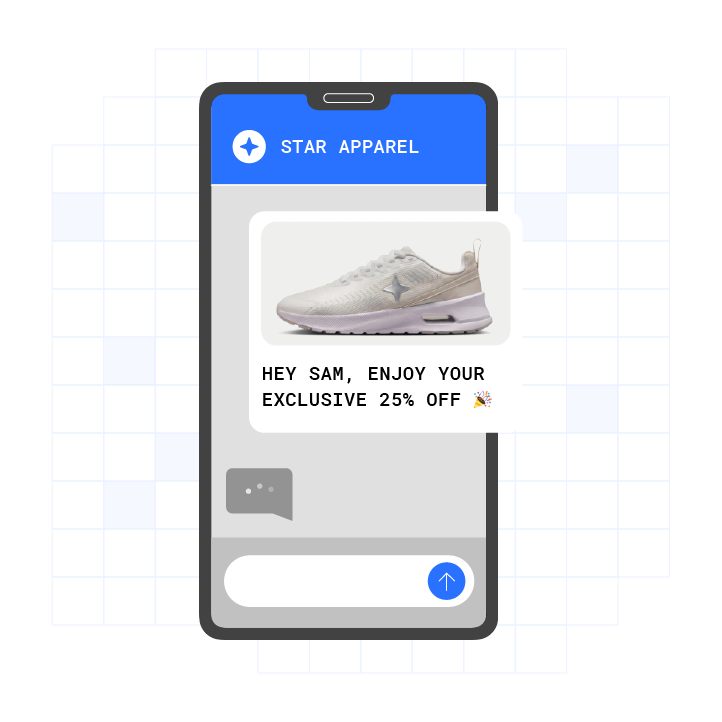
Most AI voice and SMS tools operate as separate products from separate vendors with separate memories. A lead who texts at 9 a.m. often has to re-explain themselves when the call comes at noon.
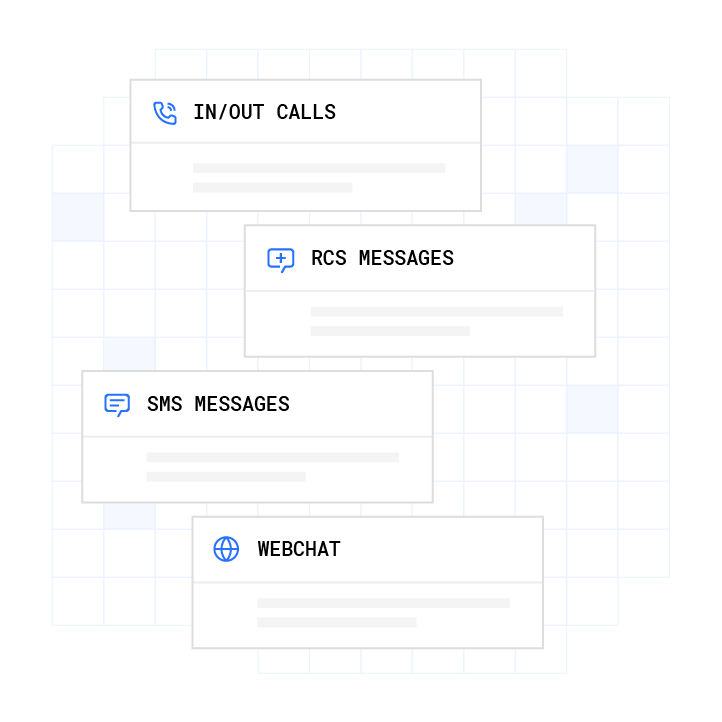
Plura solves this through architectural design rather than integration. Plura’s Stateful Conversation Database keys every interaction across voice, SMS, RCS, and webchat to a single customer token, such as phone number, email, or ID. The AI agent that texted a lead at 9 a.m. can pick up the call at noon already knowing what was said, what was offered, what objections were raised, and what qualification status was assigned. Plura supports voice, SMS, webchat, and RCS within a unified stateful inbox that maintains full conversation history.
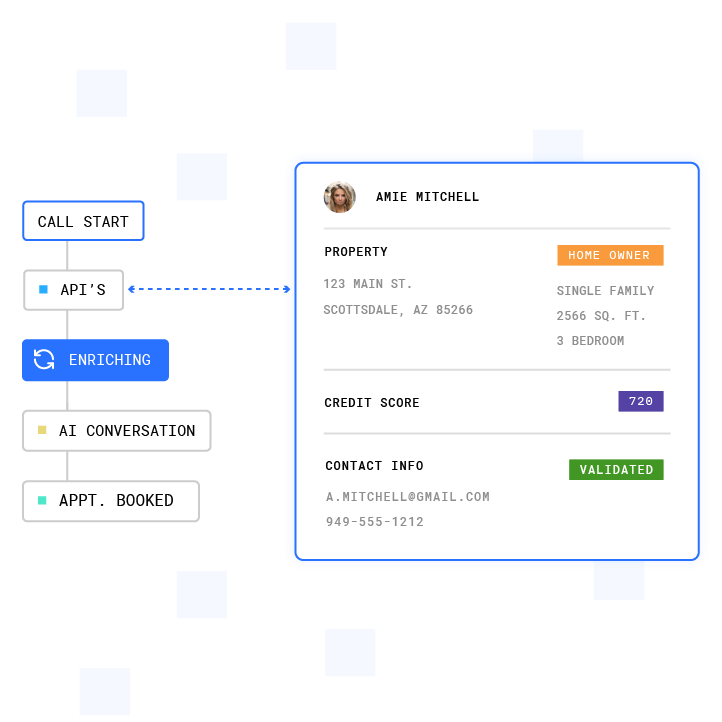
A standard no-code workflow on Plura combines speed, enrichment, qualification, and escalation into one automated sequence that replaces the traditional SDR handoff. A lead captured from a form or ad flows through real-time enrichment from 30+ data sources during the live conversation, then through a qualification gate, then into a warm transfer or escalation queue. Every node references the stateful database, and every branch decision is logged.
Branded caller ID and spam remediation for higher pickup rates
Call pickup rates have collapsed across the industry. Calls flagged as “Spam Likely” on Android and intercepted by Apple’s iOS 26 call-screening layer never reach the prospect. Plura owns its telecom infrastructure and holds an FCC carrier license, while Twilio-based platforms operate as a software layer without a carrier license.4
That carrier status changes what is possible. Plura provides carrier-provisioned branded caller ID, which is not available on Synthflow or other Twilio-wrapper tools.4 Calls present with the company’s name and the reason for the call. Plura’s AI also communicates with iOS 26’s call-screening layer, converting screened calls into pickups instead of voicemails. STIR/SHAKEN (Secure Telephone Identity Revisited / Signature-based Handling of Asserted information using toKENs) authentication runs on every outbound call at the carrier level, not through a third-party reseller.
U.S.-based AI lead automation under 2026 FCC proposals
The FCC’s Notice of Proposed Rulemaking (NPRM, CG Docket No. 26-52) describes potential caps on offshore customer-service calls at 30% and potential limits on offshore handling of sensitive consumer data including passwords, multi-factor authentication credentials, Social Security numbers, and banking and card data. Companion legislation, including the Keep Call Centers in America Act (S.2495) and the Foreign Robocall Elimination Act (S.2666), extends the federal policy perimeter. State laws in New York, New Jersey, Connecticut, Missouri, and Florida already restrict offshore handling of medical, financial, and consumer data.
Foreign infrastructure dependencies create exposure under this evolving framework. Plura runs on 100% U.S. infrastructure by design. Voice origination, model hosting, data storage, and call recording all sit on domestic infrastructure. Plura clients report “100% U.S.-handled” in their broadband consumer label disclosures. There is no offshore exposure to unwind because the stack does not include offshore components.
Request a technical walkthrough of Plura’s U.S. infrastructure architecture.
Practical evaluation criteria for AI lead follow-up platforms
Operators evaluating AI lead follow-up platforms need a simple way to separate tools that solve real problems from tools that only demo well. The five criteria below map directly to the core risks described earlier: slow response, disconnected conversations, and compliance and cost exposure.
1. Speed-to-lead. The platform should respond in under 5 seconds across every channel, the threshold established by the MIT study cited earlier.
2. Channel coverage. Voice-only tools miss leads who prefer SMS. SMS-only tools miss leads who answer calls. Effective platforms cover voice, SMS, RCS, and webchat from a single stateful memory layer instead of four separate products.
3. Compliance posture. Real-time DNC scrubbing, immutable consent logging, TCPA-litigator filtering, and 50+ state rule enforcement work best as built-in platform layers rather than third-party add-ons. Operators should consult counsel on their specific regulatory obligations.
4. Integration depth. The platform needs to read from and write to the CRM, calendar, and attribution tools already in use so that AI conversations stay aligned with existing systems. Plura provides full lead enrichment before every interaction, enabling autonomous AI voice agents to handle complete sales conversations, qualify leads, and book appointments.
5. Total cost of ownership. The ROI math on Plura is documented. TCO of $300K–$700K replaces traditional $4M–$7M contact-center economics3 on equivalent volume. To illustrate at a smaller scale, a 15-agent operation at $20/hour with standard overhead costs about $60,000 per month. Six Plura agents handling the same volume cost about $14,400 per month, which produces a 30-day saving of $45,600 and compounds to $547,200 over 12 months. That unit-level math supports an average ROI of 3× in 90 days across Plura deployments.
No-code workflow example for inbound lead handling
A standard Plura deployment for a high-volume inbound lead flow runs four nodes on a visual canvas with no engineering required. This workflow shows how instant response, enrichment, qualification, and escalation operate as one continuous conversation.
Node 1 — Instant capture. A lead submits a form or clicks an ad. Plura fires an outbound voice call and SMS simultaneously within 5 seconds. The AI agent greets the lead by name using data already pulled from the enrichment layer.
Node 2 — Real-time enrichment. While the conversation is live, Plura pings more than 30 data sources such as IP data, property records, contact data, business firmographics, and intent signals. The platform surfaces the results inside the active conversation, and the AI adjusts qualification questions based on what it has just learned.
Node 3 — Qualification gate. The AI scores the lead against defined criteria such as budget, timeline, geography, and intent. Leads that pass the route to the escalation path. Leads that fail route to a nurture cadence. Every decision is logged to the stateful database.
Node 4 — Escalation path. Qualified leads receive a warm transfer to a U.S. agent, a calendar booking via Calendly or Google Calendar, or a DocuSign or PandaDoc document sent inside an RCS message thread. The entire sequence runs without leaving the conversation.
Compliance infrastructure and healthcare use cases
Plura’s compliance engine covers TCPA, DNC, HIPAA, SOC 2 (System and Organization Controls 2), and 50+ state rule sets as pre-loaded enforcement layers rather than optional configurations.1 These layers run as real-time checks on every interaction, including TCPA rules, DNC list status, calling window restrictions, and consent requirements. Any number that fails a check is blocked before the first dial attempt, so non-compliant contacts never enter the queue. Quiet-hours rules apply state and federal calling-window restrictions through time-zone detection on every campaign. Sensitive data such as PHI, PII, and payment data is redacted at the field level and routed through HIPAA-aligned channels.
Healthcare operators use this infrastructure to improve operational metrics while staying within their own compliance frameworks. Plura supports up to 40% improvement in no-shows3 through automated appointment confirmation and reminder workflows that operate within HIPAA-aligned infrastructure. Operators in healthcare should consult qualified counsel on their specific obligations under 45 CFR Parts 160, 162, and 164 before deploying automated outreach.

Conclusion: AI lead follow-up as an infrastructure decision
AI lead follow-up automation in 2026 functions as an infrastructure decision, not a point feature. A platform that owns the carrier stack, maintains stateful memory across every channel, supports compliance at origination, and runs on 100% U.S. infrastructure sits in a different category from the Twilio-based API resellers that dominate the current market. Plura supports voice, SMS, RCS, and webchat natively in a unified platform with drag-and-drop workflows and FCC-licensed carrier status, a combination Twilio-wrapper tools cannot replicate without owning the carrier.
Conversion economics, compliance architecture, and cost structure are all measurable. Operators still running manual SDR queues, offshore BPO contracts, or Twilio-wrapper voice tools carry speed, compliance, and cost exposure that compounds every quarter.
Run the cost model yourself using Plura’s ROI calculator. Compare plans and rates to find the right deployment tier.
Frequently Asked Questions
What is AI lead follow up automation and how does it differ from traditional CRM-based follow-up sequences?
AI lead follow-up automation uses software agents to initiate and conduct full conversations with leads across voice, SMS, RCS, and webchat without a human in the loop, within seconds of a lead entering the system. Traditional CRM-based sequences send templated emails or trigger SMS blasts on a time delay, but they do not hold a two-way conversation, cannot qualify a lead in real time, and cannot adapt based on what the lead says. AI lead follow-up automation handles the entire conversation from greeting to qualification to handoff, with memory of every prior touchpoint across every channel. Operationally, a CRM sequence functions as a broadcast, while an AI agent runs a live conversation.
How does Plura maintain conversation context when a lead switches from SMS to a phone call?
The Stateful Conversation Database described earlier maintains a single customer record across all channels. Every interaction, whether it occurs via voice, SMS, RCS, or webchat, writes to the same record. The AI agent on a noon call has full context from a 9 a.m. SMS thread without requiring the lead to repeat themselves. This cross-channel memory lives in the core platform architecture instead of being assembled from separate tools.
What compliance frameworks does Plura support for automated outbound lead follow-up?
Plura supports compliance with TCPA, DNC, HIPAA, SOC 2, ISO certification, GDPR, STIR/SHAKEN caller ID verification, and 50+ state-level rule sets as first-class layers of the platform. Every outbound contact is checked against federal and state DNC registries in real time before dialing. Consent records are timestamped and immutable. Quiet-hours rules apply automatically through time-zone detection. HIPAA-aligned encryption, access controls, and audit logging cover protected health information across all four channels. The compliance dashboard exports audit-ready reports in one click. Operators are responsible for their own regulatory obligations and should consult qualified counsel on their specific requirements under TCPA, HIPAA, and applicable state statutes. Plura provides the infrastructure; compliance posture downstream remains the operator’s responsibility.
Why does carrier ownership matter for AI voice lead follow-up, and what is the practical difference versus a Twilio-based platform?
Most AI voice platforms operate as API resellers built on top of Twilio or another CPaaS (Communications Platform as a Service). They rent the telecom layer, which means they cannot issue branded caller ID at the carrier level, cannot enforce real-time DNC scrubbing at origination, and inherit the caller ID reputation of the underlying carrier rather than their own. Plura operates as its own FCC-licensed audio bridging carrier. Voice originates on Plura’s domestic infrastructure. Branded caller ID is issued directly, so calls present with the company’s name and the reason for the call instead of “Spam Likely.” STIR/SHAKEN authentication runs at the carrier level on every outbound call. Real-time DNC scrubbing and TCPA-litigator filtering are enforced before the first dial attempt, not as a downstream check. The practical result is higher pickup rates, lower per-minute costs, and compliance controls applied at origination rather than after the fact.
What does a Plura deployment timeline look like, and what is the opt-out policy?
Deployment timelines range from days to weeks, depending on conversation complexity. A straightforward inbound qualification flow typically goes live in days. A complex multi-step intake, such as a 25-question health-history survey, runs closer to one to two months because the workflow logic requires design and validation time. Plura’s onboarding sequence covers a discovery audit, intake of sample calls and existing scripts, an overnight build of a dynamic conversation mockup, a review and iteration session, engineering build of the production workflow, a pilot test on a subset of real calls, and full go-live. All annual contracts include a 90-day opt-out window. If the deployment is not delivering, the operator is not held to the annual term. Pricing details are published at plura.ai/pricing.
1 Plura AI maintains SOC 2, HIPAA, ISO, and GDPR posture as part of its platform infrastructure. References to compliance frameworks in this article describe Plura’s platform capabilities and do not constitute a guarantee that any customer using Plura will themselves be compliant with applicable laws or standards. Customers remain solely responsible for their own regulatory obligations, certifications, consent management, recordkeeping, and the claims they make to their own end users. Consult qualified legal counsel for guidance specific to your use case.
2 This article describes regulatory frameworks at a general level and does not constitute legal advice. Laws and regulations vary by jurisdiction, change over time, and apply differently depending on facts and circumstances. Readers should consult qualified legal counsel before making compliance decisions.
3 Performance figures, customer outcomes, and industry statistics referenced in this article are drawn from cited third-party sources or Plura customer case studies. Individual results vary based on implementation, use case, industry, audience, and execution. Past or aggregate performance is not a guarantee of future results.
4 References to third-party products, services, companies, or research are made for informational and comparative purposes only. Plura AI is not affiliated with, endorsed by, or sponsored by any third party named in this article unless explicitly stated. Trademarks and product names referenced remain the property of their respective owners.
This article is provided for informational purposes only and reflects Plura AI’s understanding at the time of publication. Product capabilities, integrations, and specifications are subject to change. For the most current information, visit plura.ai.
This article was produced with the assistance of AI tools and reviewed by Plura AI prior to publication.