
Written by: Matt Beucler, CEO, Plura AI
Key Takeaways for High-Volume Voicemail Drop Programs
- AI-generated voicemail drops count as artificial voices under the TCPA, which requires prior express written consent and carries $500–$1,500 statutory damages per violation.2
- Real-time DNC scrubbing, STIR/SHAKEN authentication, branded caller ID, and quiet-hours enforcement work best when applied at the carrier layer before each outbound attempt.
- Twilio-based resellers cannot issue carrier-level branded caller ID or run real-time DNC scrubbing at the network edge, which exposes high-volume teams to TCPA risk and lower answer rates.4
- Plura AI’s FCC-licensed carrier infrastructure delivers stateful cross-channel memory so voicemail drops, SMS follow-ups, and calls share context and opt-outs update instantly.
- Teams that want to reduce TCPA exposure and improve connected-call ROI can book a live demo with Plura AI to see carrier-level compliance controls in a live workflow.
5-Step Compliance Checklist for AI Power Dialer Voicemail Drops
- Real-time DNC scrubbing before every drop. The FTC requires scrubbing against the National DNC Registry no more than 31 days before any call2, but high-volume AI dialers benefit from per-dial API validation at the moment of contact. Numbers can register on the DNC at any time. Batch scrubbing at campaign load leaves gaps. Real-time scrubbing closes those gaps. Suppression results should write back to the CRM with a timestamp and suppression reason for audit purposes.
- TCPA consent ledger requirements. Prior express written consent is required for prerecorded or AI-generated voice messages to cell phones for marketing purposes. Effective January 31, 2027, a consumer’s revocation of consent for one type of communication applies to all future robocalls and robotexts from that caller on unrelated matters, which drives the need for unified, system-wide suppression management. Under the amended Telemarketing Sales Rule, sellers and telemarketers must retain consent records for five years.
- Quiet-hours enforcement. Federal and state calling-window restrictions vary by jurisdiction. Automated quiet-hours enforcement through time-zone detection on the contact record prevents calls and drops from reaching recipients outside permitted windows. Manual enforcement at scale rarely holds up in daily operations.
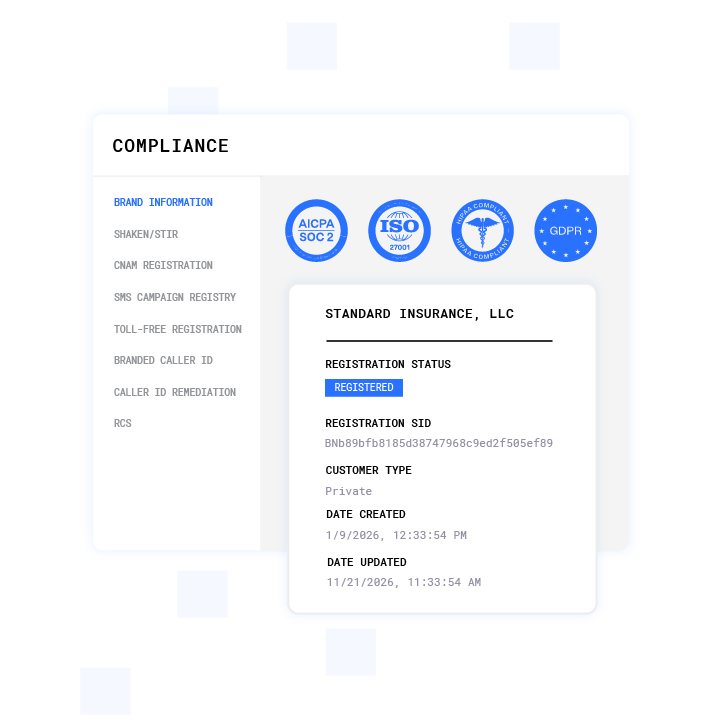
- STIR/SHAKEN authentication. STIR/SHAKEN (Secure Telephone Identity Revisited / Signature-based Handling of Asserted information using toKENs) authenticates caller identity on every outbound call. STIR/SHAKEN now sits in the baseline compliance stack for outbound operations in 2026 alongside DNC scrubbing and caller ID reputation monitoring. Platforms that do not own their carrier cannot sign calls at A-level attestation under their own identity.
- Audit-ready export. Every pre-dial decision, suppression event, consent record, and opt-out should be logged with a timestamp and exportable on demand. TSR violations can lead to penalties of up to $43,792 per non-compliant contact. An audit-ready trail becomes a primary defense in a regulatory inquiry or TCPA litigation.
Legal Landscape for Ringless Voicemail Drops
The legal status of ringless voicemail (RVM) drops in the United States remains unsettled at the federal level.2 Courts remain split on whether RVM constitutes a “call” under 47 U.S.C. § 227, and the FCC has not issued a final rule that addresses ringless voicemail specifically. The FCC’s February 2024 Declaratory Ruling established that AI-generated voices in robocalls are “artificial” voices under the TCPA, and the FCC ruled in 2022 that ringless voicemails qualify as “calls” under the TCPA, which exposes senders to statutory damages when prior express written consent is absent.
Several states, including Florida and Oklahoma, impose additional prior express written consent expectations and stricter calling-hour limits for automated commercial calls beyond federal rules. Operators running multi-state campaigns should consult qualified counsel on the specific requirements in each jurisdiction before deploying voicemail drop programs.
Many high-volume teams adopt a conservative posture and treat every automated voicemail drop to a cell phone as a covered call under the TCPA. They scrub against DNC lists in real time before each drop and maintain an immutable consent ledger. That posture remains relevant regardless of how courts ultimately resolve the RVM classification question.
1
Voicemail Drop Services for Cold Calling: Why Infrastructure Wins
Infrastructure underneath the voicemail drop matters more than the feature list on top of it. Most voicemail drop services in the market today are built on Twilio or another CPaaS (Communications Platform as a Service), which means they rent the carrier layer rather than own it. That structure creates three operational problems for high-volume teams.
First, branded caller ID cannot be issued at the carrier level by a reseller. The call presents under the reseller’s carrier identity, not the operator’s, which limits the ability to display a verified business name and call reason on the recipient’s screen. Hiya’s State of the Call 2026 report found that 86% of consumers in six countries do not answer unknown calls, and businesses using branded calling typically report answer rate increases of 30% to 70% versus unbranded calls, with some case studies showing gains up to 133%.3 Lower answer rates and weaker voicemail callbacks follow when calls present as unknown.
Second, real-time DNC scrubbing at the carrier layer before the call leaves the network is not possible on a reseller stack. Compliance controls sit after the carrier hop, which creates an enforcement gap between the platform and the network.
Third, voicemail drop programs that operate without stateful cross-channel memory treat every contact as a new conversation. A prospect who replied to an SMS cadence and then receives a voicemail drop gets no continuity. That gap hurts conversion and can create inconsistent handling of opt-outs across channels.
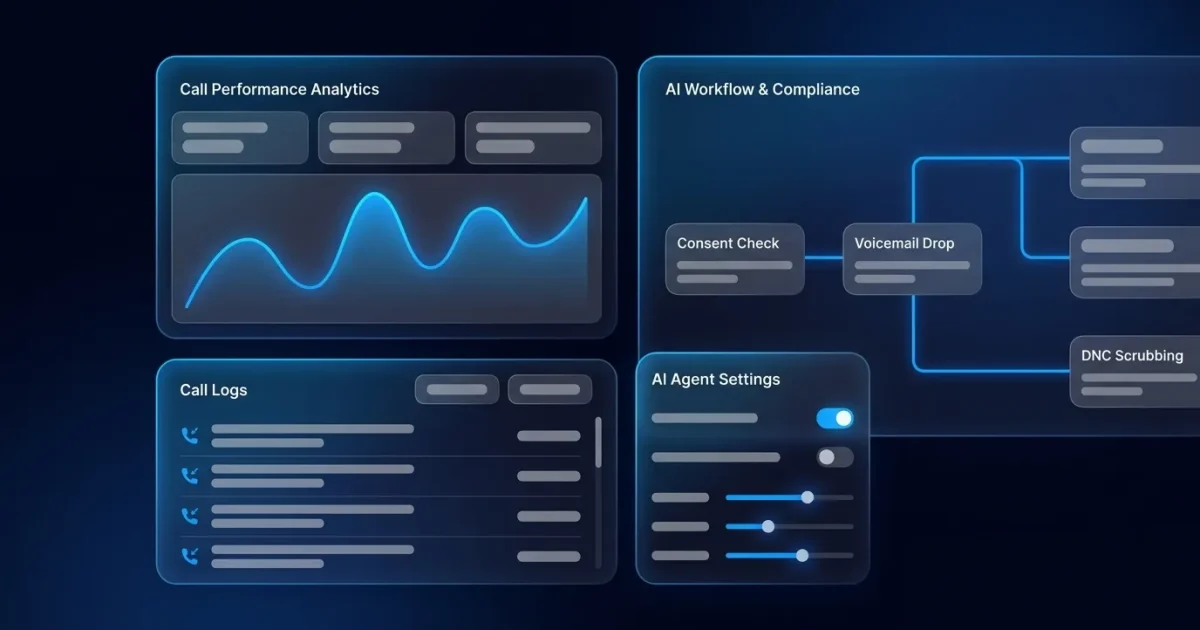
Plura’s AI Predictive Dialer runs on Plura’s own FCC-licensed audio bridging carrier. Branded caller ID is issued at the carrier level. Real-time DNC scrubbing runs before each dial. The Stateful Conversation Database means the voicemail drop is informed by every prior interaction across voice, SMS, RCS, and webchat.
Diagnosing Underperforming Power Dialer Voicemail Drops
Underperforming voicemail drop programs usually trace back to one of four root causes.
AMD accuracy. Answering machine detection (AMD) classifies a connected call as human or machine within the first seconds. Top-performing AMD systems classify calls quickly and achieve high bridge-to-connect rates, while the industry average is lower. A false-positive AMD error that labels a live human as voicemail abandons a live prospect and counts toward the FCC’s abandoned-call rate cap. Uncertain AMD cases should default to the human branch to reduce this failure mode.
Caller ID reputation. AI voice agents face higher spam-labeling risk than human agents because they place high-volume calls from consistent numbers on repeating timing patterns that carrier algorithms flag as non-human traffic. A drop that reaches voicemail but presents as “Spam Likely” generates almost no callbacks.
Stale DNC data. Batch scrubbing leaves gaps because consumers can opt out or numbers can be reassigned between scheduled scrubs. Campaigns running on stale suppression data create compliance exposure and waste drop budget on numbers that should have been suppressed.
No follow-up sequencing. Average B2B voicemail callback rates run between 4% and 5%.3 Voicemail drops perform best as one touch in a multi-channel sequence, not as a standalone tactic. Pairing a drop with an immediate SMS follow-up, informed by the same conversation memory, raises response rates in a measurable way. Understanding which dialer architecture supports that multi-channel coordination requires distinguishing between power dialers and predictive dialers.
AI Power Dialer vs. Predictive Dialer for Voicemail Drops
A power dialer dials one number per agent at a time and moves to the next number when the current call ends or goes to voicemail. An AI predictive dialer uses statistical modeling and real-time conversion signals to dial multiple numbers simultaneously, connect agents only to live answers, and route voicemails to automated drop workflows without agent involvement.
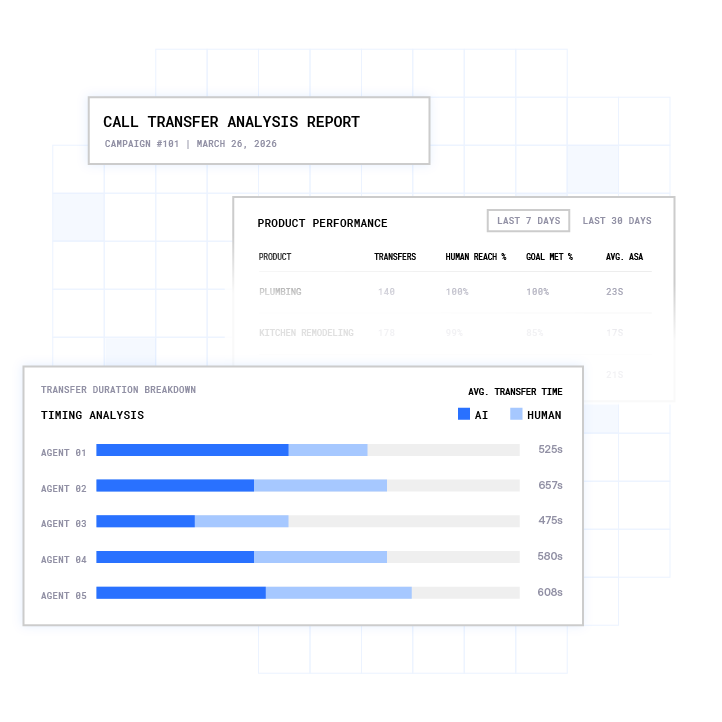
The operational difference shows up in talk time. A predictive dialer reduces the time a rep spends per number on failed calls, busy signals, and voicemail by automatically handling non-answers. Advanced AI predictive dialers can achieve up to 45 to 50 minutes of real conversation per hour versus around 12 minutes on a traditional power dialer setup, on the same team size.3
The compliance profile also differs. Predictive dialers must track the FTC’s 2% abandoned-call cap per campaign per day under the Telemarketing Sales Rule. A black-box AMD setting that operators cannot audit or tune creates TCPA exposure because false-positive machine detections can cause live calls to be dropped, counting toward the abandonment limit, or prerecorded messages to play to live answers without consent.
Plura’s AI Predictive Dialer includes tunable AMD controls, real-time DNC scrubbing, automated quiet-hours enforcement, and STIR/SHAKEN authentication on every outbound call, with enforcement applied at the carrier layer before the call leaves the network. That compliance infrastructure also drives cost efficiency because carrier-level AMD accuracy and call routing deliver more agent talk time per hour than reseller stacks.
Orum vs. Plura AI Predictive Dialer: Structural Differences
Orum operates as a parallel dialer built for B2B sales development teams.4 It runs as a software layer on top of third-party telephony infrastructure, which means it does not own the carrier stack, cannot issue branded caller ID at the carrier level, and cannot enforce real-time DNC scrubbing before the call leaves the network. Compliance features function as add-ons rather than core platform layers.
Plura operates as its own FCC-licensed audio bridging carrier. The compliance and identity layers, real-time DNC scrubbing, STIR/SHAKEN authentication, branded caller ID, TCPA consent logging, and quiet-hours enforcement are applied inside the platform before each dial, not bolted on after the fact.
The second structural difference involves cross-channel memory. Orum functions as a dialer. Plura functions as a communications OS. The Stateful Conversation Database means a prospect who received an SMS at 9 a.m. is recognized when the AI Predictive Dialer reaches them at noon. The voicemail drop, if triggered, is informed by that prior context. No other dialer category preserves that continuity across channels by default.
For a full side-by-side breakdown of Plura against other platforms on carrier ownership, real-time DNC, branded caller ID, and cross-channel memory, visit plura.ai/compare.
Carrier-Owned Infrastructure vs. Twilio-Based Resellers
Carrier ownership determines which compliance and identity features are possible in practice, not just which ones appear in marketing copy.
Twilio-based API resellers sit between the operator and the carrier. They can enforce some compliance rules at the application layer, but they cannot issue branded caller ID under their own carrier identity, cannot sign calls at A-level STIR/SHAKEN attestation under their own operating company number, and cannot run DNC scrubbing at the network edge before the call leaves the carrier. Every compliance feature sits downstream of the carrier, which means it sits downstream of Twilio’s infrastructure decisions.
Plura owns its FCC-licensed audio bridging carrier, which means voice originates on Plura’s domestic infrastructure rather than a third-party network. That ownership enables carrier-level enforcement. Branded caller ID is issued at the carrier level. STIR/SHAKEN authentication runs on every outbound call under Plura’s own operating company number. Real-time DNC scrubbing, TCPA-litigator list filtering, and quiet-hours enforcement are all applied before the call leaves the network. Synthflow, for example, depends on Twilio and operates as a software layer without a carrier license4, which means it cannot replicate these carrier-level capabilities.
The talk-time advantage described earlier compounds at scale because AMD accuracy and call routing are optimized at the carrier level rather than the application layer. Carrier-owned platforms also originate calls on their own network rather than reselling upstream carrier minutes, which produces lower per-minute economics.
Review Plura plans and rates side by side at plura.ai/pricing.
Stateful Conversation Memory Across Voice, SMS, and Webchat
Channel silos create both conversion friction and compliance gaps for outbound teams. Most AI power dialers treat each channel as a separate system. A voicemail drop goes out on Monday. An SMS follow-up goes out on Tuesday. The AI Predictive Dialer reaches the prospect on Wednesday. None of those touchpoints share memory, so the prospect re-explains their situation on every contact and opt-outs in one channel may not reach the others.
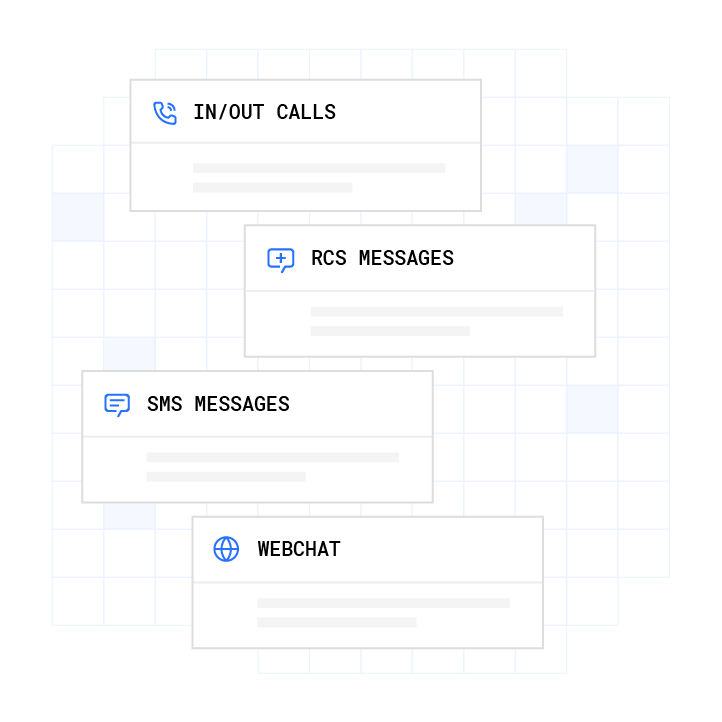
Plura’s Stateful Conversation Database keys every interaction to a customer token, phone number, email, or ID and persists that record across voice, SMS, RCS, and AI webchat. The voicemail drop is informed by prior SMS exchanges. The follow-up call picks up where the voicemail left off. Objections raised in one channel are visible in the next. This behavior comes from owning the full communications stack on a single stateful data layer, not from a narrow dialer feature.
For high-volume outbound teams running thousands of contacts monthly, stateful memory also functions as a compliance asset. Opt-outs received in any channel propagate immediately across all connected campaigns. Cross-channel opt-outs from phone, email, text, and web forms should feed directly into the DNC suppression list without manual steps to support consistent honoring across all channels under 2026 TCPA requirements.
Frequently Asked Questions
What consent is needed before an AI power dialer drops a voicemail to a cell phone?
The TCPA framework covers prerecorded and AI-generated voice messages to cell phones for marketing purposes. The FCC’s February 2024 Declaratory Ruling classified AI-generated voices as “artificial” voices under the TCPA, placing them in the same consent category as traditional prerecorded messages. The specific consent standard that applies to a given campaign depends on the type of call, the jurisdiction, and recent court decisions that have shifted the landscape at the circuit level. Operators should consult qualified counsel to determine the consent framework that applies to their specific outbound program. Plura supports compliance efforts by maintaining an immutable, timestamped consent ledger for every contact and enforcing suppression rules in real time before each dial.
How does real-time DNC scrubbing differ from batch scrubbing in an AI power dialer?
Batch scrubbing checks a contact list against DNC registries at a fixed point in time, typically at campaign load or on a scheduled cycle. The FTC requires scrubbing against the National DNC Registry no more than 31 days before any call, but numbers can be registered at any time between scrubs. Real-time per-dial scrubbing validates each number against federal, state, and internal suppression lists at the exact moment of contact, which closes the gap that batch processing leaves open. For AI power dialers operating at high volume, the difference is material because a campaign running on stale data can generate thousands of non-compliant contacts before the next batch cycle catches the error. Plura enforces real-time DNC scrubbing before each dial, with every suppression decision logged and timestamped for audit purposes. Eleven states maintain their own DNC registries in addition to the federal list, and Plura’s compliance engine supports state-level scrubbing alongside the National DNC Registry.
Why does carrier ownership matter for branded caller ID in voicemail drop programs?
Branded caller ID displays a verified business name, logo, and call reason on the recipient’s screen via major U.S. carriers. Issuing branded caller ID requires registering business identity at the carrier level and signing calls with STIR/SHAKEN A-level attestation under the operator’s own operating company number. Platforms built on Twilio or another CPaaS cannot do this under their own carrier identity because they do not own the carrier. They inherit the reseller’s caller ID reputation, not the operator’s. Plura issues branded caller ID directly through its FCC-licensed carrier, which means calls present with the operator’s verified business name rather than an unknown number or “Spam Likely” label. A Morning Consult survey found that 51% of U.S. consumers reported missing legitimate business calls because they did not recognize the number, which highlights the cost of unbranded calls. For voicemail drop programs, branded caller ID also affects callback rates because a drop from a recognized business name generates more callbacks than one from an unverified number.
What is the cost-per-connected-call difference between a carrier-owned AI predictive dialer and a Twilio-based reseller?
The cost difference operates at two levels. At the infrastructure level, carrier-owned platforms originate calls on their own network rather than reselling upstream carrier minutes, which produces lower per-minute economics. At the operational level, the difference shows up in talk time. Plura’s AI Predictive Dialer delivers more agent talk time per hour than traditional power dialer setups on the same team size because AMD accuracy and call routing are optimized at the carrier level. Operators can run their own numbers through Plura’s ROI calculator at plura.ai/calculator to model cost-per-connected-call savings against their current setup.
How does Plura AI handle opt-out propagation across voice and SMS channels?
Plura’s Stateful Conversation Database keys every interaction to a customer token across voice, SMS, RCS, and webchat. When an opt-out is received on any channel, it propagates immediately to the internal suppression list and is enforced across all connected campaigns without a manual step. This architecture supports the FCC Consent Revocation Rule, which addresses how businesses should honor opt-out requests within 10 business days and, effective January 31, 2027, treats a consumer’s revocation of consent for one type of communication as applying to all future robocalls and robotexts from that caller on unrelated matters. Plura’s compliance engine logs every opt-out with a timestamp and channel of receipt, and the suppression record is retained for audit purposes. Customers remain responsible for their own compliance obligations and should consult qualified counsel on the specific requirements applicable to their campaigns.
Run the Numbers and Compare Plans
High-volume outbound teams running AI power dialer voicemail drop programs face two compounding risks. TCPA exposure grows when platforms cannot enforce compliance at the carrier level. Cost per connected call rises when dialers deliver lower talk time per hour instead of efficient performance. Both problems trace to the same root cause: infrastructure built on a reseller stack rather than an owned carrier.
Plura AI’s FCC-licensed carrier infrastructure addresses both risk categories by applying real-time DNC scrubbing, STIR/SHAKEN authentication, branded caller ID, immutable consent logging, and stateful cross-channel memory before each dial rather than after the fact. The result is lower cost-per-connected-call and reduced TCPA exposure on the same outbound volume.
To evaluate whether Plura’s carrier-owned infrastructure delivers cost and compliance advantages for your team, start with the ROI calculator to model your cost-per-connected-call savings, review plans and rates at plura.ai/pricing, or book a live demo to see the compliance engine, AMD accuracy, and stateful memory in a live outbound workflow.
1 Plura AI maintains SOC 2, HIPAA, ISO, and GDPR posture as part of its platform infrastructure. References to compliance frameworks in this article describe Plura’s platform capabilities and do not constitute a guarantee that any customer using Plura will themselves be compliant with applicable laws or standards. Customers remain solely responsible for their own regulatory obligations, certifications, consent management, recordkeeping, and the claims they make to their own end users. Consult qualified legal counsel for guidance specific to your use case.
2 This article describes regulatory frameworks at a general level and does not constitute legal advice. Laws and regulations vary by jurisdiction, change over time, and apply differently depending on facts and circumstances. Readers should consult qualified legal counsel before making compliance decisions.
3 Performance figures, customer outcomes, and industry statistics referenced in this article are drawn from cited third-party sources or Plura customer case studies. Individual results vary based on implementation, use case, industry, audience, and execution. Past or aggregate performance is not a guarantee of future results.
4 References to third-party products, services, companies, or research are made for informational and comparative purposes only. Plura AI is not affiliated with, endorsed by, or sponsored by any third party named in this article unless explicitly stated. Trademarks and product names referenced remain the property of their respective owners.
This article is provided for informational purposes only and reflects Plura AI’s understanding at the time of publication. Product capabilities, integrations, and specifications are subject to change. For the most current information, visit plura.ai.
This article was produced with the assistance of AI tools and reviewed by Plura AI prior to publication.