

Written by: Matt Beucler, CEO, Plura AI
Updated May 2026
Key Takeaways for Revenue and Operations Leaders
-
AI sales automation splits into prospecting tools that find and initiate contact with leads and conversation execution platforms that handle qualification, negotiation, and closing across multiple channels.
-
Most teams lose deals because first contact often happens nearly two days after inquiry, while sub‑5‑minute responses dramatically increase connection and conversion rates.
-
Prospecting platforms like Clay, Apollo.io, and Outreach solve research and sequencing but leave the actual conversation work to human queues that move at human speed, creating the execution gap where deals die.4
-
Conversation execution requires sub‑5‑second response, persistent cross-channel memory, carrier-level infrastructure, real-time DNC scrubbing, and negotiation guardrails, capabilities that most point solutions do not provide.
-
Plura AI delivers the missing execution layer as an FCC-licensed, stateful AI agent that responds in under 5 seconds across voice, SMS, RCS, and webchat. Book a live demo with Plura to see how it closes the revenue gap for your team.
The Structural Problem Behind Slow Lead Response
The industry standard for first contact on an inbound lead is 47+ hours. Contacting a lead within 5 minutes makes them up to 100× more likely to connect, and a 60-second response lifts conversions by 391%.3 Most sales teams operate far outside those response windows.
The gap is structural, not motivational. Sales reps spend approximately 24 hours per week on non-revenue administrative tasks, including data entry, scheduling, and follow-ups.
The tools most teams deploy, such as Clay, Apollo.io, Outreach, and Salesloft, solve research and sequencing. They do not solve the conversation work. After a lead is identified and an email sequence fires, qualification, objection-handling, and closing still sit in a human queue that moves at human speed. That queue is where many deals stall or disappear.
Fragmented point solutions increase both cost and risk. A typical high-volume operator runs a CRM, a dialer, an SMS platform, a compliance bolt-on, and an analytics layer, each with its own contract, integration risk, and audit trail. None of these systems share conversation memory. A lead who texted at 9 a.m. often has to re-explain themselves when the call comes at noon. Understanding why this happens requires looking at the three main categories of tools most teams use today and seeing where each one stops.
Where Today’s Tools Stop: Enrichment, Sequencing, Intelligence
The AI sales automation market organizes into three upstream categories, each solving a distinct pre-execution problem.
Lead enrichment platforms such as Clay, ZoomInfo, and Apollo.io focus on contact discovery and data quality. These tools exist to put the right lead in front of a rep, not to hold the conversation.
Outreach sequencing platforms such as Outreach and Salesloft manage multi-channel cadences for SDR teams booking meetings. They automate sends and reminders. They do not execute live conversations.
Conversation intelligence platforms such as Gong analyze recorded calls and emails to surface coaching insights and objection patterns. Reps preparing for calls see Gong’s view of a deal rather than a combined picture that includes support history and product documentation. Gong observes conversations. It does not conduct them.
Each category delivers value within its lane. None of them cross into real-time execution where revenue is actually created. Book a live demo with Plura to see how the execution layer works end-to-end. Schedule your demo here.
Prospecting vs. Conversation Execution in Daily Operations
Prospecting tools focus on detection, prioritization, and initiation. AI-powered prospecting platforms process real-time data from CRM systems, social media, and website interactions to deliver up-to-date insights that guide outreach timing and personalization. These platforms operate primarily in a detection and initiation mode, not in stateful conversation execution.
Conversation execution is a different engineering problem. It requires:
-
Sub‑5‑second response across voice, SMS, RCS, and webchat, simultaneously, 24/7
-
Persistent memory across channels so a lead’s prior interactions inform every subsequent touchpoint
-
Carrier-level infrastructure to originate calls with branded caller ID and STIR/SHAKEN caller ID authentication
-
Real-time DNC (Do Not Call) scrubbing before every outbound contact
-
Negotiation guardrails with defined floors and ceilings that allow the AI to operate without constant human intervention
Clay hands off a qualified lead list. Apollo.io fires a sequence. The conversation that actually closes or loses the deal happens after both tools finish their work. That is the point where Plura steps in.
Plura’s AI Voice, AI SMS, AI RCS, and AI Webchat all share a Stateful Conversation Database. Every interaction is keyed to the customer by phone, email, or ID, and every channel inherits the full memory of every prior touchpoint. Pricing offers, objections, qualification status, and sensitive-data redactions all persist across channels and over time.
Most Twilio-based API resellers in this space cannot match that architecture because they do not own the carrier. They rent the telecom layer from a third party, which means branded caller ID is not issued at origination, real-time DNC scrubbing sits as a bolt-on, and conversation state usually stays limited to a single session on a single channel.
Regulatory Reality in 2026 for Contact Centers
The compliance landscape for high-volume U.S. operators has shifted materially in 2026. These changes affect offshore vendors and domestic AI tools that depend on foreign infrastructure.
At the federal level, the FCC’s Notice of Proposed Rulemaking (NPRM, CG Docket No. 26-52) proposes capping offshore customer-service calls at 30% and limiting offshore handling of sensitive consumer data such as passwords, multi-factor authentication, Social Security numbers, banking, and card data. Companion legislation includes the Keep Call Centers in America Act (S.2495) and the Foreign Robocall Elimination Act (S.2666), which expand the federal regulatory perimeter.
At the state level, five jurisdictions have enacted or are enforcing active restrictions as of May 2026, creating a patchwork of requirements that operators must manage in parallel. New York’s Call Center Jobs Act carries penalties up to $10,000 per day. New Jersey has enacted a mirror statute with similar enforcement mechanisms. Connecticut restricts offshore handling under state-contract frameworks. Missouri issued an executive order requiring offshore disclosure. Florida restricts offshore handling of medical information. Operators with contracts covering any of these states should consult qualified counsel on their current exposure.
On consent and disclosure, the FCC’s One-to-One Consent Rule was scheduled to take effect on January 27, 2025, but the FCC postponed its effective date pending judicial review. The rule describes separate, explicit consent specific to each caller, rather than shared consent across multiple businesses or lead generators. A pending FCC NPRM on AI-generated calls proposes mandatory in-call AI disclosure and specific consent language referencing AI use, though final timing remains uncertain as of April 2026. TCPA (Telephone Consumer Protection Act, 47 U.S.C. § 227) violations carry statutory damages of $500 to $1,500 per call or text with no aggregate cap. Readers should consult the Federal Register and qualified counsel for the current rule status.2
The Product: Plura AI as the Execution Layer
Plura AI is built for this regulatory and operational reality. It is not a Twilio wrapper or a prospecting tool with a chat widget attached. It is an FCC-licensed carrier that originates voice traffic on its own domestic infrastructure, with conversation execution across voice, SMS, RCS, and webchat running on a single Stateful Conversation Database.
Key platform capabilities:
-
FCC-licensed audio bridging carrier, where voice originates on Plura’s own infrastructure, not a third-party CPaaS. Branded caller ID is issued at the carrier level, and STIR/SHAKEN authentication runs on every outbound call.
-
Stateful Conversation Database, where every interaction across all four channels is keyed to the customer token and persists. The AI that texted at 9 a.m. can pick up the call at noon, already knowing what was said.
-
Real-time DNC scrubbing, where every outbound contact is checked against federal and state DNC registries before dial, and non-compliant numbers are blocked before the first attempt.
-
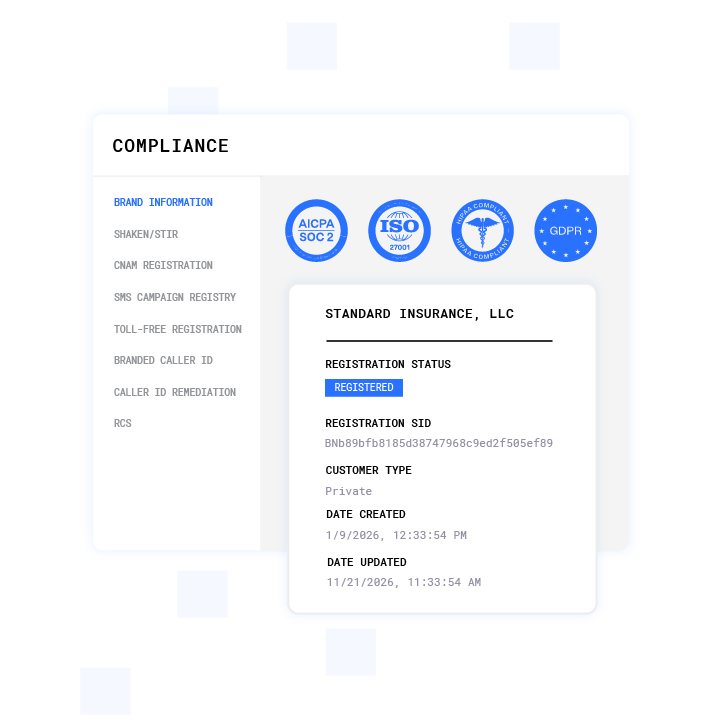
Compliance support infrastructure, where the platform supports SOC 2, HIPAA, ISO certification, GDPR, SHAKEN/STIR caller ID verification, TCPA compliance, and DNC compliance.1 Customers remain responsible for their own regulatory obligations and certifications.
-
100% U.S. infrastructure by architecture, where voice origination, model hosting, data storage, and call recording all sit on domestic infrastructure, reducing foreign-infrastructure exposure under the FCC NPRM.
The TCO (total cost of ownership) math is direct. Plura’s TCO of $300,000–$700,000 per year replaces the traditional $4M–$7M contact-center cost structure on equivalent volume. Using the default scenario on Plura’s ROI calculator, a 15-agent operation at $20 per hour with standard overhead costs $60,000 per month.3 Six Plura agents handling the same volume at 100% talk utilization cost $14,400 per month, which yields a 30-day saving of $45,600 and a 12-month saving of $547,200.
|
Category |
Primary Function |
Conversation State |
Infrastructure |
|---|---|---|---|
|
Lead enrichment (e.g., Clay, Apollo.io) |
Contact discovery, data enrichment, and outreach initiation |
None, pre-conversation only |
Third-party data APIs, no carrier ownership |
|
Sequencing platforms (e.g., Outreach, Salesloft) |
Multi-channel cadence automation for SDR teams |
Single-session, single-channel |
Third-party CPaaS for voice and SMS |
|
Conversation intelligence (e.g., Gong) |
Post-call analysis, coaching, pipeline visibility |
Retrospective only, no live execution |
Cloud analytics, no carrier ownership |
|
Live conversation execution across voice, SMS, RCS, and webchat |
Stateful, cross-channel, persistent |
FCC-licensed carrier, 100% U.S. infrastructure |
Run your numbers through Plura’s calculator to check your ROI in real time. plura.ai/calculator.
How AI Changes the Sales Rep’s Day
Rather than replacing human sales professionals, AI is positioned to amplify their capabilities by eliminating the administrative burden that has historically consumed their time.
Plura’s model is explicit. AI handles the volume work such as first contact, qualification, follow-up cadences, and appointment confirmation. When a workflow gate triggers, the system warm-transfers to a U.S. human agent. The rep who receives that transfer already has full context from the Stateful Conversation Database and does not need to restart discovery.
On spam labels: Plura issues branded caller ID directly through its FCC-licensed carrier and remediates spam labels at the carrier level. Calls present with the company’s name and the reason for the call. Most Twilio-based competitors cannot match this because they do not own the carrier and inherit the CPaaS provider’s caller-ID reputation.
On compliance: Plura’s compliance engine supports TCPA, DNC, HIPAA, SOC 2, ISO certification, GDPR, and SHAKEN/STIR caller ID verification as first-class platform layers. Every outbound contact is checked against federal and state DNC registries in real time before dial. Consent records are timestamped and immutable. Customers remain responsible for their own compliance obligations, and Plura provides infrastructure that supports those obligations.
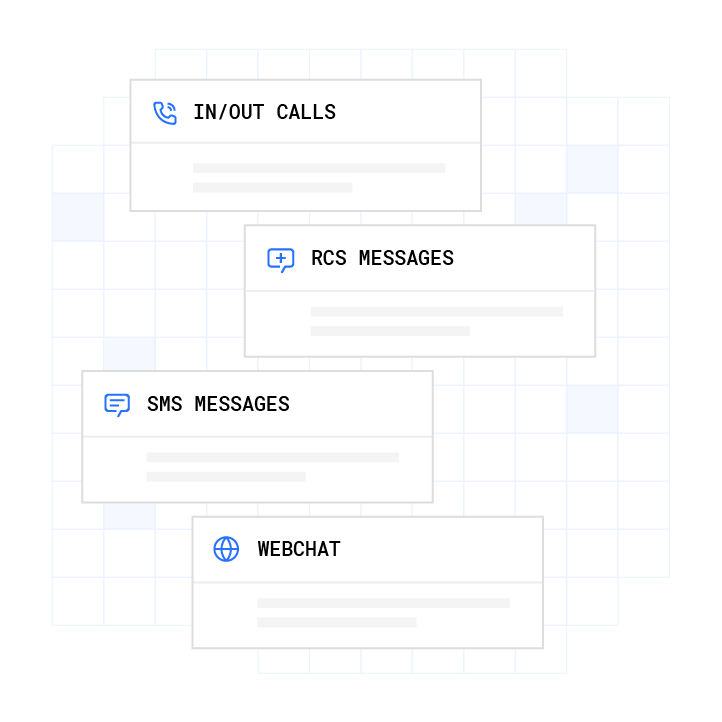
On team adoption: The day-to-day management surface is a Unified Inbox that consolidates voice transcripts, SMS threads, RCS exchanges, and webchat sessions per customer in a single screen. Workflow design uses a no-code visual canvas. Marketing and sales leaders typically reallocate 20–30% of team capacity from manual outreach to strategy and creative within the first 90 days.
Frequently Asked Questions
What is the difference between AI prospecting tools and AI conversation execution platforms?
Prospecting tools such as Clay, Apollo.io, and ZoomInfo identify leads, enrich contact data, and initiate outreach sequences. They are designed to get the right lead in front of a rep at the right time. Conversation execution platforms take over after that handoff. They conduct the actual voice call, SMS thread, RCS exchange, or webchat session, maintain memory across all of those channels, and carry the lead through qualification, objection-handling, and close. The two categories are complementary, and the execution layer is where deals are most often won or lost.
How does Plura handle compliance for high-volume outbound campaigns?
Plura’s compliance infrastructure supports TCPA, DNC, HIPAA, SOC 2, ISO certification, GDPR, and SHAKEN/STIR caller ID verification. Every outbound contact is checked against federal and state DNC registries in real time before dial. Consent records are timestamped, immutable, and exportable for audit review. Quiet-hours rules enforce automatically through time-zone detection, and the platform supports 50+ state-level rule sets. Customers are responsible for their own regulatory obligations and should consult qualified counsel on their specific compliance posture. Plura provides the infrastructure, and downstream compliance remains the customer’s responsibility.
What does “stateful conversation” mean in practice?
Stateful conversation means the AI retains full memory of every prior interaction with a lead across every channel and uses that memory in every subsequent touchpoint. If a lead received an SMS offer at 9 a.m. and calls back at noon, the AI voice agent already knows what was offered, what the lead said, and what remains open. The system does not ask the lead to repeat themselves. That context also includes qualification status, sensitive-data redactions, negotiation history, and any prior objections raised. Many AI voice tools are stateless by default because the vendor does not own a cross-channel data layer, so each session starts from zero.
How does Plura’s pricing compare to a traditional contact center?
The default scenario on Plura’s ROI calculator demonstrates a 12-month saving of $547,200 for a typical 15-agent operation. For higher-volume deployments, the TCO advantage scales proportionally, with Plura’s total cost of ownership in the $300,000–$700,000 range against a traditional contact-center benchmark of $4 million to $7 million. Three pricing tiers are available, including Multi at $5,000 per month, Agency at $7,500 per month, and Enterprise on a custom basis, all on annual contracts with a 90-day opt-out window.
Which industries does Plura serve?
Plura serves any high-volume operator with at least 500 daily customer interactions or $5,000 per month in paid-media spend. Active deployment patterns include healthcare, with appointment confirmations, patient intake, and eligibility surveys that deliver up to 40% improvement in no-shows, along with insurance, financial services, legal, real estate, franchise networks, agencies, e-commerce, automotive, and government-adjacent enterprises. All deployments inherit the same FCC-licensed carrier infrastructure, stateful database, and compliance support layers regardless of vertical.
Conclusion: Closing the Execution Gap
The prospecting layer of AI sales automation is well-served. Clay enriches lists, Apollo.io sequences outreach, and Gong analyzes what happened after the call. None of these tools close the gap between lead identification and live conversation execution, which includes sub‑5‑second response, cross-channel memory, and real negotiation.
In 2026, that execution gap also carries regulatory exposure. The FCC NPRM, the Keep Call Centers in America Act, and active state laws in New York, New Jersey, Connecticut, Missouri, and Florida have turned offshore infrastructure and fragmented compliance bolt-ons into operational liabilities. Operators who have not reviewed their vendor stack against these frameworks should do so with qualified counsel.
Plura closes the execution gap as an FCC-licensed, stateful platform delivering sub‑5‑second response, cross-channel memory, and compliance support infrastructure on 100% U.S. infrastructure. The economics include a $300,000–$700,000 TCO replacing $4 million–$7 million in traditional cost, material pipeline growth, faster lead-response times, and a 90-day opt-out window in every annual contract.
Run your numbers through Plura’s calculator to check your ROI in real time. plura.ai/calculator. Compare plans and rates side by side at plura.ai/pricing. Or book a live demo with Plura directly at plura.ai/plura-webchat.
1 Plura AI maintains SOC 2, HIPAA, ISO, and GDPR posture as part of its platform infrastructure. References to compliance frameworks in this article describe Plura’s platform capabilities and do not constitute a guarantee that any customer using Plura will themselves be compliant with applicable laws or standards. Customers remain solely responsible for their own regulatory obligations, certifications, consent management, recordkeeping, and the claims they make to their own end users. Consult qualified legal counsel for guidance specific to your use case.
2 This article describes regulatory frameworks at a general level and does not constitute legal advice. Laws and regulations vary by jurisdiction, change over time, and apply differently depending on facts and circumstances. Readers should consult qualified legal counsel before making compliance decisions.
3 Performance figures, customer outcomes, and industry statistics referenced in this article are drawn from cited third-party sources or Plura customer case studies. Individual results vary based on implementation, use case, industry, audience, and execution. Past or aggregate performance is not a guarantee of future results.
4 References to third-party products, services, companies, or research are made for informational and comparative purposes only. Plura AI is not affiliated with, endorsed by, or sponsored by any third party named in this article unless explicitly stated. Trademarks and product names referenced remain the property of their respective owners.
5 This article contains forward-looking statements regarding industry trends, technology adoption, and future capabilities. These statements reflect current expectations and are subject to change. Plura AI undertakes no obligation to update forward-looking statements except as required.
This article is provided for informational purposes only and reflects Plura AI’s understanding at the time of publication. Product capabilities, integrations, and specifications are subject to change. For the most current information, visit plura.ai.
This article was produced with the assistance of AI tools and reviewed by Plura AI prior to publication.