
Written by: Matt Beucler, CEO, Plura AI
Key Takeaways for High-Volume AI Calling
- Lightweight AI voice tools break at scale because they lack carrier-grade infrastructure, branded caller ID, and real-time compliance controls for high-volume marketing.
- Most outbound calls are ignored due to spam labeling, and only direct FCC-licensed carrier ownership enables branded caller ID and SHAKEN/STIR verification that improves pickup rates.
- High-volume teams face rising TCPA, state, and FCC regulatory risk, and Plura AI embeds real-time DNC scrubbing, consent management, and AI disclosure to help reduce exposure.
- Lightweight API-wrapper tools hide 3 to 5 times true TCO once telephony, compliance, and concurrency costs are included, while Plura AI delivers $300,000 to $700,000 annual cost versus traditional $4 million to $7 million contact-center spend.
- Plura AI delivers a carrier-owned, U.S.-only stack with a Stateful Conversation Database across voice, SMS, RCS, and webchat so marketing teams can book a live demo and see sub-five-second lead response in action.
Why AI Marketing Calls Rarely Get Answered
Outbound call pickup rates have collapsed for most marketing teams. When a call arrives labeled “Spam Likely” on an iPhone running iOS 26, it rarely rings through. Apple’s call-screening layer intercepts unfamiliar numbers before the recipient ever sees them, and Android carriers apply similar reputation filters. As a result, the majority of outbound effort goes unanswered when carrier-grade caller identity is missing.
Infrastructure drives this problem. Most AI voice tools are API resellers built on top of third-party CPaaS providers. They inherit the caller ID reputation of the underlying telecom layer instead of owning their own. Branded caller ID, which presents the company name and call purpose to the recipient, requires direct carrier issuance. Platforms that rent their telecom stack cannot issue branded caller ID at the carrier level.
Speed magnifies the impact. Contacting a lead within the first five minutes makes them up to 100 times more likely to connect (industry research published on plura.ai/calculator), and narrowing that window to 60 seconds lifts conversions by 391%.3 The industry standard for first contact on an inbound lead sits at more than 47 hours, which explains why so much marketing budget fails to convert inbound interest into closed deals.
Plura AI issues branded caller ID directly through its FCC-licensed carrier. SHAKEN/STIR caller ID verification runs on every outbound call, and the platform communicates with iOS 26’s call-screening layer so calls present with the company name and call reason instead of an unknown number. The speed-to-lead architecture contacts new leads in under five seconds across voice, SMS, RCS, and webchat at the same time.
Book a live demo with Plura to see branded caller ID and sub-five-second lead response in action.
TCPA Risk Management for AI Voice Campaigns
The FCC’s February 2024 declaratory ruling confirmed that AI-generated voices count as “artificial or prerecorded voice” under the TCPA (Telephone Consumer Protection Act, 47 U.S.C. § 227), which raises the compliance bar for every marketing team running outbound AI voice campaigns.2 TCPA violations can cost $500 to $1,500 per call or text, with no aggregate cap and a private right of action that enables class actions. Readers should consult qualified counsel for guidance specific to their operations.
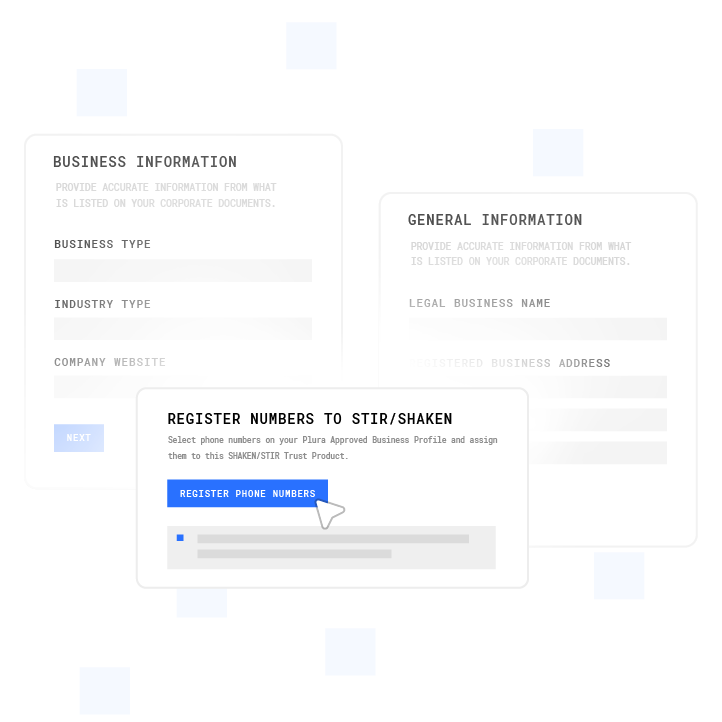
Plura supports compliance through a built-in compliance engine that enforces controls before each contact. The following checklist reflects the framework Plura applies across every outbound campaign.
- Prior express written consent (PEWC). Capture consent at the point of lead submission with timestamp, IP address, exact disclosure language, and page URL. Store records for the duration of the TCPA statute of limitations. Plura’s consent ledger is timestamped and immutable.
- Real-time DNC compliance. Scrub every number against the federal National Do Not Call Registry and applicable state lists before dial. Plura provides real-time DNC screening on every outbound contact.
- SHAKEN/STIR caller ID verification. Authenticate every outbound call at the carrier level to reduce spam labeling and support destination carrier verification requirements.
- Quiet-hours enforcement. Apply federal and state calling-window restrictions automatically through time-zone detection on the contact record. State-level rules in Florida, Oklahoma, Washington, and other jurisdictions can impose stricter windows than federal defaults.
- AI disclosure at call start. Every AI-initiated call identifies the calling business and the AI nature of the interaction within the first seconds of the call.
- Opt-out processing. Honor revocation requests received through any channel within the timeframes described in the April 2025 FCC Consent Revocation Rule. Plura’s suppression list syncs in real time across all channels.
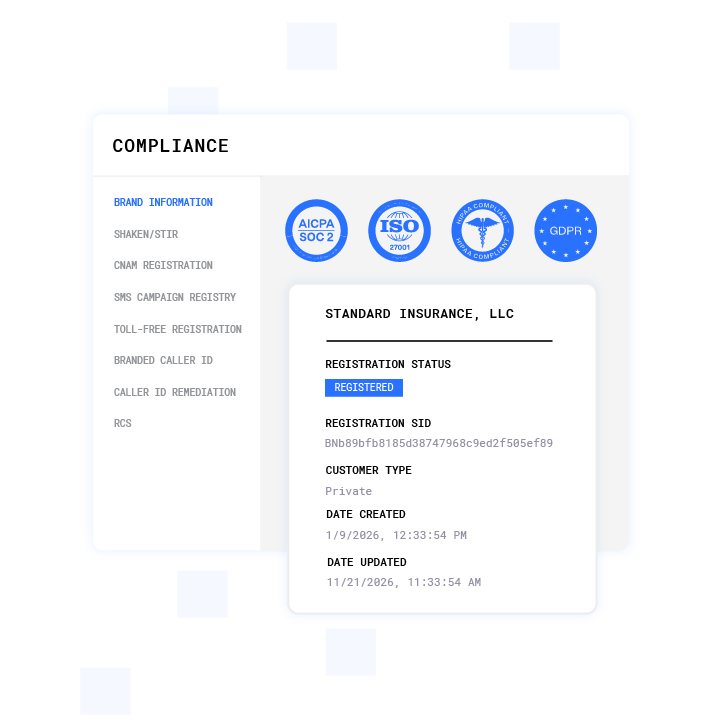
- SOC 2, HIPAA, ISO certification, and GDPR infrastructure. Plura’s platform operates under SOC 2 Type II continuous monitoring, HIPAA-aligned encryption and access controls, ISO certification, and GDPR coverage for European operations, with audit-ready exports available in one click to support compliance verification workflows.1
Customers remain responsible for their own regulatory obligations and the claims they make to their end users. Plura provides the infrastructure, and compliance posture downstream remains the customer’s responsibility.
Why U.S.-Only AI Infrastructure Now Affects Risk
The FCC’s Notice of Proposed Rulemaking (NPRM, CG Docket No. 26-52) proposes capping offshore customer-service calls at 30% of total volume and limiting offshore handling of sensitive consumer data such as passwords, multi-factor authentication codes, Social Security numbers, and banking and card data.2 Companion federal legislation, including the Keep Call Centers in America Act (S.2495) and the Foreign Robocall Elimination Act (S.2666), extends the regulatory perimeter further.
State-level exposure already affects many operations. New York’s Call Center Jobs Act carries penalties up to $10,000 per day. New Jersey, Connecticut, Missouri, and Florida each impose restrictions on offshore handling of medical, financial, or consumer data. Every offshore vendor contract a covered entity signed before these laws took effect now represents a compliance liability that sits on the balance sheet whether finance has priced it in or not.
AI tools with foreign infrastructure dependencies face similar exposure. A platform that routes voice through overseas data centers or hosts models on foreign infrastructure cannot credibly describe its handling as U.S.-only under the NPRM’s proposed rules or the existing state statutes.
Plura runs on 100% U.S. infrastructure by architecture. Voice origination, model hosting, data storage, and call recording all sit on domestic infrastructure. This approach is not a contractual promise layered on top of a foreign stack. It is the underlying design. Plura clients report “100% U.S.-handled” in their broadband consumer label disclosures and are not exposed to offshore disclosure mandates or the third-party-vendor liability extensions in the proposed rule. This article describes the regulatory landscape, and readers should consult qualified counsel for advice specific to their organization.
High-Volume TCO and Carrier Ownership Economics
The economics of lightweight API-wrapper tools break down at scale. Advertised per-minute rates represent roughly 20% of true total cost of ownership (TCO), and the fully loaded cost is typically 3 to 5 times higher once LLM tokens, telephony, concurrency, and compliance add-ons are included. For teams running thousands of calls monthly, the gap between a wrapper tax and a carrier-owned platform compounds quickly.
Plura’s TCO runs $300,000 to $700,000 per year, replacing the traditional $4 million to $7 million contact-center cost structure on equivalent volume.3 The default scenario on Plura’s ROI calculator shows a 15-agent operation at $20 per hour with standard taxes, benefits, and 40% talk utilization costing $60,000 per month. Six Plura agents at 100% talk utilization replace that team at $14,400 per month, which produces $45,600 in 30-day savings and $547,200 over 12 months.
The following capabilities distinguish carrier-owned platforms from API-wrapper tools.
| Capability | Lightweight API-Wrapper Tools | Plura AI |
|---|---|---|
| Carrier ownership | Third-party CPaaS (e.g., Twilio)4 | FCC-licensed audio bridging carrier |
| Branded caller ID | Not available at carrier level | Carrier-provisioned, issued directly |
| Real-time DNC scrubbing | Bolted on or customer-managed | First-class platform layer, pre-dial |
| Stateful cross-channel memory | Single-channel or session-only | Shared Stateful Conversation Database across voice, SMS, RCS, webchat |
For detailed feature comparisons, see Plura vs. Synthflow and Plura vs. Vapi.4
Run your numbers through Plura’s calculator to check your ROI in real time.
Cross-Channel Orchestration with Stateful Memory
The most common failure in high-volume marketing operations is not the first contact. The breakdown usually happens on the second touch. A lead who texted at 9 a.m. and receives a voice call at noon should not have to re-explain their situation. Most AI voice tools cannot prevent this because they operate as separate products with separate memories. Eighty-one percent of consumers react negatively when forced to repeat information across channels.
Plura’s Stateful Conversation Database addresses this at the architecture level. Every interaction across AI voice agent, AI SMS, AI RCS, and AI webchat is keyed to a customer token such as phone number, email, or ID and stored in one place. The AI reads and writes to this database on every conversation, referencing prior offers made, objections raised, qualification status, and sensitive-data redactions. A customer who texted at 9 a.m. is the same customer when the call comes at noon, and the agent already knows what was said.
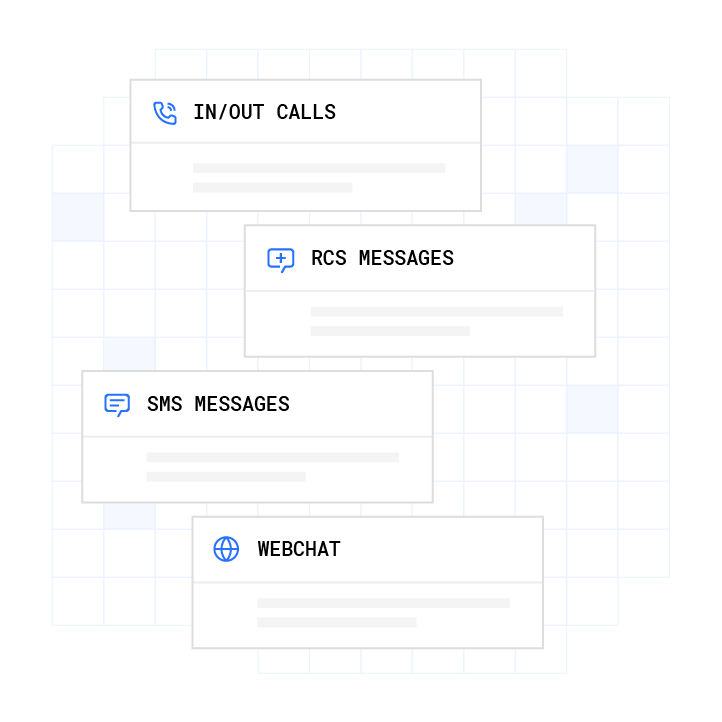
This architecture also powers Plura’s AI predictive dialer, which prioritizes outbound contacts using stateful conversion signals such as historical answer rates and prior negotiation outcomes. Calls flow over Plura’s FCC-licensed carrier with branded caller ID and SHAKEN/STIR caller ID verification on every dial.
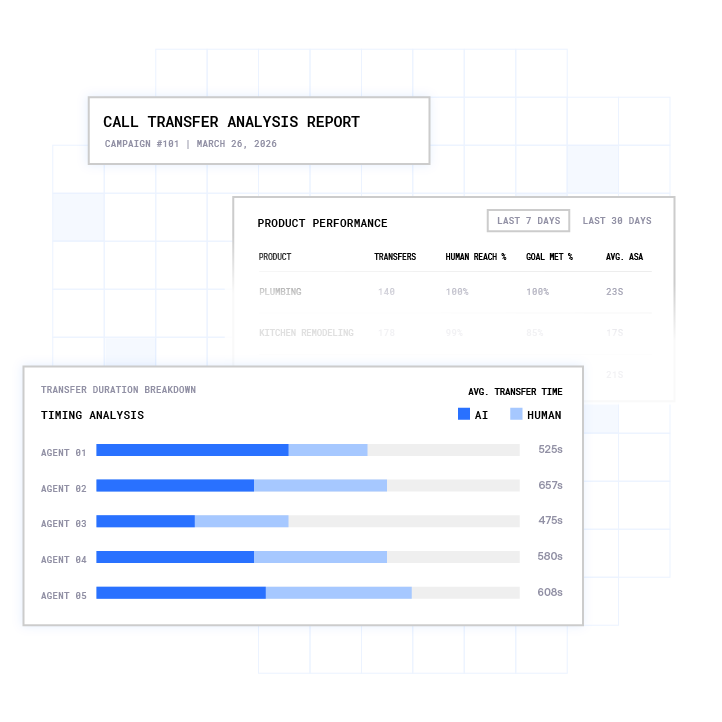
Plura enables lead response times under 60 seconds, multichannel engagement via voice, SMS, RCS, and webchat, real-time AI lead scoring, 7 to 12 follow-up touches, full conversation transcripts, and cost per qualified lead of $25 to $60.3 The conversation intelligence layer surfaces which scripts close, which objections recur, and which conversion paths win, then feeds those findings back into the no-code workflow builder for continuous iteration.
Plura’s integrations connect to more than 50 tools across CRM, calendar, attribution, and data enrichment categories, including HubSpot, Salesforce, Zoho, and Calendly. The AI agent reads the right customer record and triggers the right post-conversation event into the systems operators already run.
Frequently Asked Questions
Expected Latency for AI Voice Agents in 20265
Marketing teams should expect AI voice agents to deliver end-to-end response latency that feels natural to callers. Anything above 1.5 seconds creates a perceptible pause that signals an automated system. Human conversational response averages around 200 milliseconds, so the practical target for a voice agent that does not feel robotic is under 500 milliseconds. Plura’s carrier-owned infrastructure removes the CPaaS relay layer that adds latency in API-wrapper deployments and keeps voice interactions within the natural-feel threshold.
Consent Revocation Across Voice and SMS Campaigns
Under the FCC’s April 2025 Consent Revocation Rule, consumers may revoke consent through any reasonable means, including reply text, voicemail, email, or a verbal request during a call. Businesses must honor revocation requests within 10 business days. A “revoke-all” provision covering all future contacts from a sender is scheduled to take effect January 31, 2027. Plura’s suppression list syncs revocation signals in real time across all channels so that a verbal opt-out on a voice call immediately updates the same database that governs SMS and RCS outreach. Readers should consult qualified counsel for guidance on how these rules apply to their specific campaigns.
Why Carrier Ownership Matters for High-Volume Teams
CPaaS wrappers pass a relay tax to the customer in the form of higher per-minute rates, third-party caller ID reputation, and compliance controls that live outside the platform. Branded caller ID cannot be issued at the carrier level by a platform that does not own the carrier. Real-time DNC scrubbing bolted on after the fact creates an audit gap between the scrub event and the dial event. SHAKEN/STIR caller ID verification requires carrier-level authentication, not a software layer on top of rented telecom. At thousands of monthly calls, each of these gaps compounds into pickup rate degradation, compliance exposure, and TCO overruns that lightweight tools cannot resolve without the underlying infrastructure.
Impact of Cross-Channel Memory on Conversion Rates
Stateful memory across channels removes the re-introduction friction that causes leads to disengage on the second or third touch. When an AI agent on a voice call already knows the lead’s qualification status, the offer discussed in a prior SMS thread, and the objection raised in a webchat session, the conversation advances instead of restarting. This continuity supports Plura’s reported 47% average pipeline growth and 90% faster lead-response time. The Stateful Conversation Database also enables the AI predictive dialer to prioritize contacts based on prior interaction signals rather than static list order, which concentrates outbound effort on the contacts most likely to convert at that moment.
Conclusion and Next Steps for Marketing Leaders
An AI voice agent for marketing only performs as well as the infrastructure underneath it. Lightweight API-wrapper tools fail high-volume teams on pickup rate, compliance posture, cross-channel memory, and total cost of ownership. The FCC NPRM (CG Docket No. 26-52), state onshoring laws, and the April 2025 Consent Revocation Rule have raised the infrastructure bar further, which makes carrier ownership and U.S.-only architecture operational requirements for many organizations.
Plura’s FCC-licensed carrier stack, branded caller ID issuance, real-time DNC compliance, SHAKEN/STIR caller ID verification, SOC 2, HIPAA, ISO certification, GDPR coverage, and Stateful Conversation Database across voice, SMS, RCS, and webchat deliver the architecture high-volume marketing teams require.1 The economics described above translate into cost per qualified lead of $25 to $60 at scale.
Run your numbers through Plura’s calculator to check your ROI in real time.
Compare plans and rates side by side at Plura’s pricing page.
1 Plura AI maintains SOC 2, HIPAA, ISO, and GDPR posture as part of its platform infrastructure. References to compliance frameworks in this article describe Plura’s platform capabilities and do not constitute a guarantee that any customer using Plura will themselves be compliant with applicable laws or standards. Customers remain solely responsible for their own regulatory obligations, certifications, consent management, recordkeeping, and the claims they make to their own end users. Consult qualified legal counsel for guidance specific to your use case.
2 This article describes regulatory frameworks at a general level and does not constitute legal advice. Laws and regulations vary by jurisdiction, change over time, and apply differently depending on facts and circumstances. Readers should consult qualified legal counsel before making compliance decisions.
3 Performance figures, customer outcomes, and industry statistics referenced in this article are drawn from cited third-party sources or Plura customer case studies. Individual results vary based on implementation, use case, industry, audience, and execution. Past or aggregate performance is not a guarantee of future results.
4 References to third-party products, services, companies, or research are made for informational and comparative purposes only. Plura AI is not affiliated with, endorsed by, or sponsored by any third party named in this article unless explicitly stated. Trademarks and product names referenced remain the property of their respective owners.
5 This article contains forward-looking statements regarding industry trends, technology adoption, and future capabilities. These statements reflect current expectations and are subject to change. Plura AI undertakes no obligation to update forward-looking statements except as required.
This article is provided for informational purposes only and reflects Plura AI’s understanding at the time of publication. Product capabilities, integrations, and specifications are subject to change. For the most current information, visit plura.ai.
This article was produced with the assistance of AI tools and reviewed by Plura AI prior to publication.