

Written by: Matt Beucler, CEO, Plura AI | Last updated: August 7, 2026
Key Takeaways
- Automated lead scoring combines firmographic fit signals with behavioral intent signals to assign numeric values that help sales teams prioritize outreach effectively.
- Rule-based, predictive ML, and hybrid scoring models each create different trade-offs in accuracy, explainability, and maintenance requirements for B2B organizations.
- Effective scoring systems use time-based decay mechanics and negative scoring to keep data fresh and prevent poor-fit leads from consuming sales capacity.
- Clear MQL and SQL thresholds combined with four-tier routing workflows ensure leads receive appropriate follow-up within defined SLAs across all channels.
- Plura AI turns scored leads into live conversations across voice, SMS, RCS, and webchat in under five seconds with shared memory and real-time enrichment, and you can book a live demo to see how it works.
Fit and Behavior Signals That Drive Lead Scoring
Every automated lead scoring model rests on two independent dimensions. Fit signals are company-level attributes that show whether a prospect matches your ideal customer profile (ICP). Behavior signals are actions a prospect takes that indicate purchase intent.
Fit signals include job title and seniority, company size, industry vertical, geography, and technology stack. Behavior signals include pricing page visits, demo requests, repeat site sessions, webinar attendance, and email engagement. B2B lead scoring models in 2026 combine both categories and apply time decay for recency, reducing behavioral scores by 10 to 20 percent every 30 days of inactivity.
B2B teams with a working lead scoring model often achieve higher MQL-to-SQL conversion rates than teams without one.1 Teams that implement two-dimensional fit-plus-intent scoring can see meaningful MQL-to-SQL conversion lifts with more efficient lead volume and increased pipeline.1
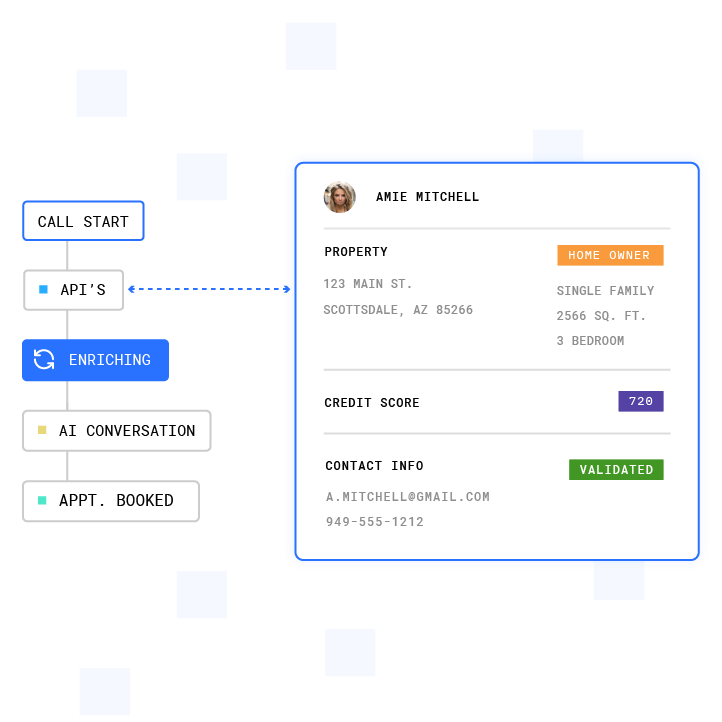
To operationalize this two-dimensional approach in real time, Plura’s business intelligence layer scores and prioritizes leads using behavioral signals, conversation context, and predictive intent modeling across every channel the platform operates.
Choosing Between Rule-Based, Predictive, and Hybrid Scoring
The choice between rule-based and AI scoring depends on your data volume, ICP stability, and the level of explainability your sales team expects.
| Approach | Launch Effort | Accuracy | Maintenance |
|---|---|---|---|
| Rule-based | Deploys in weeks, no minimum data requirement | 48 to 54 percent accuracy | Manual updates as signals decay, ongoing RevOps cost |
| Predictive ML | Requires at least 200 converted leads over 6 to 12 months of historical data | 78 to 88 percent accuracy | Periodic retraining, risk of feedback loops |
| Hybrid (fit rules + ML intent) | Requires historical data, several weeks to implement | 72 to 85 percent accuracy | Quarterly recalibration, balances transparency with pattern detection |
Rule-based scoring performs best with fewer than 1,000 closed-won deals or when scoring logic must remain fully explainable and transparent. AI-based scoring often outperforms rule-based models at scale and can deliver higher conversion rates. Many mature B2B SaaS organizations treat the hybrid approach as their default because it combines the transparency of rules with the higher accuracy ceiling of machine learning on behavioral signals.
Pure ML scoring often achieves lower AE adoption than transparent rules-based scoring because ML models can lose 20 to 30 percent of explainability due to black-box issues. Hybrid models address this by keeping fit criteria rule-based and explainable while applying ML to intent signals where pattern detection adds the most value.
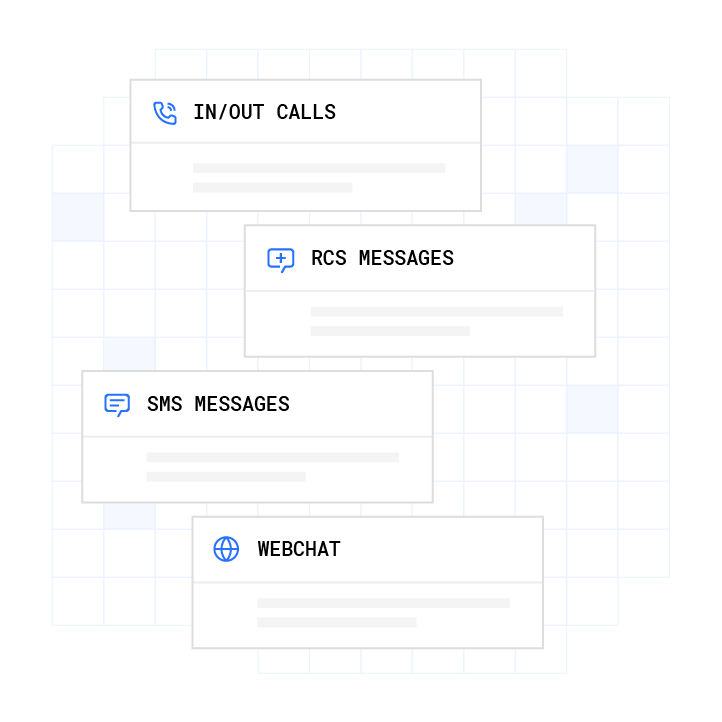
Plura’s multichannel scoring approach operationalizes this hybrid model across voice, SMS, RCS, and webchat with shared memory, so every scored lead carries the same enriched context regardless of which channel initiates contact.
Example: 15-Signal Model for Mid-Market SaaS
This example model is calibrated for a mid-market B2B SaaS company targeting organizations with 200 to 2,000 employees. The MQL threshold sits at 40 points. The SQL threshold sits at 80 points. Demo or trial requests bypass scoring and route immediately to sales.
Fit Signals (Firmographic)
- C-Suite or VP title: +40 points
- Director title: +30 points
- Manager title: +20 points
- Target company size (200 to 2,000 employees): +30 points
- Target industry vertical: +25 points
- Complementary technology stack: +20 points
- Target geography: +10 points
Behavior Signals (Intent)
- Demo request: +50 points
- Pricing page visit: +30 points
- Case study download: +25 points
- Webinar attendance (75 percent or more): +20 points
- Three or more pages in one session: +10 points
- Email click: +10 points
- Whitepaper download: +5 points
This 15-signal structure reflects current 2026 B2B scoring practice for mid-market SaaS companies targeting marketing teams. A whitepaper download scores at 5 points rather than 25 because it represents a low-intent action of downloading a free resource, while high-intent actions such as demo requests and pricing page visits receive the highest point values.
A prospect with a Director title (+30), target industry (+25), and a pricing page visit (+30) reaches 85 points and qualifies as an SQL. A Manager (+20) who downloads a whitepaper (+5) sits at 25 points and enters nurture. ReachIQ recommends multiplying fit score by intent score rather than adding them, so that a high-fit prospect with zero intent receives a different priority than a low-fit prospect with high intent.
Score Decay and Negative Scoring in Practice
Static scores overstate lead quality over time. A pricing page visit from six months ago carries far less signal than one from last week. Score decay mechanics correct for this by reducing point values as time passes without engagement.
Behavioral scores often follow half-life logic where points decay by 50 percent every 90 days. A 20-point pricing page visit drops to 10 points after 90 days, 5 points after 180 days, and zero after one year. A practical decay schedule by signal type, calibrated to match the typical decision timeline for each action, looks like this:
- Demo requests: route immediately, 7-day hard expiry if unfollowed (highest urgency)
- Trial signals: 14-day half-life, 30-day hard expiry (active evaluation window)
- Pricing page visits: 30-day half-life, 60-day hard expiry (research phase)
- Webinar attendance: 30-day half-life, 60-day hard expiry (educational engagement)
Negative scoring removes disqualifying leads before they consume sales capacity. Negative scoring signals in 2026 B2B models include personal email addresses (-15 points), competitor domains (-30 points), 30-plus days of inactivity (-10 points per month), and unsubscribes (-20 points).
Negative scoring can lift accuracy, yet only some teams use it consistently. Graduated negative points are preferable to instant disqualification, such as -50 points for a student email address versus -10 points for interest in a non-core product feature, allowing leads to be re-scored if stronger positive signals later emerge.
CRM Configuration for HubSpot and Salesforce
The following steps apply to both HubSpot and Salesforce, with platform-specific notes where the configuration differs.
- Audit and map lead fields. Lead routing accuracy depends on five core data fields: Company Name and Domain, Industry or Vertical, Company Size, Geography, and Job Title or Seniority. Map each form field to the corresponding CRM property with exact dropdown value alignment to prevent sync failures.
- Create custom score properties. In HubSpot, add a Number property called Lead Score. In Salesforce, create a custom field Real_Time_Lead_Score__c on Lead and Contact objects. Include properties for score reasoning, lead priority, and next action alongside the numeric score.
- Configure scoring rules or sync. In HubSpot, use the native lead scoring tool or a workflow-based scoring engine. In Salesforce, enable Einstein Lead Scoring in Setup if available, or build scoring logic via Flow Builder.2 For external scoring pipelines, push updated scores to Salesforce via Reverse ETL on a defined sync frequency, using lowercased email as the external ID for upsert operations.
- Build routing workflows. In HubSpot, trigger workflows on Contact creation or form submission, using enrollment filters on Company properties such as Industry, Number of Employees, and Country, followed by If or Then branches for segment-specific assignment. In Salesforce, configure Lead Assignment Rules under Setup, evaluating entries top to bottom with account-match by domain first, then segment rules, then territory rules, with round-robin as the final fallback.
- Set threshold triggers. In Salesforce, build a record-triggered Flow that fires after a Lead or Contact record is saved when the score crosses the 75-point sales-ready threshold, creating an assigned Task for the lead owner. In HubSpot, trigger lifecycle stage changes to MQL at your defined threshold and assign to the correct rep.
- Implement decay workflows. Marketo supports time-decay scoring natively via Smart Campaigns on a recurring schedule using the Change Score action with negative values. HubSpot requires workflow-based criteria triggers for manual decay. Set recurrence-based workflows that apply negative score actions when engagement date fields exceed your defined inactivity threshold.
- Test and validate before go-live. Test routing logic with sample leads of varying attributes, verify fallback handling for unmatched and duplicate leads, and confirm out-of-office rep scenarios route to backups or queues. Confirm that high-score leads reach a rep within the SLA target before full rollout.
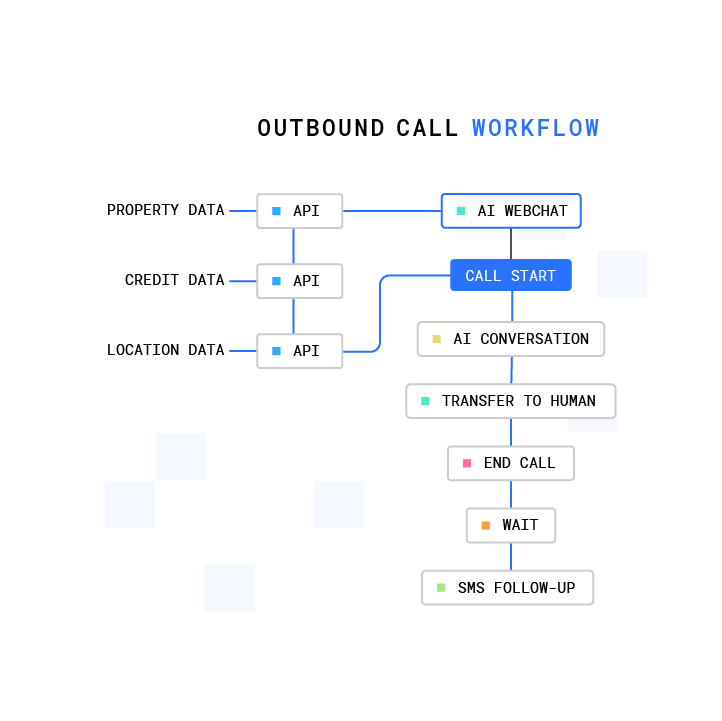
Plura’s CRM integrations with HubSpot, Salesforce, and Zoho sync scored lead data bidirectionally, so the AI agent that contacts a lead already carries the score, enrichment data, and conversation history from every prior touchpoint.2
Score Thresholds and Four-Tier Routing
MQL and SQL thresholds are typically set by analyzing historical conversion data to identify the score range where conversion rates meaningfully improve, with a common starting point of 50 to 70 points on a 0 to 100 scale, then tested for 60 to 90 days and adjusted quarterly.
A practical four-tier routing structure based on 2026 B2B benchmarks looks like this:
- Hot (80+ points): Direct to AE, SLA under one hour. Plura contacts these leads via voice or SMS in under five seconds from score threshold crossing.
- Warm (50 to 79 points): SDR qualification, SLA under four hours. AI SMS sequences initiate outreach while the SDR queue is notified.
- Cool (25 to 49 points): Nurture plus SDR, SLA under 24 hours. Automated nurture sequences run until a behavior signal pushes the lead into the warm tier.
- Cold (below 25 points): Marketing nurture only. No sales capacity is consumed until the score improves.
Many automated routing teams target under one minute from lead creation to assignment and under five minutes from assignment to first rep touch for high-priority leads. Research shows response time within five minutes dramatically increases connection rates, a finding that drives the SLA targets in the routing structure above. Plura’s AI agents support these targets by initiating contact in under five seconds across voice, SMS, RCS, and webchat the moment a lead crosses the hot threshold.
90-Day Review Cadence for Lead Scoring
Many B2B companies do not review or recalibrate their lead scoring models frequently, so they operate on stale logic that no longer reflects current buyer behavior. Companies that implement regular scoring audits often see improvement in MQL-to-pipeline rates compared to those that review less often.
The following 90-day checklist structures the review cadence by frequency.
Weekly (20-minute audit):
- Check leads created, SQLs created, meetings set, and SLA compliance for the top 20 scored leads in the prior seven days.
- Confirm the high-score band produces the highest SQL and meeting rate, and open a recalibration ticket if it does not.
- Track rep override rate, because a declining override rate signals improving model accuracy.
- Monitor time-to-first-touch for tier-1 leads and target under five minutes.
Monthly (2 to 4 hours):
- Recompute win rates by score band and flag any band where win rate is no longer at least 2x the low-score band for two straight weeks.
- Inspect high-score false positives and low-score false negatives with sales feedback.
- Adjust scoring weights, hot-lead thresholds, enrichment fields, and routing rules based on findings.
- Review MQL rejection rate, and note that rejection rates above 25 to 30 percent represent a yellow flag and above 40 percent a red flag for model decay.
Quarterly (half-day reset):
- Re-anchor scoring to winning segments, personas, use cases, ACV bands, and sales-cycle lengths from the prior quarter.
- Run correlation checks of each scoring dimension against recent closed-won data and prune signals where win-rate difference is under five percentage points.
- Sync firmographic weights to the current shared ICP with sales leadership sign-off.
- Choose explicitly whether to focus on logo wins, pipeline created, or revenue efficiency for the next quarter.
- Trigger an immediate reset the same day any ICP, product, pricing, or competitive shift is confirmed rather than waiting for the next cycle.
Beyond the explainability challenges discussed earlier, all scoring models, rule-based and ML alike, lose accuracy within months as buyer behavior and ICP drift over time. B2B revenue teams that use closed-loop data to recalibrate scoring weights often report higher accuracy in predicting SQL conversion than teams that rely on default configurations.
Plura’s conversation intelligence layer feeds closed-loop data back into the scoring model automatically, surfacing which scripts close, which objections recur, and which conversion paths win across every channel.
Connecting Scoring to Live Conversations
An automated lead scoring system that combines fit and behavior signals, applies decay and negative scoring, and routes via clear thresholds usually converts more leads into opportunities than manual or single-signal approaches. The blueprint in this guide covers the 15-signal model, the rule-based versus AI trade-offs, the seven CRM setup steps, the four-tier routing structure, and the 90-day optimization cadence that ties scoring directly to opportunity creation rates.
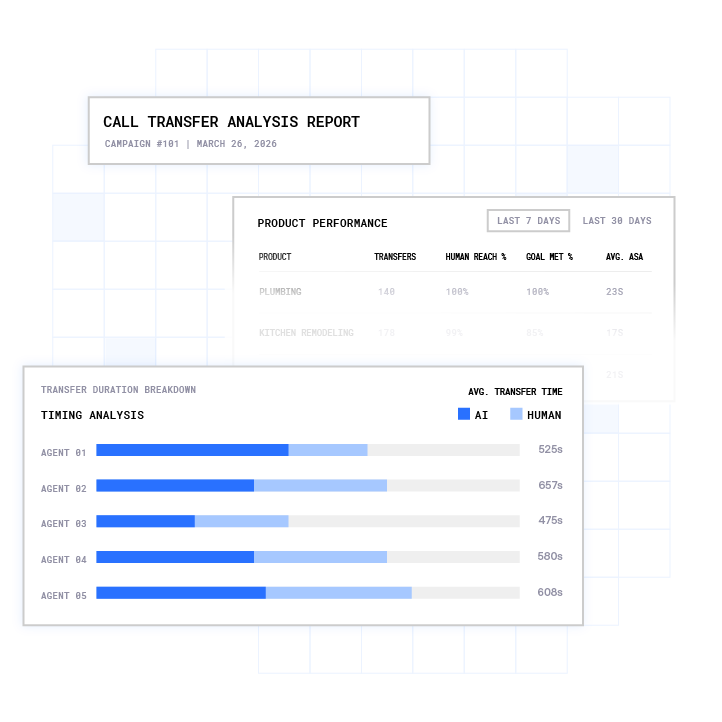
The gap most revenue operations teams face is not the scoring model itself. The real gap is the time between a lead crossing the hot threshold and a live conversation starting. Organizations deploying AI for speed to lead often see response times drop from hours to seconds and connection rates increase by 3 to 5 times.1 Plura is the operational layer that closes that gap, turning scored leads into live conversations across AI voice, AI SMS, RCS, and AI webchat in under five seconds, with shared memory and real-time enrichment on every contact.

Run your numbers through Plura’s ROI calculator to check your cost savings in real time.
Compare plans and rates side by side at Plura pricing.
Frequently Asked Questions
What is the difference between an MQL and an SQL in automated lead scoring?
An MQL (marketing qualified lead) is a prospect whose score has crossed the threshold indicating sufficient fit and early-stage intent to warrant marketing follow-up or enrollment in a nurture sequence. An SQL (sales qualified lead) is a prospect whose score has crossed a higher threshold indicating strong fit and high-intent behavior that warrants direct sales engagement. The MQL threshold is typically set lower, around 40 to 50 points, while the SQL threshold sits higher, around 75 to 100 points, depending on the scoring model. The thresholds are not fixed. They should be calibrated against historical conversion data and reviewed quarterly. A demo request or trial signup typically bypasses both thresholds and route directly to sales regardless of score.
How does Plura AI operationalize lead scoring across multiple channels?
Plura AI’s AI Lead Intelligence layer scores and prioritizes leads in real time using behavioral signals, conversation context, and predictive intent modeling. When a lead crosses a defined score threshold, Plura initiates outreach in under five seconds across voice, SMS, RCS, or webchat, depending on the routing workflow configured. All four channels share a Stateful Conversation Database, so a lead who received an SMS at 9 a.m. is recognized when the AI voice agent calls at noon, with full context from every prior touchpoint. Real-time enrichment from 30-plus data sources runs during the conversation, not in a downstream batch job, so qualification happens at the moment of contact. This shared memory architecture separates Plura from platforms that treat each channel as a separate product with a separate memory.
How often should a B2B lead scoring model be recalibrated?
The operating default for an established lead scoring model is quarterly recalibration, with a minimum six-month review if the model is stable. Monthly recalibration is warranted when MQL-to-SQL conversion drops for two consecutive weeks, when sales rejection reasons cluster around the same issue, or when the business announces a new market, region, or product. Weekly light audits of score-band SQL and meeting rates are a best practice regardless of model stability. An immediate reset should occur the same day any ICP, product, pricing, or competitive shift is confirmed rather than waiting for the next scheduled cycle. The quarterly process involves re-anchoring scoring weights to the most recent closed-won data, pruning signals where win-rate difference is under five percentage points, and syncing firmographic weights to the current shared ICP with sales leadership sign-off.
What are the most common negative scoring signals in B2B lead scoring models?
Negative scoring signals are attributes or behaviors that indicate a lead is unlikely to convert or is a poor fit for the product. Common examples include personal or free email domains such as Gmail or Yahoo, competitor company domains, student or intern job titles, company sizes outside the target range, industries outside the ICP, geographic locations outside the sales territory, unsubscribes from email communications, and extended periods of inactivity such as 30 or more days without engagement. Graduated negative point values are preferable to instant disqualification, because a lead with a negative signal today may develop stronger positive signals later and should remain eligible for re-scoring. Negative scoring signals should be derived by analyzing lost deals and churned customers to identify the concrete bad-fit patterns specific to your business rather than applying generic templates.
What CRM data quality issues cause automated lead scoring to fail?
The most common data quality issues that undermine automated lead scoring are duplicate contact records, missing or stale values in key routing fields such as industry, company size, and geography, mismatched dropdown values between form fields and CRM properties, and email address formatting inconsistencies that prevent accurate record matching during score sync. When these fields are incomplete or incorrect, routing rules default to round-robin or misassign leads, and scoring models apply the wrong weights because the firmographic inputs are wrong. Leads also fail to match existing account records when domain-based matching is used and the email field is not normalized to lowercase. Resolving these issues before configuring scoring workflows is a prerequisite, not an afterthought. A bidirectional CRM integration that syncs in real time rather than in hourly or daily batches reduces the window during which stale data can affect scoring and routing decisions.
1 Performance figures, customer outcomes, and industry statistics referenced in this article are drawn from cited third-party sources or Plura customer case studies. Individual results vary based on implementation, use case, industry, audience, and execution. Past or aggregate performance is not a guarantee of future results.
2 References to third-party products, services, companies, or research are made for informational and comparative purposes only. Plura AI is not affiliated with, endorsed by, or sponsored by any third party named in this article unless explicitly stated. Trademarks and product names referenced remain the property of their respective owners.
This article is provided for informational purposes only and reflects Plura AI’s understanding at the time of publication. Product capabilities, integrations, and specifications are subject to change. For the most current information, visit plura.ai.
This article was produced with the assistance of AI tools and reviewed by Plura AI prior to publication.