

Written by: Matt Beucler, CEO, Plura AI
Key Takeaways for High-Volume Call Operations
-
Branded caller ID replaces generic or spam-labeled displays with verified business names, logos, and call reasons.
-
Carrier-owned platforms like Plura AI issue branded caller ID at origination with STIR/SHAKEN authentication. Reseller models route identity through third-party carrier agreements.
-
Plura AI connects branded caller ID with stateful AI agents across voice, SMS, RCS, and webchat on 100% U.S. infrastructure while enforcing TCPA, DNC, SOC 2, HIPAA, and ISO compliance at the platform layer.1
-
High-volume operators gain spam remediation, A-level attestation, and cross-channel conversation memory from Plura’s direct carrier stack, which reseller solutions do not provide natively.
-
See carrier-issued branded caller ID in action and watch how it works with AI-driven outbound calling.
Branded Caller ID for Enterprise Outbound Teams
Branded caller ID is a voice feature that replaces “Unknown Caller” or “Spam Likely” with a verified business name of up to 32 characters, a high-resolution logo, and an optional call reason such as “Appointment Reminder” or “Payment Update.”
Mobile carriers deliver this information directly to the recipient’s screen. The feature builds on STIR/SHAKEN (Secure Telephone Identity Revisited / Signature-based Handling of Asserted information using toKENs), the FCC-mandated protocol that authenticates the originating number and assigns an attestation level before the call reaches the consumer.
Legacy CNAM (Caller Name) databases, which populated caller ID on landlines, are inconsistent across carriers. Branded caller ID replaces that layer with carrier-verified identity delivered in near real time.
Key Benefits and Answer-Rate Lift from Branded Caller ID
Truecaller estimates Americans wasted 196 million hours answering spam calls in 2025. In that environment, branded caller ID creates a clear performance advantage.
-
73% of consumers will answer a call when the caller’s name is presented, 76% when name and logo are shown, and 78% when the call reason is also displayed, according to a consumer survey cited in the FCC’s October 2025 proposed rule (FCC 25-76).
-
Branded calling can increase outbound pickup rates and raise answer rates on reminder calls, although results depend on implementation quality and reputation management. Watch branded caller ID with AI agents in a live environment and see how it changes pickup behavior.
Top Branded Caller ID Platforms for Compliant High-Volume Operations
This ranking focuses on high-volume U.S. operators running at least 500 daily interactions or at least $5,000 per month in paid media. Evaluation criteria include carrier ownership, compliance posture, integration depth, and U.S. infrastructure.
-
Plura AI: FCC-licensed carrier; issues branded caller ID directly; stateful AI agents across voice, SMS, RCS, and webchat; 100% U.S. infrastructure; STIR/SHAKEN, TCPA compliance, DNC compliance, SOC 2, HIPAA, ISO certification.1
-
First Orion INFORM: Carrier-integrated branded calling with broad reach, but no owned carrier network or cross-channel AI memory.4
-
TransUnion TruContact Branded Call Display: Network-level branded calling and authentication using carrier and data-partner integrations; no owned carrier network.4
-
Hiya: Analytics-driven spam detection and branded calling with carrier and device integrations; no owned carrier network.4
-
TNS Enterprise Branded Calling: Established enterprise branded-calling platform delivered through carrier partnerships; no owned carrier network.4
-
Twilio Trusted Calling: Combines STIR/SHAKEN, CNAM, and branded caller ID through Twilio Trust Hub; CPaaS platform with no owned carrier network.4
-
RingCentral Enterprise Branded Calling: Displays company name and logo on outbound calls with AI Receptionist cross-channel context; UCaaS platform with no owned carrier network.4
Plura AI Review: Carrier Stack and Stateful Conversation Memory
Plura AI issues branded caller ID directly through its own FCC-licensed audio bridging carrier, not through a third-party CPaaS such as Twilio. That carrier ownership creates three operational advantages.
Branded caller ID is issued at origination instead of being added downstream. STIR/SHAKEN authentication runs at the carrier level on every outbound call and supports A-level attestation. Spam-label remediation occurs at the network layer instead of relying solely on analytics vendors.
The Stateful Conversation Database is the second major differentiator. Every interaction across voice, SMS, RCS, and webchat ties to a customer token such as phone number, email, or internal ID and persists in one place. An AI agent that texted a lead at 9 a.m. can take a noon call already aware of prior messages, offers, and objections. Reseller-model branded calling platforms do not provide this cross-channel memory by default.
Plura’s compliance engine evaluates every outbound contact before dial against TCPA and DNC rules, with real-time scrubbing against federal and state DNC registries, timestamped consent records, and automatic quiet-hours enforcement using time-zone detection.
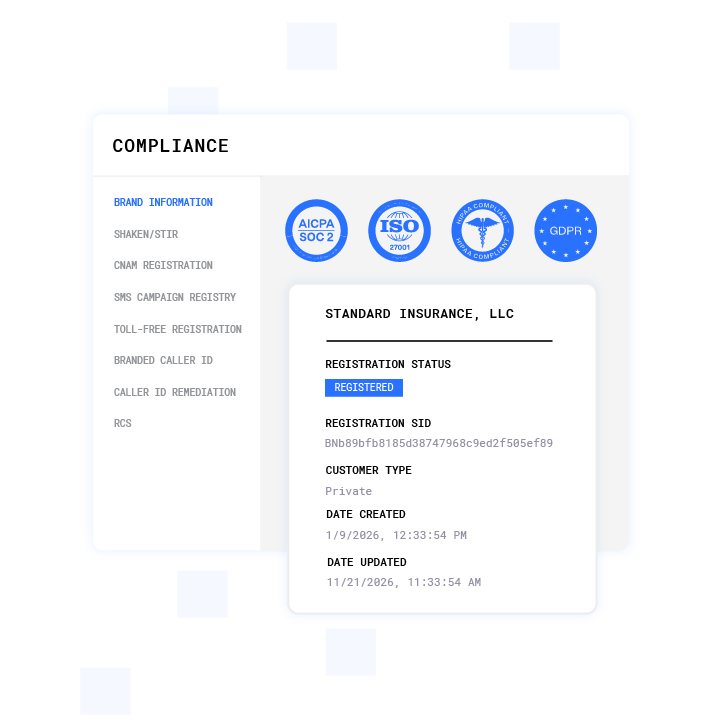
This enforcement layer operates within a certified infrastructure, and the platform holds SOC 2, HIPAA, and ISO certification. Customers remain responsible for their own regulatory obligations, while Plura supplies the compliance infrastructure. Qualified counsel should advise on how to configure and use that infrastructure for specific requirements.
Across its customer base, Plura contacts leads in under 5 seconds and delivers an average 3× ROI within 90 days.3
Branded Caller ID Pricing Models for 2026
Pricing models differ because each provider uses a distinct delivery architecture, so per-unit comparisons can be misleading. The summaries below describe how each model works.
Plura AI offers three annual tiers billed monthly: Multi at $5,000 per month, Agency at $7,500 per month, and Enterprise with custom pricing. A 90-day opt-out window applies. Agent build fees run from $2,500 to $2,750 per agent. Branded caller ID, spam remediation, STIR/SHAKEN, TCPA compliance, and DNC compliance operate as platform layers rather than add-ons. Full details appear at plura.ai/pricing.
Competitors can charge a one-time business certification fee for platform access, then apply per-call or per-minute pricing at volume. They can also use enterprise contract models with negotiated pricing per deployment. For a full TCO (Total Cost of Ownership) model comparing Plura against traditional contact-center economics, visit plura.ai/calculator.
How to Implement Branded Caller ID Across Your Stack
Implementation requirements depend on provider architecture. For carrier-owned platforms such as Plura, the sequence typically includes carrier identity registration and Operating Company Number (OCN) verification, STIR/SHAKEN certificate provisioning, and branded caller ID asset upload. Name, logo, and call reason are tied to registered DIDs.
Teams then configure DNC and TCPA compliance at the campaign level, run a pilot on a live call subset, and move to full deployment with ongoing reputation monitoring.
For reseller platforms, the operator registers business identity and phone numbers with the provider and uploads branding assets. The provider then routes branded display through carrier agreements. Typical steps include registering business identity and numbers, applying STIR/SHAKEN authentication, enabling rich call display through supported carriers, and testing for consistency across devices and operating systems.
Plura’s onboarding process runs from discovery audit through pilot to full go-live in a timeframe of days to weeks, depending on conversation complexity.
Fixing VOIP Branded ID Pains with Direct Issuance
VOIP (Voice over Internet Protocol) operators face a compounding problem because calls originating on third-party CPaaS infrastructure inherit that provider’s carrier reputation instead of the operator’s own.
When a Twilio-based AI voice tool dials out, the branded caller ID, when available, is issued through Twilio’s carrier agreements, not the operator’s. Spam labels that build on shared Twilio number pools affect every operator using that infrastructure.
Plura’s architecture removes this exposure. Voice originates on Plura’s own FCC-licensed carrier, and a branded caller ID is issued at origination. STIR/SHAKEN authentication runs at the carrier level and supports A-level attestation, which is the strongest trust signal available to terminating carriers.
Plura’s AI also communicates with Apple’s iOS 26 call-screening layer, so calls that would otherwise be intercepted before ringing can present a recognizable identity to the recipient. That connection converts screened calls into pickups.
Watch spam remediation and STIR/SHAKEN in real time and see how Plura’s carrier stack manages reputation at the network layer.
Conclusion: Selecting a Branded Caller ID Platform for Scale
For high-volume U.S. operators, the core structural question is whether the provider owns the carrier or rents from one. Plura’s carrier-owned stack addresses these gaps through architectural integration. Because Plura owns the carrier, a branded caller ID is issued directly at origination instead of being added downstream, which also enables STIR/SHAKEN authentication at the carrier level.
That same carrier ownership supports the compliance posture described earlier, allowing TCPA, DNC, SOC 2, HIPAA, and ISO controls to function as a platform layer rather than a bolt-on feature customers must manage separately. The Stateful Conversation Database then ensures every AI agent across voice, SMS, RCS, and webchat shares the same customer memory, so conversations feel continuous instead of episodic.
The economics reflect this structure: 3× average ROI in 90 days, 47% average pipeline growth, 90% faster lead-response time, and a TCO of $300,000–$700,000 compared with traditional contact-center economics of $4M–$7M.3
Experience the full Plura platform in a single demo, from carrier-level branded caller ID to stateful AI agents across voice, SMS, RCS, and webchat.
Frequently Asked Questions
What is branded caller ID?
Branded caller ID is a voice feature that displays a verified business name, logo, and optional call reason on a recipient’s mobile screen when an outbound call arrives. It replaces generic labels such as “Unknown Caller” or “Spam Likely.” The feature works alongside STIR/SHAKEN caller ID verification, the FCC-mandated protocol that authenticates the originating number and assigns a trust attestation level. Legacy CNAM databases are inconsistent across carriers and often truncate business names, while branded caller ID delivers verified identity in near real time through carrier networks. The feature is available across major U.S. carriers such as AT&T, Verizon, and T-Mobile and is supported on most modern Android devices, with iOS support expanding through Apple’s call-screening layer.
Which caller ID platform fits high-volume U.S. business operations?
For high-volume U.S. operators running AI-agent workflows across voice, SMS, RCS, and webchat, Plura AI’s carrier-owned branded caller ID platform leads on three criteria. It issues branded caller ID directly through an FCC-licensed carrier instead of a reseller model, maintains stateful cross-channel conversation memory, and treats compliance enforcement, including TCPA compliance, DNC compliance, SOC 2, HIPAA, and ISO certification, as a platform layer instead of a customer-managed add-on.
How does branded caller ID affect spam labeling?
Spam labeling occurs at the carrier level and is driven by call volume patterns, number reputation, and the absence of verified identity signals. Branded caller ID addresses the identity gap by displaying a verified business name and logo, which can reduce the likelihood that a call is flagged by carrier spam-detection systems. STIR/SHAKEN caller ID verification adds an attestation layer, and an A-level attestation signals to the terminating carrier that the originating number is verified and the call is likely legitimate.
For operators using third-party CPaaS platforms such as Twilio, branded caller ID is issued through the CPaaS provider’s carrier agreements, so the operator inherits that provider’s number reputation instead of building its own. Plura issues branded caller ID through its own FCC-licensed carrier, so spam remediation and attestation are managed at origination. Operators experiencing spam labeling events should also review DID (Direct Inward Dial) lifecycle management, call volume patterns, and consent documentation, and consult qualified counsel regarding applicable regulations.
1 Plura AI maintains SOC 2, HIPAA, ISO, and GDPR posture as part of its platform infrastructure. References to compliance frameworks in this article describe Plura’s platform capabilities and do not constitute a guarantee that any customer using Plura will themselves be compliant with applicable laws or standards. Customers remain solely responsible for their own regulatory obligations, certifications, consent management, recordkeeping, and the claims they make to their own end users. Consult qualified legal counsel for guidance specific to your use case.
2 This article describes regulatory frameworks at a general level and does not constitute legal advice. Laws and regulations vary by jurisdiction, change over time, and apply differently depending on facts and circumstances. Readers should consult qualified legal counsel before making compliance decisions.
3 Performance figures, customer outcomes, and industry statistics referenced in this article are drawn from cited third-party sources or Plura customer case studies. Individual results vary based on implementation, use case, industry, audience, and execution. Past or aggregate performance is not a guarantee of future results.
4 References to third-party products, services, companies, or research are made for informational and comparative purposes only. Plura AI is not affiliated with, endorsed by, or sponsored by any third party named in this article unless explicitly stated. Trademarks and product names referenced remain the property of their respective owners.
This article is provided for informational purposes only and reflects Plura AI’s understanding at the time of publication. Product capabilities, integrations, and specifications are subject to change. For the most current information, visit plura.ai.
This article was produced with the assistance of AI tools and reviewed by Plura AI prior to publication.