
Written by: Matt Beucler, CEO, Plura AI
Key Takeaways
- Branded caller ID display depends on carrier, device, OS, and network path. It does not appear on every call.
- Full branding with logos and call reasons reaches only a narrow slice of supported Android and iOS devices.
- Branded caller ID is distinct from CNAM and uses signed STIR/SHAKEN data instead of unauthenticated database lookups.
- Costs include registration fees, monthly fees, and per-call display charges that scale quickly at high volumes.
- Plura AI delivers carrier-issued branded caller ID with STIR/SHAKEN authentication.1 Talk to an expert to see it in action.
Executive Summary: What Branded Caller ID Really Delivers
Branded caller ID misconceptions drain budgets through wasted spend on weak services and delayed deployments that miss revenue targets. The technology delivers value, but it operates inside specific technical constraints that many vendors gloss over until after the contract is signed.
A July 2020 Pew Research Center survey of 10,211 U.S. adults found that 80% say they do not generally answer their cellphone when an unknown number calls.3 Branded caller ID exists to address that behavior. The gap between the marketing promise and what carriers and devices actually deliver in 2026 can undermine a forecast and weaken a pitch to a CFO.
This guide separates what branded caller ID delivers today from what it does not, so you can set expectations and budget with clear numbers.
See how carrier-issued branded caller ID performs in a live high-volume outbound environment.
Myth 1: Branded Caller ID Always Shows Logos and Rich Data
Most teams picture full-screen branding with logos and call reasons on every outbound call. They then face pushback when most recipients see only a text name or no enhancement at all.
Logo display occurs only on a minority of supported devices. Telnyx branded calling documentation states that display depends on the receiving carrier, device model, operating system, dialer or call-screening app, and the network path.4 Their display matrix shows that only Samsung, Motorola, and TCL Android devices on Android 14 or newer support name, logo, and call reason. Apple iPhone XS and newer on iOS 18.5 or newer support name and logo but not call reason. BYOD, unlocked, and MVNO devices typically show name only.
Rich Call Data (RCD) carries logo and call reason and remains in active deployment. The FCC’s October 2025 Further Notice of Proposed Rulemaking proposes requiring terminating providers to transmit verified caller identity information when A-level attestation is indicated, but this is a proposal and not yet a mandate.2 That fragmented deployment is one reason why branded caller ID does not work universally across every carrier, device, and network.
Myth 2: Branded Caller ID Works Everywhere
Many leaders assume one registration covers all outbound calls across the network. Actual coverage remains fragmented across carriers, and a meaningful share of calls will never display branding.
Twilio documentation states that its branded calling currently works only for calls to mobile devices on T-Mobile and Verizon networks and does not display on landlines.4 AT&T runs its own program through TransUnion/Neustar TruContact, and a business registering with one analytics partner does not automatically register with others. Verizon requires its Call Filter app on the recipient’s device before branding displays.
The TNS 2026 Robocall Investigation Report found that Tier-1 carriers signed and verified 85% of voice traffic in 2025, while only 17.5% of traffic from smaller carriers is signed, so branded display is far less consistent for prospects on regional carriers or MVNOs. Landlines cannot display branded elements at all. They rely on legacy CNAM, which the terminating carrier may not even query.
Myth 3: Branded Caller ID Equals CNAM
Some teams treat CNAM registration as equivalent to branded caller ID and expect modern display behavior from a legacy system.
CNAM and branded caller ID use different mechanisms. CNAM is a database lookup performed by the terminating carrier, not a value sent with the call. The classic payload is 15 characters of text with no logo and no call reason. The terminating carrier must choose to query a database, and many mobile terminations do not query at all. CNAM records are unauthenticated database entries keyed to a number, so a spoofed number pulls the spoofed party’s name.
Branded calling uses RCD carried in the STIR/SHAKEN authentication path as defined by IETF RFC 9795’s “rcd” PASSporT extension. The display data is signed at origination by a party with the right to make the assertion and verified at termination. The table below summarizes how CNAM and branded caller ID differ across mechanism, verification, data richness, display consistency, and spoofing resistance.
| Attribute | CNAM | Branded Caller ID |
|---|---|---|
| Mechanism | Out-of-band database lookup (LIDB dip) | In-band signed assertion via STIR/SHAKEN with RCD |
| Verification | Unauthenticated database entry | Carrier-level vetting plus STIR/SHAKEN attestation |
| Data richness | 15-character text name only | Business name, logo, and call reason on supported devices |
| Display consistency | Patchy, many mobile terminations do not query | Varies by carrier, device, OS, and network path |
| Spoofing resistance | No resistance, spoofed number pulls spoofed party’s name | High resistance, requires vetting and A-level attestation |
Myth 4: Branded Caller ID Eliminates Spoofing and Spam
Many organizations expect that once they are branded, their calls will never be flagged as spam and fraudsters will not impersonate them.
Branded caller ID authenticates your identity but leaves reputation management to separate systems. Bandwidth notes that a carrier analytics engine’s “Spam Risk” tag often overrides the branded display, regardless of branding.4
Ruby Kootval, Head of Product Marketing at Aloware, states that branded calling is not a spam eraser and that overselling it creates a trust problem for the category.
STIR/SHAKEN also has limits. The Congressional Research Service reports that as of early 2026, only about 45% of total call traffic is fully signed. Even when calls are signed, A-level attestation does not guarantee legitimacy. Numeracle reports that 48% of illegal calls carry A-level attestations. Spam labeling runs on separate reputation analytics that weigh complaint rates and calling patterns.
Myth 5: Branded Caller ID Is Cheap and Instant
Budget owners often treat branded caller ID as a low-cost add-on that can go live in a few days. Actual cost structure and implementation timelines are more complex.
Branded caller ID introduces costs at several layers. Telnyx pricing lists a $50 one-time brand registration fee, a $50 monthly brand registration fee, and a $0.075 per-call display fee. Aloware charges roughly $0.09 to $0.12 per call plus a $1,000 one-time provisioning fee, with implementation taking about four weeks end-to-end. Carrier review alone typically runs 5 to 20 business days.
CloudTalk documentation lists registration requirements such as legal business name, EIN or DUNS, authorized representative contact information, use case description, consent description, and a signed Letter of Authorization.
Carriers charge approximately $0.06 or more per call for carrier-network branded calling, applied to every branded call attempt whether or not it is answered. At 1 million outbound calls per month, that equals $60,000 per month in carrier fees alone before platform costs.
Get a detailed cost breakdown of carrier-issued branded caller ID, with no reseller markup.
Myth 6: Branded Caller ID Guarantees High Answer Rates
Leaders often expect branded caller ID to fix connect-rate problems quickly. Actual results vary by industry, audience, and how the program is deployed.
Branded caller ID can improve answer rates, but the range is wide. TransUnion claims customers are up to 105% more likely to answer a branded call, while First Orion reports gains of 30% to 70% above baseline.3 A Twilio study of roughly 720,000 calls found branded calls answered 62% of the time versus 20% for unbranded.3 These figures measure different audiences and deployment conditions, which explains the variation.
Regal.ai analysis notes that branded calling can reduce first-call answer rate while raising conversion rate, because disengaged prospects self-filter before connecting. Branded caller ID becomes one variable in a broader equation that includes list quality, calling cadence, number reputation, and offer relevance.
Myth 7: Branded Caller ID Is Set-and-Forget
Some organizations treat branded caller ID as a one-time project and feel blindsided when display degrades or spam labels return.
Branded caller ID needs ongoing reputation management and alignment with carrier requirements. Kixie’s spam remediation guide explains that spam label removal is not permanent and that a number’s reputation can change again if call patterns, complaints, or identity signals create new risk.
Branded programs can suspend a brand whose calls generate complaints. The FCC’s proposed Know-Your-Customer framework would require automated re-verification triggers when “red flags” appear, such as unusual traffic spikes, sudden activity on long-dormant accounts, or payments via untraceable methods, and retention of verified identity records for up to four years after the customer relationship ends.
Even with Branded Calling enabled, carriers may reject calls if the business has poor caller reputation due to spam complaints or calling violations.
How to Evaluate Branded Caller ID Providers
The seven myths above share a pattern: vendors often overpromise what carriers and devices actually deliver. The myths also point to five concrete criteria that separate providers who own their infrastructure from those who resell a promise.
- Carrier ownership: Determine whether the provider owns its FCC-licensed carrier infrastructure or resells through a third-party CPaaS such as Twilio. Owning the carrier means branded caller ID is issued under the provider’s own identity and enforcement occurs at origination.
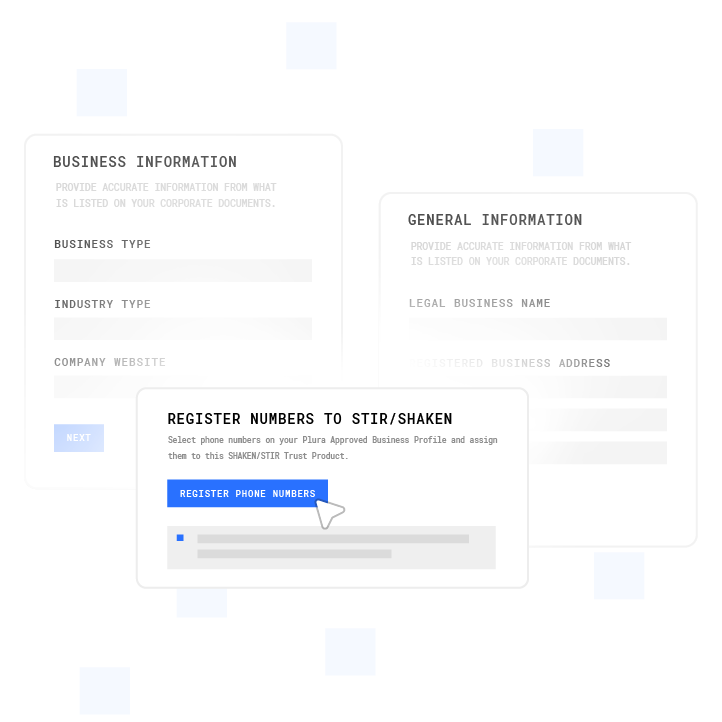
- STIR/SHAKEN implementation: Confirm whether A-level attestation runs on every outbound call or only on request. A-level attestation verifies both the caller’s identity and their right to use the number and forms the foundation for branded display.
- RCD support: Check whether the provider supports Rich Call Data transmission or only legacy CNAM. RCD carries logo and call reason and aligns with the FCC’s stated direction.
- Compliance features: Look for real-time DNC scrubbing, TCPA consent logging, and quiet-hours enforcement built into the platform instead of stitched together through third-party add-ons.2
- Cost transparency: Require clear publication of per-call fees, registration costs, and implementation timelines instead of discovering them late in the sales cycle.
Plura AI meets all five criteria. Plura is an FCC-licensed carrier that issues branded caller ID directly, runs STIR/SHAKEN authentication on every outbound call, and supports compliance inside the platform before dial. For teams running the AI Predictive Dialer at scale, branded display and compliance support operate on the same infrastructure instead of separate vendor stacks.
Compare plans and rates side by side.
Future Outlook: RCD Adoption and FCC Direction
Regulators are moving toward the outcomes branded caller ID markets today. The FCC’s October 2025 Further Notice of Proposed Rulemaking proposes requiring terminating providers to transmit verified caller name or other caller identity information whenever they transmit an indication of A-level attestation.5 The Commission leans toward mandating the Rich Call Data standard within IP networks so caller identity data remains intact during transit.
The proposal also outlines a bank-grade Know-Your-Customer framework that would require originating providers to collect legal name, verifiable physical address, government-issued ID or corporate registration documentation, and an alternative verification phone number before service activation. As Telecom Ramblings notes, “The era of seeing a simple ‘Checkmark’ without context is coming to an end.”
For organizations evaluating branded caller ID today, the direction is clear. Verified identity is becoming the baseline signal, and differentiation will come from how well teams manage reputation and customer experience on top of that baseline.
Frequently Asked Questions
Is branded caller ID the same as STIR/SHAKEN?
Branded caller ID and STIR/SHAKEN solve related but different problems. STIR/SHAKEN is the authentication framework that cryptographically verifies a call’s origin and the caller’s right to use the number. Branded caller ID is the display layer that shows verified business information on the recipient’s screen. STIR/SHAKEN authenticates the call, and branded caller ID makes that authentication visible to the consumer. A call can have A-level STIR/SHAKEN attestation and still display no branding if the terminating carrier or device does not support branded display.
Does branded caller ID work on all phones?
Branded caller ID display depends on the receiving carrier, device model, operating system, and network path. Currently, full branded display with name, logo, and call reason works on Samsung, Motorola, and TCL Android devices running Android 14 or newer. Apple iPhone XS and newer on iOS 18.5 or newer support name and logo but not call reason. Many other devices, including BYOD, unlocked, and MVNO devices, show name only or nothing at all. Landlines cannot display branded elements.
How much does branded caller ID cost?
Costs vary by provider but typically include one-time registration fees, monthly brand registration fees, and per-call display fees that often range from $0.005 to $0.12 per call. Carrier-network branding fees apply to every branded call attempt whether or not it is answered. At high volumes, these fees add up quickly, and carrier fees alone can reach $60,000 per month at scale, as the cost example above shows.
Can branded caller ID prevent spoofing?
Branded caller ID authenticates legitimate callers but does not block all spoofing activity. STIR/SHAKEN reduces spoofing by authenticating calls, yet as noted earlier, 48% of illegal calls carry A-level attestations. Spam labeling operates through separate systems that weigh reputation analytics, complaint rates, and calling patterns.
Does branded caller ID remove “Spam Likely” labels?
Branded display and spam labeling run on separate carrier systems. A branded number with a poor reputation can still be flagged “Spam Likely.” Removing spam labels requires separate number reputation management. Branded caller ID improves recognition where supported, and reputation management addresses inaccurate negative labels. Both matter for a complete outbound calling strategy.
Conclusion: Branded Caller ID That Matches Reality
Branded caller ID misconceptions persist because vendors often sell what the technology could do rather than what carriers and devices support today. The real picture is more constrained but manageable when you work with a provider that owns its infrastructure and treats branding as part of a broader outbound strategy.
Plura AI is an FCC-licensed carrier that issues branded caller ID directly through its own operating company number, runs STIR/SHAKEN authentication on every outbound call, and supports compliance inside the platform before dial. Real-time DNC scrubbing, TCPA consent logging, and quiet-hours enforcement operate as first-class platform features instead of bolt-on tools. For high-volume communicators who need branded caller ID that fits the technical realities of 2026, that structure turns a marketing claim into a repeatable operation.
Watch carrier-issued branded caller ID in production during a live demo.
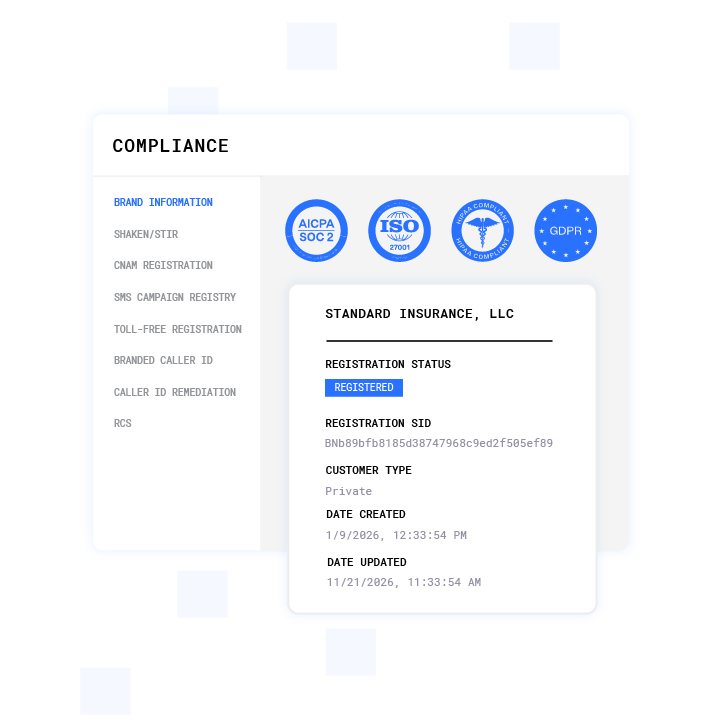
1 Plura AI maintains SOC 2, HIPAA, ISO, and GDPR posture as part of its platform infrastructure. References to compliance frameworks in this article describe Plura’s platform capabilities and do not constitute a guarantee that any customer using Plura will themselves be compliant with applicable laws or standards. Customers remain solely responsible for their own regulatory obligations, certifications, consent management, recordkeeping, and the claims they make to their own end users. Consult qualified legal counsel for guidance specific to your use case.
2 This article describes regulatory frameworks at a general level and does not constitute legal advice. Laws and regulations vary by jurisdiction, change over time, and apply differently depending on facts and circumstances. Readers should consult qualified legal counsel before making compliance decisions.
3 Performance figures, customer outcomes, and industry statistics referenced in this article are drawn from cited third-party sources or Plura customer case studies. Individual results vary based on implementation, use case, industry, audience, and execution. Past or aggregate performance is not a guarantee of future results.
4 References to third-party products, services, companies, or research are made for informational and comparative purposes only. Plura AI is not affiliated with, endorsed by, or sponsored by any third party named in this article unless explicitly stated. Trademarks and product names referenced remain the property of their respective owners.
5 This article contains forward-looking statements regarding industry trends, technology adoption, and future capabilities. These statements reflect current expectations and are subject to change. Plura AI undertakes no obligation to update forward-looking statements except as required.
This article is provided for informational purposes only and reflects Plura AI’s understanding at the time of publication. Product capabilities, integrations, and specifications are subject to change. For the most current information, visit plura.ai.
This article was produced with the assistance of AI tools and reviewed by Plura AI prior to publication.