
Written by: Matt Beucler, CEO, Plura AI
Key Takeaways for Enterprise AI SMS in 2026
- AI SMS marketing platforms can cut first-contact response time from 47+ hours to under 5 seconds while supporting real-time DNC and TCPA compliance for high-volume teams.1
- Enterprise-grade solutions require sub-5-second speed-to-lead, stateful cross-channel memory, real-time compliance controls, 100% U.S. infrastructure, live agent transfers, and audit-ready consent logs.
- Regulatory changes in 2025-2026, including FCC revocation rules, Texas SB 140, and carrier 10DLC requirements, have raised compliance expectations for automated SMS campaigns.2
- Plura AI differentiates from e-commerce SMS tools and offshore BPOs through FCC-licensed carrier ownership, built-in compliance controls, and stateful conversation memory across voice, SMS, RCS, and webchat.
- Teams can reduce costs and improve conversion rates with Plura AI’s compliant AI SMS platform. Book a live demo to see the compliance engine and workflow builder in action.
The Problem: Slow Follow-Up, Compliance Risk, and Rigid Staffing
Most high-volume teams respond to new leads far too slowly. The industry average for first contact on an inbound lead is 47+ hours.3 That delay bleeds pipeline, because only 7% of companies respond within 5 minutes, and 88% of outbound effort goes unanswered before a human ever connects.
Compliance risk compounds the operational drag. TCPA violations can cost $500 to $1,500 per text or call.2 A 100,000-message campaign sent to numbers without proper consent can create potential exposure in the tens of millions of dollars. For teams running 500+ daily interactions, a single misconfigured suppression list becomes a material liability.
Staffing adds a third constraint. Human contact centers scale linearly: more volume requires more headcount, and 35-45% annual agent turnover forces constant rehiring and retraining. Teams have no elasticity for Medicare AEP, tax season, or other peak periods without committing hiring budgets months in advance.
These three constraints, slow response, compliance exposure, and linear staffing costs, require a different approach to SMS engagement.
Solution Category: Compliant Enterprise AI SMS Platforms
Enterprise-grade AI SMS platforms operate differently from the e-commerce tools that dominate most search results. Platforms like Attentive and Klaviyo focus on bulk sends, abandoned-cart flows, and RFM segmentation.4 They are not designed for regulated industries, live agent transfers, or real-time DNC enforcement across 50+ state rule sets.
Enterprise AI SMS platforms need to deliver:
- Sub-5-second speed to lead on every inbound trigger
- Stateful cross-channel memory so a lead who texted at 9 a.m. is not re-qualified on the noon call
- Real-time DNC and TCPA controls enforced before each outbound contact
- 100% U.S. infrastructure to address FCC NPRM exposure and state onshoring laws
- Live transfer workflows that route qualified buyers directly to human agents
- Audit-ready consent logs with timestamped, immutable records
Plura AI meets all six requirements. It operates as the only FCC-licensed, stateful platform in this category running on domestic infrastructure by architecture, not by promise.
Run your numbers through Plura’s ROI calculator to see projected cost savings in real time.
Example Workflow: From Text to Qualification to Live Transfer
A practical AI SMS workflow for a high-volume team follows a consistent structure. A lead submits a form, triggers a missed-call event, or responds to an outbound campaign. Within seconds, the AI agent sends an initial SMS, confirms consent and source, and starts a qualification sequence.
The qualification phase uses 2-4 branching questions to capture intent, timeline, budget signals, and service fit. Operational targets for this phase include a first SMS send time under 60 seconds after form completion and a qualification question count capped at 2-4 questions before a booking prompt.
From that point, the workflow branches into three clear paths:
- High-intent leads receive a live transfer via text-to-call. The AI agent bridges the buyer directly to a U.S. rep, who receives a full conversation summary before the call connects.
- Warm leads enter a structured SMS nurture sequence with calendar booking options.
- Disqualified leads are suppressed from active campaigns and flagged in the CRM.
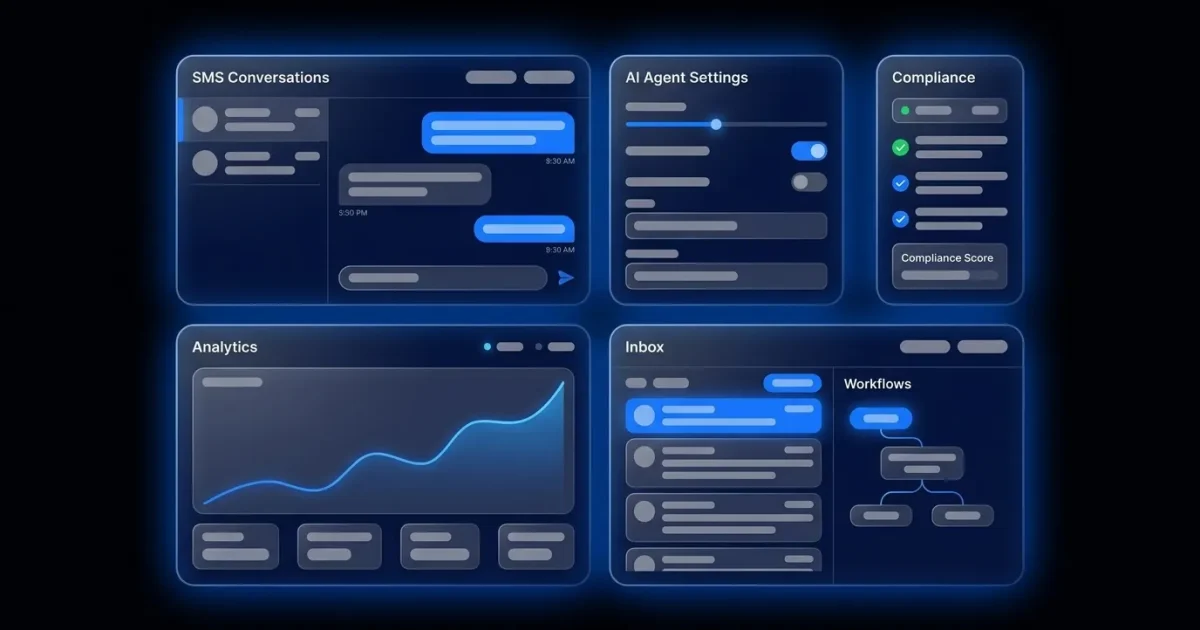
Plura’s Stateful Conversation Database keeps every channel on the same page. A lead who texted about pricing at 9 a.m. does not repeat details when the AI voice agent calls at noon. Context travels with the contact across voice, SMS, RCS, and AI webchat.
Evidence: Performance Benchmarks and 2026 Regulatory Shifts
Harvard Business Review research found that companies responding within five minutes are 100 times more likely to connect with a prospect than those waiting 30 minutes.3 Leads contacted within 1 minute are 391% more likely to convert than those contacted after 24 hours. The 47-hour baseline mentioned earlier highlights how much performance sits on the table when teams rely on manual queues.
Regulatory changes in 2025 and 2026 introduced several developments that high-volume teams need to track:
- The FCC’s one-to-one consent rule was vacated by the Eleventh Circuit in January 2025 and formally eliminated in August 2025, reinstating the pre-2024 prior express written consent standard.
- Under FCC April 2025 revocation rules, businesses have up to 10 business days to process opt-outs, with real-time suppression as the operational best practice on receipt of any standard opt-out keyword.
- Texas SB 140, effective September 1, 2025, expanded the definition of telephone solicitation to include text messages while keeping statutory damages at $500 per violation (or $1,500 if knowing or intentional).
- 2026 carrier surcharges run $0.0035 per SMS on AT&T and $0.0045 per SMS on T-Mobile and Verizon, which makes unqualified blast campaigns increasingly expensive.
- U.S. wireless carriers began blocking unregistered A2P traffic on 10-digit long codes in early 2025, which requires 10DLC Brand and Campaign registration for any automated SMS program.
Core Analysis: Matching Pain Points to Structural Fixes
Response time and automated engagement. Manual SDR queues produce the 47-hour average. AI SMS agents respond in under 5 seconds, 24/7, across every inbound trigger. Organizations deploying AI for speed to lead see response times drop from hours to seconds and connection rates increase by 3x to 5x.
Channel fragmentation and stateful memory. Most AI SMS tools operate as single-channel products with no memory of what happened on voice or webchat. Plura’s Stateful Conversation Database keys every interaction to the same customer token across all four channels. Qualification data captured in an SMS thread is available to the voice agent on the next call.
Compliance complexity and built-in controls. Plura’s compliance engine supports real-time DNC scrubbing, TCPA consent logging, quiet-hours rules by time zone, and 50+ state rule sets on every outbound contact. Consent records are timestamped and immutable. The dashboard exports audit-ready reports in one click. Customers remain responsible for their own compliance posture, and Plura provides infrastructure that supports that work.
Regulatory Framework: How SMS Marketing Operates in the USA
SMS marketing in the United States operates within the Telephone Consumer Protection Act (TCPA, 47 U.S.C. § 227), which the FCC has long treated as covering text messages. The framework includes several components that high-volume teams typically review with qualified counsel:
- Prior express written consent. Marketing SMS to mobile numbers generally relies on a signed or electronically signed affirmative agreement that names the specific business, discloses that the recipient is agreeing to receive automated marketing texts, and states that consent is not a condition of purchase.
- National DNC Registry. DNC screening typically occurs before every SMS campaign send, with lists no more than 31 days old to qualify for the FCC safe harbor.
- Quiet hours. Messages are generally sent only between 8 a.m. and 9 p.m. local time under 47 C.F.R. § 64.1200(c)(1), with Oklahoma tightening this to 8 a.m.-8 p.m.
- Revocation processing. Under FCC April 2025 rules, opt-out requests must be processed within 10 business days, and many teams treat real-time suppression as the operational standard.
- State mini-TCPA rules. Florida’s FTSA and Texas SB 140 both create private rights of action with per-message damages that exceed the federal baseline. Teams operating in multiple states typically review applicable state statutes with counsel.
Plura supports compliance with TCPA and DNC frameworks through built-in controls. Customers remain responsible for their own regulatory obligations and should consult qualified legal counsel on their specific programs.
Enterprise AI SMS Tools Compared to Other Options
Enterprise AI SMS platforms differ from e-commerce tools and offshore BPOs across several objective dimensions. The table below compares categories on like-for-like criteria:
| Criteria | E-Commerce SMS Tools (e.g., Attentive, Klaviyo) | Offshore BPOs | Plura AI (Enterprise AI SMS) |
|---|---|---|---|
| Carrier ownership | Third-party CPaaS | Varies by vendor | FCC-licensed carrier |
| Real-time DNC scrubbing | Not standard | Varies | Built-in, pre-contact |
| U.S. infrastructure | Not guaranteed | No | 100% U.S. by architecture |
| Stateful cross-channel memory | No | No | Yes, across voice/SMS/RCS/webchat |
| Live transfer capability | No | Yes (human) | Yes (AI-to-human warm transfer) |
Twilio-based API resellers form a fourth category.4 These developer-first platforms require engineering resources to build and maintain, with compliance added later rather than built into the core. Plura’s pre-conversation lead enrichment can increase conversion rates by 30% or more, which API-wrapper platforms cannot typically match without significant custom development.
Compare Plura plans and rates side by side at plura.ai/pricing.
AI SMS Strategy for High-Volume Contact and Marketing Teams
A functional enterprise AI SMS strategy covers four operational layers that work together.
- Workflow design. Map every inbound trigger, such as form fills, missed calls, and campaign replies, to a qualification sequence with defined branching logic. Keep these sequences short and limit qualification to 2-4 questions before a booking prompt or transfer trigger, because longer paths increase drop-off. Use Plura’s no-code workflow builder to iterate on these sequences without engineering cycles.
- Consent logging. Capture source URL, UTC timestamp, IP address, exact disclosure text, and opt-out events for every subscriber. TCPA demand letters typically reference consent records retained for at least four years under the federal statute of limitations.
- Quiet-hours enforcement. Plura enforces sending windows automatically by time-zone detection on the contact. The platform applies federal and state calling-window restrictions to every campaign without manual configuration.
- ROI math. At default calculator inputs, a 15-agent operation at $20/hour costs $60,000 per month. Six Plura agents at 100% talk utilization cost $14,400 per month, which creates a 30-day saving of $45,600 and a 12-month saving of $547,200.3
Risk Review and Due-Diligence Checklist
Before deploying any enterprise AI SMS platform, teams can reduce risk by verifying several structural details.
- Carrier ownership. Confirm whether the vendor owns an FCC-licensed carrier or routes through a third-party CPaaS. Twilio-based resellers inherit Twilio’s caller-ID reputation and cannot issue branded caller ID at the carrier level.
- Real-time scrubbing proof. Request documentation that DNC scrubbing occurs before each outbound contact, not in a batch job after campaign launch.
- U.S. infrastructure attestation. Confirm that voice origination, model hosting, data storage, and call recording all sit on domestic infrastructure. The FCC NPRM (CG Docket No. 26-52) discusses potential restrictions on offshore handling of sensitive consumer data.
- Audit-export capability. Verify that consent records, suppression logs, and conversation transcripts are exportable in audit-ready format on demand.
- 90-day opt-out terms. Plura includes a 90-day opt-out window in every annual contract. Vendors that do not offer this place the iteration risk entirely on the customer.
- 10DLC registration. Confirm that the vendor supports Brand and Campaign registration through The Campaign Registry, which is required for all A2P SMS traffic on 10-digit long codes as of February 2025.
Book a live demo with Plura at plura.ai/plura-webchat to see the compliance engine and workflow builder in action.
Frequently Asked Questions
How U.S. Rules Shape High-Volume SMS Campaigns
SMS marketing in the United States operates within the framework established by the TCPA and FCC rules. Core elements include prior express written consent for marketing messages, DNC Registry scrubbing before each send, quiet-hours enforcement by recipient time zone, and opt-out processing within 10 business days under the FCC’s April 2025 revocation rules. State laws in Florida, Texas, and other jurisdictions add requirements and private rights of action with per-message damages. Teams running high-volume automated campaigns should review applicable federal and state statutes with qualified legal counsel before launching.
Target Response Times for Enterprise AI SMS
Industry benchmarks show that contacting a lead within 5 minutes can make them up to 100 times more likely to connect. Leads contacted within 1 minute are 391% more likely to convert than those contacted after 24 hours. The 391% conversion lift from sub-minute response explains why enterprise platforms target sub-5-second engagement on every inbound trigger. Enterprise AI SMS platforms built for high-volume operations, including Plura, pursue this sub-5-second target around the clock without human queue dependency. Plura customers report 90% faster lead-response time compared to their baseline.
How Stateful Memory Improves Lead Qualification
Stateful memory means the AI agent retains context from every prior interaction across all channels. A lead who texted about pricing, then received a follow-up call, then opened an RCS message does not re-explain their situation at each touchpoint. Plura’s Stateful Conversation Database keys every interaction to the same customer token across voice, SMS, RCS, and webchat. This removes qualification redundancy that drags down conversion rates in multi-touch campaigns and allows live transfer recipients to start with full context instead of a cold handoff.
Differences Between E-Commerce SMS and Enterprise AI SMS
E-commerce SMS tools focus on bulk sends, segmentation by purchase history, and campaign revenue attribution for retail use cases. They are not built for real-time DNC enforcement, live agent transfers, stateful cross-channel memory, or regulated-industry compliance controls. Enterprise AI SMS platforms cover the full workflow, including inbound trigger, qualification sequence, compliance controls, CRM update, and warm transfer to a human agent. The structural difference extends beyond feature depth to carrier ownership, infrastructure jurisdiction, and whether compliance sits inside the platform or as an external add-on.
Timelines for Processing SMS Opt-Outs
Under FCC rules effective April 2025, businesses have up to 10 business days to process opt-out requests across all systems. Operational best practice treats real-time suppression as the standard upon receipt of any common opt-out keyword, including STOP, UNSUBSCRIBE, CANCEL, END, QUIT, and OPT-OUT. A defensible suppression log captures the opt-out timestamp, the keyword received, the channel, and confirmation that the number was removed from all active sequences. Plura’s compliance engine processes opt-outs and updates suppression records automatically, with audit-ready exports available on demand. Customers remain responsible for their own compliance posture and should consult counsel on their specific programs.
Conclusion: Structural Gaps and the 2026 Compliance Landscape
The gap between what e-commerce SMS tools deliver and what regulated, high-volume teams require is structural, not cosmetic. Bulk-send platforms built for retail typically cannot enforce real-time DNC controls, hold stateful memory across channels, issue branded caller ID at the carrier level, or route qualified buyers to live agents in under 5 seconds. The 2025-2026 regulatory cycle, including the FCC’s April 2025 revocation rules, Texas SB 140, and the ongoing FCC NPRM on offshore infrastructure, has raised the compliance floor for every team running automated SMS at scale.
Plura addresses this gap as the only FCC-licensed, stateful AI SMS platform on 100% U.S. infrastructure. The platform’s compliance engine, stateful conversation database, and live transfer workflows align with the operational reality of 2026 rather than retrofitting older architectures.
Run your numbers through Plura’s ROI calculator to see potential cost savings, or compare plans at plura.ai/pricing.
Updated August 2026. Plura provides communications infrastructure; customers remain responsible for their own compliance posture, regulatory obligations, and the claims they make to their end users. Nothing in this article constitutes legal advice. Consult qualified counsel for guidance on TCPA, DNC, and applicable state statutes.
1 Plura AI maintains SOC 2, HIPAA, ISO, and GDPR posture as part of its platform infrastructure. References to compliance frameworks in this article describe Plura’s platform capabilities and do not constitute a guarantee that any customer using Plura will themselves be compliant with applicable laws or standards. Customers remain solely responsible for their own regulatory obligations, certifications, consent management, recordkeeping, and the claims they make to their own end users. Consult qualified legal counsel for guidance specific to your use case.
2 This article describes regulatory frameworks at a general level and does not constitute legal advice. Laws and regulations vary by jurisdiction, change over time, and apply differently depending on facts and circumstances. Readers should consult qualified legal counsel before making compliance decisions.
3 Performance figures, customer outcomes, and industry statistics referenced in this article are drawn from cited third-party sources or Plura customer case studies. Individual results vary based on implementation, use case, industry, audience, and execution. Past or aggregate performance is not a guarantee of future results.
4 References to third-party products, services, companies, or research are made for informational and comparative purposes only. Plura AI is not affiliated with, endorsed by, or sponsored by any third party named in this article unless explicitly stated. Trademarks and product names referenced remain the property of their respective owners.
This article is provided for informational purposes only and reflects Plura AI’s understanding at the time of publication. Product capabilities, integrations, and specifications are subject to change. For the most current information, visit plura.ai.
This article was produced with the assistance of AI tools and reviewed by Plura AI prior to publication.