

Written by: Matt Beucler, CEO, Plura AI
Updated July 6, 2026
Key Takeaways for High-Volume Voice Providers
- The Foreign Robocall Elimination Act (S.2666) directs the FCC to form an interagency taskforce to study foreign robocalls and recommend mitigation strategies.2
- Providers running 100% U.S. infrastructure already align with the core architecture assumptions behind the proposed rules and face fewer new obligations.
- Offshore-dependent carriers may need to post bonds, maintain Robocall Mitigation Database (RMD) certifications, and implement STIR/SHAKEN or alternative mitigation plans to avoid traffic blocking.
- Timely traceback cooperation and continuous RMD updates are critical, because non-compliance can trigger immediate blocking by downstream providers.
- Plura AI offers a fully domestic, FCC-licensed platform that helps operators support compliance; speak with a Plura specialist to review your current exposure.
Financial Bonds and Provider Accountability
S.2666 directs the FCC to establish an interagency taskforce to study unlawful robocalls from abroad and recommend strategies and best practices. The taskforce’s work may include financial bond requirements and related measures that hold carriers accountable for foreign-originated traffic entering U.S. networks. Understanding how providers may be evaluated starts with four core parameters that shape potential obligations:
- Compliance costs vary by provider size, traffic mix, and infrastructure footprint.
- Providers that qualify as established, bona fide domestic operations may have different obligations under existing rules.
- Registration steps and documentation requirements are defined by regulation.
- Enforcement may include financial tools, as the FCC’s March 2026 draft Notice of Proposed Rulemaking (NPRM) explores requiring bonds or tariff-style duties on unlawful calls entering the United States from foreign jurisdictions.
Foreign Robocall Elimination Act Bond Requirement
Several proposals have introduced bond requirements for carriers that register in the U.S. Robocall Mitigation Database. The taskforce created under S.2666 may recommend bond structures as one tool to manage foreign robocall risk. In those proposals, the bond acts as a financial deterrent and pushes insurers and providers to screen traffic more rigorously before it reaches U.S. networks.
The RMD enables intermediate and terminating providers to verify originating carriers’ STIR/SHAKEN status or alternative mitigation steps before accepting traffic, which creates an enforcement mechanism. When that mechanism is combined with a bond requirement, a carrier that cannot post a required bond or complete RMD registration may face traffic blocking by downstream providers that rely on the database.
For domestic operators running 100% U.S. infrastructure, the bond obligation may not apply. Operators whose voice traffic originates entirely on U.S. infrastructure are not the primary focus of measures targeting foreign carriers.
Robocall Mitigation Database Certification Requirements
All voice service providers must file and maintain updated RMD certifications of their robocall mitigation plans, including STIR/SHAKEN implementation or alternative measures, to avoid certification revocation and blocking of their traffic by other providers. The taskforce established under S.2666 will review how RMD certification and related tools perform against foreign robocall threats. Under the current rules, RMD certification involves four core steps:
1
- File an initial certification with the FCC’s RMD documenting the provider’s robocall mitigation plan.
- Specify whether the provider has implemented STIR/SHAKEN or is relying on an alternative mitigation measure.
- Update the certification whenever the mitigation plan materially changes.
- Monitor RMD status continuously, because revocation triggers immediate blocking eligibility by downstream carriers.
STIR/SHAKEN and Traceback Expectations
The STIR/SHAKEN framework, mandated by the TRACED Act and implemented by the FCC in 2020, uses digital certificates to authenticate caller ID for voice calls on IP networks. It applies to all U.S. originating and terminating voice service providers on IP networks, and to gateway providers processing international calls since June 30, 2023. S.2666 may shape future recommendations around these existing requirements. Current implementation expectations include:
- Originating providers sign calls with STIR/SHAKEN digital certificates at the point of origination.
- Terminating providers transmit verified caller identity information when an A-level attestation is indicated, consistent with the FCC’s December 2025 proposed rules on advanced robocall targeting.
- Gateway providers handling international calls into U.S. networks apply STIR/SHAKEN authentication to foreign-originated traffic.
- Providers cooperate with Industry Traceback Group (ITG) requests.
- Non-cooperation with traceback requests can result in RMD removal and traffic blocking.
Traceback Duties Under the Foreign Robocall Elimination Act
The ITG requires all voice service providers to cooperate with traceback requests, and non-cooperation can result in RMD removal and traffic blocking. Traceback identifies the origin of a suspicious call by tracing it back through the call path, carrier by carrier, so enforcement agencies can focus on the true source.
Providers that handle high call volumes need a predictable process for these requests. Operational expectations include:
- Treating timely response as the standard for traceback cooperation, not an optional target.
- Recognizing that failure to respond in a timely manner can lead to RMD removal, which triggers blocking eligibility by every downstream carrier that checks the RMD before accepting traffic.
For high-volume operators, the timely response window functions as a hard threshold. Falling below that threshold turns traceback from a workflow issue into a blocking risk.
Interagency Taskforce and Global Coordination
S.2666 directs the establishment of an interagency task force comprising the FCC, FTC (Federal Trade Commission), DOJ (Department of Justice), and seven private-sector experts within 270 days of enactment to analyze foreign robocall threats and recommend enforcement strategies. The task force must submit a report to Congress within 360 days of its establishment covering call volumes, origins, technical effectiveness of mitigation measures, and agency resource needs.
Additional accountability provisions in S.2666 include:
- A directed study on whether a dedicated robocall prosecution office should be created within the DOJ.
- An international cooperation framework that provides incentives for foreign governments to adopt STIR/SHAKEN call authentication standards.
How S.2666 Relates to VoIP Providers
STIR/SHAKEN applies to all U.S. originating and terminating voice service providers on IP networks, which includes VoIP providers. The S.2666 taskforce focuses on foreign-originated robocalls, and VoIP providers that handle U.S.-bound international calls may fall within existing gateway provider rules when they process international traffic.
As noted earlier, domestic VoIP providers fall outside the primary scope of foreign robocall measures if their traffic originates entirely on U.S. infrastructure. Operators should consult qualified telecommunications counsel to assess their specific classification and obligations as the bill moves toward a floor vote.
Compare Plura’s plans and rates side by side to see how a domestic, FCC-licensed platform fits your current routing and compliance strategy.
Operational Readiness Checklist for Providers
This checklist outlines a practical workflow for voice service providers preparing for S.2666. It moves from infrastructure classification, through verification and protocols, to documentation and calendar management. This is not legal advice; consult qualified counsel for your specific obligations.
- Confirm infrastructure classification and document whether voice traffic originates on U.S. or foreign infrastructure.
- Verify current RMD filing status and confirm that the mitigation plan reflects your present operations.
- Confirm STIR/SHAKEN implementation status, and document any alternative mitigation measure in the RMD filing.
- Establish a traceback response protocol by designating a point of contact, defining the internal escalation path, and testing the workflow.
- If handling international traffic, review foreign carrier relationships and related compliance requirements.
- Monitor the ITG’s published data on suspected illegal callers and cross-reference those entries against your traffic sources.
- Review gateway provider agreements for STIR/SHAKEN pass-through obligations on international traffic.
- Set calendar alerts for the 270-day task force establishment window and the 360-day congressional report deadline after enactment.
- Audit DNC (Do Not Call) compliance, TCPA (Telephone Consumer Protection Act) consent records, and quiet-hours enforcement across all outbound campaigns.2
- Document the infrastructure audit trail that supports any broadband consumer label disclosures referencing U.S.-handled calls.
Cost Modeling for Foreign vs. Domestic Architectures
The figures below are estimates based on publicly available information and should not be treated as legal or financial advice. Actual costs will vary by provider size, classification, and infrastructure configuration. Consult qualified counsel and a licensed surety provider for precise figures. The table illustrates the cost difference between foreign carriers and domestic operators across four compliance dimensions: bond posting, RMD certification, STIR/SHAKEN implementation, and traceback infrastructure.
| Compliance Item | Estimated Cost (Foreign Carrier) | Estimated Cost (Domestic Operator) | Notes |
|---|---|---|---|
| RMD bond posting (if applicable under S.2666) | Costs vary | Not applicable (domestic exemption) | Bond may be required before RMD registration; surety premium typically a percentage of bond face value annually (estimate) |
| RMD certification filing | Staff time; no FCC filing fee currently | Staff time; no FCC filing fee currently | Ongoing update obligation if mitigation plan changes |
| STIR/SHAKEN implementation | Variable; gateway providers already subject since June 30, 2023 | Already required for U.S. IP-network providers | Large U.S. carriers report 85% of voice traffic signed with STIR/SHAKEN in 20253 |
| Traceback response infrastructure | Internal staffing; timely response | Internal staffing; timely response | Non-compliance triggers RMD removal and blocking risk |
For operators that rely on offshore infrastructure or foreign carrier relationships, compliance costs can become the most immediate budget item. If those costs prevent an operator from meeting bond or certification requirements, the operator cannot register in the RMD. Without RMD registration, the operator faces traffic blocking by every downstream carrier that checks RMD status before accepting calls, which functions as an operational shutdown.
Domestic operators running 100% U.S. infrastructure carry fewer of these costs. Their architecture already aligns with many requirements that apply to established domestic providers.
2026 Legislative Status and Planning Timeline
S.2666, the Foreign Robocall Elimination Act, was introduced in the 119th Congress. Key milestones include:
- October 2025: S.2666 cleared the Senate Commerce Committee unanimously with bipartisan support and endorsements from AARP and USTelecom.
- October 2025: The bill advanced during Senate Commerce Committee markup.
- June 1, 2026: S.2666 was placed on the Senate Legislative Calendar under General Orders (Calendar No. 422), positioning it for a floor vote.
- Companion bill to S.2666 is H.R. 2666.
- S.2666 is described as the most significant anti-robocall legislation since the TRACED Act of 2019.
After enactment, the bill’s internal clock starts. The interagency task force must be established within 270 days of enactment, and the task force must deliver its congressional report within 360 days of its establishment. Operators can treat Senate floor action as the practical trigger for internal planning, because it signals that both legislative and regulatory tracks are moving.
The FCC’s March 2026 draft NPRM on offshore call centers (CG Docket No. 26-52) builds on similar concepts and seeks comment on requiring bonds or tariff-style duties on unlawful calls entering the United States from foreign jurisdictions. The legislative and regulatory tracks are moving in parallel, which increases the value of early infrastructure decisions.
Conclusion: Why Infrastructure Drives Your Compliance Posture
The Foreign Robocall Elimination Act positions the FCC’s taskforce to refine how foreign robocalls are identified, deterred, and traced. Operators that run 100% U.S. infrastructure start from a stronger position under the existing STIR/SHAKEN and RMD framework, because their architecture already aligns with domestic assumptions.
Plura AI is an FCC-licensed platform running on 100% U.S. infrastructure by design. Voice origination, model hosting, data storage, and call recording all sit on domestic infrastructure. Plura supports compliance with TCPA, DNC, HIPAA, SOC 2, SHAKEN/STIR caller ID verification, and 50+ state rule sets through its built-in compliance engine.1 Every outbound contact is checked against federal and state DNC registries in real time before dial. STIR/SHAKEN authentication runs on every outbound call through Plura’s own FCC-licensed audio bridging carrier, not a third-party CPaaS (Communications Platform as a Service).
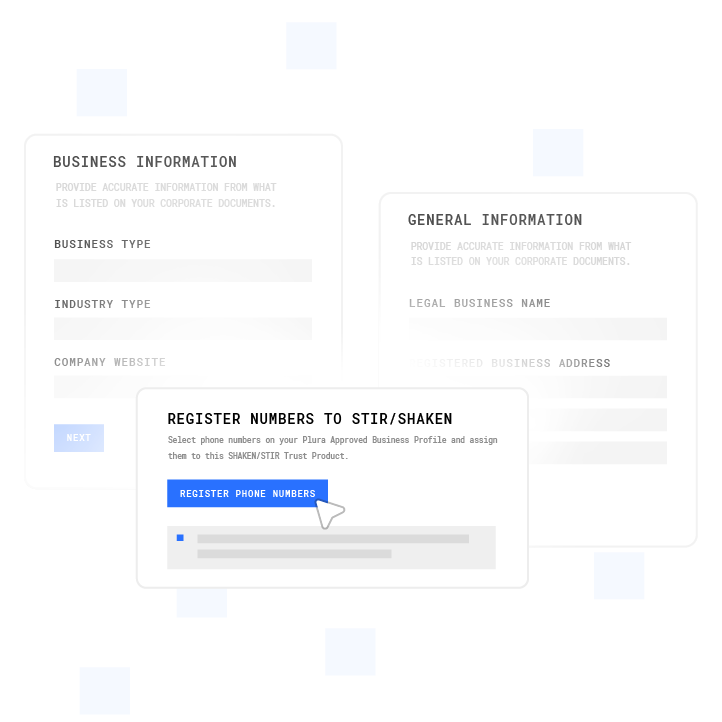
For operators reviewing S.2666 exposure and infrastructure options, pricing and capabilities help frame the decision.
Review Plura’s pricing and capability matrix to evaluate how the platform’s domestic architecture and compliance-support tooling align with your risk profile.
Frequently Asked Questions
What is the difference between the bond requirement and existing RMD filing obligations?
The existing Robocall Mitigation Database filing obligation applies to all voice service providers and requires them to certify their robocall mitigation plan, including STIR/SHAKEN implementation or an approved alternative. That obligation has been in place since the FCC implemented the TRACED Act framework. The potential bond requirement discussed in connection with S.2666 relates to financial assurances that may apply to certain carriers handling foreign-originated traffic, while domestic operators that qualify as established, bona fide providers continue under the existing RMD certification framework.
Does S.2666 apply to providers that only handle domestic calls?
S.2666 focuses on directing the FCC to create a taskforce on unlawful robocalls originating from abroad. Providers whose traffic originates entirely on U.S. infrastructure and does not involve foreign-originated calls are not the primary target of foreign robocall measures. The STIR/SHAKEN and traceback cooperation obligations reinforce existing FCC rules that already apply to all U.S. voice service providers on IP networks. Operators should consult qualified telecommunications counsel to assess their specific classification under applicable rules.
What happens if a provider fails to respond to a traceback request within 24 hours?
The Industry Traceback Group’s timely response standard ties directly to RMD standing. A provider that fails to cooperate with a traceback request faces removal from the RMD. Once removed from the RMD, every downstream carrier that checks RMD status before accepting traffic is eligible to block that provider’s calls. For high-volume operators, RMD removal functions as an operational shutdown event rather than a simple regulatory fine.
How does Plura’s infrastructure relate to S.2666 compliance obligations?
Plura AI operates as an FCC-licensed audio bridging carrier running on 100% U.S. infrastructure. Voice origination, model hosting, data storage, and call recording all sit on domestic infrastructure. Plura supports SHAKEN/STIR caller ID verification on every outbound call through its own carrier, not through a third-party CPaaS. Plura supports compliance with TCPA, DNC, HIPAA, SOC 2, and 50+ state rule sets.1 Operators using Plura remain responsible for their own regulatory obligations and certifications, while Plura provides the infrastructure and compliance-support tooling. The domestic infrastructure architecture means Plura-based operators are not in the class of foreign carriers that potential S.2666 bond requirements are designed to evaluate.
What is the current legislative status of S.2666 and when should operators begin preparing?
As of July 2026, S.2666 has cleared the Senate Commerce Committee unanimously and was placed on the Senate Legislative Calendar under General Orders (Calendar No. 422) as of June 1, 2026, positioning it for a floor vote. The companion House bill is H.R. 2666. After enactment, the interagency task force must be established within 270 days and must deliver a congressional report within 360 days of its establishment. Many operators treat placement on the Senate calendar as the signal to begin internal planning. The FCC’s March 2026 draft NPRM on offshore call centers is moving on a separate regulatory track and may impose additional requirements through rulemaking independent of S.2666’s enactment. Consult qualified telecommunications and regulatory counsel for guidance specific to your organization’s classification and obligations.
1 Plura AI maintains SOC 2, HIPAA, ISO, and GDPR posture as part of its platform infrastructure. References to compliance frameworks in this article describe Plura’s platform capabilities and do not constitute a guarantee that any customer using Plura will themselves be compliant with applicable laws or standards. Customers remain solely responsible for their own regulatory obligations, certifications, consent management, recordkeeping, and the claims they make to their own end users. Consult qualified legal counsel for guidance specific to your use case.
2 This article describes regulatory frameworks at a general level and does not constitute legal advice. Laws and regulations vary by jurisdiction, change over time, and apply differently depending on facts and circumstances. Readers should consult qualified legal counsel before making compliance decisions.
3 Performance figures, customer outcomes, and industry statistics referenced in this article are drawn from cited third-party sources or Plura customer case studies. Individual results vary based on implementation, use case, industry, audience, and execution. Past or aggregate performance is not a guarantee of future results.
This article is provided for informational purposes only and reflects Plura AI’s understanding at the time of publication. Product capabilities, integrations, and specifications are subject to change. For the most current information, visit plura.ai.
This article was produced with the assistance of AI tools and reviewed by Plura AI prior to publication.