

Written by: Matt Beucler, CEO, Plura AI | Last updated: August 25, 2026
How S.2666 Changes Robocall Duties for Gateway Providers
The Foreign Robocall Elimination Act (S.2666) targets unlawful robocalls entering the U.S. network from foreign sources.2 It shifts more responsibility to gateway providers and other voice service providers that touch foreign-originated traffic. These changes affect carrier selection, infrastructure design, and how your operation cooperates with traceback investigations. This article explains the core obligations in S.2666 and how carrier-level infrastructure shapes your compliance posture.
Key Takeaways
- Gateway providers must maintain Robocall Mitigation Database certifications, implement STIR/SHAKEN, and cooperate with traceback investigations under S.2666.2
- Foreign-originated calls must be flagged, U.S. numbers cannot be spoofed, and terminating providers must transmit verified caller identity on A-level attestations.
- Traceback cooperation is mandatory. Providers that refuse can be publicly listed and face FCC enforcement actions.
- Plura AI’s FCC-licensed carrier stack delivers real-time DNC scrubbing, STIR/SHAKEN verification, and 100% U.S. infrastructure to support S.2666-related obligations without offshore exposure.1
DNO Blocking and Core Duties Under S.2666
The Foreign Robocall Elimination Act (S.2666) currently has the status of Introduced, was reported by committee on June 1, 2026, and has not passed the Senate. The list below summarizes core duties drawn from the bill text and Congressional Research Service analysis.
- Post a Robocall Mitigation Database (RMD) bond. S.2666 directs the FCC to issue rules requiring certain voice service providers to file an RMD certification that they are implementing measures to mitigate unlawful robocalls.
- Maintain annual RMD certification. Voice service providers must file RMD certifications annually.
- Implement STIR/SHAKEN authentication. The S.2666 task force will examine technical standards for authenticating calls. Existing FCC rules already require most providers, including gateway providers, to implement STIR/SHAKEN or equivalent robocall mitigation steps.
- Cooperate with traceback investigations. The Foreign Robocall Elimination Act permits the FCC or the registered traceback consortium to publish a list of voice service providers that refuse to participate in traceback efforts or that originate or transmit substantial volumes of unlawful robocalls, and authorizes the FCC to use that information as the basis for enforcement actions.
- Identify and flag foreign-originated calls. The FCC proposes to require voice service providers to implement measures to ensure that consumers know which calls originate from outside of the United States and to prohibit spoofing of U.S. telephone numbers for calls that originate from outside of the United States.
- Transmit verified caller identity on A-level attestations. The FCC proposes to require terminating providers to transmit verified caller name or other caller identity information for presentation on a consumer’s handset whenever they transmit an indication that a call has received an A-level attestation.
Operators working with qualified counsel on these obligations can also review the Federal Register and the Congressional Research Service analysis of S.2666 for the most current regulatory text.
See how Plura’s carrier stack handles STIR/SHAKEN verification in a live demo, including caller ID authentication and real-time DNC checks on every outbound call.
How Traceback Works for Foreign-Originated Robocalls
Robocalls can be traced within technical and jurisdictional limits. S.2666 directs the Federal Communications Commission to establish a taskforce on unlawful robocalls. The traceback process relies on an FCC-registered private consortium that follows call-detail records upstream from the terminating carrier to the originating provider.
S.2666 grants a registered private traceback consortium statutory immunity from civil suits for traceback activities. That immunity is designed to accelerate cooperation.
For high-volume operators, traceback exposure creates both risk and protection. Providers that cooperate with traceback requests demonstrate good-faith mitigation and support enforcement against bad actors. Providers that refuse can be publicly listed and face FCC enforcement. Plura’s platform logs every outbound contact with immutable, audit-ready records, which supports traceback cooperation without manual reconstruction of call-detail data.
Why Foreign Robocalls Remain Hard to Stop
The FCC’s enforcement authority is domestic, while many unlawful robocalls originate abroad. Foreign-originated robocalls enter the U.S. phone network through gateway providers, and many originating actors operate outside U.S. jurisdiction. S.2666 directs the Federal Communications Commission to establish a taskforce on unlawful robocalls.
The S.2666 task force will examine the technical and jurisdictional gaps that allow foreign-originated robocalls to evade domestic enforcement, including gaps that current FCC authority cannot close alone.
The most significant gap is authentication. STIR/SHAKEN was designed for domestic call paths. The FCC proposes foreign-call identification and anti-spoofing rules to address this gap. Until those rules are final, gateway providers carry the primary enforcement burden at the point of entry.
Current Rules Versus Proposed Rules Under S.2666
The following table compares existing FCC requirements with changes introduced by S.2666. These differences affect whether your current carrier infrastructure meets the new compliance floor or requires architectural changes.
| Rule Area | Current Requirement | S.2666 Change | Source |
|---|---|---|---|
| RMD Certification Cadence | Annual certification to the Robocall Mitigation Database | Annual certification retained; additional conditions may apply for covered providers | Congress.gov, S.2666 bill text |
| Traceback Consortium Designation | FCC seeks applications from the traceback consortium annually | S.2666 amends a provision requiring an annual report to be submitted to Congress once every three years. | Congress.gov, S.2666 bill text |
| Traceback Consortium Immunity | No explicit statutory immunity for the private traceback consortium | S.2666 grants traceback-related immunities to a registered consortium | Congress.gov, S.2666 bill text |
| Interagency Coordination | No standing interagency task force on foreign robocalls | Task force established to examine authentication and enforcement gaps | Congress.gov, S.2666 bill text |
Additional Questions on S.2666 Gateway Provider Obligations
Who qualifies for a bond exemption under S.2666?
The Foreign Robocall Elimination Act directs the FCC to establish objective exemption criteria and categorical exemptions from the bond requirement for bona fide providers, considering factors such as FCC registration and contributions, state public-utility oversight, exchange listing, and other indicia of regulated, established operations. Providers seeking exemption status can consult qualified counsel and monitor FCC rulemaking for the specific criteria once finalized.
What happens if a provider refuses traceback requests?
The Foreign Robocall Elimination Act permits the FCC or the registered traceback consortium, in consultation with the FCC, to publish a list of voice service providers that refuse to participate in private traceback efforts or that are found to originate or transmit substantial unlawful robocalls, and authorizes the FCC to use such information as the basis for enforcement actions. Public listing on that registry creates downstream blocking risk from other carriers and can affect interconnection decisions.
What does the task force examine?
The task force includes representatives from federal agencies plus seven private-sector members drawn from entities with expertise in fighting unlawful robocalls, the registered traceback consortium, businesses that communicate by phone, and a consumer advocacy organization. Its findings will inform future FCC rulemaking on gateway provider obligations.
While those rules are still being finalized, operators can evaluate their current infrastructure against the obligations S.2666 has already defined. The following checklist maps those obligations to specific infrastructure and process elements.
Infrastructure Checklist for Gateway and Downstream Providers
The checklist below highlights infrastructure and process elements that high-volume operators and their counsel can evaluate against S.2666 obligations and existing FCC rules. This checklist describes Plura’s platform capabilities and does not constitute legal advice. Consult the regulation text and qualified counsel to determine your organization’s specific obligations.
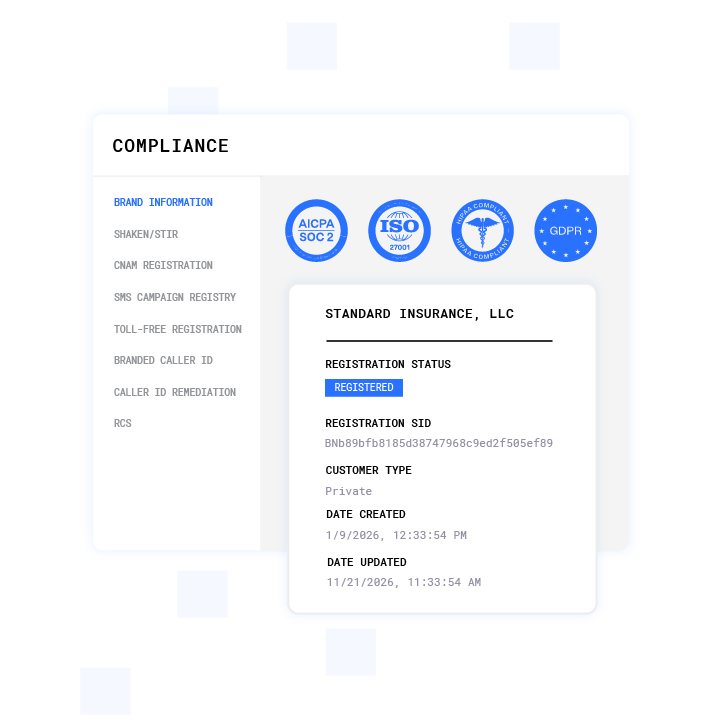
- STIR/SHAKEN caller ID verification. Confirm that every outbound voice call originates with STIR/SHAKEN authentication at the carrier level, not through a third-party reseller. Plura issues STIR/SHAKEN authentication on every outbound call through its own FCC-licensed carrier.
- DNC compliance. Verify that every outbound contact is checked against federal and state Do Not Call registries in real time before dial. Plura’s platform enforces real-time DNC scrubbing on every outbound contact.
- TCPA compliance infrastructure. Confirm that consent records are timestamped, immutable, and audit-ready. Plura’s compliance engine logs express written consent per contact with one-click audit exports.
- RMD bond readiness. Assess whether your organization falls within the covered-provider category under S.2666 and whether a bond will be required before your next RMD certification. Consult qualified counsel on exemption eligibility.
- Traceback cooperation posture. Confirm that call-detail records are retained and accessible for traceback requests from the FCC-registered consortium. Plura’s platform logs every interaction with immutable records.
- Foreign-call identification. Evaluate whether your gateway infrastructure can flag and label calls originating from outside the United States, consistent with the FCC’s proposed rules on foreign-call identification.
- SOC 2 and HIPAA alignment. For operators handling protected health information or sensitive consumer data, confirm that your carrier infrastructure supports SOC 2 and HIPAA-aligned encryption, access controls, and audit logging. Plura holds SOC 2 certification and supports HIPAA-aligned infrastructure.1
- ISO certification and GDPR coverage. For operators with international data obligations, confirm ISO certification and GDPR coverage at the infrastructure level. Plura is ISO certified and covers GDPR for applicable operations.1
- 100% U.S. infrastructure. Confirm that voice origination, model hosting, data storage, and call recording all sit on domestic infrastructure. Plura runs on 100% U.S. infrastructure by architecture, which reduces offshore exposure under the FCC NPRM and companion legislation including S.2666.
Walk through Plura’s compliance infrastructure in a live demo to see how each checklist item maps to the platform.
Next Steps for High-Volume Voice Operations
S.2666 moves the compliance floor for every voice service provider that touches foreign-originated traffic. The bond requirement, traceback cooperation mandate, and STIR/SHAKEN authentication obligations are now conditions for maintaining RMD standing, which means they are conditions for continued access to the U.S. phone network.
Operators running on Twilio-based API resellers face a structural problem.4 Those platforms do not own the carrier, cannot issue branded caller ID at the carrier level, and cannot enforce real-time DNC scrubbing before the call leaves the network. Plura is its own FCC-licensed audio bridging carrier. Every obligation in the checklist above is enforced inside the platform, not through a third-party add-on.
Leaders focused on cost impact can run their numbers through Plura’s ROI calculator to estimate savings in real time. The default scenario shows a 15-agent operation dropping from $60,000 per month to $14,400 per month, with 12-month savings of $547,200.3
Leaders focused on capability and carrier-stack fit can compare plans and rates to see how Plura’s carrier-level compliance maps to their operation.
Watch the FCC-licensed carrier stack in action on a live call, including real-time DNC enforcement and STIR/SHAKEN caller ID verification.
Frequently Asked Questions
What is the Foreign Robocall Elimination Act and who does it apply to?
The Foreign Robocall Elimination Act (S.2666) has the status of Introduced, was reported by committee on June 1, 2026, and has not passed the Senate. It targets unlawful robocalls entering the U.S. phone network from foreign sources. It applies to voice service providers broadly, with specific obligations falling on gateway providers that receive calls directly from foreign originating or intermediate providers. The bill addresses cooperation with FCC-registered traceback investigations and STIR/SHAKEN authentication on calls passing through their networks. Operators can consult qualified counsel and the bill text on Congress.gov to determine whether and how S.2666 applies to their specific operations.
What is the Robocall Mitigation Database bond requirement under S.2666?
The Robocall Mitigation Database is a tool used to help mitigate unlawful robocalls. Voice service providers file certifications. Operators can consult qualified counsel and review official FCC and congressional sources for details on any bond requirements under S.2666.
How does STIR/SHAKEN authentication relate to the Foreign Robocall Elimination Act?
STIR/SHAKEN is the FCC-mandated caller ID authentication framework that assigns attestation levels to outbound calls based on the originating provider’s ability to verify the caller’s identity. An A-level attestation indicates the provider has fully verified the caller. The FCC has proposed requiring terminating providers to transmit verified caller name or other caller identity information for presentation on a consumer’s handset whenever an A-level attestation is indicated. S.2666’s task force examines issues related to authentication of calls. Operators running on platforms that do not own their carrier stack cannot issue STIR/SHAKEN authentication at the origination level and instead inherit the authentication posture of the underlying CPaaS provider.
What is traceback cooperation and why does it matter for gateway providers?
Traceback is the process by which an FCC-registered private consortium follows call-detail records upstream from the terminating carrier to identify the originating provider of an unlawful robocall. S.2666 strengthens this process by granting the registered traceback consortium statutory immunity from civil suits. Providers that refuse to participate in traceback investigations can be publicly listed by the FCC or the consortium, and the FCC is authorized to use that list as the basis for enforcement actions. For gateway providers, traceback cooperation functions as a condition of maintaining good standing in the Robocall Mitigation Database ecosystem.
How does Plura AI’s carrier stack support S.2666 compliance infrastructure?
Plura AI is its own FCC-licensed audio bridging carrier, which means voice origination, STIR/SHAKEN caller ID verification, and real-time DNC scrubbing are enforced at the carrier level before any call leaves the network. Plura’s compliance engine checks every outbound contact against federal and state DNC registries in real time, logs consent records with immutable timestamps, and enforces quiet-hours rules automatically through time-zone detection. The platform supports SOC 2, HIPAA-aligned infrastructure, ISO certification, GDPR coverage, TCPA compliance infrastructure, and DNC compliance controls.1 All voice origination, model hosting, data storage, and call recording run on 100% U.S. infrastructure by architecture, which addresses offshore exposure concerns raised by S.2666 and the companion FCC NPRM (CG Docket No. 26-52). Customers remain responsible for their own regulatory obligations and can consult qualified counsel on how Plura’s infrastructure maps to their specific compliance requirements.
1 Plura AI maintains SOC 2, HIPAA, ISO, and GDPR posture as part of its platform infrastructure. References to compliance frameworks in this article describe Plura’s platform capabilities and do not constitute a guarantee that any customer using Plura will themselves be compliant with applicable laws or standards. Customers remain solely responsible for their own regulatory obligations, certifications, consent management, recordkeeping, and the claims they make to their own end users. Consult qualified legal counsel for guidance specific to your use case.
2 This article describes regulatory frameworks at a general level and does not constitute legal advice. Laws and regulations vary by jurisdiction, change over time, and apply differently depending on facts and circumstances. Readers should consult qualified legal counsel before making compliance decisions.
3 Performance figures, customer outcomes, and industry statistics referenced in this article are drawn from cited third-party sources or Plura customer case studies. Individual results vary based on implementation, use case, industry, audience, and execution. Past or aggregate performance is not a guarantee of future results.
4 References to third-party products, services, companies, or research are made for informational and comparative purposes only. Plura AI is not affiliated with, endorsed by, or sponsored by any third party named in this article unless explicitly stated. Trademarks and product names referenced remain the property of their respective owners.
This article is provided for informational purposes only and reflects Plura AI’s understanding at the time of publication. Product capabilities, integrations, and specifications are subject to change. For the most current information, visit plura.ai.
This article was produced with the assistance of AI tools and reviewed by Plura AI prior to publication.