
Written by: Matt Beucler, CEO, Plura AI
Key Takeaways for Contact Center Leaders
-
The Keep Call Centers in America Act (S.2495) requires covered operators to notify the Department of Labor before relocating call center work overseas. Non-compliance can affect eligibility for certain federal grants and loans and can trigger placement on a public bad-actor list.
-
Operators need detailed compliance records. These include dated DOL notices, proof of delivery, and documentation of domestic operations that support continued access to federal funding.
-
The Act intersects with the FCC NPRM (CG Docket No. 26-52) and state onshoring laws in New York, New Jersey, Connecticut, Missouri, and Florida.2 Together, they create layered disclosure, transfer, and data-handling obligations.
-
Contact centers in regulated industries such as healthcare, insurance, and financial services face heightened exposure. S.2495, the FCC NPRM, HIPAA, and state restrictions on offshore handling of sensitive data all apply at the same time.
-
Plura AI uses 100% U.S.-based AI infrastructure that helps contact centers support a compliant onshoring posture. Request a live demo to see how domestic infrastructure fits your onshoring strategy.
Executive Summary
S.2495 targets businesses that move significant call center work offshore.2 The Act’s core obligations include a DOL notification, placement on a public employer list for non-compliant operators, and loss of eligibility for certain federal grants and loans. These obligations run alongside the FCC’s Notice of Proposed Rulemaking (NPRM) in CG Docket No. 26-52, which proposes disclosure, transfer, and data-handling requirements for FCC-regulated communications providers.
State-level onshoring laws in New York, New Jersey, Connecticut, Missouri, and Florida add further obligations for operators in those jurisdictions. Plura AI’s 100% U.S.-based AI infrastructure supports a compliance posture aligned with these onshoring expectations. It does not guarantee outcomes, and operators remain responsible for their own legal obligations.
Scope of the Keep Call Centers in America Act
S.2495 applies to businesses that employ 50 or more workers and relocate call center work, defined as customer service, sales, or technical support functions, to a location outside the United States. The Act covers all businesses using offshore call centers, not just FCC-regulated communications providers, so its scope is broader than the FCC NPRM.
Regulated industries such as healthcare, insurance, financial services, and franchise networks face compounded exposure. Offshore handling of sensitive consumer data is addressed at the same time by the FCC NPRM, HIPAA (45 CFR Parts 160, 162, 164), and state-level restrictions. Legislative action could replace or amplify agency-level restrictions, so treating FCC compliance alone as sufficient carries risk if S.2495 is enacted. Operators that want to reduce this exposure should evaluate whether their current infrastructure can support a fully domestic posture.
Notification Requirement to the Department of Labor
Under S.2495, covered operators must submit a written notice to the DOL Secretary before relocating call center work overseas. Operators must maintain dated notice submissions and proof of delivery as compliance records. The notice must identify the employer, the location of the work being relocated, the destination country, the number of workers affected, and the anticipated date of relocation.
Filing methods follow DOL foreign labor submission procedures. Operators should consult the DOL Employment and Training Administration for current submission channels and any updated guidance. Once filed, proof of delivery, whether an electronic acknowledgment or a certified mail receipt, becomes the primary evidence that the notification obligation was met, so it should be retained as a permanent compliance record alongside the original notice text and any DOL correspondence.
Because the notification must precede the actual relocation, operators should also review vendor agreements for SLAs and notice periods. This review confirms that subcontractor timelines do not create a gap between the contractual offshore transition date and the notification window.
Federal Funding Penalties and Public Listing Exposure
S.2495 would create a public list of employers moving significant call center work offshore, with consequences for federal grant and loan eligibility. Operators placed on the list lose eligibility for certain federal grants and loans for a period tied to the listing. The public nature of the list creates reputational exposure beyond the direct funding consequences.
Companies offshoring call center work risk losing eligibility for certain federal grants and loan programs, so documentation of domestic call center operations becomes a prerequisite for continued access to federal funding. Operators serving federal contracts face an additional layer. The Act mandates that federal contract call center work be performed inside the United States, which requires location records and contractual flow-down terms that demonstrate domestic performance.
How FCC NPRM and State Onshoring Laws Interact
The FCC’s March 5, 2026 Draft NPRM proposes rules for providers of telecommunications service, commercial mobile radio service (CMRS), interconnected VoIP, cable television service, and direct broadcast satellite (DBS) service. The proposal includes a 30% cap on offshore customer service calls, mandatory consumer disclosures at the start of each offshore-handled call, consumer transfer rights to U.S. representatives, and sensitive-data restrictions. The FCC is also seeking comment on extending these rules to emails, texts, and online chats.
State laws add jurisdiction-specific obligations. New York’s Call Center Jobs Act imposes penalties up to $10,000 per day for non-compliant offshore relocations. New Jersey’s mirror statute creates parallel obligations. Connecticut bans offshore call center work on state contracts. Missouri’s executive order requires offshore disclosure. Florida restricts offshore handling of medical information. Operators in these states should consult the relevant statutes directly: New York, New Jersey, Connecticut, Missouri, and Florida.
2026 Enforcement and Implementation Timeline
The FCC NPRM on combatting illegal robocalls entered the Federal Register on May 8, 2026, which opened a public comment period. Final FCC rules are expected later in 2026 following the comment period.4
S.2495 remains in the legislative process, so operators should monitor Congress.gov for markup and floor vote scheduling. State laws in New York, New Jersey, and Florida are already in effect. Connecticut’s contract ban and Missouri’s executive order are active. DOL list publication procedures under S.2495 would follow enactment and implementing rulemaking.
With final FCC rules expected later in 2026, leadership teams have a limited window to confirm that their infrastructure and records can meet these expectations. Schedule a demo to assess how Plura’s domestic platform aligns with your 2026 enforcement roadmap.
7-Step Numbered Compliance Checklist
|
Step |
Action |
Documentation Required |
Deadline / Frequency |
|---|---|---|---|
|
1 |
Map full call center footprint: onshore, offshore, vendor, hybrid, and AI-supported operations |
Location inventory with worker counts and function descriptions |
Immediately; update on any operational change |
|
2 |
File DOL notification before any offshore relocation of call center work |
Dated notice text, proof of delivery, DOL acknowledgment; retain permanently |
Before relocation per S.2495 |
|
3 |
Audit vendor and subcontractor agreements for offshore service terms and notice periods |
Annotated contracts with SLA terms, offshore clauses, and flow-down requirements |
Quarterly; on each contract renewal |
|
4 |
Implement and log consumer disclosure scripts for any offshore-handled calls |
Disclosure script versions, call recordings, QA logs, and timestamp records per S.2495 disclosure requirements |
Per call; retain for audit period |
|
5 |
Log transfer requests, completion times, and wait-time comparisons for offshore-to-U.S. transfers |
Transfer request logs with timestamps and outcomes per FCC NPRM CG Docket No. 26-52 |
Per call; monthly reporting as proposed |
|
6 |
Retain sensitive-data access controls showing which entity handled each transaction and its geographic location |
Data-access logs by location, agent, and transaction type per FCC Draft NPRM sensitive-data restrictions |
Per transaction; quarterly audit |
|
7 |
Review AI and telephony infrastructure for U.S.-only data residency, voice origination, and model hosting |
Infrastructure attestation, vendor data-processing agreements, and carrier documentation |
Annually; on each vendor change |
How Plura Supports Onshoring Expectations
Plura is an FCC-licensed carrier. Voice originates on Plura’s domestic infrastructure, not a third-party Communications Platform as a Service (CPaaS) layer, so voice origination, model hosting, data storage, and call recording all sit on U.S. soil. Operators using Plura report “100% U.S.-handled” in their broadband consumer label disclosures without offshore exposure under the FCC NPRM or S.2495.
Plura’s platform includes SHAKEN/STIR caller ID verification on every outbound call, real-time Do Not Call (DNC) registry scrubbing before each dial, Telephone Consumer Protection Act (TCPA) compliance enforcement with immutable consent logging, and a Stateful Conversation Database that holds context across voice, SMS, Rich Communication Services (RCS), and webchat, all on U.S. infrastructure.1 The platform carries SOC 2 Type II certification, HIPAA-aligned encryption and audit logging, ISO certification, and GDPR coverage for European operations.1
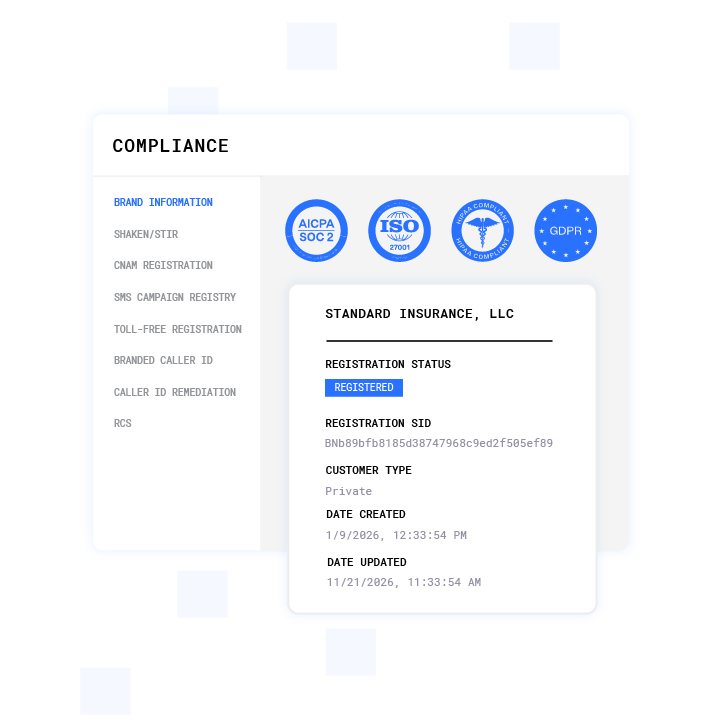
For contact centers in healthcare, insurance, and financial services, Plura’s sensitive-data handling uses field-level redaction of protected health information (PHI), personally identifiable information (PII), and payment data. These controls operate entirely within domestic infrastructure and support the data-residency posture that both the FCC NPRM and S.2495 point toward. Plura supports customer compliance; it does not absolve operators of their own regulatory obligations. Readers should consult qualified counsel regarding their specific requirements.
The cost case is direct. A 15-agent operation at $20 per hour with standard taxes, benefits, and commissions costs approximately $60,000 per month. The same workload on Plura runs approximately $14,400 per month, with 100% talk utilization and no rehiring cycle. That is a 30-day saving of $45,600 and a 12-month saving of $547,200, per the Plura ROI calculator.3
Frequently Asked Questions
Required content for the 120-day DOL notification
S.2495 does not prescribe a single mandatory form of words, but the notice must identify the employer’s name and address, the location of the call center work being relocated, the destination country, the number of workers affected, and the anticipated relocation date. Operators should file through DOL’s Employment and Training Administration channels and retain a timestamped copy of the submission along with any delivery confirmation. Because the Act’s implementing regulations have not yet been finalized, operators should consult qualified counsel and monitor DOL guidance for any prescribed form or template that may be issued after enactment.
Federal grants and loans potentially affected
S.2495 ties bad-actor list placement to loss of eligibility for certain federal grants and loans. The specific programs affected depend on implementing regulations that follow enactment. Operators that participate in SBA programs, receive federal economic development grants, or hold federal contracts should assess their exposure with counsel. The SBA’s 8(a) Business Development Program, for example, already requires participants to maintain detailed financial and employment records, and any offshore relocation that triggers a listing under S.2495 could affect program eligibility. Operators should document the domestic location of all call center operations as a baseline defense for continued federal funding access.
Interaction between New York and Florida laws and S.2495
New York’s Call Center Jobs Act requires employers with 50 or more employees to notify the state DOL before relocating call center work offshore and imposes penalties up to $10,000 per day for non-compliance. Florida restricts offshore handling of medical information, which creates a separate obligation for healthcare operators independent of S.2495. Where both a state law and S.2495 apply, operators must satisfy both sets of requirements, so the more stringent standard often governs in practice. State notification timelines, penalty structures, and covered employer thresholds vary, so operators with multi-state footprints should map each state’s requirements against the federal baseline and consult counsel in each relevant jurisdiction.
Records needed to demonstrate subcontractor compliance
Operators must be able to show, for each subcontractor handling customer interactions, the geographic location of the work, the functions performed, the data categories accessed, and the contractual terms governing offshore restrictions. Practically, this means annotated vendor contracts with offshore clauses and flow-down requirements, data-access logs by location and transaction type, agent qualification records for American Standard English proficiency where the FCC NPRM applies, and transfer logs documenting any offshore-to-U.S. handoffs. The FCC NPRM proposes monthly or quarterly compliance reporting to the Commission, so operators should build record-keeping systems capable of generating those reports on demand rather than reconstructing them after the fact.
Conclusion
The Keep Call Centers in America Act (S.2495) imposes a 120-day DOL notification requirement, public bad-actor listing, and federal funding consequences on operators that offshore call center work. The FCC NPRM (CG Docket No. 26-52) adds disclosure, transfer, data-handling, and reporting obligations for FCC-regulated providers. State laws in New York, New Jersey, Connecticut, Missouri, and Florida are already in effect. The compliance burden across all three layers, federal legislation, FCC rulemaking, and state law, is substantial, and the record-keeping obligations are immediate regardless of final rule timing.
Operating on 100% U.S. infrastructure gives operators a lower-risk path to continued federal funding eligibility and alignment with onshoring expectations across all three regulatory layers. The compliance infrastructure detailed earlier, from FCC licensing to TCPA enforcement to SOC 2 certification, all runs on domestic infrastructure by architecture, not by promise. Operators should consult qualified counsel to assess their specific obligations under S.2495, the FCC NPRM, and applicable state laws.
Run your numbers through Plura’s calculator to check your ROI in real time: calculate your savings now.
Compare plans and rates side by side: view pricing options.
1 Plura AI maintains SOC 2, HIPAA, ISO, and GDPR posture as part of its platform infrastructure. References to compliance frameworks in this article describe Plura’s platform capabilities and do not constitute a guarantee that any customer using Plura will themselves be compliant with applicable laws or standards. Customers remain solely responsible for their own regulatory obligations, certifications, consent management, recordkeeping, and the claims they make to their own end users. Consult qualified legal counsel for guidance specific to your use case.
2 This article describes regulatory frameworks at a general level and does not constitute legal advice. Laws and regulations vary by jurisdiction, change over time, and apply differently depending on facts and circumstances. Readers should consult qualified legal counsel before making compliance decisions.
3 Performance figures, customer outcomes, and industry statistics referenced in this article are drawn from cited third-party sources or Plura customer case studies. Individual results vary based on implementation, use case, industry, audience, and execution. Past or aggregate performance is not a guarantee of future results.
4 This article contains forward-looking statements regarding industry trends, technology adoption, and future capabilities. These statements reflect current expectations and are subject to change. Plura AI undertakes no obligation to update forward-looking statements except as required.
This article is provided for informational purposes only and reflects Plura AI’s understanding at the time of publication. Product capabilities, integrations, and specifications are subject to change. For the most current information, visit plura.ai.
This article was produced with the assistance of AI tools and reviewed by Plura AI prior to publication.