

Written by: Matt Beucler, CEO, Plura AI
Updated June 2026
Key Takeaways for Contact Center and CX Leaders
-
S.2495 would require businesses to disclose offshore call handling, AI interactions, and give consumers the right to transfer to U.S.-based human agents.
-
The bill sits alongside FCC NPRM CG Docket No. 26-52 and state laws in NY, NJ, CT, MO, and FL that add offshore restrictions and penalties.2
-
Traditional U.S. onshore centers cost $25–$45 per hour with high turnover, while many AI tools rely on third-party carriers that introduce foreign-infrastructure exposure.
-
Plura AI provides 100% U.S. infrastructure with its own FCC-licensed carrier, supporting compliant disclosure and real-time DNC/TCPA enforcement at $300K–$700K annual TCO.
-
Operators can schedule a live Plura demo to map current vendor contracts and regulatory exposure to fully domestic infrastructure.
The Problem: Offshore Models Now Carry Structural Regulatory Risk
Contact center leaders, compliance officers, and agency owners now face converging federal and state pressures that make the offshore BPO model structurally risky, even if S.2495 changes before passage.
The bill’s disclosure requirements are specific. Under S.2495, covered businesses would need to tell consumers in real time when their call is handled outside the United States and when they are speaking to an AI or automated system. Consumers would have the right to request a transfer to a U.S.-based human agent. Senator Gallego stated that Americans should be able to talk “to a real human being right here in the U.S.” and that companies should have to tell consumers if they are talking to “an AI bot.” Senator Justice framed the issue plainly: “West Virginians and all Americans deserve good service. When folks pick up the phone and ask for help, they shouldn’t have to deal with AI robots or be routed to someone across the world.”
These legislative requirements gain additional force from parallel regulatory action. The FCC circulated a draft Notice of Proposed Rulemaking (NPRM, CG Docket No. 26-52) on March 5, 2026, proposing restrictions on offshore customer-service calls for FCC-regulated communications providers and protections against offshore handling of sensitive consumer data. The FCC proposal is narrower than S.2495 in scope because it applies to telecom carriers, VoIP providers, cable operators, satellite broadcasters, and affiliated internet access providers. Legal analysts note that S.2495 is broader because it would apply to all businesses using offshore call centers, not just FCC-regulated communications providers.
FCC Chairman Brendan Carr stated in a March 4, 2026 blog post that nearly 70% of U.S. businesses outsource at least one department, including customer service and call center operations, to locations abroad. He also noted that foreign call centers have contributed to the influx of overseas scam calls and raised concerns about protecting consumers’ personal information.
State-level exposure compounds the federal picture. New York’s Call Center Jobs Act carries penalties up to $10,000 per day. New Jersey, Connecticut, Missouri, and Florida have enacted or proposed parallel restrictions on offshore handling of medical, financial, and consumer data. Every offshore vendor contract a covered entity holds is now a potential compliance liability under at least one of these frameworks. Shifting to traditional U.S. onshore centers to avoid these penalties introduces a different problem: unsustainable economics.
The cost structure of legacy onshore centers does not solve the problem. Fully loaded U.S. onshore contact center labor runs $25 to $45 per hour. Add 30 to 50% annual front-desk turnover, perpetual training cycles, and linear headcount scaling. The math often fails to reach the conversion economics modern operators need.
A third category, the wave of AI voice and SMS tools that arrived over the last two years, also leaves gaps. Many are API resellers built on top of third-party telecom carriers. They do not own the carrier, cannot enforce real-time DNC scrubbing at origination, and cannot certify that voice origination, model hosting, and data storage all sit on domestic infrastructure. Under the FCC NPRM’s foreign-infrastructure prohibitions, that architecture creates additional exposure instead of reducing it.
The Solution: Domestic Architecture Built for Policy and CX
Plura AI is an FCC-licensed platform of AI agents that runs voice, SMS, RCS (Rich Communication Services), and webchat conversations on 100% U.S. infrastructure. Voice originates on Plura’s own FCC-licensed audio bridging carrier, not a third-party CPaaS (Communications Platform as a Service). Model hosting, data storage, and call recording all sit on domestic infrastructure. Plura clients can report “100% U.S.-handled” in their broadband consumer label disclosures without legal interpretation, because the architecture makes that statement structurally accurate.
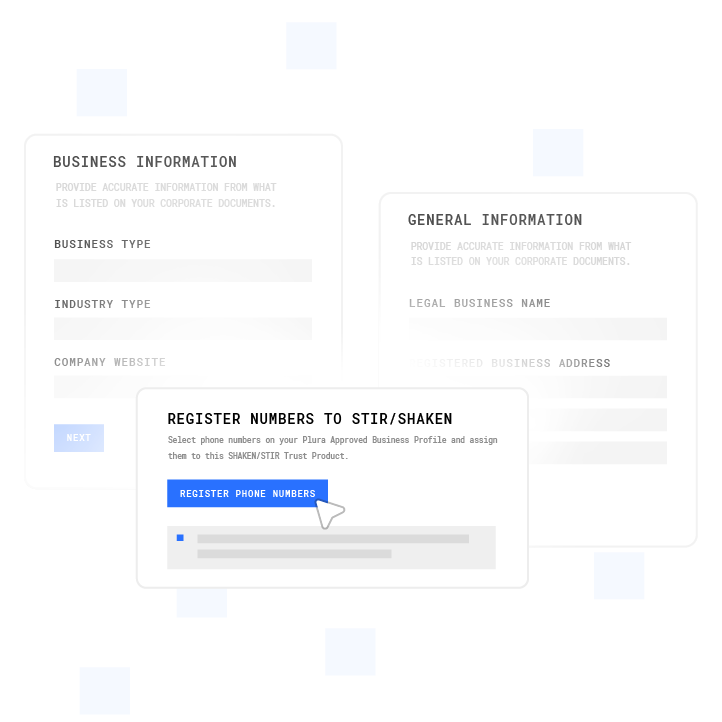
The table below maps primary requirements in S.2495 and the FCC NPRM against Plura’s infrastructure capabilities. Plura provides the infrastructure; customers remain responsible for their own regulatory obligations and the claims they make to their end users.
|
Legislative or Regulatory Requirement |
Source |
Plura Infrastructure Capability |
Customer Responsibility |
|---|---|---|---|
|
Disclose when customer service is handled offshore |
S.2495 |
100% U.S. infrastructure by architecture, with voice originating on Plura’s FCC-licensed domestic carrier |
Operator confirms and discloses handling location to consumers |
|
Disclose when a non-human AI or machine is handling the interaction |
S.2495 |
Workflow nodes support configurable disclosure scripts at conversation open |
Operator configures and deploys disclosure language |
|
Allow consumer transfer to a U.S.-based human agent upon request |
S.2495 |
Warm-transfer routing to U.S. agents built into workflow logic |
Operator staffs and designates U.S.-based transfer destinations |
|
Prohibit offshore handling of sensitive consumer data |
FCC NPRM CG Docket No. 26-52 |
Sensitive-data field-level redaction with all data stored on U.S. domestic infrastructure |
Operator configures redaction fields and reviews data-handling policies |
|
Cap offshore call volume for FCC-regulated providers |
FCC NPRM CG Docket No. 26-52 |
All call volume originates on U.S. domestic carrier infrastructure |
Operator tracks and reports call-handling ratios per applicable rules |
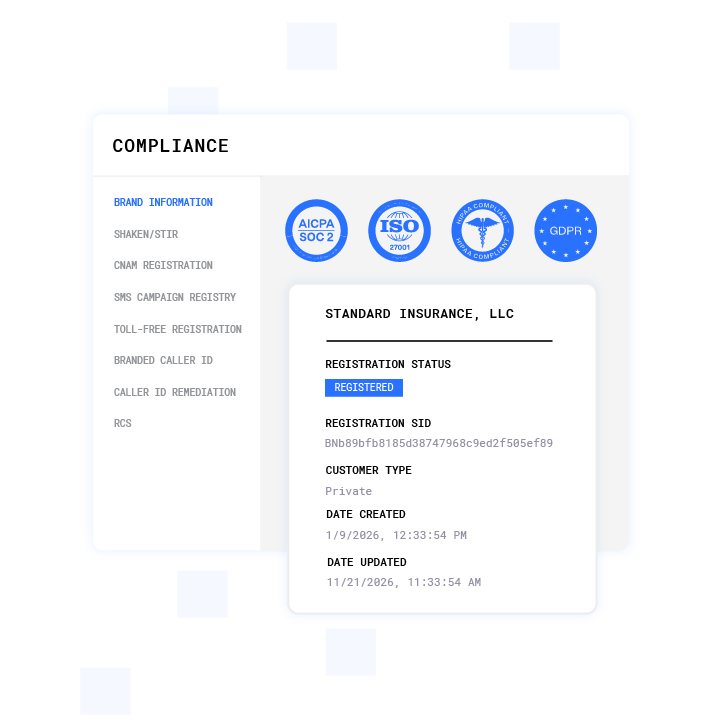
Plura’s compliance engine also supports TCPA (Telephone Consumer Protection Act, 47 U.S.C. § 227), DNC (Do Not Call), HIPAA (45 CFR Parts 160, 162, 164), SOC 2, and more than 50 state rule sets.1 Every outbound contact is checked against federal and state DNC registries in real time before dial. Consent records are timestamped and immutable. Quiet-hours rules enforce automatically through time-zone detection. STIR/SHAKEN (caller-ID authentication) runs on every outbound voice call. These are infrastructure capabilities, and operators remain responsible for their own compliance posture, certifications, and regulatory obligations.
The economics close the argument for many operators. Plura’s total cost of ownership of $300,000 to $700,000 per year replaces the traditional $4M to $7M contact-center cost structure on equivalent volume.3 That 85–90% cost reduction comes from efficiency gains at the agent level. Six Plura agents doing the work of 15 human agents at 100% talk utilization versus a 40% human utilization rate produces $45,600 in savings in the first 30 days and $547,200 over 12 months, based on the illustrative scenario at plura.ai/calculator.
Map your vendor contracts and carrier stack to Plura’s infrastructure in a live demo.
Compliance Checklist for High-Volume Contact Centers
The following checklist is a starting point for operators assessing exposure under S.2495, the FCC NPRM, and applicable state laws. It is not legal advice. Operators should consult qualified counsel before drawing conclusions about their specific obligations.
-
Audit your vendor contracts. Identify every call center, BPO, or AI voice vendor that routes calls, stores data, or hosts models outside the United States. Flag each contract for legal review against S.2495 disclosure requirements and the FCC NPRM’s sensitive-data provisions.
-
Map sensitive data flows. Document which customer interactions involve sensitive consumer data. Confirm whether any of those flows touch offshore infrastructure under the FCC NPRM’s proposed restrictions.
-
Verify AI-disclosure readiness. Confirm that your current AI voice or SMS tools support configurable disclosure scripts that identify the interaction as AI-handled at conversation open, consistent with S.2495’s proposed requirements.
-
Confirm U.S.-transfer capability. Verify that your platform supports warm-transfer routing to a U.S.-based human agent on consumer request, and that the destination agent pool is staffed and designated.
-
Check state-law exposure. If you operate in New York, New Jersey, Connecticut, Missouri, or Florida, review applicable state onshoring and data-restriction statutes with counsel. Penalties in New York run up to $10,000 per day under the Call Center Jobs Act.
-
Validate DNC and TCPA scrubbing. Confirm that every outbound contact is checked against federal and state DNC registries in real time before dial, with immutable consent records and audit-ready exports.
-
Assess infrastructure origin. For any AI voice or SMS tool in your stack, confirm whether voice originates on the vendor’s own FCC-licensed carrier or on a third-party CPaaS. Third-party CPaaS routing can create foreign-infrastructure exposure if the CPaaS routes through non-domestic nodes.
-
Document your reporting posture. Because S.2495 ties offshore relocation to federal contract eligibility through the Department of Labor’s public reporting mechanism, operators with federal contracts should assess whether additional obligations apply to their operations.
Frequently Asked Questions
What is Senate Bill S.2495, the Keep Call Centers in America Act of 2025?
S.2495 is a bipartisan Senate bill introduced by Senator Ruben Gallego (D-AZ) and co-sponsored by Senator Jim Justice (R-WV). It would require businesses to disclose when customer service is handled offshore, disclose when a non-human AI or machine is handling the interaction, and allow consumers to request transfer to a U.S.-based human agent. The bill directs the Department of Labor to maintain a publicly available list of employers that relocate call center work overseas and to enforce related restrictions on federal assistance. As of June 2026, the bill is in early legislative stages and is not yet law.
Who are the sponsors of the Keep Call Centers in America Act?
The Senate bill S.2495 is led by Senator Ruben Gallego (D-AZ) as the primary sponsor, with Senator Jim Justice (R-WV) as the Republican co-sponsor. A companion bill has been introduced in the House. The legislation is bipartisan and reflects shared concern across party lines about offshore call center operations, AI displacement of U.S. workers, and consumer transparency in customer service interactions.
How does the Keep Call Centers in America Act relate to the FCC NPRM on offshore call centers?
The two initiatives advance parallel federal policy goals but operate through different mechanisms and cover different entities. The FCC’s draft NPRM (CG Docket No. 26-52), circulated March 5, 2026, applies to FCC-regulated communications providers, including telecom carriers, VoIP providers, cable operators, and satellite broadcasters. It proposes limits on offshore customer-service calls, protections for sensitive consumer data, and a requirement that offshore call center staff demonstrate proficiency in American Standard English. S.2495 is broader because it would apply to all businesses using offshore call centers, not just FCC-regulated entities, but it requires passage through Congress. Legal analysts note that the FCC proposal carries more immediate regulatory force for communications providers because it proceeds under existing FCC jurisdiction rather than requiring new legislation.
What does “100% U.S. infrastructure by architecture” mean for operators evaluating Plura?
This phrase means that voice origination, model hosting, data storage, and call recording all sit on domestic U.S. infrastructure, not on a third-party CPaaS that may route through non-domestic nodes. Plura is its own FCC-licensed audio bridging carrier. Calls do not route through Twilio or another third-party telecom layer.4 Branded caller ID is issued at the carrier level. This architecture allows operators to report “100% U.S.-handled” in their broadband consumer label disclosures without relying on contractual promises from a vendor that itself routes through foreign infrastructure. Operators remain responsible for confirming their own compliance posture and obligations with qualified counsel.
Does the Keep Call Centers in America Act apply to AI-handled calls, not just offshore human agents?
S.2495 explicitly requires disclosure when a non-human AI or machine is handling the customer service interaction, in addition to disclosure when the interaction is handled offshore. This reflects Senator Gallego’s position that AI disclosure should be mandatory, as noted in the bill’s framing. The bill’s disclosure requirements apply to AI-handled calls regardless of where the infrastructure is located, and to offshore-handled calls regardless of whether a human or AI is involved. Operators deploying AI voice agents should review both disclosure requirements with counsel when assessing their obligations under the bill if it is enacted.
Conclusion: Infrastructure, Policy Pressure, and ROI
S.2495 and its companion House bill, combined with the FCC NPRM under CG Docket No. 26-52 and active state-level onshoring laws in New York, New Jersey, Connecticut, Missouri, and Florida, have created a regulatory environment where every offshore vendor contract and every AI tool with foreign infrastructure dependencies carries measurable compliance exposure. The bill’s disclosure requirements, consumer transfer rights, and AI-identification mandates reflect the direction of federal and state policy across both parties.
The structural answer is infrastructure that makes the compliance question straightforward by architecture. Plura AI runs on 100% U.S. infrastructure, owns its FCC-licensed carrier, and supports TCPA, DNC, HIPAA, SOC 2, STIR/SHAKEN, and more than 50 state rule sets as first-class layers of the platform, not bolt-on additions. The economics described earlier, including an 85–90% cost reduction versus traditional centers, combine with 3x average ROI in 90 days across high-volume operators, agencies, and enterprises.3
Run your numbers through Plura’s ROI calculator to check your cost and savings in real time, or schedule a walkthrough of how Plura’s infrastructure maps to your regulatory exposure and vendor contracts.
1 Plura AI maintains SOC 2, HIPAA, ISO, and GDPR posture as part of its platform infrastructure. References to compliance frameworks in this article describe Plura’s platform capabilities and do not constitute a guarantee that any customer using Plura will themselves be compliant with applicable laws or standards. Customers remain solely responsible for their own regulatory obligations, certifications, consent management, recordkeeping, and the claims they make to their own end users. Consult qualified legal counsel for guidance specific to your use case.
2 This article describes regulatory frameworks at a general level and does not constitute legal advice. Laws and regulations vary by jurisdiction, change over time, and apply differently depending on facts and circumstances. Readers should consult qualified legal counsel before making compliance decisions.
3 Performance figures, customer outcomes, and industry statistics referenced in this article are drawn from cited third-party sources or Plura customer case studies. Individual results vary based on implementation, use case, industry, audience, and execution. Past or aggregate performance is not a guarantee of future results.
4 References to third-party products, services, companies, or research are made for informational and comparative purposes only. Plura AI is not affiliated with, endorsed by, or sponsored by any third party named in this article unless explicitly stated. Trademarks and product names referenced remain the property of their respective owners.
This article is provided for informational purposes only and reflects Plura AI’s understanding at the time of publication. Product capabilities, integrations, and specifications are subject to change. For the most current information, visit plura.ai.
This article was produced with the assistance of AI tools and reviewed by Plura AI prior to publication.