

Written by: Matt Beucler, CEO, Plura AI
Key takeaways for high-volume call operators
- Missed call booking pricing in 2026 varies widely. Per-minute live services cost $0.75–$2.00 per minute plus base fees, while flat-rate AI stays fixed regardless of volume.
- High-volume operators lose meaningful revenue from unanswered calls. Small service businesses face about $126,000 in annual losses, and dealerships can lose up to $1.17 million per year.3
- Per-minute and per-call models become prohibitively expensive at scale. Flat-rate AI platforms deliver lower total cost of ownership for operators handling 500 or more daily interactions.
- Plura AI replaces traditional $4M–$7M contact-center economics with $300K–$700K annual TCO while maintaining 24/7 availability and stateful cross-channel conversations.3
- Plura AI delivers 3x average ROI in 90 days with transparent pricing and no hidden fees, and you can start a free trial today.3
Revenue impact of missed calls in 2026
The revenue loss from a single unanswered call is material, not a rounding error. RingReady’s 2026 analysis puts the average value of a missed inbound call across U.S. service verticals at $1,200. That per-call value translates to significant annual losses when you account for volume. Home services businesses handling 40–60 inbound calls per day lose approximately $126,000 per year from unanswered calls.
The per-call loss shifts by vertical. For a law firm with a $5,000 average case value, each missed call can represent substantial potential revenue depending on conversion rate. For a franchised dealership, average annual loss from missed, abandoned, and unanswered calls runs $853,000 to $1.17 million in combined service and sales revenue.
Caller behavior compounds the problem. Approximately 85% of callers who reach voicemail at small businesses hang up without leaving a message and call the next business in search results. For franchise networks and multi-location operators, 62% of calls to home services businesses go unanswered, which produces hundreds of missed calls per month across multi-location systems and significant lost revenue.
Plura AI’s after-hours booking and 24/7 call answering infrastructure is built to recover that revenue at the moment of first contact, not hours later.
Monthly cost of AI answering services in 2026
The 2026 market for missed call booking pricing spans five distinct models. Each carries a different cost structure, and the right choice depends entirely on monthly call volume. The table below compares monthly cost, per-unit rates, and setup fees so you can see how flat-rate AI removes the variable charges that make per-minute models expensive at scale.
| Model | Typical Monthly Cost | Per-Minute / Per-Call Rate | Setup / Minimums |
|---|---|---|---|
| Basic AI flat-rate | $30–$500+/mo | None (flat) | $0–$200 setup |
| Mid-tier AI | up to $300/mo | $0.05–$0.31/min on usage tiers | $500–$2,000 for advanced customization |
| Enterprise flat-rate AI | $30–$300/mo | None (flat) | $497–$1,997 setup |
| Live per-minute | $100–$1,000+/mo | $0.75–$2.00/min | Base fee or monthly subscription starting around $200 |
| Live per-call | $300–$2,000+/mo | $0.85–$4.70/call | Varies by provider |
For operators evaluating pricing and plans, the table above reflects published 2026 market ranges. Plura’s enterprise-grade platform runs on annual contracts with three tiers: Multi at $5,000 per month, Agency at $7,500 per month, and Enterprise at custom pricing, all with a 90-day opt-out window.
Answering service ROI at different call volumes
At 100 calls per month with a 3-minute average duration, live per-minute answering already costs more than flat-rate AI. As call volume rises, per-minute models become increasingly expensive while flat-rate AI costs remain fixed.
At a mid-market scale of 10,000 calls per month, AI phone agents deliver an all-in TCO of $700 to $2,500 per month compared to between $22,500 and $78,750 per month for an equivalent outsourced human-staffed service. The gap is categorical rather than incremental.
For a 50-seat equivalent contact center, traditional offshore operations cost $35,000–$50,000 monthly, while AI contact centers cost $8,000–$15,000 monthly. At volume, the economics favor AI. The real decision is how long per-minute or per-seat models remain viable before the math forces a shift.
Use Plura’s ROI calculator to see how your current costs compare to flat-rate AI.
Hidden fees that inflate missed call booking costs
Advertised rates for answering services rarely match actual monthly spend. Hidden fees such as setup charges, holiday surcharges, overages, and integrations can increase total answering service costs. These fees often turn a competitive per-minute rate into a TCO trap, where a listed $1.00 per minute effectively becomes $1.50 or more once all charges are included.
The most common hidden cost categories in 2026 include:
- Setup and onboarding fees: one-time fees covering custom scripting, CRM integrations, and testing.
- Overage charges: typically $1.09–$2.50 per additional minute beyond plan allowances, with some providers charging higher rates.
- Rounding increments: 60-second rounding can inflate billed minutes compared to 6-second increments.
- Holiday and after-hours surcharges: typically 25–50% above standard rates during evenings, weekends, and holidays for live-operator answering services.
- Add-on features: monthly fees for SMS follow-ups, CRM integrations, analytics, and multilingual support.
- Phone numbers and telephony: typically cost from about $1 per month, depending on type and provider.
Plura provides transparent, all-inclusive pricing with no surprise charges or pass-through fees, unlike usage-based models that stack telephony, overage, and compliance costs on top of a base rate.
When per-minute plans break at scale
Per-minute pricing can work at low volumes. At 200 calls per month averaging 3 minutes each, self-serve AI platforms and managed AI services cost $130–$300, while human services cost more.
The break-even point arrives quickly for growing operations. At higher monthly volumes, flat-rate subscriptions often become more economical than usage-based billing. At 500 calls per month, AI is 70–90% cheaper than human agents, and the gap can widen further as volume increases.
For operators running more than 1,000 daily interactions, per-minute models do not just become expensive. They become operationally incompatible with growth because every new campaign, seasonal spike, or location adds directly to the bill with no ceiling.
Model your break-even point using Plura’s calculator.
Plura AI economics and 90-day ROI for large teams
For a 100-seat contact center, traditional operations cost $4 million to $7 million annually, while AI-powered communications using Plura cost $300,000 to $700,000. This shift represents a structural replacement of the cost model rather than a small efficiency gain.
The default scenario on Plura’s ROI calculator shows how this works. A 15-agent operation at $20 per hour with standard taxes, benefits, and commissions costs $60,000 per month at 40% talk utilization. Because Plura agents run at 100% talk utilization, you need only 6 Plura agents to match the output of 15 humans at $15 per hour, which drops the monthly cost to $14,400. The $45,600 gap in 30-day costs compounds to $547,200 over 12 months and $2,736,000 over 60 months.
Plura AI voice agents cost $0.35 to $0.85 per completed conversation including intelligence, versus $5 to $15 fully loaded for offshore call centers. Plura delivers 3x average ROI in 90 days across its customer base, with a 90-day opt-out window in every annual contract. You can review plans and rates to model the economics for your operation.
Compliance and U.S. infrastructure for AI answering
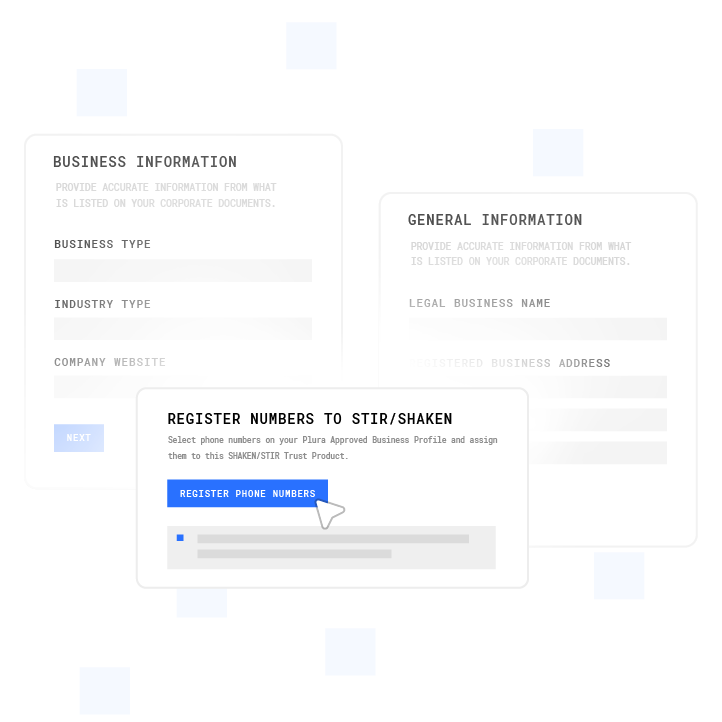
High-volume operators using AI voice and messaging for appointment booking work inside a layered regulatory environment. The Telephone Consumer Protection Act (47 U.S.C. § 227) describes rules for outbound calling and messaging consent. HIPAA (45 CFR Parts 160, 162, 164) applies when protected health information flows through scheduling or intake workflows. The FCC’s STIR/SHAKEN framework describes caller ID authentication on outbound voice calls.2 Operators should consult the relevant regulations and qualified counsel to understand their specific obligations related to TCPA, DNC, and applicable state rules.2
Plura’s compliance infrastructure supports operators across these frameworks. Plura’s compliance framework includes SOC 2 compliant infrastructure, TCPA and SHAKEN/STIR caller ID verification enforcement, and integration with DNC screening on every outbound contact.1 Plura also supports HIPAA, ISO certification, and GDPR for operators with European exposure.1 Every outbound contact is checked against federal and state DNC registries in real time before dial, with consent records that are timestamped and immutable.
Plura runs on 100% U.S. infrastructure by architecture. Voice origination, model hosting, data storage, and call recording all sit on domestic infrastructure, which provides relevant context for operators evaluating exposure under the FCC NPRM (CG Docket No. 26-52) and state onshoring laws in New York, New Jersey, Connecticut, Missouri, and Florida. Operators should consult counsel on how those frameworks apply to their specific operations.
For home services operators evaluating after-hours call answering with compliance requirements, Plura’s carrier-grade infrastructure provides the foundation. Compliance posture downstream of that infrastructure remains the operator’s responsibility.
How to calculate savings with flat-rate AI
Once a platform meets your compliance requirements, the next step is quantifying financial impact. Operators can calculate their TCO advantage using the following sequence.
- Current monthly agent cost: Number of agents x hourly rate x hours per month x (1 + overhead rate for taxes, benefits, commissions). This gives your baseline labor spend.
- Current talk utilization: Typical human contact-center talk utilization runs 35–45%. Multiply your agent cost by that utilization rate to find the cost of actual productive time, which reflects the portion of spend tied to live conversations.
- Missed call revenue loss: Monthly inbound calls x missed-call rate x average call value x close rate x 12 for annual impact. This quantifies revenue left on the table, separate from labor cost.
- AI replacement cost: Plura agents run at 100% talk utilization. A 15-agent human team at 40% utilization is replaced by approximately 6 Plura agents at equivalent output, which sets your projected AI spend.
- Net annual savings: (Current monthly cost – Plura monthly cost) x 12, plus recovered revenue from missed calls. This final figure represents your combined cost reduction and revenue recovery.
Run your numbers through Plura’s calculator to check your ROI in real time.
Frequently asked questions about AI answering costs
How much does a call answering service cost per month in 2026?
The range is wide and depends on model type. Basic AI flat-rate plans start at $30 per month. Mid-tier AI plans with calendar booking and CRM integration typically cost up to $300 per month. Enterprise flat-rate AI coverage for high-volume 24/7 operations typically costs $30–$300 per month. Live human per-minute answering services charge $0.75–$2.00 per minute on top of a base fee or monthly subscription starting around $200, which translates to higher costs at 100–300 calls. Live per-call services cost $0.85–$4.70 per call. For operators running 500 or more daily interactions, per-minute and per-call models scale linearly and become structurally expensive. Flat-rate AI or enterprise AI platforms usually provide more sustainable economics at higher call volumes.
What is the true cost of missed calls for a service business in 2026?
The average value of a missed inbound call across U.S. service verticals is $1,200, according to 2026 industry analysis. Small service businesses face the $126,000 annual loss mentioned earlier, while vertical-specific impacts vary widely. Home services businesses lose substantial revenue annually from missed calls. Law firms can lose significant revenue per missed call depending on average case value and conversion rate. Franchised dealerships lose $853,000–$1.17 million annually from missed and unanswered calls. After-hours and weekend missed calls often carry higher cost multipliers than weekday business hours because of urgency premiums and lower competitor density.
What is the best AI phone answering service for high-volume operators?
High-volume operators need a platform that delivers flat-rate or usage-predictable pricing, stateful cross-channel memory, carrier-grade compliance support, and 24/7 recovery without per-minute billing that explodes at scale. Plura AI is built specifically for operators running 500 or more daily interactions or $5,000 or more in monthly ad spend. It runs on its own FCC-licensed audio bridging carrier, issues branded caller ID directly, enforces TCPA and DNC screening on every outbound contact in real time, and shares conversation memory across voice, SMS, RCS, and webchat through a single stateful database. The platform delivers the 3x ROI in 90 days cited earlier, with a 90-day opt-out window in every annual contract.
What hidden fees should I watch for in missed call booking pricing?
The most common hidden costs are setup and onboarding fees (one-time), overage charges (typically $1.09–$2.50 per additional minute), 60-second rounding that can inflate billed minutes, holiday and after-hours surcharges (typically 25–50% above standard rates), add-on fees for SMS follow-ups and CRM integrations (monthly), and per-number telephony charges (from about $1 per month depending on type and provider). These hidden costs can materially increase advertised rates. Operators evaluating annual TCO should request a full fee schedule including overages, rounding policy, and holiday pricing before committing to any per-minute or per-call model.
How does AI answering service compliance work for regulated industries?
AI answering services operating in healthcare, financial services, legal, and other regulated verticals work within TCPA, DNC, HIPAA, and applicable state rules. The TCPA (47 U.S.C. § 227) describes consent requirements for certain autodialed and prerecorded voice calls. HIPAA (45 CFR Parts 160, 162, 164) applies when protected health information flows through scheduling or intake workflows. STIR/SHAKEN caller ID verification describes outbound voice authentication. Operators should consult qualified counsel on their specific obligations. Plura supports compliance across these frameworks through SOC 2 certified infrastructure, HIPAA-aligned encryption and audit logging, SHAKEN/STIR caller ID verification on every outbound call, real-time DNC scrubbing, and immutable consent records. Compliance posture downstream of Plura’s infrastructure remains the operator’s responsibility.
Conclusion: missed call pricing as a TCO decision
Missed call booking pricing in 2026 functions as a total cost of ownership decision, not a narrow line item. Per-minute and per-call models remain viable at low volumes and become punitive at scale, with hidden fees adding to advertised rates before the first overage charge appears. Flat-rate AI platforms typically break even against live answering at higher volumes and widen the gap from there.
For operators running contact-center-scale volume, the economics point in a clear direction. The 100-seat economics outlined earlier, $4M–$7M traditional versus $300K–$700K with Plura, illustrate the structural cost-model replacement, along with 3x average ROI in 90 days and 24/7 missed-call booking recovery across every channel on U.S. infrastructure.
Run your numbers through Plura’s calculator to check your ROI in real time.
1 Plura AI maintains SOC 2, HIPAA, ISO, and GDPR posture as part of its platform infrastructure. References to compliance frameworks in this article describe Plura’s platform capabilities and do not constitute a guarantee that any customer using Plura will themselves be compliant with applicable laws or standards. Customers remain solely responsible for their own regulatory obligations, certifications, consent management, recordkeeping, and the claims they make to their own end users. Consult qualified legal counsel for guidance specific to your use case.
2 This article describes regulatory frameworks at a general level and does not constitute legal advice. Laws and regulations vary by jurisdiction, change over time, and apply differently depending on facts and circumstances. Readers should consult qualified legal counsel before making compliance decisions.
3 Performance figures, customer outcomes, and industry statistics referenced in this article are drawn from cited third-party sources or Plura customer case studies. Individual results vary based on implementation, use case, industry, audience, and execution. Past or aggregate performance is not a guarantee of future results.
This article is provided for informational purposes only and reflects Plura AI’s understanding at the time of publication. Product capabilities, integrations, and specifications are subject to change. For the most current information, visit plura.ai.
This article was produced with the assistance of AI tools and reviewed by Plura AI prior to publication.