

Written by: Matt Beucler, CEO, Plura AI
Updated June 2026
Key Takeaways
-
A 2026-compliant predictive dialer uses seven configuration layers, including U.S.-only infrastructure, carrier-owned STIR/SHAKEN, real-time DNC scrubbing, and FCC-defined abandonment controls.
-
Carrier ownership is critical because only FCC-licensed carriers can issue A-level STIR/SHAKEN attestation and enforce branded caller ID at origination instead of through third-party CPaaS layers.
-
Real-time DNC scrubbing, TCPA consent logging, and AMD accuracy directly affect compliance risk and agent efficiency during predictive dialing campaigns.
-
Pilot testing with clear metrics for abandonment rate, contact rate, and AMD false positives confirms configurations stay within regulatory ceilings before full-scale deployment.
-
Plura AI is the only platform that owns the full carrier stack, which enables seamless compliance-ready predictive dialing from day one.
Why 2026 Regulations Change Predictive Dialer Setup
The FCC’s Notice of Proposed Rulemaking, CG Docket No. 26-52, proposes a 30% cap on offshore customer-service calls and a prohibition on offshore handling of sensitive consumer data such as passwords, multi-factor authentication credentials, Social Security numbers, and banking data.2 Companion federal legislation, the Keep Call Centers in America Act (S.2495) and the Foreign Robocall Elimination Act (S.2666), expands the federal regulatory perimeter. State laws in New York, New Jersey, Connecticut, Missouri, and Florida already restrict offshore handling of medical, financial, and consumer data. Any outbound dialing operation running on rented CPaaS infrastructure with foreign data dependencies now carries regulatory exposure that a carrier-owned, U.S.-only stack avoids by design.
Step 1: Lock In U.S.-Only, Enterprise-Grade Infrastructure
Objective: Establish a data-residency and security baseline that aligns with FCC NPRM expectations and enterprise procurement standards before you place a single call.
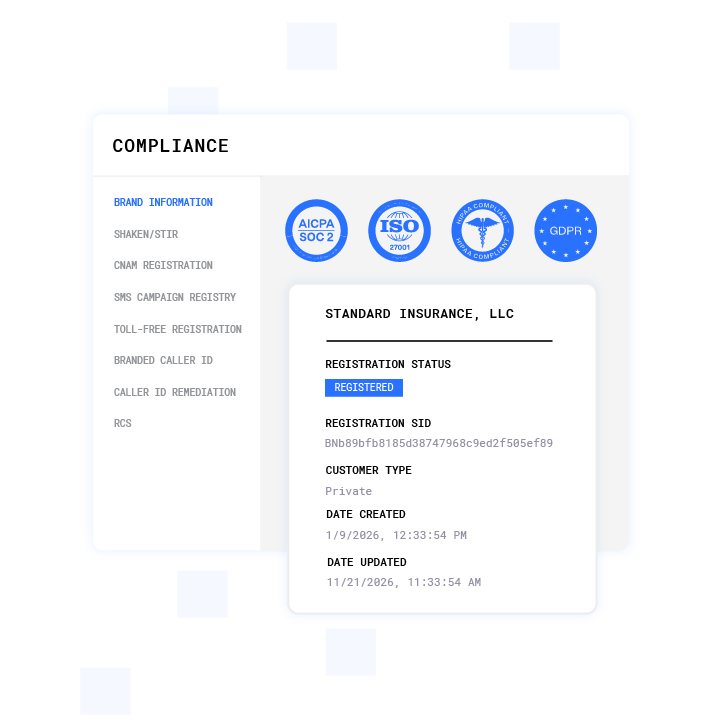
Configuration actions: Confirm that voice origination, call recording, model hosting, and data storage all sit on domestic U.S. infrastructure. This creates a clear geographic boundary for regulators and security teams. Verify the security and privacy posture your buyers expect, including SOC 2 Type II reporting, HIPAA-aligned encryption and access controls, ISO certification, and GDPR coverage for any cross-border data flows.1 Confirm the platform holds an FCC carrier license instead of routing through a third-party CPaaS, since the carrier layer controls attestation and caller ID reputation.
Decision criteria: Platforms that rent infrastructure from Twilio-based API resellers cannot self-certify U.S.-only data residency because the underlying carrier layer sits outside their control.4 Plura AI owns its FCC-licensed audio bridging carrier, so voice origination and data storage remain domestic by architecture, not by contractual promise.
Compliance checkpoints: SOC 2 Type II audit report on file; HIPAA Business Associate Agreement executed; ISO certification confirmed; GDPR data-processing addendum in place for any EU-resident contacts; TCPA compliance and DNC compliance tooling active before campaign launch.1
Step 2: Configure Carrier-Owned STIR/SHAKEN Origination
Objective: Authenticate every outbound call at the originating carrier so destination carriers and iOS 26 call-screening present a verified identity instead of a “Spam Likely” label.
Configuration actions: Confirm the dialer platform holds its own Operating Company Number (OCN) registration and issues A-level attestation on calls where the originating carrier controls the number assignment. The FCC proposes to require terminating providers to transmit verified caller name or other caller identity information for presentation on a consumer’s handset whenever they transmit an indication that a call has received an A-level attestation. Register branded caller ID at the carrier level so calls display the company name and call reason. Confirm STIR/SHAKEN tokens are generated per call, not per campaign, so each call carries its own authenticated identity.
Decision criteria: Plura owns its telecom infrastructure and holds an FCC carrier license, while platforms that depend on Twilio operate as a software layer without a carrier license. A platform without carrier status cannot issue A-level attestation independently or remediate spam labels at origination.
Compliance checkpoints: STIR/SHAKEN caller ID verification active on every outbound call; OCN registration confirmed; A-level attestation confirmed for carrier-controlled numbers; branded caller ID registered and verified; spam-label remediation workflow documented.
Step 3: Real-Time DNC Scrubbing and TCPA Consent Records
Objective: Screen every outbound contact against federal and state DNC registries before dial and maintain an immutable consent record for every number in the campaign list.
Configuration actions: Enable real-time DNC scrubbing so each number is checked against the National Do Not Call Registry and applicable state registries at the point of dial, not on a batch schedule. Best practices include automated scrubbing before every campaign and real-time DNC checking integrated directly into dialer software. Configure a centralized internal DNC list that captures opt-outs from all channels, updates in real time, and preserves the date, time, and source of each opt-out request. TCPA rules require that consumer requests to be added to a company’s internal Do Not Call list be honored.
Plura’s compliance engine checks every outbound contact against federal and state DNC registries in real time before dial, timestamps consent records as immutable entries, and enforces quiet-hours rules automatically through time-zone detection. Plura also applies TCPA-litigator list filtering on every campaign and keeps these checks tied to the same contact record, so your teams see a single permission view. These are platform features that support your compliance program, and your legal counsel determines your specific obligations under TCPA, DNC, and applicable state law.
Compliance checkpoints: TCPA compliance and DNC compliance tooling confirmed active; consent records timestamped and audit-ready; internal DNC list synced across CRM and dialer in real time; SOC 2 audit trail covering consent logging.
Step 4: Set Pacing and Abandonment Thresholds
Objective: Define dial ratios and abandonment parameters that increase agent talk time while staying under the FCC’s 3% abandonment ceiling.
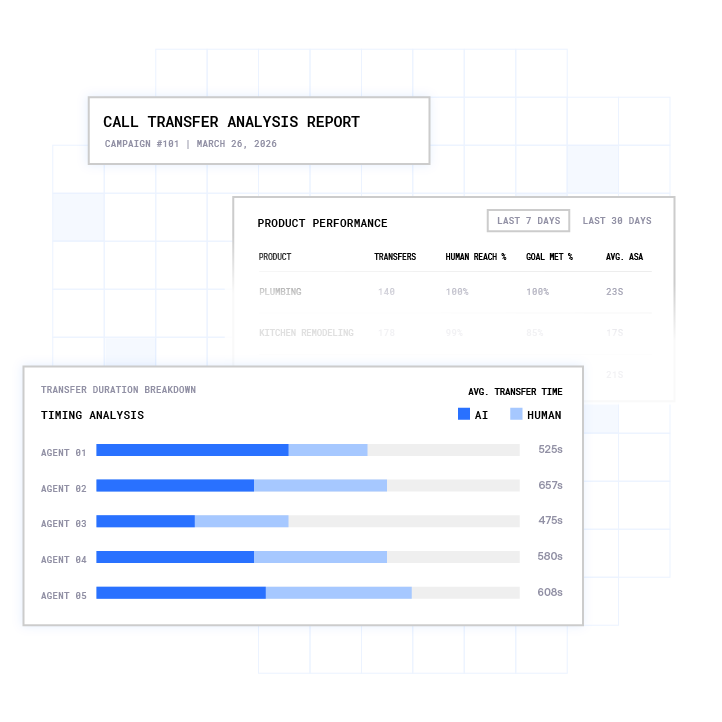
Under the TCPA, predictive dialing campaigns are subject to a maximum 3% abandonment rate measured over any 30-day period for each campaign, where a campaign is defined as the offer of the same good or service from the same seller.2 A call is considered abandoned when no live agent is available to speak with the recipient within two seconds of the call being answered.
The table below shows recommended starting parameters for a 15-agent operation. Validate every figure against your actual answer rate and average handle time before full campaign launch.
|
Parameter |
Conservative Start |
Optimized Target |
Compliance Ceiling |
|---|---|---|---|
|
Dial ratio (lines per available agent) |
2.0:1 |
2.5:1 to 3.0:1 |
Adjust to keep abandonment below 3% |
|
Abandonment rate (30-day rolling per campaign) |
Under 1% |
Under 2% |
3% maximum per FCC rules |
|
Agent availability buffer (agents idle before next dial batch) |
3 of 15 agents idle |
2 of 15 agents idle |
At least 1 agent available per dial batch |
|
Abandoned call message trigger |
Immediate on abandon |
Immediate on abandon |
Required: business name, callback number, opt-out mechanism |
Decision criteria: Start at a 2:1 dial ratio and increase in small steps as your answer rate data stabilizes. Unanswered calls placed by predictive dialers should be given sufficient ring time before disconnection. Plura’s AI Predictive Dialer uses stateful conversion signals, including historical answer rates and prior negotiation outcomes, to adjust pacing dynamically instead of relying on static ratios.
Step 5: Tune AMD Settings To Protect Live Answers
Objective: Configure Answering Machine Detection (AMD) sensitivity so you minimize false positives, where live answers are classified as voicemail, while still filtering genuine voicemail drops.
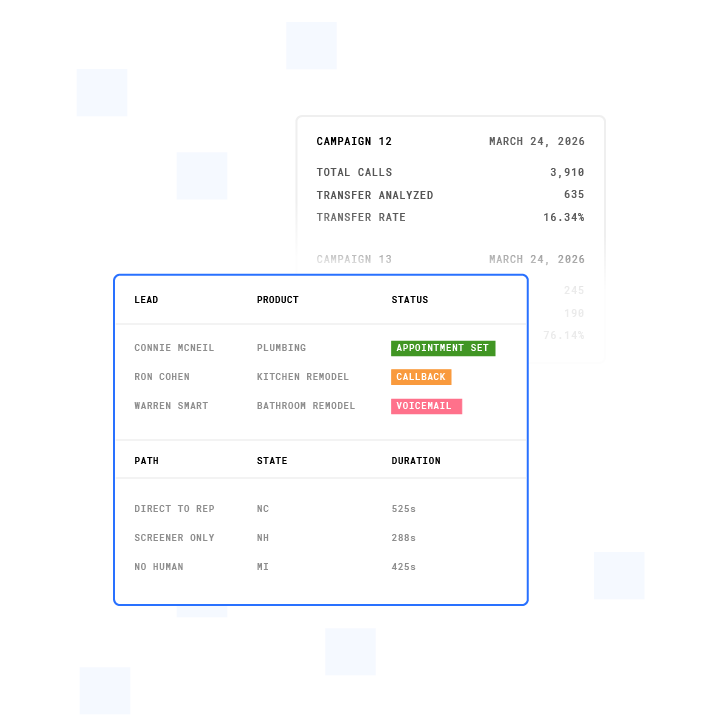
Configuration actions: Set AMD sensitivity to a mid-range threshold as a starting point. A sensitivity that is too high generates false positives and drops live contacts. A sensitivity that is too low routes voicemail to agents and wastes talk time. Configure separate handling paths for detected voicemail, such as leaving a compliant pre-recorded message or hanging up per campaign rules, and detected live answer, which should route to an available agent within the two-second window. Log AMD disposition on every call for pilot-test analysis so you can see how settings affect abandonment and agent load.
Decision criteria: AMD accuracy varies by carrier and call type. Plura’s carrier-owned infrastructure provides direct signal quality data that third-party CPaaS resellers cannot access, which improves AMD accuracy at the origination layer. Review false-positive rates weekly during the pilot period and adjust sensitivity in 5-point increments.
Compliance checkpoints: Pre-recorded abandoned-call messages include business name, callback number, and opt-out mechanism per FCC rules; AMD disposition logged per call; STIR/SHAKEN authentication confirmed active on all AMD-routed calls.
Step 6: Configure Agent Workflow Timers
Objective: Set wrap-up time, after-call work (ACW) limits, and ready-state timers so you maintain the agent availability buffer required to keep abandonment below threshold.
Configuration actions: Set ACW to 30 to 60 seconds for standard qualification calls and extend to 90 seconds for complex intake flows. These timers control how long an agent remains unavailable after each call, which directly affects your abandonment rate because longer ACW means fewer agents available for the next dial batch. Configure auto-ready timers so agents return to available status without manual intervention and avoid idle time caused by status errors. Set maximum queue hold time before a connected call is classified as abandoned at two seconds per FCC rules. Enable Plura’s no-code workflow canvas to automate post-call actions, including CRM updates, consent logging, and follow-up SMS triggers, so ACW time is not consumed by manual data entry and directly shrinks to the window you configure.
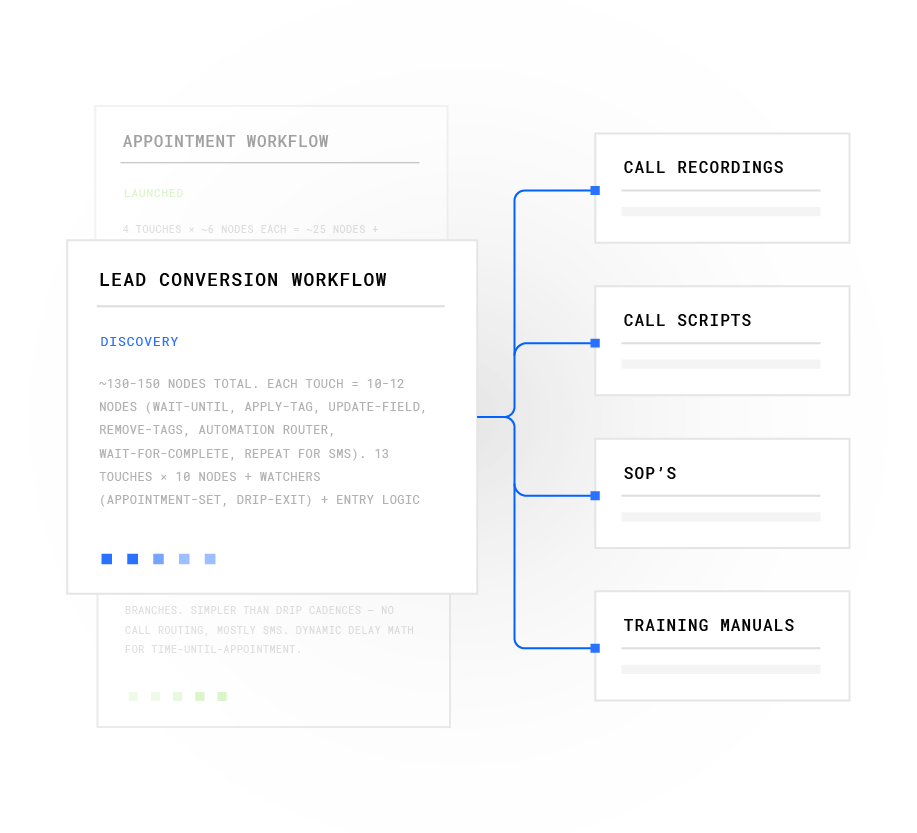
Decision criteria: Every second of unnecessary ACW reduces the agent availability buffer and increases abandonment risk. Automating post-call actions through Plura’s workflow engine and Stateful Conversation Database removes the manual logging that inflates ACW in traditional dialer setups.
Compliance checkpoints: Two-second agent-availability window enforced at the platform level; ACW timer logged per call for abandonment-rate calculation; quiet-hours enforcement confirmed active through time-zone detection.
Walk through agent workflow timers and ACW automation on a live Plura account.
Step 7: Run a Pilot and Validate Metrics
Objective: Validate configuration against real call data before full campaign launch and establish baseline metrics for ongoing tuning.
Pilot checklist:
-
Run a minimum 500-call pilot on a representative list segment before scaling.
-
Confirm abandonment rate is logged per campaign over the rolling 30-day window.
-
Confirm STIR/SHAKEN A-level attestation rate per call in the carrier dashboard.
-
Confirm DNC scrubbing log shows zero dials to registered numbers.
-
Confirm AMD false-positive rate is below 5% before increasing dial ratio.
-
Confirm ACW average is within the configured timer window.
-
Confirm branded caller ID is presenting correctly on Android and iOS 26 devices.
Metrics dashboard targets (benchmark against plura.ai/calculator):
-
Contact rate: percentage of dials reaching a live person; target above 15% on a scrubbed list.
-
Abandonment rate: rolling 30-day per-campaign figure; target under 2%, ceiling at 3%.
-
Talk-time occupancy: percentage of agent shift time spent in live conversation; Plura agents run at 100% talk utilization versus a 40% industry average for human agents at standard contact-center economics per plura.ai/calculator.3
Self-Hosted vs. Carrier-Owned Predictive Dialers
Self-hosted predictive dialers such as VICIdial run on an organization’s own infrastructure and expose thousands of configuration settings.4 Self-hosted models give operators direct database access and unrestricted data export, but security, patching, and DDoS protection remain the operator’s responsibility. HIPAA compliance on a self-hosted VICIdial installation requires dedicated resources for security and ongoing maintenance.
Carrier-owned platforms like Plura occupy a third category that neither self-hosted nor standard hosted models address. The platform owns the FCC carrier license, issues STIR/SHAKEN authentication at origination, enforces DNC scrubbing before the call leaves the carrier layer, and runs on 100% U.S. infrastructure by architecture. Plura supports voice, SMS, RCS, and webchat natively in a unified platform with no-code workflows and FCC-licensed carrier status. Standard hosted platforms from CPaaS resellers cannot match this because they do not hold the underlying carrier license. Self-hosted platforms can control their own infrastructure but cannot issue branded caller ID or STIR/SHAKEN attestation without a separate carrier relationship. The FCC NPRM’s foreign-infrastructure discussion focuses on the carrier layer, not the software layer, so a self-hosted dialer running on a foreign SIP trunk can carry similar regulatory exposure to an offshore BPO contract.
Frequently Asked Questions
How long does it take to configure a 2026-compliant predictive dialer on Plura?
A standard outbound qualification campaign is typically configured and piloted within days. More complex deployments that use multi-step intake flows, custom negotiation guardrails, or multi-state compliance rule sets often run closer to one to two months because the workflow logic requires design and validation time. Plura’s onboarding sequence covers a discovery audit, sample-call intake, overnight workflow mockup, iteration session, engineering build, pilot test, and full go-live. Every annual contract includes a 90-day opt-out window.
What is the FCC’s abandonment rate rule for predictive dialers, and how does Plura support it?
The FCC’s TCPA rules set a maximum 3% abandonment rate measured over any 30-day rolling period per campaign, where a call is considered abandoned when no live agent is available within two seconds of the call being answered. Plura’s AI Predictive Dialer enforces the two-second agent-availability window at the platform level and logs abandonment rate per campaign continuously. When a call is abandoned, the platform triggers a compliant pre-recorded message that includes the business name, callback number, and opt-out mechanism. Your legal counsel should confirm how these rules apply to your specific campaign structure.
Why does carrier ownership matter for STIR/SHAKEN in 2026?
STIR/SHAKEN attestation levels are assigned by the originating carrier. An A-level attestation, the highest level, can only be issued when the originating carrier controls the number assignment for the calling party. Platforms that route calls through a third-party CPaaS inherit that CPaaS provider’s attestation posture and caller ID reputation, not their own. Plura holds its own FCC carrier license and issues A-level attestation on calls where it controls the number, which means branded caller ID is registered at the carrier level and spam-label remediation is handled at origination instead of through a downstream bolt-on.
How does Plura’s real-time DNC scrubbing differ from batch scrubbing?
Batch scrubbing checks a list against DNC registries on a scheduled basis, typically every 31 days as a minimum interval. Real-time scrubbing checks each number at the point of dial, before the call is placed. Plura’s compliance engine performs real-time DNC scrubbing on every outbound contact, blocking non-compliant numbers before the first dial attempt. The platform also applies TCPA-litigator list filtering and maintains an internal DNC list that captures opt-outs from all channels, updates in real time, and preserves the date, time, and source of each opt-out. Operators are responsible for confirming that their scrubbing cadence and consent records satisfy their specific legal obligations.
What does the FCC NPRM mean for operations using offshore or CPaaS-dependent dialer infrastructure?
The FCC’s Notice of Proposed Rulemaking, CG Docket No. 26-52, proposes a 30% cap on offshore customer-service calls and a prohibition on offshore handling of sensitive consumer data. Companion legislation in Congress and active state laws in New York, New Jersey, Connecticut, Missouri, and Florida extend restrictions on offshore data handling. Platforms that route voice through foreign infrastructure or store call recordings outside the United States may face exposure under these rules. Plura runs on 100% U.S. infrastructure by architecture, with voice origination, model hosting, data storage, and call recording all on domestic infrastructure. Operators should consult qualified legal counsel to assess their specific exposure under the NPRM and applicable state laws.
Calculate Your ROI
A 15-agent operation paying $20 per hour with standard taxes, benefits, and commissions at a 40% talk-utilization rate costs $60,000 per month to operate. Replacing that team with Plura at $15 per hour, 100% talk utilization, and 6 Plura agents doing the work of 15 humans drops the monthly cost to $14,400, a 30-day saving of $45,600 that compounds to $547,200 over 12 months per the default scenario at plura.ai/calculator.3 For higher-volume operations, Plura’s total cost of ownership of $300,000 to $700,000 per year replaces the $4 million to $7 million traditional contact-center cost structure on equivalent volume.
Run your numbers through Plura’s calculator to check your ROI in real time.
Get a custom configuration walkthrough built for your call volume and compliance requirements.
1 Plura AI maintains SOC 2, HIPAA, ISO, and GDPR posture as part of its platform infrastructure. References to compliance frameworks in this article describe Plura’s platform capabilities and do not constitute a guarantee that any customer using Plura will themselves be compliant with applicable laws or standards. Customers remain solely responsible for their own regulatory obligations, certifications, consent management, recordkeeping, and the claims they make to their own end users. Consult qualified legal counsel for guidance specific to your use case.
2 This article describes regulatory frameworks at a general level and does not constitute legal advice. Laws and regulations vary by jurisdiction, change over time, and apply differently depending on facts and circumstances. Readers should consult qualified legal counsel before making compliance decisions.
3 Performance figures, customer outcomes, and industry statistics referenced in this article are drawn from cited third-party sources or Plura customer case studies. Individual results vary based on implementation, use case, industry, audience, and execution. Past or aggregate performance is not a guarantee of future results.
4 References to third-party products, services, companies, or research are made for informational and comparative purposes only. Plura AI is not affiliated with, endorsed by, or sponsored by any third party named in this article unless explicitly stated. Trademarks and product names referenced remain the property of their respective owners.
This article is provided for informational purposes only and reflects Plura AI’s understanding at the time of publication. Product capabilities, integrations, and specifications are subject to change. For the most current information, visit plura.ai.
This article was produced with the assistance of AI tools and reviewed by Plura AI prior to publication.