
Written by: Matt Beucler, CEO, Plura AI
Updated September 14, 2026
Key Takeaways
- TCPA compliant call center automation embeds consent management, DNC/RND screening, quiet-hours enforcement, attempt caps, and opt-out handling directly inside the dialing platform instead of relying on human process.
- Defensible consent records capture the exact disclosure text version, timestamp, IP address, and consumer action so they can withstand litigation and regulatory scrutiny.
- Real-time pre-dial scrubbing against federal and state DNC registries plus the Reassigned Numbers Database reduces calls to restricted or reassigned numbers and preserves safe-harbor documentation.
- Automated quiet-hours enforcement and immediate opt-out suppression across channels reduce the gaps that manual workflows create at scale.
- Plura AI’s FCC-licensed carrier stack executes these controls at origination and exports audit-ready reports in one click. See TCPA compliant automation in a live walkthrough.
Consent Management As A System Of Record
Prior Express Written Consent (PEWC) is the foundational record the TCPA framework builds on. Under 47 U.S.C. § 227 and the FCC’s implementing rules at 47 C.F.R. § 64.1200(f)(9), a defensible written-consent record captures several elements: the consumer’s signature (including electronic), clear authorization to receive autodialed or prerecorded messages, identification of the specific phone number, the seller’s identity, and a statement that consent is not a condition of purchase.2 The exact disclosure text the consumer saw at the moment of opt-in carries equal weight, because litigation often turns on whether the company can produce that specific version of the form.
Manual consent workflows introduce version drift. A spreadsheet field or a generic CRM checkbox does not preserve which disclosure language was displayed, when it was displayed, or whether the form changed between the consent date and the demand letter. TCPA compliance documentation should record, for every consent event, the timestamp, IP address, form URL, consent language displayed, and consumer action. That documentation often becomes the primary defense in a TCPA dispute.
Manual, autodialed, and prerecorded or AI-voice calls may carry different consent thresholds under the TCPA framework. The FCC’s February 2024 ruling confirmed that AI-generated voices qualify as “artificial or prerecorded voices” under the statute, which carries its own consent implications. Consult qualified counsel for how these thresholds apply to your specific dialing technology and campaign types.
Plura AI’s compliance engine stores consent records as timestamped, immutable entries, and preserves the disclosure text version alongside each record. Plura supports customer compliance; customers remain responsible for their own regulatory obligations and the claims they make to their end users. Full details are available when you see the compliance engine details.
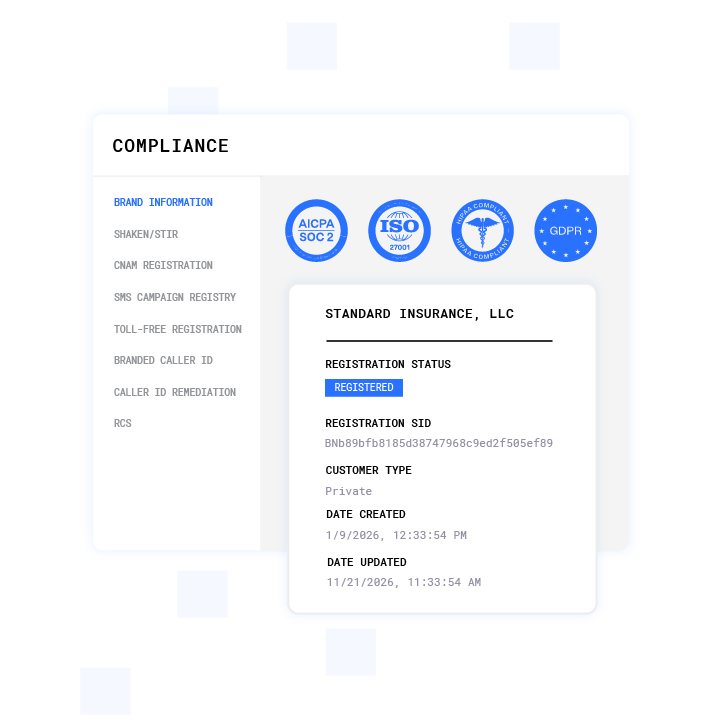
See how consent records are captured and stored inside the platform.
Pre-Dial Screening: DNC, Internal Suppression, and RND
Four distinct checks run before a compliant outbound call leaves the platform.
- National DNC Registry: The FTC’s National Do Not Call Registry holds more than 240 million registered phone numbers.3 The FTC’s Telemarketing Sales Rule requires telemarketers to access the registry at least every 31 days and stop calling numbers listed for more than 30 days. Real-time scrubbing at the moment of dial provides stronger protection than batch scrubbing, because a number can land on the registry after the batch ran but before the campaign ends.
- Internal suppression lists: Opt-out requests, prior revocations, and litigation-flagged numbers sit in a separate internal DNC list. Internal DNC requests must be honored within 30 days and retained for at least five years.
- State DNC registries: Several states maintain their own DNC registries that sit on top of the federal registry, including Indiana, Tennessee, Wyoming, Texas, Colorado, Missouri, and Louisiana. A platform with federal-only scrubbing misses these state-level lists.
- Reassigned Numbers Database (RND): The FCC’s Reassigned Numbers Database, live since November 2021, lets callers check whether a phone number was permanently disconnected since the date consent was collected. Around 35 million U.S. mobile numbers are disconnected and made available for reassignment each year.3 A caller submits two data points: the phone number and the consent date. The RND returns “No” (not disconnected since that date, safe harbor may apply if the answer proves wrong), “Yes” (disconnected, likely reassigned), or “No Data” (consent date predates the database’s January 2021 data floor, no safe harbor either way).
Plura enforces real-time DNC scrubbing against federal and state registries before dial. Non-compliant numbers are blocked before the first attempt. The same pre-dial step runs RND queries, pairing each phone number with its consent date and returning a response that determines whether the caller may proceed. Plura supports customer compliance; customers remain responsible for their own regulatory obligations.
Quiet Hours and Attempt Caps
The TCPA and its rules ban telemarketing calls before 8 a.m. or after 9 p.m. in the called party’s local time zone, not the caller’s.2 A team in California calling East Coast numbers at 7:00 p.m. local time is dialing at 10:00 p.m. Eastern. Area-code-based time-zone detection makes this enforceable at scale. Agent judgment alone does not.
The FTC Telemarketing Sales Rule (TSR), codified at 16 C.F.R. Part 310, operates as a separate framework from the TCPA and imposes its own requirements on the same outbound campaigns.2 The TSR’s abandonment provisions are distinct from TCPA’s quiet-hours rules. The TSR caps abandoned calls at 3% of calls answered by a live person, measured per calling campaign or over successive 30-day periods for campaigns longer than 30 days. It defines an abandoned call as one where the dialer reaches a live person but fails to connect a live agent within two seconds of the greeting. When a call is abandoned under the TSR, the telemarketer must promptly play a recorded message that identifies the seller and provides a callback number. Both the TCPA and the TSR can apply to the same outbound campaign simultaneously. Consult qualified counsel for how each framework applies to your operations.
Plura enforces quiet-hours rules automatically through time-zone detection on the contact record. The platform applies state and federal calling-window restrictions to every campaign without relying on agent judgment or a manually set dialer clock.
Real-Time Opt-Out Handling
Under the TCPA framework, consumers may revoke consent using any reasonable means, including recognized terms STOP, QUIT, END, REVOKE, OPT-OUT, CANCEL, and UNSUBSCRIBE, or any free-text reply clearly expressing intent to opt out, and revocation must be honored as soon as practicable and no later than 10 business days from receipt. A verbal request on a live call, a keypad press, or a text reply all qualify. The FCC and courts have consistently rejected attempts to require a specific revocation channel.
Manual opt-out workflows struggle at volume because they depend on an agent correctly flagging the record, that flag propagating to every active campaign list, and the update completing before the next dial cycle runs. Each gap in that chain creates potential violations. TCPA statutory damages are $500 per violating call, text, or fax under 47 U.S.C. § 227(b)(3), tripled to $1,500 per violation if the court finds the conduct willful or knowing. Continuing to call after a consumer has revoked consent is conduct courts often treat as willful.
Plura’s compliance engine applies suppression decisions inside the platform before dial. The same immutable record that captures consent also records opt-out events with precise timestamps, creating a continuous audit trail from first contact through revocation.
Audit Trail And Evidence
When a demand letter or regulatory inquiry arrives, in-house counsel focuses on what a defensible record contains and whether it can be exported quickly. Opposing counsel typically demands the consent record for the specific number called (timestamp, IP address, opt-in language, source), DNC scrub logs showing the number was checked before calling, call recordings, the agent who made the call and their training records, the internal DNC list showing the number was not on it, and campaign settings at the time of the call.
A defensible record contains:
- Consent proof: Timestamped record with the exact disclosure text version the consumer saw, the phone number, and the seller identity.
- Call logs: Every outbound attempt, connected call, and disposition, keyed to the contact record.
- DNC events: Federal and state registry scrub receipts with the scrub date and list version.
- RND query logs: The number submitted, the consent date submitted, the response returned, and the timestamp of the query.
- Suppression decisions: Opt-out events with timestamps, across every channel.
- Campaign configuration: The calling-window rules, attempt caps, and consent type active at the time of each dial.
Plura’s dashboard exports this combined record in one click for legal review, carrier requirements, or regulatory inquiries. The record is generated by the platform itself, so it does not depend on someone remembering to document it afterward.
Walk through a live audit export and see what the compliance record looks like in practice.
Manual Process Vs. Automated Platform Enforcement
Whether a complete record exists at all depends on how each control executes. The table below maps each TCPA compliance control against how it runs in a manual process versus inside an automated platform. The pattern to watch is consistency: manual execution depends on a person completing each step correctly and on time, while platform enforcement applies the same rule to every dial without human intervention.
| Control | Manual Process | Automated Platform Enforcement |
|---|---|---|
| Consent capture | Spreadsheet or CRM field, version drift risk on disclosure text | Timestamped record with disclosure text version preserved alongside the consent artifact |
| DNC screening | Batch scrub on a schedule, leaving a window where newly registered numbers are not caught | Real-time scrub before each dial against federal and state registries |
| RND query | Ad hoc, if performed; consent date often not paired correctly with the number | Pre-dial query paired with consent date, response logged for safe harbor documentation |
| Quiet hours | Agent judgment or a single dialer clock set to the caller’s time zone | Time-zone detection on the contact record, enforced per call regardless of agent location |
| Opt-out handling | Manual list update dependent on agent flagging and propagation across campaign lists | Immediate suppression across channels, timestamped and logged at the platform level |
| Audit export | Manual assembly of records from multiple systems, often incomplete under time pressure | One-click report from platform dashboard covering consent, DNC events, RND queries, and call logs |
Plura AI’s Carrier-Level Enforcement Architecture
Outbound compliance controls can execute either at the carrier level or as add-ons layered over third-party infrastructure. Some platforms enforce these controls at origination on their own carrier stack. Others apply them on top of third-party CPaaS (Communications Platform as a Service) providers after the call leaves the network. The difference determines whether the compliance record is generated by the platform or assembled afterward from multiple systems.
Plura AI owns its FCC-licensed audio bridging carrier. Voice originates on Plura’s domestic infrastructure rather than a third-party CPaaS. That architecture means DNC scrubbing, TCPA-litigator screening, automated quiet hours, and consent logging all execute inside the platform before dial. The compliance record exists because the controls execute at the carrier level, so it does not depend on a downstream process running correctly.
That compliance foundation carries into every Plura product: the AI Predictive Dialer, AI SMS, AI Voice, and AI RCS. The platform is SOC 2 certified, HIPAA-aligned, and ISO certified.1 Because every outbound contact is checked against federal and state DNC registries in real time before dial, the resulting records are structured for audit and review. Quiet-hours rules enforce automatically through time-zone detection, and the dashboard exports the resulting record in one click.
Plura supports customer compliance. Customers remain responsible for their own certifications, regulatory obligations, and the claims they make to their end users. You can review the compliance engine details and see how Plura connects to your CRM on the integrations page.
Watch TCPA compliant call center automation execute inside the dial path.
Conclusion
Manual compliance processes fail at volume because they run on human memory and batch schedules. A number lands on the DNC registry after the batch ran. An agent marks a record “callback later” instead of flagging it for suppression. A consent form is updated and the old disclosure text is no longer retrievable. Each gap is a potential violation, and at $500 to $1,500 per call, volume amplifies exposure fast.
TCPA compliant call center automation moves each control inside the platform, before the call leaves the network. Consent capture, DNC and RND screening, quiet-hours enforcement, opt-out handling, and audit logging all execute at origination and leave an immutable record. That record is what a demand letter or regulatory inquiry will request, and it either exists or it does not.
Plura operationalizes these controls inside the dial path on its own FCC-licensed carrier stack. The compliance record is a byproduct of how the platform works, rather than a separate documentation effort.
Compare plans and rates side by side. Run your numbers through Plura’s ROI calculator to check your return in real time.
The questions below cover the definitions, exemptions, and exposure ranges that teams most often review while mapping these controls to their own dialing technology.
Frequently Asked Questions
What Qualifies as an Autodialer Under the TCPA?
Under 47 U.S.C. § 227, an Automatic Telephone Dialing System (ATDS) is equipment with the capacity to store or produce telephone numbers using a random or sequential number generator and to dial such numbers. In Facebook, Inc. v. Duguid, 592 U.S. 395 (2021), the Supreme Court held unanimously that a dialer calling numbers from a stored list does not qualify as an ATDS because it does not use a random or sequential number generator. The Court held that the phrase “using a random or sequential number generator” modifies both “store” and “produce” in the ATDS definition. Some sources describe this reading as the rule of the last antecedent; others call it the series-qualifier canon. Prerecorded or artificial voice calls to cell phones carry their own TCPA restrictions that operate independently of the ATDS definition, so the ATDS question does not resolve all compliance considerations. Several states, including Florida, Washington, and Oklahoma, define automated calling equipment more broadly than the post-Duguid federal standard. Consult qualified counsel for how the ATDS definition applies to your specific dialing technology and jurisdiction.
Who Is Exempt from TCPA Rules?
Under 47 U.S.C. § 227(b)(1), emergency calls, calls by or on behalf of a tax-exempt nonprofit, and calls to anyone who gave prior express consent are among the exemptions from the TCPA’s ATDS restrictions. The FCC’s 2012 order removed the established business relationship exemption for prerecorded calls to cell phones, effective October 2013. Informational calls such as appointment reminders, fraud alerts, and delivery notifications may carry a lower consent threshold than telemarketing calls, and adding marketing content to an informational message can affect that analysis. Exemptions are narrow and fact-specific. Consult qualified counsel for how these exemptions apply to your operations.
Are Automatic Dialers Illegal?
The TCPA does not ban automatic dialers outright. It restricts their use without prior express consent when calling cell phones and separately addresses prerecorded or artificial voice messages under 47 U.S.C. § 227(b)(1)(A). The FCC’s February 2024 ruling confirmed that AI-generated voices qualify as “artificial or prerecorded voices” under the statute, meaning that consent considerations apply to AI voice calls regardless of how the number was selected. A dialer that is not an ATDS under the post-Duguid federal standard can still trigger state-level exposure under broader state definitions. Consult qualified counsel for how these restrictions apply to your dialing technology and target states.
What Are the Five Major Types of TCPA Violations?
Commonly cited categories in FCC enforcement actions and private litigation include:
- Autodialed calls or texts to cell phones without prior express written consent.
- Calls to numbers on the National Do Not Call Registry without an applicable exception.
- Abandoned calls under the FTC Telemarketing Sales Rule (failing to connect a live agent within two seconds of the called party’s greeting).
- Prerecorded or artificial voice messages without consent.
- Failure to honor an opt-out request within the required timeframe.
The same statutory damages described above apply here, with no cap on the number of violations in a single lawsuit. A single campaign of 100,000 texts without valid consent carries potential exposure of $50 million at the base rate, or $150 million if a court finds willful conduct. Consult qualified counsel for how these categories and exposure calculations apply to your operations.
Does the FTC Telemarketing Sales Rule Apply Separately from the TCPA?
Yes. The FTC’s Telemarketing Sales Rule, codified at 16 C.F.R. Part 310, operates independently from the TCPA and imposes its own requirements. The TSR’s 3% abandoned-call cap described earlier applies here as well. The rule also requires caller ID transmission that reflects either the number used to make the call or the seller’s customer service number, and it restricts calling times to 8 a.m. to 9 p.m. in the called party’s local time zone. Both frameworks can apply to the same outbound campaign simultaneously, and TSR civil penalties can reach $51,744 per call under the Federal Civil Penalties Inflation Adjustment Act, separate from TCPA statutory damages available in private lawsuits. Consult qualified counsel for how each framework applies to your operations.
What Does the Reassigned Numbers Database Safe Harbor Require?
The FCC’s Reassigned Numbers Database safe harbor is conditioned on four elements. The caller had prior express consent to call the number before it was reassigned. The caller then called the number after reassignment. Before calling, the caller queried the RND using the most recent available data and received a “No” response. The call occurred because the database erroneously returned that “No” response. The safe harbor does not apply when the caller ignores a “Yes” response or proceeds without a valid pre-call query. It also does not apply when the caller lacked valid consent from the prior subscriber in the first place. The caller carries the burden of proof on every element, which in practice requires retaining the query log: the number submitted, the consent date submitted, the response returned, and the timestamp. Consult qualified counsel for how the safe harbor applies to your operations.
1 Plura AI maintains SOC 2, HIPAA, ISO, and GDPR posture as part of its platform infrastructure. References to compliance frameworks in this article describe Plura’s platform capabilities and do not constitute a guarantee that any customer using Plura will themselves be compliant with applicable laws or standards. Customers remain solely responsible for their own regulatory obligations, certifications, consent management, recordkeeping, and the claims they make to their own end users. Consult qualified legal counsel for guidance specific to your use case.
2 This article describes regulatory frameworks at a general level and does not constitute legal advice. Laws and regulations vary by jurisdiction, change over time, and apply differently depending on facts and circumstances. Readers should consult qualified legal counsel before making compliance decisions.
3 Performance figures, customer outcomes, and industry statistics referenced in this article are drawn from cited third-party sources or Plura customer case studies. Individual results vary based on implementation, use case, industry, audience, and execution. Past or aggregate performance is not a guarantee of future results.
This article is provided for informational purposes only and reflects Plura AI’s understanding at the time of publication. Product capabilities, integrations, and specifications are subject to change. For the most current information, visit plura.ai.
This article was produced with the assistance of AI tools and reviewed by Plura AI prior to publication.