
Written by: Matt Beucler, CEO, Plura AI
Key Takeaways
- TCPA violations fall into seven categories under 47 U.S.C. § 227, each carrying $500–$1,500 in statutory damages per contact with no aggregate cap.
- AI dialers, predictive dialers, and automated SMS workflows create consent, DNC, quiet-hours, and reassigned-number gaps that multiply exposure at campaign scale.
- Most platforms bolt compliance on after the fact, leaving consent verification, DNC scrubbing, and quiet-hours enforcement as manual processes that fail under volume.
- Plura AI is the only platform that enforces every rule at the carrier layer, blocking each failure before the first contact attempt.
- Operators can reduce TCPA exposure by using Plura’s carrier-grade compliance engine, supported at origination on every outbound contact. Start a conversation with Plura AI today.
The Problem: Why TCPA Violations Still Cost $500–$1,500 per Contact
47 U.S.C. § 227(b)(3) sets statutory damages at $500 per violation for ordinary breaches and up to $1,500 per violation when a court finds the conduct willful or knowing.2 Each call or text is treated as a separate violation with no statutory cap on total damages. A campaign that contacts 10,000 numbers without valid consent carries up to $15 million in potential exposure before a single class-action motion is filed.
AI voice agents, predictive dialers, and SMS campaigns introduce specific compliance gaps that compound this exposure. Class-action settlements in TCPA cases have reached tens of millions of dollars.3 Many platforms treat compliance as an afterthought, so consent checks, DNC scrubs, and quiet-hours enforcement remain manual and brittle under volume. Plura AI supports compliance with a carrier-grade layer that evaluates every outbound contact at origination.
Calculate your potential TCPA exposure across a 10,000-contact campaign.
1. The Seven TCPA Violation Categories Under 47 U.S.C. § 227
47 U.S.C. § 227 restricts calls and texts to wireless numbers when an automatic telephone dialing system (ATDS) or artificial or prerecorded voice is used without prior express consent. The seven most common violation categories in high-volume operations are:
- ATDS or AI voice calls to wireless numbers without prior express written consent
- Contacts to numbers on the National Do Not Call Registry without a qualifying exemption
- Quiet-hours violations outside the allowed local calling window
- Contacts to reassigned numbers where the original consent no longer applies
- AI or prerecorded voice campaigns that lack the required disclosure in the consent language
- Failures to honor opt-out and revocation requests in a timely manner
- Abandoned calls where no live agent connects within two seconds of answer
These violations fall into two broad groups. Failures of authorization cover missing or defective consent, DNC contacts, reassigned numbers, and ignored opt-outs. Failures of execution cover abandoned calls, quiet-hours violations, and missing disclosures in AI or prerecorded campaigns. Each contact within these categories can trigger $500–$1,500 in statutory damages.
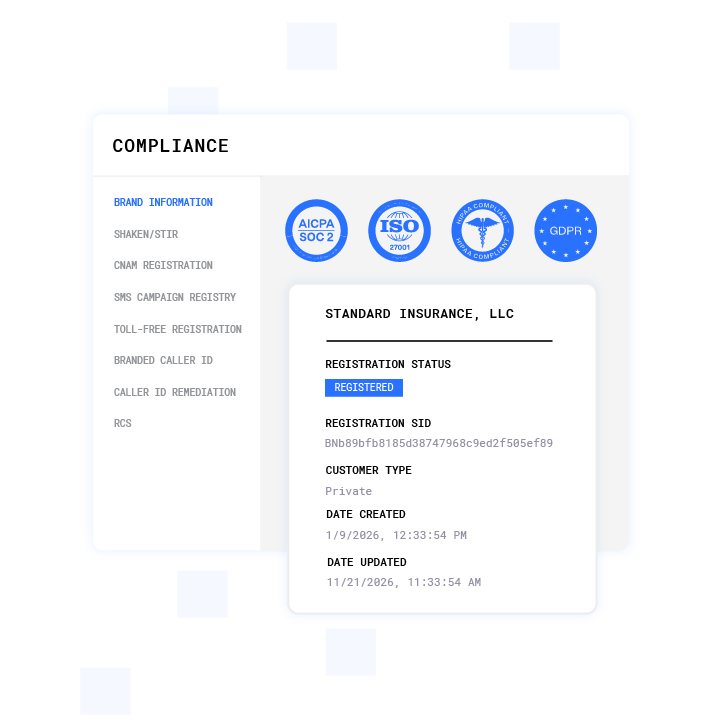
Plura pre-loads relevant rule sets and checks consent, DNC status, time zone, and number status in real time before each dial or send, blocking non-compliant contacts at the carrier layer.
1
2. TCPA Violations in AI Dialer Campaigns
Under FCC Declaratory Ruling FCC-24-17 (February 8, 2024), AI-generated voices qualify as “artificial or prerecorded voice” under the TCPA. AI voice agents therefore sit in the strictest consent tier, with no exception for systems that sound human or operate conversationally. Every outbound AI voice agent marketing call to a wireless number requires prior express written consent that names the calling company and discloses the use of artificial or AI-generated voice.
AI dialer deployments often rely on consent language that authorizes “phone calls” but omits the “artificial or prerecorded voice” disclosure. That gap can convert an otherwise compliant campaign into a TCPA risk across every contact. Each violation carries the same $500–$1,500 statutory damages. Before any AI voice call is placed, Plura validates that the consent record on file matches the call type, purpose, and required disclosure.
3. Ignoring DNC Registry Requirements in Voice and SMS
Under 47 U.S.C. § 227(c) and 47 C.F.R. § 64.1200(c), telemarketers may not contact numbers listed on the National Do Not Call Registry unless a qualifying exemption applies.2 Lists must be scrubbed against a version of the registry no older than 31 days. Operators must also maintain an internal DNC list and retain opt-out records for at least five years.
Automated SMS and AI predictive dialer campaigns often fail when DNC scrubs run as nightly batches instead of in real time, or when internal suppression lists do not sync across campaigns. In Pero v. Brown-Daub Chevrolet of Nazareth (E.D. Pa. June 17, 2026), a federal court held that an unwanted marketing text message constitutes a “call” under 47 U.S.C. § 227(c), allowing consumers on the National DNC Registry to sue over spam texts. DNC failures face the standard per-contact penalty range.
Plura scrubs every outbound contact against federal and state DNC registries at dial-time and blocks non-compliant numbers before origination.
The following table summarizes core violation types, their statutory ranges, and how Plura’s carrier-grade controls address each failure mode before contact:
| Violation Type | Statutory Range (per contact) | Plura Carrier Control |
|---|---|---|
| ATDS/AI Voice Without Consent | $500–$1,500 | Real-time consent record validation before dial |
| DNC Registry Contact | $500–$1,500 | Real-time federal and state DNC scrub at origination |
| Quiet-Hours Violation | $500–$1,500 | Automatic time-zone detection and calling-window enforcement |
| Reassigned Number Contact | $500–$1,500 | Reassigned Numbers Database (RND) check before each dial |
| Prerecorded/AI Voice Without Disclosure | $500–$1,500 | Consent purpose-matching and AI disclosure enforcement at call initiation |
4. Consent Failures with AI Voice Agents
47 C.F.R. § 64.1200(f)(9) defines prior express written consent for autodialed or prerecorded marketing calls to wireless numbers. The agreement must be signed, clearly disclose the use of an ATDS or artificial or prerecorded voice, identify the specific seller, specify the authorized phone number, and state that consent is not a condition of purchase. The FCC’s April 2025 revocation rules expect operators to honor opt-out requests made through any reasonable means in a timely manner.
AI voice consent failures typically follow three patterns. First, consent language omits the artificial voice disclosure. Second, purchased lead lists contain consent that does not name the calling company. Third, revocation requests do not propagate across all campaigns in real time. Class-action settlements in 2025 and 2026 involving AI voice consent failures have included $25 million (Amazon), $68 million (Google), and $95 million (Apple).3 These violations carry the same statutory range as other TCPA failures.
Plura stores timestamped, immutable consent records and validates consent purpose against call type before every dial attempt.
5. Quiet-Hours Violations in Predictive Dialers
47 C.F.R. § 64.1200(c)(1) prohibits telemarketing calls before 8 a.m. and after 9 p.m. in the called party’s local time zone. Several states enforce stricter windows. Florida, Oklahoma, Maryland, and Washington apply an 8 p.m. cutoff, and Pennsylvania’s Act No. 47 of 2026 (effective October 18, 2026) bans solicitations before 9 a.m. and after 7 p.m.
AI predictive dialer operations often misapply a single time zone to an entire campaign list instead of resolving each contact’s local time from area code and zip code data. A national campaign can generate hundreds of quiet-hours violations in one session. Quiet-hours violations are subject to the same statutory range as other TCPA failures.
Plura enforces calling windows automatically through time-zone detection on each contact and applies both federal and state-specific restrictions before any dial is placed. Even when a contact falls within the correct time window and is not on the DNC registry, exposure remains if the number has been reassigned to a new subscriber.
6. Reassigned-Number Risk in AI SMS Campaigns
Under 47 U.S.C. § 227, consent attaches to the person, not the phone number. When a carrier reassigns a number to a new subscriber, prior consent from the original subscriber does not transfer. The U.S. processes tens of millions of number reassignments annually, and courts increasingly expect recent number verification rather than reliance on stale list scrubs.
In AI SMS campaigns, reassigned-number exposure grows when lists are not checked against the FCC’s Reassigned Numbers Database (RND) before each send. The July 2026 TCPA class settlement in Jackson v. Gen Digital approved a $9.95 million payment covering prerecorded calls to wrong numbers between February 2021 and October 2025. As with other TCPA failures, reassigned-number contacts carry $500–$1,500 per instance.
Plura integrates with the Reassigned Numbers Database and checks each number before dial or send, blocking contacts where reassignment is detected.
Model the cost of reassigned-number failures in your current SMS volume.
7. ATDS and Prerecorded-Voice Failures
47 U.S.C. § 227(b)(1)(A)-(B) restricts the use of an ATDS or artificial or prerecorded voice to contact wireless numbers without prior express consent. Prerecorded or artificial voice calls to residential lines for telemarketing purposes require prior express written consent even when no ATDS is used. The Supreme Court’s 2021 Facebook v. Duguid decision narrowed the federal ATDS definition to systems using a random or sequential number generator, but prerecorded-voice violations remain separately actionable, and state mini-TCPA laws often apply broader definitions.
The ATDS failure mode in modern outbound operations involves systems that generate numbers dynamically or randomize dial sequences, which courts may still treat as ATDS equipment even after Facebook v. Duguid. A parallel failure mode, prerecorded-voice violations, occurs when AI voice agents operate without the specific written consent disclosure required by FCC-24-17, creating liability independent of whether the system qualifies as an ATDS. Under the TRACED Act (2019), these violations can trigger both TCPA statutory damages and FCC civil penalties up to $10,000 per intentional robocall.
Plura authenticates caller ID with STIR/SHAKEN on every outbound voice call and validates that the consent record on file covers the specific call type before origination.1
One-Click TCPA Audit Checklist
Plura’s carrier-grade compliance engine runs a consistent set of checks on every outbound contact before the first dial or send:
- Real-time consent record lookup that confirms a timestamped, immutable consent record exists, matches the call or text purpose, and includes the required artificial or prerecorded voice disclosure for AI voice campaigns
- Federal and state DNC scrubs at dial-time instead of nightly batch cycles
- Internal suppression list checks that confirm the number is not on the company-specific DNC list and that no active opt-out or revocation flag exists
- Reassigned Numbers Database (RND) verification to detect reassignment since consent was obtained and block affected contacts
- Quiet-hours enforcement that resolves the called party’s local time zone from area code and zip code data and applies both federal and state-specific calling windows
- STIR/SHAKEN authentication on every outbound voice call at the carrier level
- Audit-ready export that surfaces one-click compliance reports for legal review, carrier requirements, or regulatory inquiries
Frequently Asked Questions
What are the most common TCPA violation types for high-volume outbound operations?
The seven most common TCPA violation types in high-volume outbound voice and SMS operations are:
- Contacting wireless numbers with an ATDS or AI-generated voice without prior express written consent
- Contacting numbers on the National Do Not Call Registry without a qualifying exemption
- Placing calls outside the 8 a.m. to 9 p.m. local time window or stricter state windows
- Sending texts or making calls to reassigned numbers where the original consent no longer applies
- Using AI voice agents without consent language that specifically discloses the use of artificial or prerecorded voice
- Failing to honor opt-out and revocation requests in a timely manner
- Abandoning calls by failing to connect a live agent within two seconds of the called party answering
Each violation is treated as a separate offense under 47 U.S.C. § 227, with statutory damages of $500 to $1,500 per contact and no aggregate cap. Predictive dialers, AI voice agents, and automated SMS campaigns can trigger several of these failure types within a single campaign.
Do AI voice agents face different TCPA consent requirements than traditional robocalls?
The FCC’s February 2024 Declaratory Ruling (FCC-24-17) classified AI-generated voices as “artificial or prerecorded voice” under the TCPA. AI voice agents therefore sit in the same consent tier as traditional robocalls, with no carve-out for conversational or human-sounding systems. For marketing calls to wireless numbers, prior express written consent is required, and that consent must specifically disclose the use of artificial or AI-generated voice.
Consent forms that authorize “phone calls” without this specific language may not satisfy the requirement for AI voice agent campaigns. Operators should consult qualified counsel to review their consent language and assess alignment with current FCC standards. The Fifth Circuit’s February 2026 decision in Bradford v. Sovereign Pest Control created a circuit split on whether oral consent may suffice in some circumstances, but that ruling applies only within the Fifth Circuit’s jurisdiction and does not limit FCC enforcement authority.
How does the Reassigned Numbers Database reduce TCPA exposure in SMS campaigns?
The FCC’s Reassigned Numbers Database (RND) allows operators to check whether a phone number has been reassigned to a new subscriber since consent was originally obtained. Because TCPA consent attaches to the person rather than the phone number, contacting a new subscriber on a recycled number can create exposure even when a valid consent record exists for the original subscriber.
Court decisions have narrowed the “reasonable reliance” defense and increasingly expect active, recent number verification instead of outdated list scrubs. Operators running AI SMS campaigns can reduce risk by checking the RND before each send, not just at list-import time, because reassignments occur continuously. Plura integrates with the Reassigned Numbers Database and performs this check at the carrier layer before each contact attempt. Operators should consult qualified counsel regarding their specific RND-related obligations.
What quiet-hours rules apply to predictive dialers operating across multiple states?
Federal TCPA rules under 47 C.F.R. § 64.1200(c)(1) prohibit telemarketing calls before 8 a.m. and after 9 p.m. in the called party’s local time zone. Several states enforce stricter windows. Oregon, Florida, Oklahoma, Maryland, and Washington apply an 8 p.m. cutoff, and Pennsylvania’s Act No. 47 of 2026 (effective October 18, 2026) bans solicitations before 9 a.m. and after 7 p.m.
For predictive dialer operations running national campaigns, the applicable window for each contact is determined by the called party’s local time zone, not the operator’s time zone. Applying a single time zone to a multi-state campaign list is a common source of quiet-hours violations. Operators should consult qualified counsel regarding the specific state-level calling-window rules that apply to their campaigns. Plura’s compliance engine resolves each contact’s local time zone from area code and zip code data and applies both federal and applicable state restrictions automatically before each dial.
What is the difference between a TCPA violation and a willful TCPA violation for penalty purposes?
Under 47 U.S.C. § 227(b)(3), ordinary TCPA violations carry statutory damages of $500 per contact. If a court finds the violation was willful or knowing, damages may be trebled to up to $1,500 per contact. Many federal circuits apply a relatively low bar for willfulness, focusing on the intentional placement of the call or text rather than proof that the operator knew the conduct violated the TCPA.
Continuing to contact a number after receiving a STOP reply, for example, is often treated as a willful violation in litigation. Because each call or text is a separate violation with no aggregate cap, the difference between $500 and $1,500 per contact becomes material at campaign scale. A 10,000-contact campaign could face $5 million at the base rate or $15 million if willfulness is established. Operators should consult qualified counsel regarding their specific exposure and how to document good-faith compliance efforts.
Conclusion: Stop TCPA Violations at the Carrier Layer
TCPA violation types reflect an infrastructure problem, not just a paperwork problem. Consent verification, DNC scrubbing, quiet-hours enforcement, reassigned-number checks, and AI voice disclosure requirements all need to execute in real time, before the first contact attempt, on every outbound call and text. Bolt-on compliance tools that run nightly batch jobs or rely on manual list management struggle to keep pace with modern volume and regulatory complexity.
Plura AI is an FCC-licensed carrier that supports compliance with these controls at origination. The compliance engine operates as a core layer of the platform, running on the same infrastructure that originates every voice call and SMS. Consent records are timestamped and immutable. DNC scrubs run at dial-time. Quiet-hours windows apply automatically by time zone. Reassigned-number checks run before each contact. Every outbound call authenticates through STIR/SHAKEN. The compliance dashboard exports audit-ready reports in one click.
Operators running AI voice agents, AI predictive dialers, and AI SMS campaigns at scale carry exposure across all seven TCPA violation categories. The key decision is whether that exposure is managed at the carrier layer or left to post-hoc review.
Run the numbers on carrier-grade compliance for your operation.
1 Plura AI maintains SOC 2, HIPAA, ISO, and GDPR posture as part of its platform infrastructure. References to compliance frameworks in this article describe Plura’s platform capabilities and do not constitute a guarantee that any customer using Plura will themselves be compliant with applicable laws or standards. Customers remain solely responsible for their own regulatory obligations, certifications, consent management, recordkeeping, and the claims they make to their own end users. Consult qualified legal counsel for guidance specific to your use case.
2 This article describes regulatory frameworks at a general level and does not constitute legal advice. Laws and regulations vary by jurisdiction, change over time, and apply differently depending on facts and circumstances. Readers should consult qualified legal counsel before making compliance decisions.
3 Performance figures, customer outcomes, and industry statistics referenced in this article are drawn from cited third-party sources or Plura customer case studies. Individual results vary based on implementation, use case, industry, audience, and execution. Past or aggregate performance is not a guarantee of future results.
This article is provided for informational purposes only and reflects Plura AI’s understanding at the time of publication. Product capabilities, integrations, and specifications are subject to change. For the most current information, visit plura.ai.
This article was produced with the assistance of AI tools and reviewed by Plura AI prior to publication.