
Written by: Matt Beucler, CEO, Plura AI
Updated September 2026
Key Takeaways
- A voice AI call center uses speech-to-text, intent detection, CRM integrations, and human handoff to manage inbound and outbound calls at scale.
- Production-grade systems require sub-1.5-second latency, real-time CRM read-write loops, and seamless warm transfers to human agents when needed.
- Enterprise deployments typically cost $0.10–$0.50 per minute, with Plura AI documenting a 30-day ROI of $45,600 and a 12-month ROI of $547,200 in a 15-agent replacement scenario.3
- Legal compliance relies on TCPA, STIR/SHAKEN, DNC scrubbing, and state quiet-hours rules, and carrier-owning platforms like Plura AI support compliance controls at the network level before any call is placed.
- Operators evaluating platforms should verify carrier ownership, cross-channel memory, and 99.9% uptime SLAs. Plura AI’s FCC-licensed carrier infrastructure is detailed later in this guide; start a conversation with Plura AI to see how it meets these requirements.
How A Voice AI Call Center Works In Production
The architecture of a voice AI call center runs through five integrated layers, and each layer feeds the next. Speech recognition converts telephony-grade audio to text in real time, and intent detection then maps that text to a predefined category while extracting entities like account numbers, dates, and product names. From there, a conversation generation layer produces the agent’s response. Voice synthesis converts that response to audio, and a telephony layer delivers the audio over the carrier network.
Latency is the production variable that separates demos from deployments. A 2026 benchmark sampling approximately 25 production stacks found that end-to-end turn-taking latency lands between 600 ms and 1,800 ms, measured from end-of-turn detection to first audio frame returned. Under 1.5 seconds is the practical target for natural conversation rhythm. Callers notice and disengage above approximately 2,000 ms. Tool and integration calls on the critical path often create the real bottleneck, and a CRM call into an on-premise system can dominate total latency.
CRM integration drives real outcomes. The AI reads the customer record before the call begins and writes the outcome after it ends. That read-write loop lets the agent greet a caller by name, reference a prior interaction, and log a disposition without human intervention. Plura’s platform supports 50+ integrations across CRMs, calendars, payment processors, and data enrichment providers, so the AI agent reads the right record and triggers the right post-call event in the systems operators already run.
Human handoff functions as a first-class feature. When a caller’s response falls outside defined workflow paths, a sentiment threshold drops, or a legal trigger fires, the AI warm-transfers the call to a U.S. agent with a pre-generated context packet that includes the transcript, classified intent, extracted entities, and relevant CRM data. The caller does not repeat themselves.
See the production architecture in a live Plura demo to understand how these layers behave under real call volume.
How Much Does An AI Voice Calling Agent Cost?
Voice AI pricing varies widely across vendors, and inconsistent billing units create most buyer confusion. A 2026 pricing survey found that headline per-minute rates are not comparable because each vendor sells a different unit such as orchestration, a completed call, or a resolved ticket. Buyers need to normalize the billing unit before comparing numbers.
The cost stack for a production voice AI deployment has five layers:
- Telephony: US PSTN carrier rates run approximately $0.0085 to $0.014 per minute for inbound and $0.013 to $0.014 per minute for outbound via third-party carriers, per a March 2026 cost analysis.
- Speech-to-text: The lowest-cost layer, running $0.003 to $0.008 per minute depending on provider.
- LLM inference: Raw API costs are under $0.01 per minute for most models, and platform markups on this layer are where vendor margins accumulate.
- Text-to-speech: The most variable layer, ranging from $0.01 to $0.25 per minute depending on voice quality.
- Platform fee: Orchestration, compliance tooling, concurrency, and support, billed as a subscription or per-minute markup.
A September 2026 pricing guide reports that most enterprises pay between $0.10 and $0.25 per minute for voice AI. Managed all-in-one platforms that bundle voice, orchestration, and monitoring typically run $0.25 to $0.50 per minute, with implementation, integration, and ongoing QA adding 20 to 40 percent to total spend beyond the quoted per-minute rate. A June 2026 pricing guide reports that free voice AI tiers typically offer only 5 to 10 calls per month or up to $10 in credits, and that production-grade voice AI requires a paid plan for reliability, integrations, and support.
Plura’s agent build fee is $2,750 per agent, with plans and rates published on the pricing page. The illustrative 15-agent scenario from Plura’s ROI calculator shows the following:
- Human agent cost: $60,000 per month (15 agents at $20 per hour, with taxes, benefits, commissions, and 40% talk utilization)
- Plura agent cost: $14,400 per month (6 Plura agents replacing 15 humans, at $15 per hour, 100% talk utilization)
- 30-day ROI: $45,600
- 12-month ROI: $547,200
For higher-volume operations, Plura’s executive communications guide models a total cost of ownership of $700,000 per year replacing traditional contact-center economics of $7 million on equivalent volume. Run your own numbers through Plura’s ROI calculator to see how your economics compare.
Are AI Voice Calls Legal?
The primary federal framework governing AI voice calls is the TCPA, codified at 47 U.S.C. § 227.2 The FCC’s February 8, 2024 Declaratory Ruling (FCC 24-17) confirmed that the TCPA’s restriction on “artificial or prerecorded voice” calls covers calls that use AI to generate or clone human voices, effective immediately. A September 2024 Notice of Proposed Rulemaking (FCC 24-84) proposed a definition of “AI-generated call” and a requirement that callers disclose AI use at the start of the call. As of September 2026, that NPRM has not been finalized into a binding rule, but enforcement on the underlying TCPA prohibition is active.
TCPA statutory damages run $500 per violating call, rising to $1,500 per call for willful or knowing violations, with no statutory cap. The average TCPA class action settlement reaches $6.6 million, according to a 2018 study cited in CRC Group’s report.
STIR/SHAKEN is the caller ID authentication framework implemented under the TRACED Act.2 FCC orders implementing STIR/SHAKEN require originating carriers to authenticate outbound calls so destination carriers can verify legitimate origination. Operators placing outbound AI voice calls at scale should consult the FCC’s implementing orders and qualified counsel on their specific authentication obligations.
State quiet-hours rules layer additional restrictions on top of the federal 8 a.m. to 9 p.m. floor. Five states enforce narrower windows as of 2026:
- Florida: 8 a.m. to 8 p.m. under the FTSA (Fla. Stat. §501.059)
- Oklahoma: 8 a.m. to 8 p.m. under Okla. Stat. tit. 15 §§775C.1 to 775C.6
- Oregon: 8 a.m. to 8 p.m. under HB 3865, effective January 1, 2026
- Connecticut: 9 a.m. to 8 p.m. under Conn. Gen. Stat. §42-288a
- Texas: 9 a.m. to 9 p.m. Monday through Saturday, noon to 9 p.m. Sunday under Tex. Bus. and Com. Code ch. 301
10DLC (10-digit long code) registration governs A2P (application-to-person) SMS messaging. Operators sending AI-generated texts at volume are subject to carrier registration requirements. They should consult the applicable carrier guidelines and qualified counsel for their specific registration obligations.
Nothing in this section constitutes legal advice. Readers should consult the statutes, FCC orders, and qualified counsel before designing or operating an outbound AI voice program. Compliance obligations are one reason the underlying carrier infrastructure matters, and the next section explains why.
The Carrier-Stack Distinction: Why It Matters Before You Sign
The most consequential infrastructure difference between voice AI call center platforms is whether the vendor owns an FCC-licensed carrier or rents access from a third-party CPaaS. Most platforms in this category are API resellers built on top of Twilio or another CPaaS.4 They rent access from a third-party CPaaS, which means they cannot issue branded caller ID under their own identity or enforce compliance before the call leaves the network.
Plura AI is its own FCC-licensed audio bridging carrier. That distinction produces four concrete operational differences:
- Branded caller ID at the carrier level: Calls present with the company’s name and reason for the call instead of “Spam Likely” or an unfamiliar number. Plura issues branded caller ID directly through its carrier identity, not through a reseller.
- STIR/SHAKEN on every outbound call: Authentication runs at origination, so destination carriers receive a verified call rather than an unverified one that triggers spam labels.
- Real-time DNC scrubbing before dial: Every outbound contact is checked against federal and state DNC registries before the carrier is asked to place the call, and non-compliant numbers are blocked before the first attempt.
- Immutable consent logging: Consent records are timestamped and audit-ready, and quiet-hours rules are enforced automatically through time-zone detection on the contact.
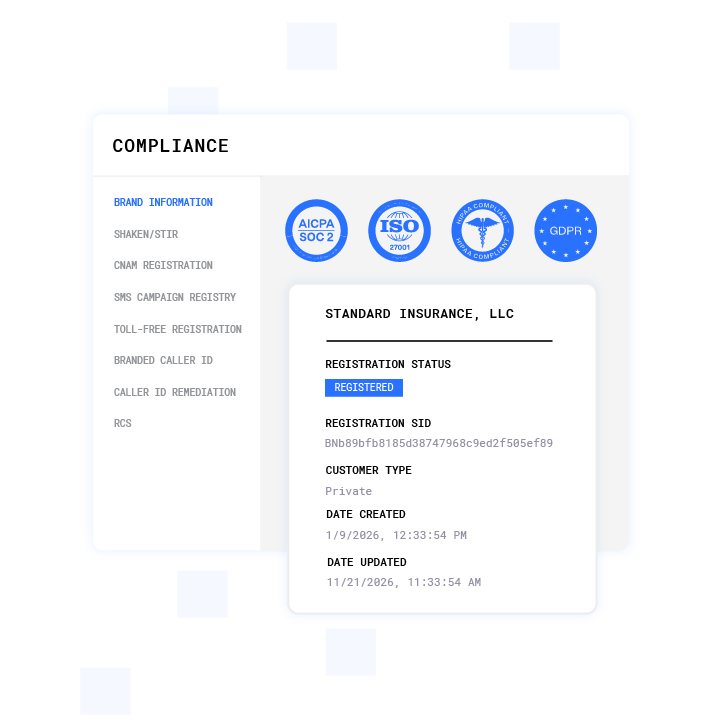
Plura’s compliance engine covers TCPA, DNC, HIPAA, SOC 2, and 50+ state rule sets.1 The compliance dashboard exports audit-ready reports in one click. SOC 2 Type II certification covers the underlying infrastructure through continuous monitoring, penetration testing, and third-party audits.1 HIPAA alignment covers end-to-end encryption, access controls, and audit logging for protected health information across all four channels.1
Inbound Vs. Outbound Voice AI: Where Each Wins
Inbound voice AI handles calls that arrive, such as customer service inquiries, appointment scheduling, lead intake, and after-hours coverage. The AI voice agent answers on the first ring, 24/7, reads the caller’s CRM record before the conversation begins, and routes complex calls to a human agent with full context. For appointment-driven businesses, Plura’s platform supports up to 40% improvement in no-shows through automated confirmations and reminders. See Plura’s healthcare deployment data for specifics.
Outbound voice AI handles calls that originate from the platform, including lead follow-up, re-engagement, collections, and qualification. The AI Predictive Dialer decides who to call next using stateful conversion signals such as historical answer rates, prior negotiation outcomes, and prior offer-acceptance bands. Calls flow over Plura’s FCC-licensed carrier with branded caller ID and STIR/SHAKEN authentication. Human agents receive only live-transferred, qualified contacts instead of a queue of unanswered dials.
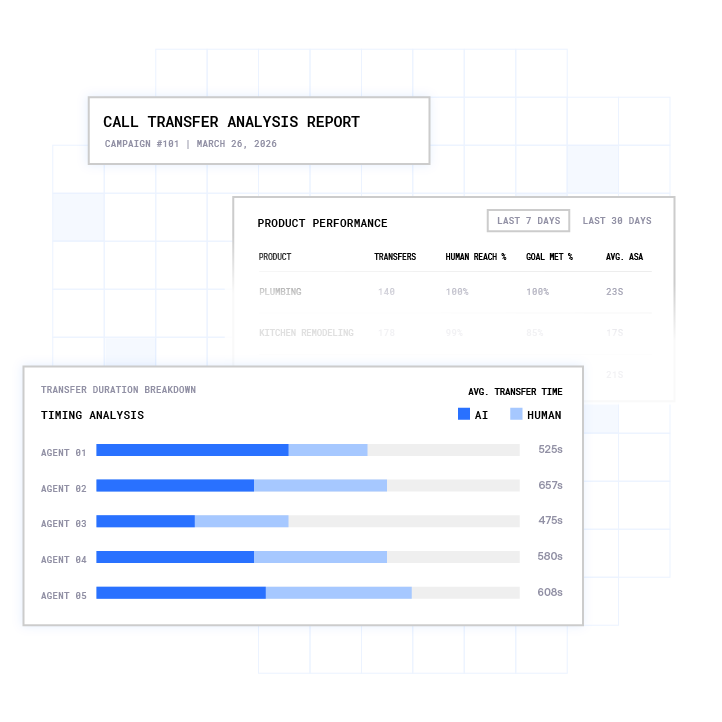
Human handoff matters in both directions. The median escalation rate from AI to human across enterprise deployments is 22% of AI-engaged interactions, per Forrester and Gartner CX research. Top triggers include low confidence score, explicit user request, sentiment dropping below threshold, and regulated topic. Plura’s warm-transfer protocol delivers the caller’s transcript, classified intent, and CRM data to the receiving agent before they speak.
How To Evaluate A Voice AI Call Center Platform
Operators can separate a production-grade voice AI call center from a thin API wrapper by focusing on six categories of questions:
- Carrier ownership: Does the vendor hold an FCC carrier license, or does voice route through a third-party CPaaS? Ask for the operating company number and STIR/SHAKEN authentication documentation.
- Compliance enforcement mechanics: Is DNC scrubbing enforced before dial, or is it a post-hoc checkbox? Are consent records immutable and audit-ready? Are quiet-hours rules enforced by time-zone detection on the contact instead of the caller?
- Cross-channel memory: Does the AI agent that texted a lead at 9 a.m. pick up the call at noon already knowing what was said, or does each channel start from zero?
- Integrations: How many CRMs, calendars, and data enrichment providers does the platform support natively? Plura’s integrations directory covers 50+ tools across 10+ categories.
- Uptime and contract terms: What is the SLA? Plura carries a 99.9% uptime SLA with automatic failover, and every annual contract includes a 90-day opt-out window if the deployment is not delivering.
- Conversation engineering: Does the vendor iterate the workflow after launch, or hand off the keys and step back?
Plura’s verifiable platform facts include FCC-licensed carrier status, SOC 2 Type II, HIPAA alignment, and ISO certification.1 The platform enforces 50+ state rule sets on every outbound contact, achieves under-5-second first contact, and carries a 99.9% uptime SLA with a 90-day opt-out window. Customers report 3x average ROI in 90 days, 47% pipeline growth, and 90% faster lead-response time.3 The total cost of ownership is $700,000, replacing $7 million in traditional contact-center economics, and the platform supports 50+ integrations across 4 channels on one stateful conversation database.
Walk through this evaluation framework in a live Plura session and map it to your current stack.
Common Questions About Voice AI Call Centers
Leaders often raise a consistent set of follow-up questions after reviewing the core framework above. These answers highlight key data points and point back to the sections that cover each topic in more depth.
Are Call Centers Using AI Voices Today?
Adoption is accelerating across large contact centers. Forrester Wave research found that voice AI handled 19% of inbound contact-center volume in 2026, up from 6% in 2024, with banking and telecom leading because password-reset, balance, and outage volumes map cleanly to scoped voice intents. Forrester forecasts voice AI will handle 33% to 37% of inbound contact-center volume in 2027.5 Gartner’s 2026 Customer Service Technology Survey found that 34% of enterprises used AI voice agents in some production capacity as of mid-2026, up from 22% in 2024. Most of that 34% use AI for simple tasks like authentication and appointment confirmations, and full conversational AI handling qualification, objection handling, or sales is used by approximately 8 to 12% of enterprises. The global Call Centre AI market reached $6.3 billion in 2026 and is projected to expand to approximately $36.9 billion by 2035 at a 21.7% CAGR.5
What Is The All-In Cost Of A Production Voice AI Deployment?
The detailed breakdown of the five cost layers and current per-minute pricing ranges appears in the “How Much Does An AI Voice Calling Agent Cost?” section above. In short, most enterprises pay $0.10–$0.25 per minute, managed platforms run $0.25–$0.50, and implementation adds 20–40%. Plura’s agent build fee is $2,750 per agent, and the 15-agent ROI scenario is modeled in Plura’s calculator with the 30-day and 12-month ROI figures cited earlier.
How Do Legal Rules Apply To AI Voice Calls?
The legal framework is covered in detail in the “Are AI Voice Calls Legal?” section above. In brief, the TCPA governs AI voice calls, the FCC has confirmed that AI-generated voices fall under its restrictions, and state quiet-hours rules add further limits. Readers should consult the statutes, FCC orders, and qualified counsel for their specific obligations.
Is There A Free AI Voice Calling Agent?
Free tiers exist across several platforms, but they are scoped for testing rather than production. Quiq’s 2026 pricing guide reports that free voice AI tiers typically offer only 5 to 10 calls per month or up to $10 in credits. Bland AI’s published “Start” plan carries no monthly fee but charges $0.14 per minute, per published platform pricing. Vapi offers approximately 60 free minutes for new users on its Build plan. For production-grade deployments handling thousands of calls per month, free tiers do not provide the reliability, concurrency, compliance tooling, or CRM integrations that operators require. The real cost model for production voice AI is per-minute usage plus platform fees plus implementation, with total monthly spend for operations running 5,000 to 10,000 minutes typically landing between $600 and $2,700 depending on platform and component architecture, per a June 2026 pricing analysis.
Conclusion: A Practical Evaluation Framework For Operators
A voice AI call center performs only as well as the infrastructure underneath it. The evaluation framework that separates a production-grade platform from a thin API wrapper covers six dimensions: carrier ownership, compliance enforcement mechanics, cross-channel memory, integrations, uptime, and contract terms.
API resellers on third-party CPaaS lack carrier-level control, which prevents them from issuing branded caller ID, enforcing DNC scrubbing before dial, or holding context across channels. Carrier-owning platforms like Plura support compliance enforcement inside the platform, originate calls on their own FCC-licensed infrastructure, and maintain stateful conversation memory across voice, SMS, RCS, and webchat on one database.
The cost math is documented, the compliance framework is primary-source citable, and the infrastructure distinction is verifiable. The next step is running your specific call volume and agent economics through the model.
Run your numbers through Plura’s calculator to check your ROI in real time. Compare plans and rates side by side on the pricing page. Explore the carrier stack, compliance controls, and cross-channel memory in a live Plura demo and benchmark them against your current deployment.
1 Plura AI maintains SOC 2, HIPAA, ISO, and GDPR posture as part of its platform infrastructure. References to compliance frameworks in this article describe Plura’s platform capabilities and do not constitute a guarantee that any customer using Plura will themselves be compliant with applicable laws or standards. Customers remain solely responsible for their own regulatory obligations, certifications, consent management, recordkeeping, and the claims they make to their own end users. Consult qualified legal counsel for guidance specific to your use case.
2 This article describes regulatory frameworks at a general level and does not constitute legal advice. Laws and regulations vary by jurisdiction, change over time, and apply differently depending on facts and circumstances. Readers should consult qualified legal counsel before making compliance decisions.
3 Performance figures, customer outcomes, and industry statistics referenced in this article are drawn from cited third-party sources or Plura customer case studies. Individual results vary based on implementation, use case, industry, audience, and execution. Past or aggregate performance is not a guarantee of future results.
4 References to third-party products, services, companies, or research are made for informational and comparative purposes only. Plura AI is not affiliated with, endorsed by, or sponsored by any third party named in this article unless explicitly stated. Trademarks and product names referenced remain the property of their respective owners.
5 This article contains forward-looking statements regarding industry trends, technology adoption, and future capabilities. These statements reflect current expectations and are subject to change. Plura AI undertakes no obligation to update forward-looking statements except as required.
This article is provided for informational purposes only and reflects Plura AI’s understanding at the time of publication. Product capabilities, integrations, and specifications are subject to change. For the most current information, visit plura.ai.
This article was produced with the assistance of AI tools and reviewed by Plura AI prior to publication.