

Written by: Matt Beucler, CEO, Plura AI
Key Takeaways
-
24/7 speed to lead coverage gives every inbound lead across voice, SMS, RCS, and webchat a first contact in under 5 seconds, day or night.
-
Plura AI agents deliver sub-5-second responses on 100% U.S. infrastructure with support for SOC 2, HIPAA, ISO, GDPR, SHAKEN/STIR, TCPA, and DNC compliance.1
-
Automated triggers and stateful memory across channels let AI agents qualify leads, handle objections, and schedule instantly, so humans focus on complex cases only.
Why Nearly Half of Your Leads Arrive After Hours
Enterprise buyers submit demo requests and contact forms at 9 PM, on weekends, and during industry events. A human-only coverage model cannot absorb that volume without a night shift. A night shift carries payroll, benefits, management overhead, and the same 30–50% annual turnover that affects most front-desk roles. The math compounds quickly.
Offshore BPOs filled that gap for two decades, but the FCC’s Notice of Proposed Rulemaking (CG Docket No. 26-52) describes a framework that would cap offshore customer-service calls at 30% and limit offshore handling of sensitive consumer data. State laws in New York, New Jersey, Connecticut, Missouri, and Florida already restrict offshore handling of medical, financial, and consumer data. Every offshore contract a covered entity holds now carries additional compliance risk that counsel must evaluate.
The result is a structural gap between when leads arrive and when operators can respond. That gap is where paid media budgets go to die.
See how Plura covers your after-hours lead gap with instant AI response: book a demo.
The 5-Second Response vs. the 47-Hour Industry Average
The after-hours coverage gap is a primary driver behind weak response-time performance across many contact centers. The industry standard for first contact on an inbound lead is 47+ hours. That number is not a floor, it is the average. The conversion penalty for that delay is severe.
Contacting a lead within the first 5 minutes makes them up to 100× more likely to connect.3 A 60-second response lifts conversions by 391%.3
The gap between what the data supports and what human-only operations deliver is not a staffing problem. It is an architecture problem. Human agents work one channel at a time, sleep, and cannot scale into Medicare AEP or Black Friday season without burning hiring budgets months in advance.
Plura responds in under 5 seconds across voice, SMS, RCS, and webchat, 24/7, on every channel, in parallel, without adding a single headcount.
Three Core Tactics for Always-On Coverage
1. AI Agents on Every Channel You Use
AI agents on voice, SMS, RCS, and webchat at the same time create the only architecture that closes the after-hours gap without linear cost increases. Plura’s AI Voice agents handle inbound and outbound calls on its own FCC-licensed audio bridging carrier, with no third-party CPaaS in the path. Plura owns its telecom infrastructure and holds an FCC carrier license, whereas platforms like Synthflow depend on Twilio and operate as a software layer without a carrier license.4
That distinction matters operationally. Branded caller ID is issued at the carrier level, SHAKEN/STIR caller ID verification runs on every outbound call, and calls present with the company’s name instead of “Spam Likely”.
Plura enables franchises to handle 3x to 5x call volume during peak seasons without temporary staff. The same architecture supports any high-volume operator running Medicare AEP, tax season, or a major product launch.
2. Automated Triggers with Shared Conversation Memory
Speed with context produces higher-quality conversations. Most Twilio-based API resellers handle voice and SMS as separate products with separate memories. A customer who texted at 9 AM has to re-explain themselves when the call comes at noon. Plura supports voice, SMS, webchat, and RCS within a unified stateful inbox that maintains full conversation history.4 Every interaction is keyed to the same customer token, such as phone, email, or ID. The AI agent that texted a lead at 9 AM picks up the call at noon already knowing what was said, what was offered, and what objections were raised.
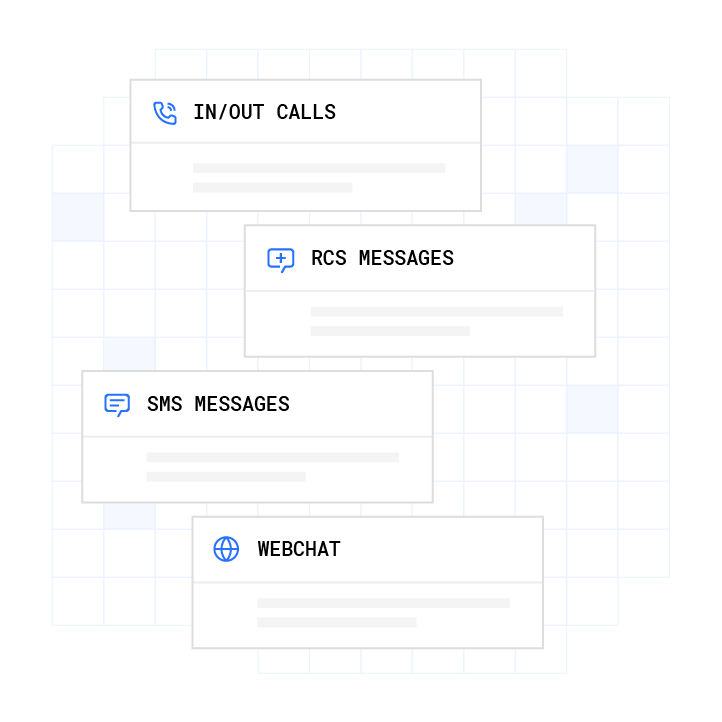
Automated triggers fire the moment a lead submits a form, clicks an ad, or visits a pricing page, which initiates contact before a human would even see the notification. This immediate activation is how Plura enables lead contact within 60 seconds for every lead, compared to 1–4 hours in manual operations. That trigger-to-contact window is where the 391% conversion lift occurs.
3. Human Handoffs That Protect Experience
AI agents handle qualification, objection handling, and scheduling. When a workflow gate triggers, such as a high-value negotiation, a sensitive disclosure, or a complex compliance question, the call warm-transfers to a U.S. agent with full conversation context already loaded. 82% of service professionals using AI say that AI frees representatives to focus on more complex cases. The handoff is not a failure state. It is the designed outcome for conversations that require human judgment. The AI handles the volume, and the human handles the exceptions.
Watch a live AI-to-human handoff in your demo: see the full context transfer in action.
Compliance Infrastructure for 24/7 Outreach
Running AI agents 24/7 across voice, SMS, RCS, and webchat expands the compliance surface area that leaders and counsel must manage. Plura’s compliance engine operates as a core layer of the platform, not an afterthought. Operators and their counsel should review the applicable frameworks, including TCPA (47 U.S.C. § 227), HIPAA (45 CFR Parts 160, 162, 164), and relevant state rules, to determine their own obligations.2 Plura supports compliance, and customers own their downstream compliance posture.
Plura’s compliance engine performs several specific functions. Every outbound contact is checked against federal and state DNC registries in real time before dial, and blocked numbers do not receive an attempt.2 TCPA consent records are timestamped, immutable, and audit-ready. Quiet-hours rules are enforced automatically through time-zone detection on the contact. HIPAA-aligned encryption, access controls, and audit logging cover protected health information across all four channels. Plura supports HIPAA, SOC 2 compliance, and integration with The Blacklist Alliance’s TCPA Litigation Firewall® for real-time DNC scrubbing and litigation protection.1 SOC 2, ISO certification, and GDPR coverage apply across the platform.

Operators running 24/7 coverage without this type of infrastructure layer leave conversion gains on the table and increase consent-violation exposure on every after-hours contact.
Cost Comparison: Human Night Shift vs AI Coverage
|
Metric |
Human Night-Shift Model |
Plura AI Agent Model |
|---|---|---|
|
Monthly cost (15-agent equivalent) |
$60,000/month (15 agents × $20/hr × taxes/benefits/commission × 40% talk utilization) |
$14,400/month (6 Plura agents at $15/hr, 100% talk utilization) |
|
Annual TCO (high-volume operators) |
||
|
After-hours coverage |
Requires additional shift staffing, nights, weekends, holidays uncovered without added headcount |
24/7/365 by default, no additional headcount required |
|
Peak-season scaling |
Requires hiring months in advance, linear cost increase |
Handles peak volumes as described above without temporary staff |
|
First-contact speed |
Industry average (as noted above) |
|
|
30-day savings (15-agent scenario) |
— |
|
|
12-month savings (15-agent scenario) |
— |
Run your numbers through Plura’s calculator to check your ROI in real time: plura.ai/calculator.
Deployment Timeline and 90-Day Success Metrics
A simple inbound qualification flow deploys in days. A complex multi-step intake, such as a 25-question health-history survey, runs closer to one to two months because the workflow logic requires design and validation. Plura’s onboarding sequence follows a consistent pattern: discovery audit, intake of sample calls and existing scripts, overnight build of a conversation mockup, iteration meeting, engineering build of the production workflow, pilot on a subset of real calls, and full go-live.
Operators track specific 90-day success metrics. These include lead-response time, contact rate per dial, cost per qualified lead (industry baseline: $85–$200 traditional vs. $25–$60 with Plura), pipeline growth, and talk utilization. Every annual contract includes a 90-day opt-out window. If the deployment is not delivering, operators are not held to the annual term. The platform’s track record across deployments includes 3× average ROI in 90 days, 47% pipeline growth, and 90% faster lead-response time.3
Frequently Asked Questions
What “24/7 speed to lead coverage” means in daily operations
24/7 speed to lead coverage means every inbound lead, regardless of channel or time of day, receives first contact in under 5 seconds. That includes a form submission at 11 PM on a Saturday, a webchat inquiry during a holiday, and an inbound call during peak season when human queues are backed up. Plura runs AI agents continuously across voice, SMS, RCS, and webchat on 100% U.S. infrastructure, so there is no after-hours gap, no queue delay, and no dependency on overnight staffing.
How Plura responds in seconds without a human on standby
Plura’s AI agents stay active at all times. When a lead submits a form, clicks an ad, or initiates a webchat session, an automated trigger fires immediately and contacts the lead via the configured channel before a human agent would see the notification. The AI handles greeting, qualification, objection handling, and scheduling. When a workflow gate triggers a human handoff, the call warm-transfers to a U.S. agent with full conversation context already loaded from the Stateful Conversation Database.
Compliance frameworks supported by Plura’s platform
Plura’s compliance engine supports the frameworks outlined above and adds operational controls such as real-time DNC scrubbing, timestamped consent records, and automatic quiet-hours enforcement. Every outbound contact is checked against federal and state DNC registries in real time before dial. Consent records are timestamped and immutable. Quiet-hours rules enforce automatically through time-zone detection. The compliance dashboard exports audit-ready reports in one click. Operators and their counsel are responsible for determining their own regulatory obligations under applicable law, and Plura provides the infrastructure layer.
How Plura differs from AI tools built on third-party carriers
Plura owns its FCC-licensed audio bridging carrier. Voice originates on Plura’s domestic infrastructure, not a third-party CPaaS. Branded caller ID is issued at the carrier level, SHAKEN/STIR authentication runs at origination, and real-time DNC scrubbing is enforced before the first dial attempt. Twilio-based API resellers rent these layers from a third party, which means caller ID reputation is inherited rather than owned, and compliance is bolted on rather than built in. Plura also maintains a Stateful Conversation Database shared across voice, SMS, RCS, and webchat, so conversation context persists across channels by default, not as an add-on.
Cost of 24/7 AI coverage compared to a human night shift
In a 15-agent equivalent scenario, a human model costs approximately $60,000 per month at standard wages, taxes, benefits, and a 40% talk utilization rate. Plura’s model drops that to $14,400 per month, with 6 Plura agents at 100% talk utilization replacing 15 humans. That shift generates $45,600 in 30-day savings and $547,200 over 12 months. For higher-volume operations, Plura’s total cost of ownership runs $300,000–$700,000 per year against a traditional contact-center benchmark of $4M–$7M. The full model is available at plura.ai/calculator.
Time required to go live with Plura
Simple inbound qualification flows deploy in days. Complex multi-step workflows, such as a 25-question health-history intake or a multi-state franchise rollout, run closer to one to two months. Every deployment follows the same sequence: discovery audit, script and SOP intake, overnight mockup build, iteration meeting, production engineering, pilot on real calls, and full go-live. Annual contracts include a 90-day opt-out window if the deployment is not delivering the agreed outcomes.
Compare plans and rates side by side at plura.ai/pricing.
See 24/7 AI coverage on U.S. infrastructure: schedule your demo now.
1 Plura AI maintains SOC 2, HIPAA, ISO, and GDPR posture as part of its platform infrastructure. References to compliance frameworks in this article describe Plura’s platform capabilities and do not constitute a guarantee that any customer using Plura will themselves be compliant with applicable laws or standards. Customers remain solely responsible for their own regulatory obligations, certifications, consent management, recordkeeping, and the claims they make to their own end users. Consult qualified legal counsel for guidance specific to your use case.
2 This article describes regulatory frameworks at a general level and does not constitute legal advice. Laws and regulations vary by jurisdiction, change over time, and apply differently depending on facts and circumstances. Readers should consult qualified legal counsel before making compliance decisions.
3 Performance figures, customer outcomes, and industry statistics referenced in this article are drawn from cited third-party sources or Plura customer case studies. Individual results vary based on implementation, use case, industry, audience, and execution. Past or aggregate performance is not a guarantee of future results.
4 References to third-party products, services, companies, or research are made for informational and comparative purposes only. Plura AI is not affiliated with, endorsed by, or sponsored by any third party named in this article unless explicitly stated. Trademarks and product names referenced remain the property of their respective owners.
This article is provided for informational purposes only and reflects Plura AI’s understanding at the time of publication. Product capabilities, integrations, and specifications are subject to change. For the most current information, visit plura.ai.
This article was produced with the assistance of AI tools and reviewed by Plura AI prior to publication.