

Written by: Matt Beucler, CEO, Plura AI
Updated July 2026
Key Takeaways for Outbound Leaders
- Modern machine-learning voicemail detection systems consistently outperform legacy rule-based AMD, with higher accuracy and lower false-positive rates across benchmarks.
- High false-positive rates in AMD can increase TCPA risk and financial exposure, with penalties from $500 to $1,500 per call and strict FTC abandonment caps at 3%.
- Production targets for compliant high-volume outbound operations include 95%+ overall accuracy, under 1% false positives, under 2% false negatives, and median detection latency of 2 seconds or less.
- Carrier-specific audio characteristics and voicemail implementations create large variance in AMD performance, so per-carrier benchmarking and adaptive ML models matter for reliable results.
- Plura AI’s AI Predictive Dialer delivers carrier-grade voicemail detection integrated with real-time DNC and TCPA compliance infrastructure to help operators stay under regulatory thresholds.
Executive Summary for Contact Center and Revenue Teams
Published answering machine detection (AMD) accuracy varies by more than 20 percentage points between legacy rule-based systems and modern machine-learning deployments.3 Legacy rule-based AMD, including default VICIdial configurations, can show overall accuracy that shifts with false-positive rates as high as 25%.3 Machine-learning systems can reach high F1 scores with low false-positive rates and fast detection latency.
The regulatory stakes are direct for outbound operations. Under the FTC Telemarketing Sales Rule (TSR), abandoned calls cannot exceed 3% of answered calls per campaign per 30-day period. Each false positive, a live human classified as a voicemail, counts as an abandoned call. Under the Telephone Consumer Protection Act (TCPA), per-violation exposure ranges from $500 to $1,500 per call. Operators running high daily dials at elevated false-positive rates can lose hundreds of live connections per day to misclassification alone.
Practical production targets for compliant high-volume outbound operations include overall accuracy at or above 95%, false-positive rate below 1%, false-negative rate below 2%, median detection latency at or below 2 seconds, and abandonment rate below 3%.
Published Voicemail Detection Accuracy Benchmarks
The table below aggregates published benchmark figures from academic, vendor, and independent sources.4 Every numeric value is cited to its source. Dataset notes reflect the evaluation conditions reported by each source, so figures are not directly comparable across rows without accounting for dataset differences.
| Source | Model / Method | F1 Score | False-Positive Rate | False-Negative Rate | Latency | Dataset Notes |
|---|---|---|---|---|---|---|
| arXiv:2604.09675 (Kumar Saurav, Apr 2026) | Temporal speech activity features + shallow tree-based ensemble | 96.1% combined accuracy (734/764) | 0.3% | 1.3% | 46 ms end-to-end (dual-core CPU, no GPU) | 764 telephony recordings (140 expert-labeled + 624 held-out production); production validation over 77,000 calls |
| LiveKit AMD4 | google/gemini-3.1-flash-lite + STT | Not published | Not published | Not published | 840 ms median (P50) from session start | Internal dataset; voicemails, IVR prompts, live human pick-ups across carriers, languages, and accents |
| Vida.io (ML) | ML model on audio spectrograms | Not published | Not published | Not published | Not published | Controlled testing environment; first few seconds of audio analyzed |
| ViciStack AI AMD | AI-based AMD (neural network, acoustic features) | 92-96% accuracy (or 98.3% accuracy with sub-200 ms decisions in related materials) | Not published | Not published | sub-200 ms in related materials | Vendor reported across VICIdial deployments |
| ViciStack Tuned Rule-Based AMD | Per-carrier calibrated rule-based AMD (VICIdial) | Not published | Not published | Not published | Not published | Vendor reported across VICIdial deployments |
| ViciStack Default Rule-Based AMD | Default rule-based AMD (VICIdial / Asterisk) | Not published | exceeds 30% | Not published | Not published | Observations from VICIdial deployments |
Book a live demo with Plura to see how carrier-grade voicemail detection integrates with real-time DNC and TCPA compliance infrastructure.
False-Positive Cost Under TCPA and TSR
The accuracy differences shown in the benchmark table above translate directly into regulatory and financial exposure. A false positive in AMD occurs when a live human answer is classified as a voicemail. The system either hangs up or plays a pre-recorded message without transferring to an agent. Both outcomes create regulatory exposure.
Under the TCPA (47 U.S.C. § 227), statutory penalties are $500 per violation for standard non-compliance and up to $1,500 per violation for willful or knowing violations, with no statutory cap on total damages.2 The FTC TSR sets a strict 3% cap on abandoned calls per campaign per 30-day period.2
The arithmetic compounds quickly at scale. TCPA class actions aggregate thousands of calls; at $500–$1,500 per call for willful violations, 10,000 non-compliant calls create $5M–$15M exposure. TCPA-related lawsuits and settlements have resulted in significant financial exposure.
At the operational level, a 50-agent floor running 12,000 daily dials at an 18.5% false-positive rate loses 533 live connections per day. Reducing that rate to 4.2% through per-carrier tuning recovers 422 of those connections daily. The compliance exposure and the revenue loss represent the same underlying problem.
Operators should consult qualified legal counsel regarding their specific TCPA and TSR obligations. Plura supports compliance through real-time DNC scrubbing, TCPA compliance infrastructure, and immutable consent logging built into the platform.
Latency, Dead Air, and Conversation Rates
Detection latency determines how long a live caller hears silence before an agent or AI voice agent connects. That silence directly affects whether the caller stays on the line.
Higher AMD latency can reduce prospect connection rates because prospects may disconnect during the silence. AI-based AMD can introduce additional post-answer latency compared with tuned traditional AMD. That increase can raise total agent connect delay on ambiguous calls and affect conversation rates.
The published range across systems in this benchmark spans 46 ms (arXiv:2604.09675 ML model on CPU) to several seconds. The fastest production-validated latency in the dataset is 46 ms end-to-end on a commodity dual-core CPU with no GPU, supporting 380+ concurrent WebSocket calls. LiveKit’s LLM-based system reports 840 ms median time to detection from session start, with preemptive generation allowing the agent’s first reply to begin the moment a human is confirmed.
For TCPA purposes, AMD detection delays must allow live calls to connect within 2 seconds of answer to avoid violations under U.S. TCPA and FTC rules. Operators should verify their specific obligations with qualified counsel.
Rule-Based vs Machine-Learning Performance Gap
The performance gap between rule-based and machine-learning AMD appears consistently across every published source in this benchmark. Rule-based systems count sound events above a silence threshold and measure word boundaries using fixed parameters. These systems do not adapt to carrier-specific audio characteristics, regional accents, or custom voicemail greetings.
VICIdial’s native rule-based AMD routinely exceeds 30% false positives and drops 15–25% of live answers. Per-carrier tuning can improve that performance. Static AMD parameter tuning alone typically reduces false positives, and adaptive thresholds are required to push false positives lower.
Machine-learning systems in the same dataset can reach high accuracy with low false-positive rates. AI and ML-based detection reaches high accuracy by analyzing speech cadence, frequency patterns, background noise, and semantic content simultaneously. Performance improves over time as additional training data becomes available.
The accuracy gap between tuned traditional AMD and AI AMD varies by campaign type. The gap can be larger for B2C cell-phone-only campaigns and smaller for B2B office lines. Cell-phone campaigns carry the highest false-positive risk because cell-phone AMD accuracy can be lower due to carrier-specific voicemail implementations, network delays, and audio compression from Verizon, AT&T, and T-Mobile.
Benchmark Limits and Measuring Your Own Traffic
Every benchmark in this report carries dataset-specific constraints. The arXiv:2604.09675 evaluation used 764 telephony recordings and production-validated over 77,000 calls, but the dataset composition and carrier mix are not publicly disclosed. LiveKit’s benchmark used an internal dataset with undisclosed size. ViciStack’s figures come from observations across 100+ VICIdial deployments, not a controlled experiment. No independent third-party validation exists for any of these figures as of July 2026.
Operators running high-volume outbound campaigns should benchmark AMD performance against their own traffic. A practical methodology:
- Manually label a minimum of 200–500 calls per carrier prefix, recording the actual outcome (human, voicemail, IVR, SIT tone, or no answer) by listening to call recordings independently of the AMD system’s classification.
- Log classification features for every call in the sample, including greeting length, beep detection result, VAD (voice activity detection) speech start time, and AMD output.
- Calculate false-positive rate (live calls classified as voicemail / total live calls) and false-negative rate (voicemails classified as live / total voicemails) per carrier prefix.
- Identify carriers with outlier false-positive rates. Carrier-specific false-positive rates can vary significantly; one published example shows a 5% FP rate on one carrier versus 22% on another within the same campaign.
- A/B test AMD settings monthly against a fresh 100-call sample per carrier. Rate-limit parameter adjustments to no more than one change per 15 minutes to prevent oscillation, and never tune based on fewer than 500 calls per parameter set.
- Even with rigorous testing, some calls will return uncertain classifications. When AMD classification returns uncertain or low-confidence results, default to connecting the agent rather than hanging up. A brief moment of silence is better than an abandoned call from a compliance perspective.
Practical Production Targets for High-Volume Outbound
Based on the published benchmarks above and the regulatory thresholds described in this report, the following production targets apply to high-volume outbound operations targeting sub-3% abandonment and sub-1% false-positive rates:
- Overall AMD accuracy: at or above 95%
- False-positive rate: below 1% (live humans classified as voicemail)
- False-negative rate: below 2% (voicemails classified as live)
- Median detection latency: at or below 2 seconds
- Campaign abandonment rate: below 3% per 30-day period
These targets are more stringent than the 90%+ accuracy and sub-5% false-positive rate recommended for general AI outbound campaigns. The tighter thresholds reflect the higher compliance exposure of operations running at scale under TCPA and TSR rules. Many operations target 1–2% abandon rates to provide a safety margin under regulatory ceilings.
Book a live demo with Plura to review how these production targets map to your current dialer configuration and call volume.
How Plura AI’s AI Predictive Dialer Hits These Targets
Plura AI’s AI Predictive Dialer is built on Plura’s own FCC-licensed audio bridging carrier, not a third-party CPaaS (Communications Platform as a Service). That architectural distinction affects voicemail detection accuracy and compliance in three specific ways.
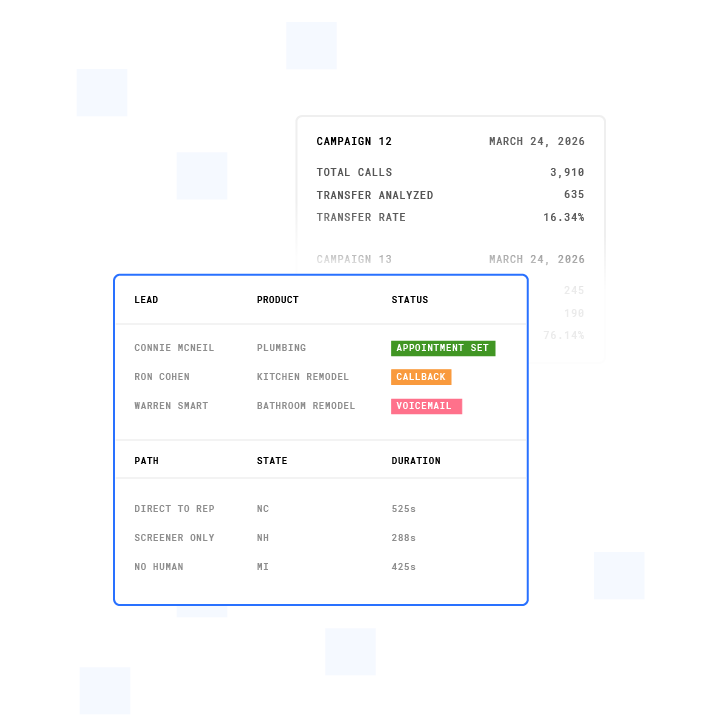
First, carrier-grade detection. Because Plura owns the carrier stack, voicemail detection operates at the origination layer with direct access to carrier signal data. SHAKEN/STIR caller ID verification runs on every outbound call through Plura’s FCC-licensed carrier.1 which affects how destination carriers handle the call and reduces the audio distortion that can degrade AMD accuracy on third-party-routed traffic.
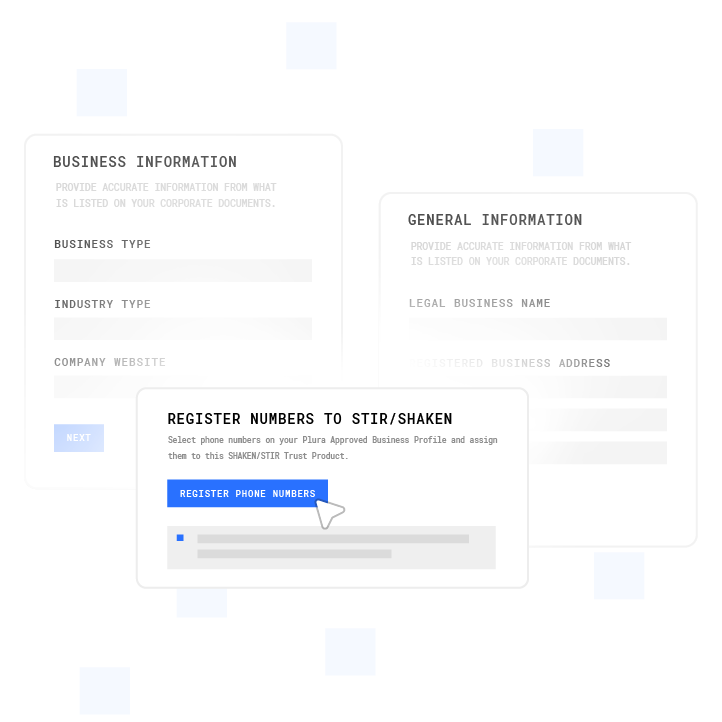
Second, real-time compliance infrastructure. Every outbound contact is checked against federal and state DNC registries before dial. TCPA compliance infrastructure includes timestamped, immutable consent records and automated quiet-hours enforcement through time-zone detection. The compliance dashboard exports audit-ready reports in one click. Plura supports customer compliance; customers remain responsible for their own regulatory obligations.
Third, stateful cross-channel memory. Plura’s Stateful Conversation Database keys every interaction to a customer token across voice, SMS, RCS, and webchat. A contact reached by the AI Predictive Dialer at 10 a.m. carries full context into an AI SMS follow-up at 2 p.m. The dialer’s AMD decision, the call outcome, and any prior negotiation state remain available to the next touchpoint without manual data transfer.
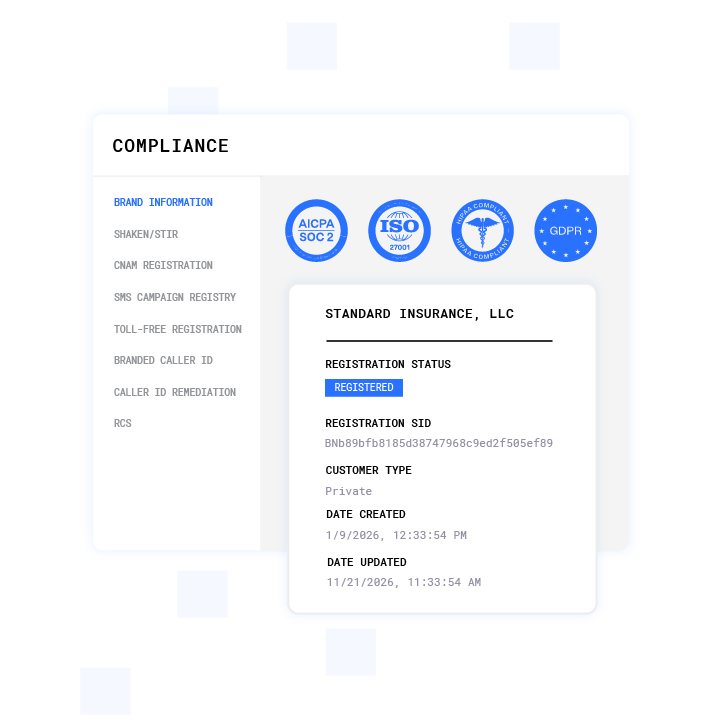
Plura holds SOC 2, HIPAA, and ISO certification, and supports GDPR, TCPA compliance, and DNC compliance across its platform.1 The platform’s compliance posture is documented at plura.ai/products/compliance.
Run your numbers through Plura’s ROI calculator to check your cost savings in real time. Compare plans and rates side by side.
Frequently Asked Questions
How does answering machine detection work?
Answering machine detection (AMD) analyzes the audio signal at the start of a connected call to determine whether a live human or a voicemail system answered. Rule-based systems count sound events above a silence threshold and measure word boundaries using fixed parameters such as maximum number of words and silence duration. Machine-learning systems extract acoustic features including speech cadence, frequency patterns, background noise, and in some implementations semantic content from a short transcript, then classify the call using a trained model.
The classification triggers a routing decision. The system connects the agent or AI voice agent for a live human, or executes a voicemail drop or hang-up for a machine. The accuracy of that classification directly determines abandonment rate and compliance exposure.
What false-positive rate is acceptable for outbound calling under TCPA?
A false positive in AMD means a live human was classified as a voicemail. The system either hangs up or plays a pre-recorded message without agent transfer. Both outcomes can count as abandoned calls under FTC TSR rules, which cap abandonment at 3% of answered calls per campaign per 30-day period.
Many high-volume operations target 1–2% abandonment to maintain a safety margin. To stay under 3% abandonment with normal pacing variance, a false-positive rate below 1% is the practical production target. Operations with higher false-positive rates can lose large numbers of live connections per day to misclassification. Operators should consult qualified legal counsel regarding their specific TCPA and TSR obligations.
What is the difference between F1 score, false-positive rate, and accuracy in AMD benchmarks?
Overall accuracy measures the percentage of all calls classified correctly, both live and voicemail. F1 score is the harmonic mean of precision and recall for a given class, which balances the cost of false positives and false negatives. Macro F1 averages F1 equally across classes, while Micro F1 weights by class frequency and functions as overall accuracy.
False-positive rate measures how often live humans are classified as voicemails, expressed as a percentage of total live calls. False-negative rate measures how often voicemails are classified as live, expressed as a percentage of total voicemail calls. For TCPA-sensitive outbound operations, false-positive rate is the most operationally critical metric because it directly influences abandoned-call counts and per-violation exposure.
Why does AMD accuracy vary by carrier?
Carrier-specific voicemail implementations differ in greeting length, beep characteristics, ringback tones, and audio compression. A rule-based AMD system tuned on AT&T landline traffic may misclassify Google Voice or T-Mobile mobile voicemails at significantly higher rates. Published data shows carrier-specific false-positive rates for tuned traditional AMD ranging from 3.4% on AT&T landlines to 11.3% on Google Voice within the same deployment.
Cell-phone campaigns carry the highest false-positive risk because carrier-specific voicemail implementations, network delays, and audio compression from major carriers can degrade AMD accuracy to 70–80% on mobile traffic under some configurations. Machine-learning systems trained on diverse carrier datasets reduce this variance but do not eliminate it.
What are the latency tradeoffs between rule-based and ML-based AMD?
Rule-based AMD in tuned VICIdial configurations can complete classification quickly. AI-based AMD systems using neural networks on acoustic features have varying detection latency in production deployments. The fastest published production-validated latency in the benchmark dataset is 46 ms end-to-end for a temporal speech activity feature model running on a commodity dual-core CPU with no GPU.
LLM-based systems such as LiveKit’s default configuration report 840 ms median time to detection. The operational tradeoff is accuracy versus dead-air duration. Longer detection windows improve accuracy but increase the silence a live caller hears before connection, which can reduce conversation rates.
How should operators benchmark their own AMD traffic?
The published benchmarks in this report reflect specific datasets and carrier mixes that may not match your traffic. Operators should build a ground-truth dataset by manually labeling at least 200–500 calls per carrier prefix, recording the actual outcome independently of the AMD system’s classification. Teams should calculate false-positive and false-negative rates per carrier, identify outlier carriers, and A/B test AMD settings monthly against a fresh 100-call sample.
Teams should also log classification features for every call in the sample including greeting length, beep detection result, VAD speech start time, and AMD output. Leaders should avoid tuning based on fewer than 500 calls per parameter set to reduce misleading results from statistical noise. When AMD returns uncertain results, defaulting to connecting the agent rather than hanging up reduces abandoned-call risk.
How does Plura AI’s AI Predictive Dialer support TCPA compliance?
Plura’s AI Predictive Dialer includes real-time DNC scrubbing that checks every outbound contact against federal and state DNC registries before dial. TCPA compliance infrastructure includes timestamped and immutable consent records, automated quiet-hours enforcement through time-zone detection, and a compliance dashboard that exports audit-ready reports in one click.
SHAKEN/STIR caller ID verification runs on every outbound call through Plura’s FCC-licensed carrier.1 Plura supports customer compliance; customers remain responsible for their own TCPA obligations and should consult qualified legal counsel regarding their specific regulatory requirements. Plura’s compliance posture is documented at plura.ai/products/compliance.
Conclusion for Contact Center and CX Leaders
The 2026 voicemail detection accuracy benchmarks show a clear and measurable gap between legacy rule-based AMD and modern machine-learning systems. Default rule-based configurations can produce false-positive rates of 15–25%, with some systems exceeding 30% as documented earlier. Machine-learning systems validated in production can reach low false-positive rates and high overall accuracy. For high-volume outbound operators, that gap translates directly into abandoned-call counts, TCPA exposure, and lost live connections at scale.
The practical production targets for compliant operations are specific. Teams should aim for overall accuracy at or above 95%, false-positive rate below 1%, false-negative rate below 2%, median detection latency at or below 2 seconds, and campaign abandonment below 3%. Meeting those targets requires carrier-grade AMD paired with real-time compliance infrastructure, not a rule-based system bolted onto a third-party CPaaS.
Compare plans and rates side by side to see how Plura’s platform maps to your volume and compliance requirements.
Book a live demo with Plura to walk through how the AI Predictive Dialer’s voicemail detection, DNC compliance, and SHAKEN/STIR caller ID verification work together in a production outbound environment.
1 Plura AI maintains SOC 2, HIPAA, ISO, and GDPR posture as part of its platform infrastructure. References to compliance frameworks in this article describe Plura’s platform capabilities and do not constitute a guarantee that any customer using Plura will themselves be compliant with applicable laws or standards. Customers remain solely responsible for their own regulatory obligations, certifications, consent management, recordkeeping, and the claims they make to their own end users. Consult qualified legal counsel for guidance specific to your use case.
2 This article describes regulatory frameworks at a general level and does not constitute legal advice. Laws and regulations vary by jurisdiction, change over time, and apply differently depending on facts and circumstances. Readers should consult qualified legal counsel before making compliance decisions.
3 Performance figures, customer outcomes, and industry statistics referenced in this article are drawn from cited third-party sources or Plura customer case studies. Individual results vary based on implementation, use case, industry, audience, and execution. Past or aggregate performance is not a guarantee of future results.
4 References to third-party products, services, companies, or research are made for informational and comparative purposes only. Plura AI is not affiliated with, endorsed by, or sponsored by any third party named in this article unless explicitly stated. Trademarks and product names referenced remain the property of their respective owners.
This article is provided for informational purposes only and reflects Plura AI’s understanding at the time of publication. Product capabilities, integrations, and specifications are subject to change. For the most current information, visit plura.ai.
This article was produced with the assistance of AI tools and reviewed by Plura AI prior to publication.