
Written by: Matt Beucler, CEO, Plura AI
Key Takeaways for Outbound Teams
- iOS 26 Call Screening intercepts unknown calls before they ring, plays a prompt for the caller, and shows a live transcript to the recipient.
- High-volume outbound teams can see up to a 45% drop in first-dial connect rates when recipients enable the feature.3
- Branded caller ID and clear AI responses during the screening window significantly increase the likelihood of a live answer.
- Plura AI’s FCC-licensed carrier issues branded caller ID and deploys AI voice agents that respond to the iOS screening prompt with company name and reason for calling.
- Teams can improve connect rates and reduce missed opportunities by using Plura AI’s AI voice agents that pass screening in a natural, human-sounding way.
How iOS 26 Call Screening Works
iOS 26, released September 2025, introduced an opt-in Call Screening feature that intercepts calls from numbers not saved in the recipient’s address book. When Call Screening activates, the iPhone answers the call before it rings and presents a screening prompt to the caller. The recipient’s phone does not ring until after the caller has responded and the recipient has reviewed the live transcript.
The feature is opt-in and disabled by default. iOS 26 Call Screening is not spam protection and does not block or evaluate calls for spam, it only provides the recipient with caller identity information before answering. For high-volume outbound teams, even a small share of the iOS user base enabling this feature creates a measurable drag on connect rates. iOS holds roughly 60% of U.S. mobile OS market share, which amplifies the reach of any screening feature Apple ships.
Steps iPhone Users Take to Turn On Screen Unknown Callers
Users enable iOS 26 Call Screening through the following steps:
- Open the Settings app on the iPhone.
- Tap Apps, then tap Phone.
- Scroll to Screen Unknown Callers and tap it.
- Select Ask Reason for Calling to enable the full screening prompt, Silence to suppress the ring without prompting the caller, or Never to disable screening entirely.
- Confirm the selection. The setting applies immediately to all subsequent calls from numbers not saved in contacts.
Users can also access call filtering settings by opening the Recents tab, tapping the filter icon, and selecting Manage Filtering.
What Callers Experience During Screening
When iOS 26 Call Screening intercepts an outbound call, the caller hears a specific automated prompt. The iOS Call Screener opens with a prompt that asks the caller to record their name and reason for calling.
After the caller responds, the system states: “Thanks. Please stay on the line.” In most cases, the call then rings briefly and routes to voicemail. The caller hears: “I’m sorry. This person is not available. If you would like to leave an additional message, please reply after the tone.”
If the recipient chooses to answer during screening, the call connects directly with no further automated messages played to the caller.
One additional scenario affects outbound teams. If the iOS 26 system classifies the call as spam or a robocall during screening, it automatically hangs up without presenting the transcription to the recipient. For outbound teams using auto-dialers or parallel dialers, this is the worst-case outcome. The call is terminated before any human decision is made.
How the Live Transcript Drives the Answer Decision
During iOS Call Screening there is no two-way interaction, the caller’s message is transcribed and presented to the recipient exactly as spoken. The recipient sees the transcription in real time on their iPhone screen while the caller remains on hold.
The recipient has three options at this stage:
- Answer the call, connecting directly to the caller.
- Decline, which sends the call to voicemail.
- Let it keep screening, allowing more time to review the transcript before deciding.
Even if the caller remains silent or provides no response, the prospect’s phone rings after 30 seconds. A caller who says nothing still has a chance at a live connection, but without a useful transcript, the recipient has little reason to answer.
The quality of what the caller says during those first 30 seconds becomes the key variable that determines whether the call converts to a live conversation or routes to voicemail.
Why Recipients Screen Outbound Calls
The behavioral foundation for call screening predates iOS 26. A July 2020 Pew Research Center survey of 10,211 U.S. adults found that 80% say they do not generally answer their cellphone when an unknown number calls.4 iOS 26 gives that behavior a system-level mechanism.
The data on business impact is emerging. An analysis of 34,145 cold dials found that numbers with call screening enabled connected at 5.9% on the first dial versus 10.6% for non-screened live lines. That result reflects a nearly 45% reduction in first-dial connect rate for screened numbers.3
Recent reports indicate that outbound calls on high-volume platforms are being routed into screening environments, which results in fewer live connections and requires more dials per conversion.
The consumer-side driver is fraud. One consumer survey indicated that 90% of consumers are uncomfortable answering unidentified calls and that 78% of consumers have missed an important call in the last month because they did not answer an unidentified call. Another survey revealed that 92% of consumers assume unidentified calls are fraudulent. iOS 26 Call Screening responds directly to that consumer sentiment.
How Branded Caller ID and AI Voice Agents Improve Screening Outcomes
The transcript is the decision point for the recipient. When a recipient reads “Hi, this is Sarah from Acme Insurance calling about your renewal quote,” they have a reason to answer. When they read a generic hold message or silence, they usually decline.
Two variables determine whether a screened call converts to a live connection. The first is what the caller’s number displays as. The second is what the caller says during the screening window.
Plura AI addresses both variables at the carrier level. Plura is its own FCC-licensed audio bridging carrier, which means branded caller ID is issued directly rather than inherited from a third-party CPaaS (Communications Platform as a Service). This direct issuance means calls present with the company’s name instead of an unfamiliar number string. STIR/SHAKEN (Secure Telephone Identity Revisited/Signature-based Handling of Asserted information using toKENs) caller ID verification runs on every outbound call, and destination carriers use that signal to confirm legitimate origination.
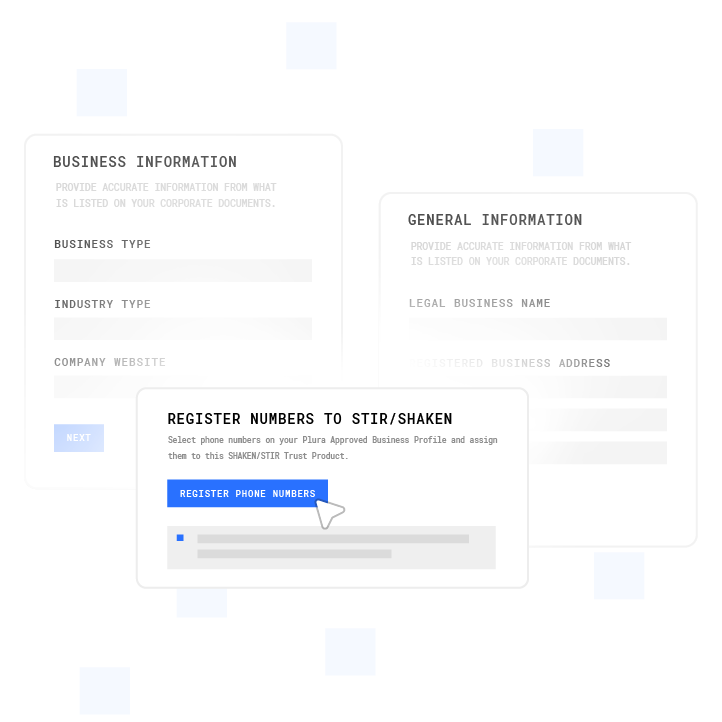
TransUnion states that customers are up to 105% more likely to answer a branded call.3 That lift applies directly to screened calls, because a recipient reading a transcript that includes a recognized company name is more likely to tap Answer.
Plura’s AI voice agents are built to respond to the iOS screening prompt with a clear, structured identification that includes company name, caller name, and reason for the call. The agent communicates with the screening layer instead of staying silent or playing a generic hold message, which is the pattern that often triggers automatic termination.
The stateful conversation database underneath Plura’s platform means the agent already knows the contact’s history before the call begins. If a lead was texted at 9 a.m. and called at noon, the agent references that prior context in the screening response. That context makes the transcript more specific and more likely to prompt a live answer.
Troubleshooting iOS 26 Screening Issues
High-volume outbound teams report several recurring patterns after iOS 26 deployment.
Calls go straight to screening with no ring. This behavior is expected when the recipient has “Ask Reason for Calling” enabled. The call is not dropped, it is intercepted. Because the screening system needs a spoken response to generate a readable transcript, the fix is ensuring the agent or caller delivers a clear identification during the screening window rather than staying silent or playing hold music.
How to tell if someone is screening your calls. The iOS Call Screener plays a prompt asking the caller to record their name and reason for calling. If your dialer or agent hears this prompt, the call is in screening. Screening can be detected by running pattern matching on call transcripts for the iPhone prompt phrase.
What iPhone Call Screening says to the caller. The caller hears the automated prompt described above, followed by “Thanks. Please stay on the line.” after responding. There is no further interaction until the recipient decides.
Parallel dialers failing on screened calls. Parallel dialers cannot respond to iOS 26 AI screening prompts because their Voice Activity Detection algorithms become confused by the AI voice and either drop the call or bridge it without context. An AI voice agent that can interpret and respond to the screening prompt serves as the operational replacement for a parallel dialer on screened numbers.
Spam label triggering automatic termination. If the call is classified as spam during screening, it is terminated before the recipient sees any transcript. This situation reflects a carrier-reputation problem rather than a screening problem. Plura’s STIR/SHAKEN authentication and branded caller ID address this at origination.
Measuring iOS 26 Impact on Connect Rates
The business case for addressing iOS 26 screening is straightforward to model. Start with your current daily dial volume, your first-dial connect rate, and the percentage of your contact list on iOS devices.
A significant portion of U.S. mobile users rely on call screening tools. Even at the current opt-in adoption rate for iOS 26 specifically, the directional impact on first-dial connect rates is measurable.
The comparison below shows the difference between a screened call and a branded-caller-ID call across four operational dimensions.
| Dimension | Screened Call (Unknown Number) | Branded Caller ID Call (Plura) | Source |
|---|---|---|---|
| First-dial connect rate | 5.9% | 10.6% (baseline from earlier analysis) | 34,145-dial analysis |
| Likelihood recipient answers vs. unknown number | Baseline | +105% (TransUnion data referenced earlier) | TransUnion, via FCC filing |
| Caller ID presentation | Unknown number or “Spam Likely” | Company name via FCC-licensed carrier | Plura branded caller ID |
| Screening prompt response | Silent, generic, or auto-terminated | Structured name + reason via AI voice agent | Plura AI voice agent |
For a team running 1,000 dials per day, the difference between a 5.9% and a 10.6% connect rate is 47 additional live conversations daily.3 At standard conversion rates, that gap compounds into pipeline within weeks. Check your ROI in real time using Plura’s calculator.
Frequently Asked Questions
What does iPhone Call Screening say to the caller?
When iOS 26 Call Screening intercepts a call, the caller hears an automated prompt asking them to record their name and reason for calling. After the caller responds, the system says: “Thanks. Please stay on the line.” If the recipient does not answer, the call routes to voicemail and the caller hears: “I’m sorry. This person is not available. If you would like to leave an additional message, please reply after the tone.” If the recipient answers during screening, the call connects directly with no further automated messages.
How do I know if someone is screening my calls?
The clearest indicator is hearing the iOS screening prompt asking the caller to record their name and reason for calling. If your dialer or agent records this phrase in the call transcript, the number is iOS-screened. High-volume teams can detect screened calls programmatically by running pattern matching on call transcripts for the prompt phrase. A call that connects briefly and then routes to voicemail without ringing normally is also a common pattern for screened calls where the caller did not respond to the prompt.
Does iOS 26 Call Screening block spam calls?
iOS 26 Call Screening is not a spam filter. It does not evaluate calls for spam before intercepting them. Its function is to collect caller identity information and present it to the recipient before the phone rings. However, if the system classifies a call as spam or a robocall during the screening process itself, it can automatically terminate the call before the recipient sees any transcript. This automatic termination is the scenario most damaging to high-volume outbound teams, and it is triggered by caller behavior during the screening window, not by the screening feature’s initial interception.
What happens if the caller says nothing during iOS Call Screening?
If the caller does not respond to the screening prompt, the recipient’s phone still rings after approximately 30 seconds. The recipient sees no transcript or caller identification, which means they have no information on which to base a decision to answer. In practice, a blank transcript produces the same outcome as a declined call for most recipients. For outbound teams, this means silence during the screening window is functionally equivalent to a missed call. An AI voice agent that responds to the prompt with a clear name and reason for calling is the operational fix for this scenario.
How does Plura AI help outbound teams pass iOS 26 Call Screening?
Plura AI addresses iOS 26 Call Screening at two layers. First, Plura issues branded caller ID directly through its FCC-licensed carrier, so calls present with the company’s name rather than an unknown number string. STIR/SHAKEN caller ID verification runs on every outbound call, which reduces the likelihood of automatic spam termination during screening. Second, Plura’s AI voice agents are built to respond to the iOS screening prompt with a structured identification that includes company name, caller name, and reason for the call. The agent communicates with the screening layer instead of going silent, which produces a readable transcript for the recipient and increases the probability of a live answer. Plura’s stateful conversation database means the agent can reference prior contact history in the screening response, which makes the transcript more specific and more compelling. Teams can model the connect-rate impact of these changes using Plura’s ROI calculator at plura.ai/calculator. Plura supports compliance with TCPA, DNC, SHAKEN/STIR caller ID verification, SOC 2, HIPAA, ISO certification, and GDPR frameworks, and customers remain responsible for their own regulatory obligations.1
Check your ROI in real time with Plura’s calculator.
1 Plura AI maintains SOC 2, HIPAA, ISO, and GDPR posture as part of its platform infrastructure. References to compliance frameworks in this article describe Plura’s platform capabilities and do not constitute a guarantee that any customer using Plura will themselves be compliant with applicable laws or standards. Customers remain solely responsible for their own regulatory obligations, certifications, consent management, recordkeeping, and the claims they make to their own end users. Consult qualified legal counsel for guidance specific to your use case.
2 This article describes regulatory frameworks at a general level and does not constitute legal advice. Laws and regulations vary by jurisdiction, change over time, and apply differently depending on facts and circumstances. Readers should consult qualified legal counsel before making compliance decisions.
3 Performance figures, customer outcomes, and industry statistics referenced in this article are drawn from cited third-party sources or Plura customer case studies. Individual results vary based on implementation, use case, industry, audience, and execution. Past or aggregate performance is not a guarantee of future results.
4 References to third-party products, services, companies, or research are made for informational and comparative purposes only. Plura AI is not affiliated with, endorsed by, or sponsored by any third party named in this article unless explicitly stated. Trademarks and product names referenced remain the property of their respective owners.
This article is provided for informational purposes only and reflects Plura AI’s understanding at the time of publication. Product capabilities, integrations, and specifications are subject to change. For the most current information, visit plura.ai.
This article was produced with the assistance of AI tools and reviewed by Plura AI prior to publication.