
Written by: Matt Beucler, CEO, Plura AI
Key Takeaways
AI voice agents are reshaping how high-volume teams handle appointment scheduling and inbound leads. Before you compare platforms, anchor on these points.
- AI voice agents handle the full appointment scheduling workflow, answering calls, checking availability, booking slots, and sending confirmations 24/7 without human intervention.
- Businesses can cut receptionist costs by 75–95% while reducing missed calls and achieving up to a 50% reduction in no-shows through automated reminders.3
- Responding to leads within 60 seconds can boost conversion rates by up to 391%, and AI agents deliver that speed-to-lead across voice, SMS, RCS, and webchat.3
- Pricing typically ranges from $0.12–$0.45 per conversation minute, and hidden fees often add 20–30% to the total. Plura AI starts at $7,500 per month after a $2,750 build fee.
- Plura AI provides carrier-grade infrastructure, compliance support for TCPA, DNC, and HIPAA, and stateful conversations across every channel.1
See Plura in a live demo and watch the full scheduling workflow end to end.
How AI Voice Agents Handle Appointment Scheduling
An AI voice agent for appointment scheduling is a conversational AI system that manages the complete booking process over the phone. It replaces rigid IVR menus with natural, human-like conversations driven by speech recognition and natural language understanding.
The core workflow covers four layers:
- Voice processing: Speech-to-text (STT) converts what callers say into text, NLP interprets intent, and text-to-speech (TTS) responds in a natural voice.
- Calendar integration: The agent connects directly to your calendar system, including Google Calendar, Calendly, or Cal.com, to check real-time availability and book appointments without double-booking.
- Workflow automation: Agents gather caller details, send SMS or email confirmations, and notify staff through tools like Slack.
- CRM integration: Advanced agents sync appointment data directly to your CRM so your team has full context before the appointment.
Modern AI voice agents handle inbound and outbound calls, including proactive appointment reminders and follow-ups. They run 24/7 and scale instantly to handle peak call volumes without adding headcount.
Key Benefits of AI Voice Agents for Scheduling
24/7 Coverage With Lower Staffing Costs
Missed calls quietly drain revenue across locations. AI voice agents answer 100% of inbound calls within two rings at any hour, so callers reach a live experience instead of voicemail.
That 24/7 coverage comes at a fraction of traditional staffing costs. A full-time in-house receptionist costs $40,000 to $60,000 annually including benefits. An AI voice agent typically costs $2,400 to $9,600 per year, which delivers continuous coverage at 75 to 95% lower cost than human alternatives.
For larger operations, the savings compound. Domestic contact center agents cost $15 to $25 per hour before benefits and overhead, and a 50-seat equivalent contact center often runs $35,000 to $50,000 monthly. AI contact centers typically land between $8,000 and $15,000 monthly. AI agents also carry a 0% turnover rate compared to 30 to 45% annually for traditional operations.
No-Show Reduction Across Locations
No-shows create one of the most expensive leaks in appointment-based businesses. The average no-show rate across service businesses is approximately 23%, with some healthcare specialties reaching 39%. Each missed appointment costs a medical practice roughly $200 in lost revenue, adding up to $150 billion annually across the U.S. healthcare system.
A peer-reviewed study of 135,393 healthcare appointments reported a 50.7% relative reduction in no-shows after AI-driven reminder calls were introduced, with missed appointments falling from 20.82% to 10.25%. Plura customers see up to 40% improvement in no-show rates through AI-powered reminders and confirmations.
Speed-to-Lead That Lifts Conversion
Speed-to-lead directly shapes conversion rates for inbound calls and form fills. The industry standard for first contact on an inbound lead is 47+ hours. Harvard Business Review research found that companies responding within five minutes are 100 times more likely to connect with a prospect than those waiting 30 minutes. Lead conversion rates drop 10x after the first 5 minutes, and leads contacted within 1 minute are 391% more likely to convert than those contacted after 24 hours.
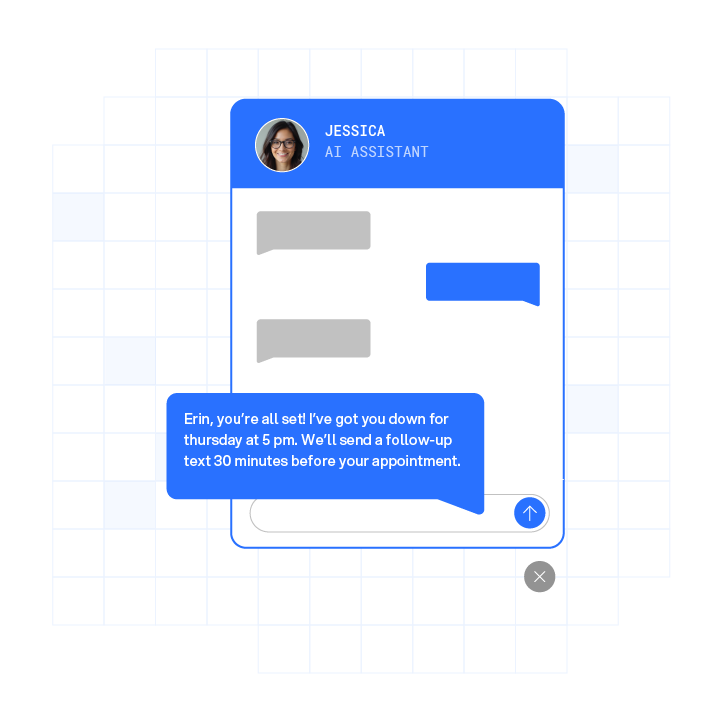
Plura enables lead responses in under 60 seconds across voice, SMS, RCS (Rich Communication Services), and webchat, automatically, on every channel, in parallel.
See sub-60-second lead response in action with a live Plura walkthrough.
How Much Does an AI Voice Agent Cost?
AI voice agent pricing varies by provider, deployment model, and call volume. Most platforms unbundle pricing into several components, so the headline rate rarely reflects the full stack.
The per-minute infrastructure cost of an AI voice agent typically breaks down as follows, per a 2026 analysis of 50+ U.S. AI voice agent providers. The key takeaway is that each layer adds incremental cost, so budgeting by component produces more accurate forecasts.
- Telephony (Twilio, Vonage): approximately $0.014 per minute
- Speech-to-text (Deepgram, Whisper): $0.015 to $0.02 per minute
- Large language model (GPT-4o, Claude, Gemini): $0.03 to $0.08 per minute
- Text-to-speech (ElevenLabs, PlayHT, OpenAI): $0.02 to $0.10 per minute
All-in costs for AI voice agents range from $0.12 to $0.45 per conversation minute once telephony, STT, LLM, TTS, and platform overhead are included. A typical 3-minute appointment scheduling call costs $0.36 to $1.35 in variable costs depending on the platform and configuration.
Monthly spend for most deployments lands in these ranges, per CETRAI’s 2026 pricing analysis. These bands help leaders benchmark proposals against similar use cases.
- Small business after-hours answering: $100 to $300 per month
- Mid-market teams replacing a receptionist: $500 to $1,500 per month
- High-volume contact centers: $3,000 to $15,000+ per month
Hidden Costs to Watch For
Most AI voice agent providers do not highlight several costs that can add up quickly. These include per-minute overage charges ($0.10 to $0.20 per minute), SMS confirmation fees ($0.01 to $0.04 per text), CRM integration setup fees ($300 to $1,500 one-time), phone number rental ($1 to $5 per month), premium voice upgrades ($50 to $200 per month), call recording storage ($50 per month or more), and API call limits that throttle the LLM.
Because these variables shift with usage and configuration, budget 20 to 30% on top of any quoted price to cover them.
Top AI Voice Agent Platforms for Appointment Scheduling
The AI voice agent market has matured quickly, and platforms now differ meaningfully in architecture, compliance posture, and ease of deployment. The summaries below draw on published documentation and independent evaluations.
Retell AI
Retell AI is a developer-friendly platform known for low latency and natural conversation flow.4 It supports inbound and outbound calling, integrates with CRMs and calendars via webhooks and APIs, and offers a visual flow builder for simpler use cases.
Retell AI’s pricing is modular and pay-as-you-go, with voice infrastructure at $0.055 per minute, standard TTS at $0.015 per minute, and LLM costs ranging from $0.003 per minute to $0.345 per minute depending on model. A realistic production agent costs $0.11 to $0.15 per minute all-in. Monthly fixed costs include $2 per phone number and $8 per concurrent call slot beyond 20 free.
Retell AI fits developers and integrators who are comfortable with APIs and webhooks. Complex production flows require engineering support, and component pricing complexity makes total cost hard to forecast until production configuration is locked.
Synthflow
Synthflow is a no-code AI voice agent builder that raised a $20M Series A in June 2025 and reportedly powers 65M+ voice calls monthly across 30+ countries.4 It targets non-technical teams that want to configure flows without code.
Vapi
Vapi is a Y Combinator-backed, developer-first platform that gives builders granular control over the voice stack.4 It supports multi-agent squads, outbound campaigns, persistent sessions, and structured outputs, with SDKs in TypeScript, Python, C#, Ruby, and PHP.
Vapi’s real all-in blended cost is approximately $0.14 to $0.33 per minute, compared to its advertised rate of approximately $0.05 per minute, because STT, LLM, TTS, and telephony are billed separately. Vapi requires significant technical expertise and does not provide managed onboarding for non-developers.
Plura AI
Plura AI differentiates itself through infrastructure ownership and compliance depth. Plura is an FCC-licensed carrier that owns its carrier stack, unlike providers that rent from a third-party CPaaS (Communications Platform as a Service) like Twilio. This architecture produces three concrete advantages.
- Branded caller ID issued at the carrier level, which reduces “Spam Likely” labels and improves answer rates.
- Stateful conversation memory across voice, SMS, RCS, and AI webchat, so a customer who texted at 9 AM is the same customer when the call comes at noon.
- Compliance support for TCPA, DNC, HIPAA, SOC 2, and 50+ state rule sets, with checks enforced before every contact.
Plura’s deployment typically takes 2 to 4 weeks from contract to live AI conversations, with no-code templates and concierge onboarding. Pricing starts at $2,750 per agent build fee with plans starting at $7,500 per month. Every annual contract includes a 90-day opt-out window.
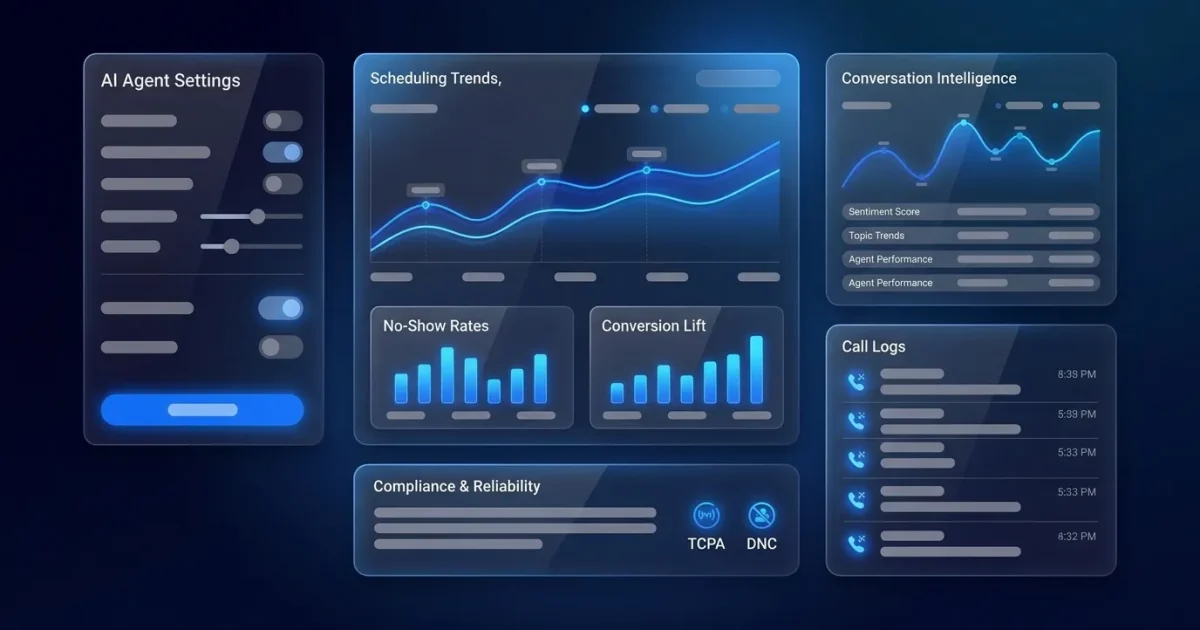
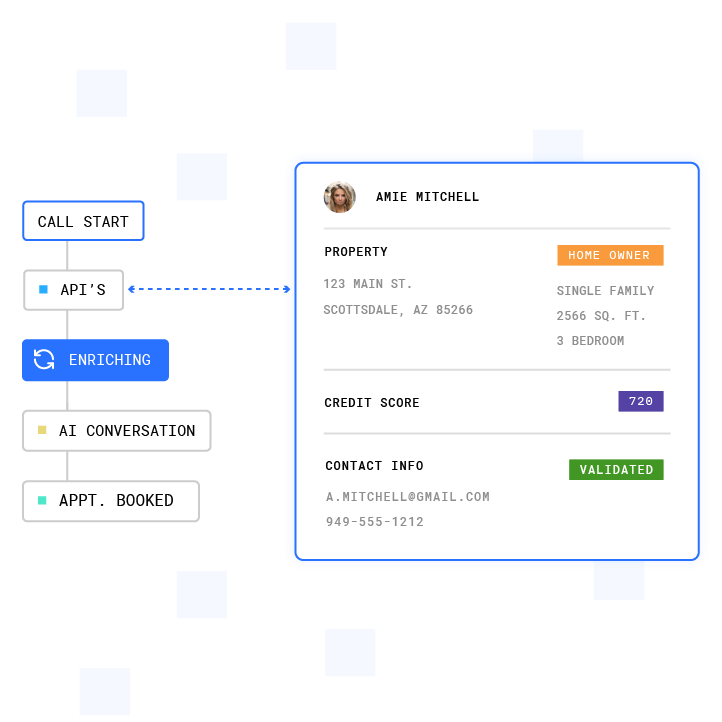
Plura’s AI Lead Intelligence enriches leads with 30+ data sources in real time, and its conversation intelligence layer surfaces patterns across every call, text, and chat. The platform integrates with 50+ tools including HubSpot, Salesforce, Zoho, Google Calendar, Calendly, and Cal.com. See the full integrations directory.
Walk through the full Plura platform in a 30-minute live session.
How to Set Up an AI Voice Agent for Appointment Scheduling
Once you select a platform, implementation follows a consistent sequence that keeps risk low and time-to-value short.
- Choose a platform. For high-volume operators, Plura often fits best because of its carrier-grade infrastructure, compliance support, and stateful conversation memory. For smaller operations or technical teams, Retell AI or Vapi may cover the core needs.
- Connect your calendar. Integrate Google Calendar, Calendly, Cal.com, or your practice management system. This integration enables real-time availability checking and booking.
- Design your conversation flow. Map the complete caller journey. Include greeting, purpose identification, availability check, booking confirmation, and next steps. Add fallback paths for complex requests that need human escalation.
- Integrate with your CRM. Connect your CRM so every interaction is logged with full context. Plura integrates with 50+ tools across 10+ categories.
- Test thoroughly. Run test calls across different accents, background noise levels, and edge cases. Leading ASR systems achieve 95%+ accuracy on standard American English in clean audio, but drop to 80 to 88% on accented speech and 70 to 85% in high-noise environments. Test interruptions, mid-call intent changes, and escalation paths before going live.
- Launch and monitor. Go live with a pilot group, then monitor call containment rate, booking completion rate, no-show rate, and customer satisfaction. Iterate on conversation design based on real call data.
Compliance and Reliability for AI Voice Scheduling
Compliance and reliability sit at the center of any AI voice deployment that touches customers. The regulatory landscape spans federal and state frameworks, and operators should consult qualified counsel before launching outbound AI voice campaigns.
TCPA and AI Voice
The FCC’s February 2024 Declaratory Ruling classified AI-generated voices as “artificial or prerecorded voice” under the Telephone Consumer Protection Act (TCPA), which places them within the same consent framework as robocalls.2 TCPA violations carry penalties of $500 per violation for standard infractions and $1,500 per violation for willful or knowing violations, with each individual call counting as a separate violation.
DNC Compliance
Outbound telemarketing lists must be scrubbed against the federal DNC Registry within 31 days of dialing.2 In addition to the federal DNC Registry, businesses maintain an internal DNC suppression list of anyone who has asked to stop calling, and those requests persist indefinitely. Many states maintain their own DNC lists that also require suppression.
What to Look For in a Platform
- Real-time DNC scrubbing against federal and state registries before every call
- Consent management with timestamped, immutable records
- Quiet hours enforcement based on the recipient’s time zone
- STIR/SHAKEN (Secure Telephone Identity Revisited/Signature-based Handling of Asserted information using toKENs) authentication for caller ID verification
- Audit trails with call logging and consent records retained for at least 4 years
- HIPAA compliance support for healthcare deployments, including BAA (Business Associate Agreement) and encryption
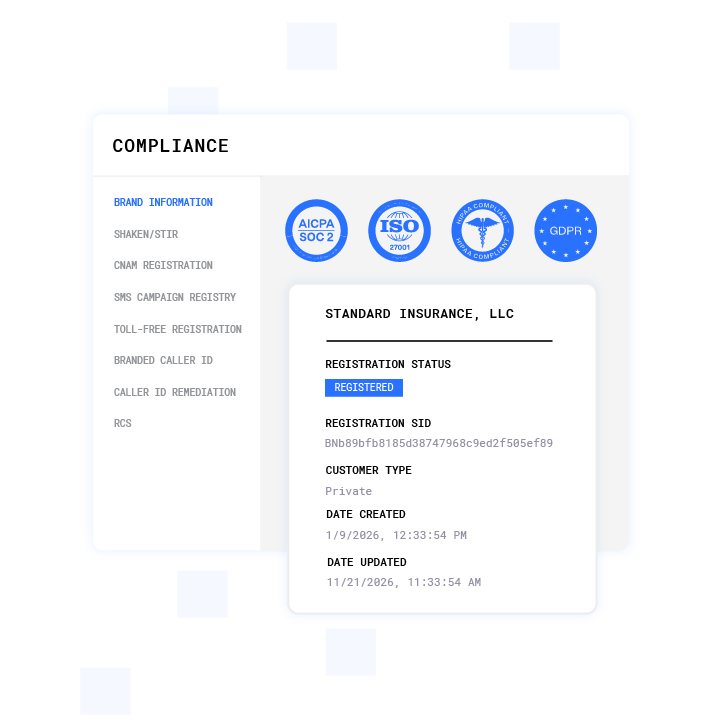
Plura’s compliance engine includes pre-loaded TCPA, DNC, HIPAA, SOC 2, and 50+ state rule sets.1 As an FCC-licensed carrier, Plura supports compliance at the carrier level before the call leaves the network. Plura provides a 99.9% uptime SLA with automatic failover and no single point of failure.
Best Practices for High Conversion
- Respond within 60 seconds. Earlier research shows that sub-60-second response times dramatically increase connection and conversion rates. Plura delivers responses in under 60 seconds across all channels.
- Use branded caller ID. Calls flagged as “Spam Likely” get answered at rates below 15%. Plura issues branded caller ID directly through its FCC-licensed carrier, which improves pickup rates at the carrier level.
- Personalize conversations with lead data. Plura’s pre-conversation lead enrichment can increase conversion rates by 30% or more.
- Follow up via SMS. Plura’s AI SMS agents hold real text conversations, qualify leads, and can live-transfer warm buyers to your reps.
- Track the right metrics. Measure call containment rate, booking completion rate, no-show rate, and cost per booked appointment. Use conversation intelligence to identify script improvements and objection patterns.
See how Plura handles scheduling, compliance, and follow-up in a single stack.
Run your numbers through Plura’s ROI calculator to check cost savings in real time. Compare plans and rates on the pricing page.
Frequently Asked Questions
Can I use AI for appointment scheduling?
AI voice agents can handle the complete appointment booking workflow, including answering calls, checking availability, booking appointments, and sending confirmations, 24/7 without human intervention. Modern platforms like Plura integrate directly with calendar systems such as Google Calendar, Calendly, and Cal.com, as well as CRM systems including HubSpot, Salesforce, and Zoho. The agent greets the caller, identifies the purpose of the call, checks real-time availability, books the slot, and sends a confirmation via SMS or email within a single phone call.
How much does an AI voice agent for appointment scheduling cost?
All-in costs range from $0.12 to $0.45 per conversation minute depending on the platform and configuration. Most small businesses pay $200 to $800 per month, and mid-market operations typically spend $500 to $2,500 per month. Enterprise deployments with dedicated support, SSO, and custom integrations typically start at $3,500 per month. Plura charges a $2,750 per-agent build fee with plans starting at $7,500 per month, which includes the full platform across voice, SMS, RCS, and webchat. Budget 20 to 30% on top of any quoted price to account for hidden costs such as per-minute overages, SMS fees, phone number rental, and premium voice upgrades.
How do AI voice agents reduce no-shows?
AI voice agents reduce no-shows through automated reminders, easy rescheduling, and confirmation tracking. A peer-reviewed study of 135,393 healthcare appointments found a 50.7% relative reduction in no-shows after AI-driven reminder calls were introduced, with missed appointments falling from 20.82% to 10.25%. Optimal reminder timing varies by appointment type: high-value medical visits often use a 7-day, 48-hour, and day-of cadence, while routine visits typically use a 72-hour and 24-hour sequence. Plura customers see up to 40% improvement in no-show rates through AI-powered reminders and confirmations.
What compliance requirements apply to AI voice agents for appointment scheduling?
Several federal and state frameworks apply to outbound AI voice calls in the United States. The FCC’s February 2024 Declaratory Ruling classified AI-generated voices as “artificial or prerecorded voice” under the TCPA, which places them within consent requirements. Outbound lists are typically scrubbed against the National Do Not Call Registry before dialing, and businesses maintain an internal DNC suppression list. Calling hours align with the recipient’s local time zone under federal rules, and many states apply stricter windows. Healthcare deployments involve additional considerations under HIPAA, including encryption and BAA requirements. Operators should consult qualified counsel before launching outbound AI voice campaigns, as the regulatory landscape continues to evolve.
What are the most common technical failure modes for AI voice agents?
The most common production failure modes include ASR (automatic speech recognition) accuracy degradation in noisy environments or with non-standard accents, integration fragility when CRM or calendar APIs are slow or return errors, latency spikes that break the conversational turn-taking rhythm, and context loss during human handoffs. Humans expect a conversational turn in under 800ms, and past 1.5 seconds callers often assume something broke. Effective practices include testing with your actual caller population’s accent and audio profile, defining escalation ownership and boundaries before launch, stress-testing integrations under realistic concurrent load, and tracking hallucination rate and escalation rate as primary metrics alongside call containment rate. Passing full conversation context, including intent, caller identity, and what the AI attempted, during any human handoff is critical to preventing the most common escalation failure.
1 Plura AI maintains SOC 2, HIPAA, ISO, and GDPR posture as part of its platform infrastructure. References to compliance frameworks in this article describe Plura’s platform capabilities and do not constitute a guarantee that any customer using Plura will themselves be compliant with applicable laws or standards. Customers remain solely responsible for their own regulatory obligations, certifications, consent management, recordkeeping, and the claims they make to their own end users. Consult qualified legal counsel for guidance specific to your use case.
2 This article describes regulatory frameworks at a general level and does not constitute legal advice. Laws and regulations vary by jurisdiction, change over time, and apply differently depending on facts and circumstances. Readers should consult qualified legal counsel before making compliance decisions.
3 Performance figures, customer outcomes, and industry statistics referenced in this article are drawn from cited third-party sources or Plura customer case studies. Individual results vary based on implementation, use case, industry, audience, and execution. Past or aggregate performance is not a guarantee of future results.
4 References to third-party products, services, companies, or research are made for informational and comparative purposes only. Plura AI is not affiliated with, endorsed by, or sponsored by any third party named in this article unless explicitly stated. Trademarks and product names referenced remain the property of their respective owners.
This article is provided for informational purposes only and reflects Plura AI’s understanding at the time of publication. Product capabilities, integrations, and specifications are subject to change. For the most current information, visit plura.ai.
This article was produced with the assistance of AI tools and reviewed by Plura AI prior to publication.