
Written by: Matt Beucler, CEO, Plura AI
Updated September 2026
Key Takeaways
- A multi-tenant dialer platform lets agencies and BPOs manage multiple clients from one interface while keeping each tenant’s data, branding, and compliance rules fully isolated.
- Three isolation models (row-level, schema-level, and database-level) determine how strongly tenant data is separated. Stronger isolation improves compliance posture but raises infrastructure cost.
- Key features to evaluate include white-labeling depth, multiple dialing modes, per-tenant TCPA/DNC enforcement, CRM integrations, real-time analytics, and AI across voice, SMS, RCS, and webchat.
- Buying a purpose-built platform usually beats building in-house. Carrier licensing, STIR/SHAKEN, and ongoing compliance work take years and significant capital for most operators.
- Agencies and BPOs ready to scale client campaigns without adding headcount can see Plura AI in a live demo and review how its FCC-licensed, multi-tenant AI dialer supports carrier-grade controls and AI outreach from a single stateful system.
Multi-Tenant Architecture Explained: How Tenant Isolation Works
A multi-tenant dialer runs a single codebase that serves many tenants simultaneously. The critical architectural decision is how data is separated. Three models are common in production deployments:
- Shared database with row-level isolation. All tenants share one database, and every record is tagged with a tenant identifier. This model is simpler to operate but requires rigorous query-level enforcement to prevent data bleed.
- Separate schemas per tenant. Each tenant gets its own schema within a shared database engine. This model provides stronger logical separation and easier per-client backups, with more complexity at scale.
- Separate databases per tenant. This model provides the strongest isolation. Each tenant’s data lives in an independent database. Infrastructure cost is higher, and the compliance posture is cleanest for regulated industries.
Multi-tenant architecture differs from multi-instance architecture. Multi-instance deployments run a separate copy of the entire application for each client. That approach removes shared infrastructure but multiplies maintenance work for every new client. Multi-tenant keeps one codebase running and enforces isolation at the data and configuration layer instead of at the deployment layer.
A well-built multi-tenant dialer also simplifies provisioning. The platform exposes an API so operators can spin up new tenants programmatically, assign dialing modes, configure compliance rules, and set branding without touching the underlying codebase. New clients go live in hours instead of weeks.
Telephony buyers often compare PBX systems and dialers. A PBX (Private Branch Exchange) routes internal calls within an organization. A dialer manages outbound campaigns at volume, with predictive pacing, DNC scrubbing, and agent handoff logic. Agencies running client campaigns rely on the dialer layer.
Key Features to Look for in a Multi-Tenant Dialer Platform
Eight capabilities separate platforms built for multi-tenant operations from those retrofitted for it:
- Tenant isolation and data security. Each client’s call records, contact lists, and consent logs stay logically or physically separated. Any data bleed between clients creates a compliance risk and a client-retention problem.
- White-labeling and custom branding. Agencies that resell the platform need custom domains, logos, and sender identities. The platform should support this at the tenant level without engineering work for each new client.
- Multiple dialing modes. Predictive, power, preview, and progressive dialing serve different campaign types. A platform that supports only one mode forces operators to compromise on performance. For example, Plura’s AI Predictive Dialer supports all four modes with list management, dynamic pacing, timezone logic, and answer rate controls that adjust to each campaign.
- Compliance management at the tenant level. TCPA, DNC, and 10DLC (10-Digit Long Code, the A2P messaging registration framework) rules need enforcement per client. A single misconfigured campaign on a shared compliance layer can affect the entire platform operator.
- API access and integrations. Agencies run HubSpot, Salesforce, Zoho, and many other CRMs. The platform should connect to those systems through webhooks and native integrations so lead data flows without manual exports.
- Real-time reporting and analytics per tenant. Each client needs its own dashboard for contact rates, conversion metrics, and compliance status. Operators also need a consolidated view across all tenants in one place.
- Scalability and reliability. Adding a new tenant should take an API call instead of an infrastructure project. Uptime SLAs matter. Plura operates at a 99.9% uptime SLA with automatic failover.1
- AI capabilities. AI SMS for lead qualification, AI voice agents for inbound and outbound calls, and stateful conversation memory across channels now define modern high-volume operations.
Watch these features in a live Plura demo to see how they work in a production multi-tenant environment.
Buy vs. Build: Architecture Considerations for Multi-Tenant Dialers
The build-vs-buy decision for a multi-tenant dialer is primarily a telecom infrastructure question rather than a pure software choice. Building a compliant, production-grade dialer in-house requires assembling a stack that most software teams have never operated. Core components include:
- Carrier integration and voice origination
- STIR/SHAKEN (the caller ID authentication framework mandated by the FCC under the TRACED Act) implementation at the carrier level
- Database isolation architecture across tenants
- Real-time DNC scrubbing against federal and state registries
- TCPA consent logging with immutable audit trails
- 10DLC registration and A2P (application-to-person) messaging controls
- Ongoing carrier relationship management and number reputation monitoring
Plura’s own FCC carrier license took approximately two years to obtain. Teams that pursue a similar foundation should expect comparable timelines. The comparison below highlights the practical trade-offs:
| Criterion | Build In-House | Buy a Platform |
|---|---|---|
| Time-to-market | 12-24+ months (carrier licensing alone can take approximately 2 years) | Days to weeks |
| Upfront cost | High: telecom infrastructure, development team, compliance engineering | Subscription-based; no capital expenditure |
| Compliance (TCPA, DNC, STIR/SHAKEN) | Must build and maintain in-house | Controls built into the platform and enforced at the carrier level |
| Scalability | Requires proportional engineering investment per new tenant | Scales horizontally; add tenants via API |
| Maintenance | Ongoing burden: carrier relationships, uptime, feature development | Vendor-managed with continuous updates |
For most agencies and BPOs, buying is the pragmatic choice. Matching a purpose-built platform’s compliance posture and carrier infrastructure requires significant engineering investment, and the time-to-market gap is measured in years. Plura suits operators who need to be live with clients quickly instead of after a multi-year infrastructure build.
Vendor Landscape: How Leading Multi-Tenant Dialer Platforms Position in 2026
Several platforms appear consistently in searches and AI Overviews for multi-tenant dialer software. The summaries below focus on each platform’s primary positioning and typical buyer profile.4
- iCallify. A cloud-based contact center platform that supports multi-tenant deployments with white-labeling options. It primarily targets VoIP resellers and hosted contact center providers.
- ICTBroadcast. An open-source unified communication platform with multi-tenant support. It covers voice broadcasting, SMS, and IVR (Interactive Voice Response) campaigns and is typically deployed on-premise or on private cloud.
- Hot Prospector. A sales dialer platform with multi-line dialing and CRM integration. It focuses on sales teams and agencies running outbound prospecting campaigns.
- Thirdlane. A multi-tenant PBX and communications platform for VoIP service providers and managed service providers that host multiple business phone systems on shared infrastructure.
- Plura AI. An FCC-licensed AI communications platform that covers voice, SMS, RCS, and webchat on a single stateful conversation database. Plura owns its carrier stack, issues branded caller ID at the carrier level, enforces TCPA and DNC rules in real time before each dial, and supports HIPAA, SOC 2, and STIR/SHAKEN caller ID verification.1 The AI Predictive Dialer includes dynamic pacing, timezone logic, and answer rate optimization. Agencies using Plura report that account managers can handle 15–20 clients per person, compared to 5–8 in manual operations.3
Compare plans and rates side by side on Plura’s pricing page.
Use Cases: How Agencies, BPOs, and VoIP Providers Put Multi-Tenant Dialers to Work
Agencies, BPOs, and VoIP providers tend to deploy multi-tenant dialers in a few repeatable patterns. These patterns shape how you evaluate features and pricing.
White-labeling for agencies. Agencies present the platform under their own brand, with custom domains, sender identities, and client-facing dashboards. The underlying infrastructure stays invisible to the end client.
Multi-client campaign management. Each client operates in an isolated tenant with its own contact lists, compliance rules, dialing configurations, and reporting. A misconfigured campaign for one client does not affect another client’s data or compliance posture.
Scaling without proportional headcount. Plura’s agency guide documents that account managers using the platform can support far more clients than manual operations. That capacity expansion comes from AI handling lead contact, qualification, and follow-up across every client account simultaneously.
Speed-to-lead at scale. Harvard Business Review research found that companies responding within five minutes are 100 times more likely to connect with a prospect than those waiting 30 minutes.3 Plura contacts leads within 60 seconds across voice and AI SMS for every client account, without additional headcount.
VoIP providers adding dialer services. Providers running multi-tenant PBX infrastructure can extend into outbound campaign management by adding a dialer layer. This approach creates a new revenue line without a separate deployment.
Schedule a walkthrough of multi-tenant campaign management to see these patterns in a live Plura environment.
Compliance and Security in Multi-Tenant Dialer Platforms
The compliance landscape for outbound dialing in the United States spans several overlapping frameworks. TCPA (47 U.S.C. § 227) describes consent requirements for automated calls and texts. The National DNC Registry limits outbound contact to numbers that have opted out of solicitation. 10DLC registration governs A2P SMS messaging through major carriers. STIR/SHAKEN (implemented under FCC orders enforcing the TRACED Act) authenticates caller ID on every outbound call.2 State-level rules add quiet-hours restrictions, disclosure requirements, and in some cases stricter consent standards than the federal baseline. Operators should consult qualified counsel on their specific obligations under each framework.
In a multi-tenant environment, compliance enforcement needs to operate at the tenant level. Each client maintains its own consent records, DNC suppression list, and audit trail. A shared compliance layer that applies one rule set to all tenants can over-restrict some clients and under-protect others.
Plura’s compliance engine enforces TCPA and DNC rules per outbound contact in real time before the call leaves the network. Consent records are timestamped and immutable, and quiet-hours rules enforce automatically through time-zone detection on the contact record. On top of that, the platform supports HIPAA-aligned encryption for protected health information, SOC 2 certification with continuous monitoring, and STIR/SHAKEN caller ID verification on every outbound call. It also integrates with The Blacklist Alliance’s TCPA Litigation Firewall for real-time litigator screening, and audit-ready exports are available in one click from the compliance dashboard.4
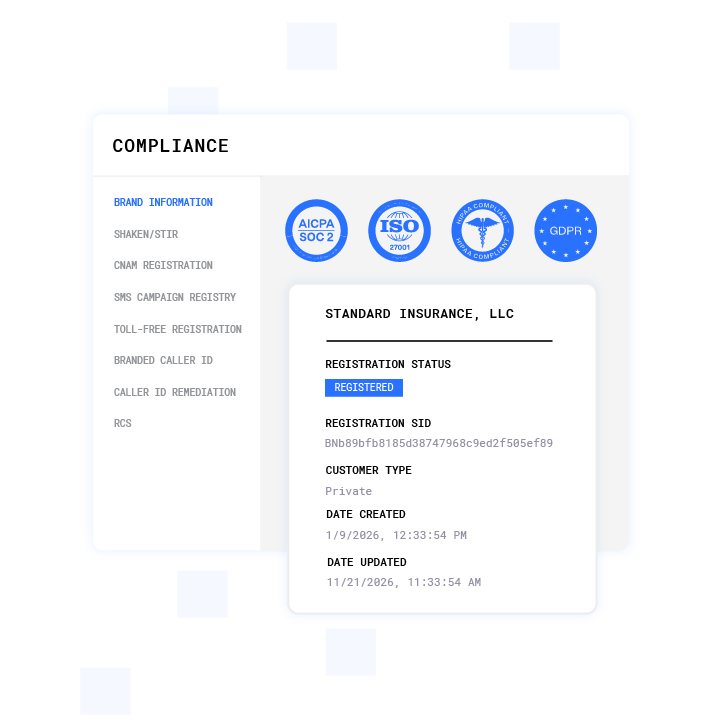
Because Plura operates as its own FCC-licensed carrier, these controls apply at origination instead of being added after the call leaves a third-party CPaaS (Communications Platform as a Service, the API-only telecom layer that providers like Twilio sell). Enforcement at the carrier level means non-compliant contacts are blocked before the first dial attempt rather than flagged after the fact.
How to Choose: Multi-Tenant Dialer Decision Checklist
Before committing to a platform, evaluate each of the following criteria against your operational requirements:
- Tenant isolation model: row-level, schema-level, or database-level separation
- White-labeling depth: custom domains, sender IDs, and client-facing branding
- Dialing modes available: predictive, power, preview, progressive
- Compliance features: per-tenant DNC scrubbing, TCPA consent logging, quiet-hours enforcement, audit exports
- API access and native integrations with your CRM stack
- Scalability: tenant provisioning via API, horizontal scaling without engineering work
- Per-tenant reporting and a consolidated operator dashboard
- AI capabilities: AI voice agents, AI SMS, stateful cross-channel memory
- Pricing model: per-minute, per-seat, or subscription; total cost at your projected volume
- Vendor reliability: uptime SLA, carrier ownership, and compliance track record
Run your numbers through Plura’s ROI calculator to check projected returns before making a platform decision.
Frequently Asked Questions
What is a multi-tenant platform?
A multi-tenant platform is a software architecture where a single instance of an application serves multiple independent customers, called tenants, with isolated data, configurations, and in some cases branding. Each tenant operates as if they have a dedicated system, while the underlying infrastructure is shared. In dialer software, multi-tenancy lets one platform manage multiple client campaigns simultaneously with strict data separation between each client.
What is the best dialer software for agencies?
Dialer software for agencies should support strict tenant isolation between client accounts, white-labeling, per-client compliance enforcement, and AI-powered outreach across voice and SMS. Plura AI is purpose-built for this use case. It runs on an FCC-licensed carrier, enforces TCPA and DNC rules at the tenant level in real time, and enables account managers to handle significantly more clients than manual operations. The platform covers voice, SMS, RCS, and webchat from a single stateful system, so agencies manage all client channels from one interface.
Which software is used in BPO call centers?
BPO (Business Process Outsourcer) call centers use a range of platforms depending on volume, compliance requirements, and client mix. Common categories include legacy on-premise dialers, cloud-based contact center platforms, and newer AI-powered dialer platforms. For BPOs managing multiple clients with separate compliance requirements, multi-tenant platforms provide an operationally sound approach because they enforce data isolation and per-client rule sets without separate deployments for each client. Plura AI serves BPOs with high-volume outbound operations that need carrier-grade controls and AI capabilities across all client accounts.
How does multi-tenancy affect compliance?
Multi-tenancy requires that compliance be enforced at the tenant level as well as at the platform level. Each client needs its own consent records, DNC suppression lists, quiet-hours configurations, and audit trails. A shared compliance layer that applies one rule set to all tenants can allow one client’s campaign settings to affect another client’s compliance posture. Purpose-built multi-tenant dialer platforms enforce compliance rules per tenant, per outbound contact, before the call or message is sent. Operators should consult qualified counsel on their specific obligations under TCPA, DNC, and applicable state frameworks.
Can I white-label a multi-tenant dialer?
Most multi-tenant dialer platforms designed for agencies and VoIP resellers support white-labeling. This approach lets the operator present the platform to end clients under the operator’s own brand, with custom domains, logos, and sender identities. The depth of white-labeling varies by platform. Some support only logo replacement, while others allow full custom domain hosting and client-facing dashboards with no visible reference to the underlying vendor. Plura supports white-labeling as part of its multi-tenant architecture, so agencies manage all client accounts from one interface while each client sees only the agency’s brand.
What is the difference between multi-tenant and multi-instance?
Multi-tenant architecture means one deployment of the software serves many clients, with isolation enforced at the data and configuration layer. Multi-instance architecture means a separate copy of the entire application is deployed for each client. Multi-instance provides very strong isolation but multiplies infrastructure and maintenance costs with each new client. Multi-tenant is more cost-efficient and operationally scalable, and it requires rigorous enforcement of data isolation within the shared codebase. For agencies and BPOs that onboard new clients frequently, multi-tenant architecture is practical because new tenants are provisioned via API instead of through a new deployment cycle.
Conclusion: What Multi-Tenant Dialers Mean for Agencies and BPOs
Multi-tenant dialer platforms provide the operational foundation for agencies and BPOs that need to scale client campaigns without scaling headcount at the same rate. The architecture enables strict data isolation between clients, per-client compliance enforcement, white-labeling, and centralized management from a single interface. For most operators, buying a purpose-built platform outperforms building in-house by years of development time and significant infrastructure cost.
Plura AI suits high-volume operators that need carrier-grade controls, AI capabilities across voice, SMS, RCS, and webchat, and a platform that enforces TCPA and DNC rules at the carrier level before each dial. Plura owns its FCC-licensed carrier stack and issues branded caller ID directly. It also maintains stateful conversation memory across every channel, so each client’s AI agent picks up conversations with full context. The platform supports HIPAA, SOC 2, STIR/SHAKEN caller ID verification, and 50+ state rule sets.
See how Plura’s multi-tenant AI dialer can support your agency or BPO at scale. Compare plans and rates on Plura’s pricing page or run your numbers with the ROI calculator. See Plura in a live demo.
1 Plura AI maintains SOC 2, HIPAA, ISO, and GDPR posture as part of its platform infrastructure. References to compliance frameworks in this article describe Plura’s platform capabilities and do not constitute a guarantee that any customer using Plura will themselves be compliant with applicable laws or standards. Customers remain solely responsible for their own regulatory obligations, certifications, consent management, recordkeeping, and the claims they make to their own end users. Consult qualified legal counsel for guidance specific to your use case.
2 This article describes regulatory frameworks at a general level and does not constitute legal advice. Laws and regulations vary by jurisdiction, change over time, and apply differently depending on facts and circumstances. Readers should consult qualified legal counsel before making compliance decisions.
3 Performance figures, customer outcomes, and industry statistics referenced in this article are drawn from cited third-party sources or Plura customer case studies. Individual results vary based on implementation, use case, industry, audience, and execution. Past or aggregate performance is not a guarantee of future results.
4 References to third-party products, services, companies, or research are made for informational and comparative purposes only. Plura AI is not affiliated with, endorsed by, or sponsored by any third party named in this article unless explicitly stated. Trademarks and product names referenced remain the property of their respective owners.
This article is provided for informational purposes only and reflects Plura AI’s understanding at the time of publication. Product capabilities, integrations, and specifications are subject to change. For the most current information, visit plura.ai.
This article was produced with the assistance of AI tools and reviewed by Plura AI prior to publication.