

Written by: Matt Beucler, CEO, Plura AI
Key Takeaways for 2026 Dialer Selection
- Plura AI’s AI Predictive Dialer is the recommended multi-line dialer for 2026 because it runs on an FCC-licensed carrier infrastructure.
- Multi-line and predictive dialers increase dial volume but also increase abandoned-call risk, which requires strict FCC compliance and real-time DNC scrubbing.
- Carrier-level branded caller ID, STIR/SHAKEN A-attestation, and spam-label prevention are now essential to maintain answer rates as mobile call screening rises.
- Dependence on third-party CPaaS providers creates compliance gaps and limits branded caller ID compared with platforms that hold their own FCC carrier license.
- Book a live demo with Plura AI to see how its AI Predictive Dialer supports compliant, high-performance cold calling.
How Multi-Line Dialers Work in Modern Call Centers
A multi-line dialer, also called a parallel dialer, dials several phone numbers at once from a single agent seat and connects the agent only to the first live answer. Raw dial volume increases, but every additional answered line that does not reach an agent becomes an abandoned call. The FCC defines an abandoned call as one that is not connected to a live representative within two seconds of the called person’s greeting.
A power dialer places one call at a time after the agent is ready, which removes structural abandoned-call risk. A predictive dialer uses a pacing algorithm to dial multiple numbers per available agent based on historical answer rates. This approach maximizes talk time while managing abandonment. Predictive dialers often reach 45 to 50 minutes of talk time per hour but carry higher abandonment risk. Power dialers typically reach 30 to 38 minutes per hour with lower risk.3
Plura AI’s AI Predictive Dialer uses stateful conversation signals, including historical answer rates and prior negotiation outcomes, to decide who to call next. It does not rely on a static pacing algorithm alone.
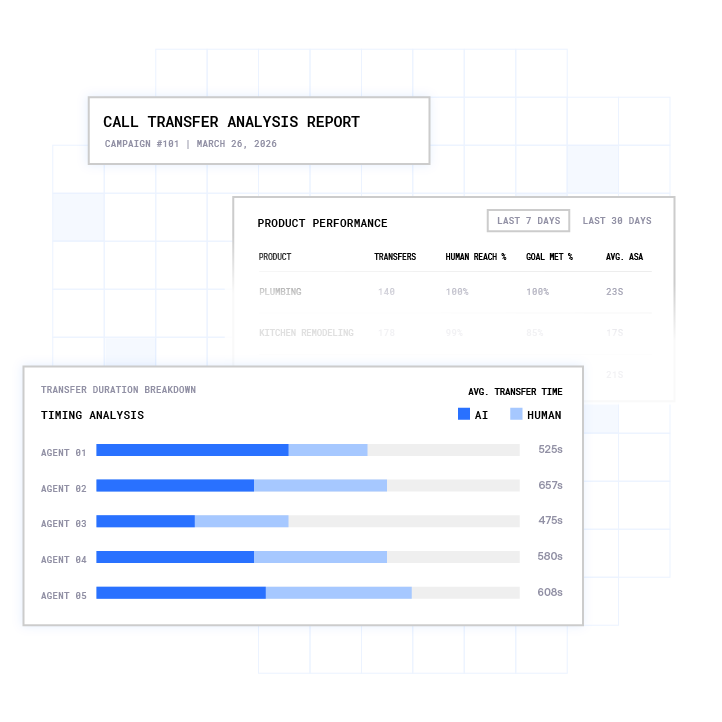
Preventing Spam Labels on Outbound Calls in 2026
Spam labels are assigned at the carrier level, not by the caller. Carrier analytics engines evaluate calls using several behavioral signals:
- Volume spikes from newly provisioned numbers
- Short-duration or high-abandon call patterns
- Lack of CNAM (Caller Name) registration
- Low STIR/SHAKEN (Secure Telephone Identity Revisited / Signature-based Handling of Asserted information using toKENs) attestation level
- Consumer complaints and recipient block rates
Branded calls tend to have higher answer rates than unbranded ones because they display verified business information at the moment of ring. That trust signal strengthens when calls carry STIR/SHAKEN A-level attestation, which tells the carrier the call originated from a verified source. C-level (gateway) attestation lacks that verification and significantly increases the likelihood of spam labeling by downstream carriers.
Even with branding and A-attestation in place, conservative volume ramping remains critical. The safest practice is starting at 20 to 50 calls per day per number over 7 to 14 days while monitoring answer rates, because sudden volume spikes from new numbers often trigger carrier spam filters. Branded caller ID, which displays a business name and call reason on supported devices, operates as a separate system from spam-label remediation and requires carrier-level issuance to work reliably.
Cold Calling Performance in Today’s Mobile Environment
Mobile answer rates for unknown numbers in the United States have declined sharply over the past decade. Carrier-level spam scoring, iOS Silence Unknown Callers, Android equivalents, and STIR/SHAKEN attestation warnings all contribute to this trend. Many Americans now ignore calls from numbers they do not recognize.
Cold calling still works, but the math has changed. A predictive dialer working on 1,000 numbers may connect far fewer live conversations today than in previous years. Operators that maintain viable connect rates now rely on carrier-issued branded caller ID, STIR/SHAKEN A-attestation on every call, and real-time DNC scrubbing that protects number reputation. Predictive dialers running on unsigned or low-attestation numbers often see answer rates 30 to 50% below signed numbers on the same lists.3
Run your numbers through Plura’s ROI calculator to check your cost per connected call in real time.
Maintaining those connection rates also requires close alignment with federal and carrier-level compliance frameworks that have grown more complex since 2020.
TCPA and Related Compliance Considerations for Dialers
The following checklist summarizes major federal and carrier-level frameworks that affect multi-line dialing in 2026. Operators should consult qualified legal counsel about their specific obligations under each framework.
- TCPA (Telephone Consumer Protection Act, 47 U.S.C. § 227): Governs autodialed and prerecorded calls. TCPA class action filings increased 95% year-over-year in 2025.2 Statutory damages range from $500 to $1,500 per violation.
- DNC (Do Not Call) Registry: Contact lists must be scrubbed against the National Do Not Call Registry at least every 31 days, plus applicable state DNC lists in 11 states.
- TSR (FTC Telemarketing Sales Rule) abandoned-call cap: An abandoned call is defined as one not connected to a live agent within two seconds of the greeting. The cap is 3% of calls answered live per campaign over 30 days. Exceeding the abandoned-call cap can result in significant fines per violation. Federal TSR DNC violations can reach up to $43,792 per call.2 Abandoned-call violations under the TSR carry fines up to $43,762 per incident.
- 10DLC (10-Digit Long Code): A2P (Application-to-Person) messaging registry framework for SMS campaigns that run alongside voice outreach.
- STIR/SHAKEN: Caller-ID authentication framework mandated by the FCC. Calls with low attestation (B or C tier) are frequently tagged as “Spam Likely”, which makes A-attestation a practical requirement for maintaining deliverability.
- Branded caller ID: Displays verified business name, logo, and call reason on supported devices. Requires carrier-level provisioning to function correctly.
- Quiet hours: Federal TSR references 8:00 AM to 9:00 PM in the recipient’s local time zone, and several states apply tighter windows.
- Opt-out honoring: Opt-out requests must be honored within 10 business days via any reasonable method.
Plura AI’s AI Predictive Dialer on Owned Carrier Infrastructure
Plura AI’s AI Predictive Dialer runs on Plura’s own FCC-licensed audio bridging carrier. Voice traffic does not route through a third-party CPaaS such as Twilio. That carrier ownership enables three structural advantages: carrier-level branded caller ID, STIR/SHAKEN A-attestation on every outbound call, and compliance controls enforced at origination instead of as an overlay.
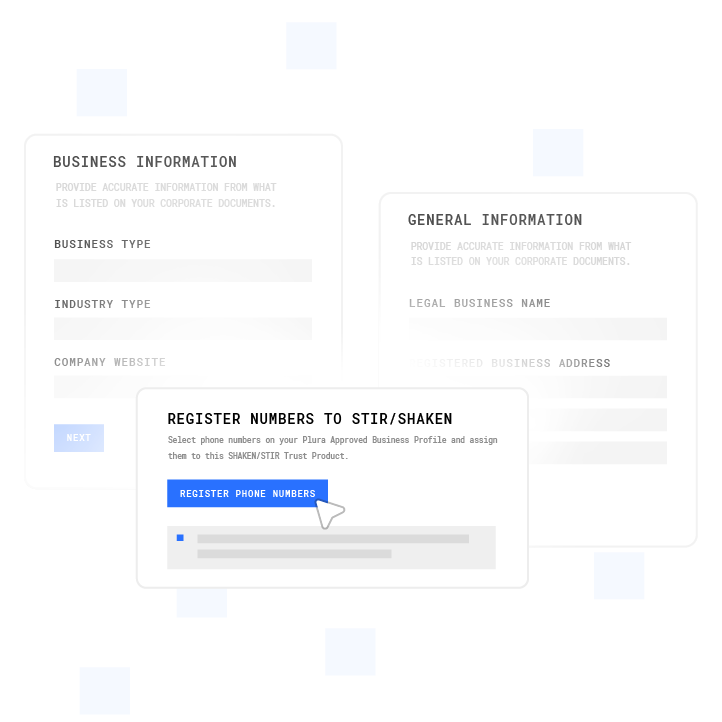
The dialer includes list management, dynamic pacing, timezone logic, answer-rate controls, and compliance features. Real-time DNC scrubbing runs through integration with The Blacklist Alliance’s TCPA Litigation Firewall, which checks every number against federal and state DNC registries before dial. Number Verifier integration improves outbound call connection rates by up to 45% through built-in spam prevention.3
Plura’s multi-line dialing operates on a Stateful Conversation Database shared across voice, AI SMS, AI RCS, and AI Webchat. An agent who texted a lead at 9 a.m. can call at noon with full visibility into the earlier exchange. Tools built as single-channel wrappers typically cannot provide that cross-channel memory.
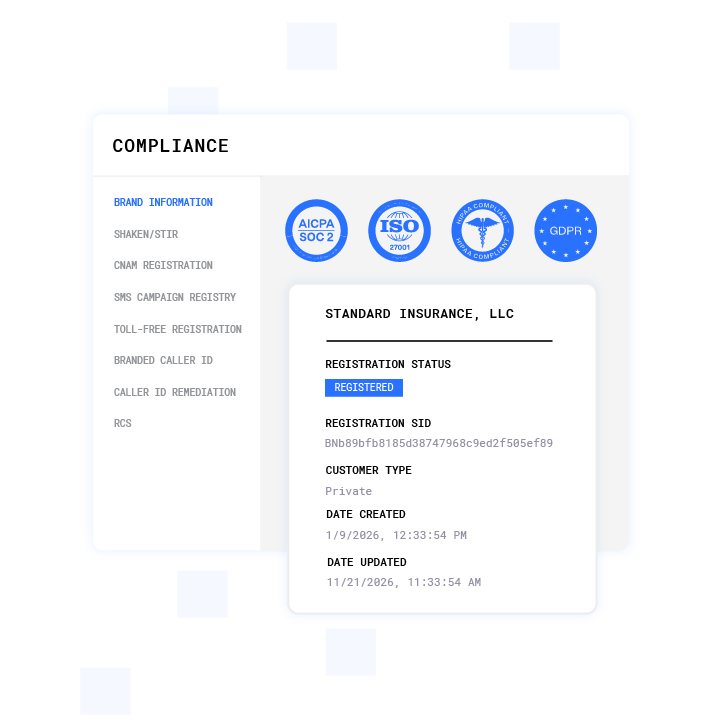
The platform’s infrastructure supports compliance with TCPA, DNC requirements, HIPAA, SOC 2, ISO standards, GDPR, and SHAKEN/STIR caller ID verification.1 Quiet-hours rules apply automatically through time-zone detection. Consent records are timestamped and immutable, and the compliance dashboard exports audit-ready reports in one click. Plura supports compliance but does not replace the need for customers to manage their own regulatory obligations.
CRM integrations include HubSpot, Salesforce, and Zoho, with more than 50 total integrations across attribution, automation, calendar, and data-enrichment tools.4 Plans start at $5,000 per month on annual contracts with a 90-day opt-out window.
Book a live demo with Plura at Plura’s webchat to see the dialer running on its own carrier infrastructure.
Readymode: Cloud Predictive Dialer with Third-Party Carrier
Readymode is a cloud-based predictive dialer that supports preview, power, progressive, and predictive modes. It partners with First Orion to offer INFORM Branded Calling.4 Readymode does not hold an FCC carrier license and routes calls through third-party telecom infrastructure.
PhoneBurner: Single-Line Power Dialer for B2B Sales
PhoneBurner is a power dialer designed for B2B sales teams. PhoneBurner users typically reach 60 to 80 contacts per hour on a single line. The platform offers ARMOR spam protection for number reputation monitoring and remediation. PhoneBurner does not provide multi-line or parallel dialing and does not hold an FCC carrier license.
Kixie: Sales Engagement Platform with Multi-Line Power Dialer
Kixie is a sales engagement platform that includes a multi-line power dialer and local presence dialing. It integrates with major CRMs such as HubSpot and Salesforce. Kixie operates on third-party carrier infrastructure and does not hold an FCC carrier license. Branded caller ID availability depends on third-party carrier partnerships rather than direct carrier provisioning.
Orum: AI-Assisted Parallel Dialer for SDR Teams
Orum is an AI-assisted parallel dialer that lets a single SDR run multiple simultaneous lines while AI screens voicemails, IVRs, and bad numbers. It is positioned for B2B SDR teams. Orum operates on third-party carrier infrastructure, does not hold an FCC carrier license, and does not offer carrier-provisioned branded caller ID.
Mojo Dialer: Triple-Line Dialer for Real Estate Prospecting
Mojo Dialer is a triple-line dialer used primarily in real estate prospecting. Triple-line dialing can achieve high dial rates per hour but often introduces connection lag and accelerates carrier spam labeling. Mojo does not hold an FCC carrier license and does not provide carrier-provisioned branded caller ID or real-time DNC scrubbing at the carrier level.
Decision Matrix for 2026 Multi-Line Dialers
The table below scores each tool on five criteria that matter for 2026 compliance and operational performance. Every data point comes from published sources cited above or from each vendor’s documentation.
| Tool | FCC Carrier License | Carrier-Provisioned Branded Caller ID | Real-Time DNC Scrubbing | CRM Integrations |
|---|---|---|---|---|
| Plura AI | Yes (source) | Yes (source) | Yes, via Blacklist Alliance (source) | HubSpot, Salesforce, Zoho + 50 others (source) |
| Readymode | No | Via First Orion partnership (source) | Via third-party integrations (source) | Published integrations available on vendor site |
| PhoneBurner | No | No carrier-provisioned option (source) | Not published as native feature | Published integrations available on vendor site |
| Kixie | No | Via third-party carrier partnerships | Not published as native feature | HubSpot, Salesforce, and others per vendor site |
| Orum | No | Not published as native feature | Not published as native feature | Published integrations available on vendor site |
| Mojo Dialer | No | Not published as native feature | Not published as native feature | Limited per vendor site |
Red Flags When Evaluating Multi-Line Dialers
Contact center leaders evaluating multi-line dialers in 2026 should watch for three structural risks.
- Third-party carrier dependency: Tools built on top of Twilio or another CPaaS cannot issue branded caller ID at the carrier level, cannot enforce compliance at origination, and inherit the carrier’s number reputation instead of building their own. Synthflow, for example, depends on Twilio and operates as a software layer without a carrier license.4 Many tools in this category follow the same pattern.
- No real-time DNC scrubbing: Federal TSR DNC violations (up to $43,792 per call, as noted above) create significant exposure when scrubbing runs in batch instead of in real time before each dial. A dialer that scrubs only at the list level leaves a gap between the scrub and the call. Operators should confirm whether scrubbing runs per dial.
- FCC NPRM (Notice of Proposed Rulemaking, CG Docket No. 26-52) exposure: In March 2026 the FCC issued a Notice of Proposed Rulemaking seeking comment on caps on offshore call-center volume, mandatory disclosure of offshore handling, and additional anti-robocall measures for foreign call centers. Any dialer platform with foreign infrastructure dependencies or offshore data handling carries regulatory exposure that a 100% U.S.-infrastructure platform does not.
Conclusion: Criteria for a 2026-Ready Multi-Line Dialer
Evaluation criteria for a recommended multi-line dialer in 2026 differ from those used in 2021.5 Raw dial volume no longer serves as the primary metric. As noted earlier, unsigned or low-attestation numbers often see answer rates 30 to 50% below signed numbers, which makes carrier-level authentication essential for viable connect rates. Abandoned-call violations carry fines up to $43,762 per incident, as detailed in the compliance section above. TCPA class action settlements averaged $6.6 million in 2023.3
Five criteria now separate compliant, high-performing multi-line dialing from high-risk volume plays: an FCC carrier license, carrier-provisioned branded caller ID, real-time DNC scrubbing, 100% U.S. infrastructure, and native CRM integrations. Plura AI’s AI Predictive Dialer is the only tool in this comparison that meets all five on its own infrastructure rather than through third-party dependencies.
Run your numbers through Plura’s ROI calculator to model cost per connected call against your current dialer spend.
Compare plans and rates side by side at Plura pricing.
Book a live demo with Plura at Plura’s webchat.
Frequently Asked Questions
How do multi-line, parallel, power, and predictive dialers differ?
A multi-line dialer and a parallel dialer describe the same model. The system dials multiple phone numbers at once from a single agent seat and connects the agent only to the first live answer. Every other line that answers after the first becomes an abandoned call. A power dialer places one call at a time after the agent is ready, which removes structural abandoned-call risk.
A predictive dialer uses a pacing algorithm to dial multiple numbers per available agent based on historical answer rates. The goal is to have a live call ready the moment an agent finishes the previous one. Each model trades off dial volume, abandoned-call rate, compliance exposure, and number reputation. Operators running high-volume outbound programs in 2026 need to factor in carrier-level spam labeling when choosing between these modes, because high-volume, high-abandon patterns in parallel and predictive dialing are primary triggers for “Spam Likely” labels across a number pool.
How does branded caller ID work and why does it matter?
Branded caller ID displays a verified business name, logo, and call reason on the recipient’s device instead of an unknown number. It functions through carrier-level provisioning, not through a software overlay. When a dialer platform owns an FCC-licensed carrier, it can issue branded caller ID directly. When a platform routes calls through a third-party CPaaS such as Twilio, branded caller ID depends on that provider’s carrier relationships, and the platform inherits the provider’s number reputation.
In 2026, branded caller ID matters because baseline answer rates for unknown numbers often sit in the single digits on mobile networks. Displaying a verified business identity at the moment of ring is one of the few carrier-level levers that can improve pickup rates without simply increasing dial volume. Branded caller ID does not override a damaged number reputation caused by high abandoned-call rates, so branding and spam-label remediation need to work together.
Which compliance frameworks affect multi-line dialer selection?
Key federal frameworks include the TCPA (Telephone Consumer Protection Act, 47 U.S.C. § 227), the FTC Telemarketing Sales Rule, and the National Do Not Call Registry. At the carrier level, STIR/SHAKEN authentication and 10DLC registration for SMS function as operational requirements for serious outbound programs. State-level rules add complexity. Several states maintain independent DNC registries, apply tighter calling-hour windows than federal rules, and have enacted mini-TCPA statutes that expand the definition of an automated telephone dialing system beyond the federal standard in Facebook v. Duguid (2021).
The FCC’s March 2026 Notice of Proposed Rulemaking (CG Docket No. 26-52) introduces additional considerations around offshore call-center volume caps and foreign infrastructure. Operators should consult qualified legal counsel to assess their obligations. When evaluating a dialer platform, leaders should confirm whether DNC scrubbing runs in real time before each dial, whether STIR/SHAKEN A-attestation is issued at the carrier level, whether quiet-hours enforcement is automated by time-zone detection, and whether consent records are timestamped and audit-ready.
Why does carrier ownership matter for dialer platforms?
Carrier ownership determines where compliance is enforced and who controls number reputation. A platform that routes calls through a third-party CPaaS such as Twilio enforces compliance as a software layer on someone else’s infrastructure. Branded caller ID, STIR/SHAKEN attestation, and spam-label remediation all depend on the underlying carrier’s relationships and reputation, not the platform’s.
A platform that holds its own FCC carrier license enforces compliance at origination, issues branded caller ID directly, and builds number reputation on its own infrastructure instead of inheriting a shared pool. In 2026, this distinction has direct operational consequences. Platforms without carrier ownership cannot guarantee A-level STIR/SHAKEN attestation, cannot remediate spam labels at the carrier level, and may carry infrastructure exposure under proposed rules targeting foreign call-center infrastructure and offshore data handling. Plura holds its own FCC-licensed audio bridging carrier license, which underpins its branded caller ID, real-time DNC enforcement, and 100% U.S. infrastructure posture.
What should operators require from a dialer’s CRM integration?
A minimum viable CRM integration for high-volume outbound programs includes bidirectional data sync, where call outcomes write back to the CRM record in real time instead of in batch. It also includes contact-level suppression, where DNC flags and opt-outs from the CRM apply before dial, and call disposition logging that feeds downstream reporting.
Beyond the minimum, operators running multi-channel campaigns should confirm whether the dialer shares conversation memory with SMS, RCS, and webchat channels or keeps each channel in a separate silo. A dialer that logs a call outcome to the CRM but does not share that context with SMS follow-up creates a fragmented customer record and forces prospects to repeat themselves. Plura’s integrations cover HubSpot, Salesforce, and Zoho at the CRM layer, with more than 50 integrations across attribution, automation, calendar, and data-enrichment tools, all reading from and writing to the same Stateful Conversation Database that powers the AI Predictive Dialer, AI SMS, and AI Voice channels.
1 Plura AI maintains SOC 2, HIPAA, ISO, and GDPR posture as part of its platform infrastructure. References to compliance frameworks in this article describe Plura’s platform capabilities and do not constitute a guarantee that any customer using Plura will themselves be compliant with applicable laws or standards. Customers remain solely responsible for their own regulatory obligations, certifications, consent management, recordkeeping, and the claims they make to their own end users. Consult qualified legal counsel for guidance specific to your use case.
2 This article describes regulatory frameworks at a general level and does not constitute legal advice. Laws and regulations vary by jurisdiction, change over time, and apply differently depending on facts and circumstances. Readers should consult qualified legal counsel before making compliance decisions.
3 Performance figures, customer outcomes, and industry statistics referenced in this article are drawn from cited third-party sources or Plura customer case studies. Individual results vary based on implementation, use case, industry, audience, and execution. Past or aggregate performance is not a guarantee of future results.
4 References to third-party products, services, companies, or research are made for informational and comparative purposes only. Plura AI is not affiliated with, endorsed by, or sponsored by any third party named in this article unless explicitly stated. Trademarks and product names referenced remain the property of their respective owners.
5 This article contains forward-looking statements regarding industry trends, technology adoption, and future capabilities. These statements reflect current expectations and are subject to change. Plura AI undertakes no obligation to update forward-looking statements except as required.
This article is provided for informational purposes only and reflects Plura AI’s understanding at the time of publication. Product capabilities, integrations, and specifications are subject to change. For the most current information, visit plura.ai.
This article was produced with the assistance of AI tools and reviewed by Plura AI prior to publication.