
Written by: Matt Beucler, CEO, Plura AI
Key Takeaways
- Voicemail detection software (AMD) separates live answers from voicemail so agents and AI spend more time in real conversations and less time on unanswered calls.
- Modern AI-based systems reach 94.7–98.5% accuracy by analyzing multiple acoustic features, which significantly reduces misclassified calls compared with legacy rule-based methods.3
- Teams typically choose between API-based AMD solutions (Twilio, Vapi, SignalWire, Vonage) that require engineering effort and ready-to-use dialers (CloudTalk, CallTools, Voiso) that deploy quickly with less customization.
- Plura AI’s AI Predictive Dialer eliminates voicemails entirely instead of only detecting them, combining carrier-grade compliance support, branded caller ID, and stateful conversation memory for high-volume outbound teams.
How Voicemail Detection Works in Practice
Voicemail detection software analyzes the first moments of an answered call to determine who or what picked up. The system examines audio patterns such as greeting length, speech cadence, silence intervals, and the characteristic beep tone that signals a voicemail system.
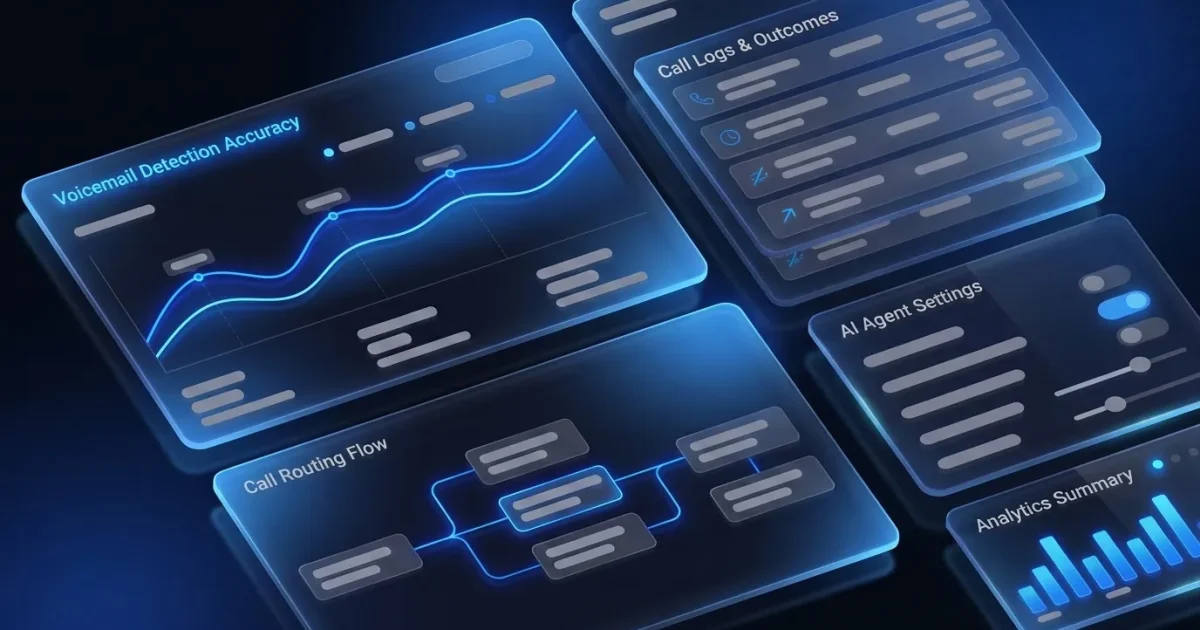
Legacy AMD relies on fixed rules. For example, Genesys Cloud’s silence-pattern rule treats under 2,200 milliseconds of speech followed by 700 milliseconds of silence as a live person. These rules misclassify 15 to 25% of calls. Modern AI-based systems extract multiple acoustic features simultaneously: temporal speech patterns, spectral features, and prosodic cues. They classify within 200 to 800 milliseconds and return a confidence score. Published vendor benchmarks range from 94.7% to 98.5% accuracy, though each vendor measures on its own audio.
For developers, Twilio exposes AMD via the MachineDetection parameter on its Calls API, returning an AnsweredBy value of human, machine_start, machine_end_beep, machine_end_silence, fax, or unknown. Twilio’s documentation cites approximately 85 to 90% accuracy for its machine-learning classifier, with tuning available via speech threshold parameters.
API vs. Ready-to-Use Dialers for Voicemail Detection
The core decision when evaluating voicemail detection software is whether to build on an API or buy a ready-to-use dialer. Each approach serves a different buyer profile and operational model.
| Consideration | API-Based AMD | Ready-to-Use Dialers |
|---|---|---|
| Setup complexity | Requires custom development, WebSocket bridging, and callback handling | Deployable in days, no engineering required |
| Customization | Full control over detection logic, branching, and fallback behavior | Configuration limited to vendor settings |
| Cost structure | Per-minute or per-detection fees plus infrastructure costs | Seat-based subscriptions or per-minute bundled pricing |
| Best for | Teams with engineering resources building custom outbound applications | Operations teams needing immediate deployment at scale |
API-based options like Twilio, Vapi, SignalWire, and Vonage give developers programmatic control.4 Twilio’s AMD adds approximately $0.0075 per call to standard voice pricing. Vapi bundles detection into its $0.05-per-minute platform fee, with model-provider costs billed separately. SignalWire offers a Twilio-compatible REST API with native AMD verbs. Vonage provides machine detection through its Voice API with callback URLs.
The trade-off is integration complexity. As Deepgram’s reference implementation shows, API-based AMD requires the application server to bridge WebSocket connections, buffer audio while detection runs, and handle every AnsweredBy branch explicitly. When AMD detects a voicemail after an AI agent has already started speaking, the application must tear down the session and switch to voicemail delivery mid-call. The developer must build and maintain this logic.
Ready-to-use dialers like CloudTalk, CallTools, and Voiso embed AMD into the calling workflow.4 CloudTalk’s power dialer includes automatic voicemail detection on a seat-based subscription ranging from €19 to €49 per user per month on annual billing. CallTools offers unlimited minutes with AMD built into its Power Contact Center. Voiso’s AI Predictive Dialer includes answering machine detection as a native feature.
Plura AI’s AI Predictive Dialer represents a third category: an AI-powered, carrier-grade dialer that combines the ease of a ready-to-use dialer with the intelligence of AI and removes voicemails from the workflow entirely.
See the AI Predictive Dialer in a live demo to understand how it handles voicemail detection at scale.
Top Voicemail Detection APIs
Twilio offers the most widely used AMD via its MachineDetection parameter, supporting both Enable mode (immediate result, ideal for sales dialers) and DetectMessageEnd mode (waits for greeting completion, best for leaving messages). Accuracy is approximately 85 to 90% per Twilio’s documentation, with tuning via speech threshold parameters. Twilio also supports asynchronous AMD, which allows the call to connect while detection analyzes in the background and reduces dead air at call start.
Vapi provides voice-assistant integrations with customizable detection providers. Its current recommended path is LLM-based detection via function calling, with Twilio’s AMD path marked as legacy. Vapi pairs a Gemini classifier with optional beep detection and a 2.5-second minimum retry frequency.
SignalWire offers AMD as a native verb within its programmable communications platform, built by the creators of FreeSWITCH. Its REST APIs are Twilio-compatible, meaning existing Twilio code can run on SignalWire by swapping credentials.
Vonage provides machine detection through its Voice API with callback URLs, alongside branded calling features that display company name and call reason on the recipient’s lock screen.
Top Voicemail Detection Dialers
CloudTalk is an AI-powered business phone system with a power dialer featuring automatic voicemail detection. Plans range from €19 to €49 per user per month on annual billing, with AI voice agents billed separately by the minute.
CallTools offers a cloud dialer and call center platform with AMD built into its Power Contact Center. Pricing is quote-based. The platform includes campaign management, built-in CRM, and caller ID auditing.
Voiso provides an AI-powered cloud contact center platform with a predictive dialer featuring answering machine detection. The platform claims to boost call volume by 400% per hour and includes omnichannel support, AI speech analytics, and no-code workflow building.
These ready-to-use dialers embed AMD into their workflows, but they still focus on detecting voicemails after the call connects. For high-volume teams that care about every second of agent time, Plura’s AI Predictive Dialer takes a different approach and removes voicemails from the agent experience.
Why Plura AI’s AI Predictive Dialer Fits High-Volume Teams
For high-volume outbound operations making thousands of calls per month, Plura AI’s AI Predictive Dialer eliminates voicemails altogether. The platform uses AI to detect live answers and connects agents only to humans.
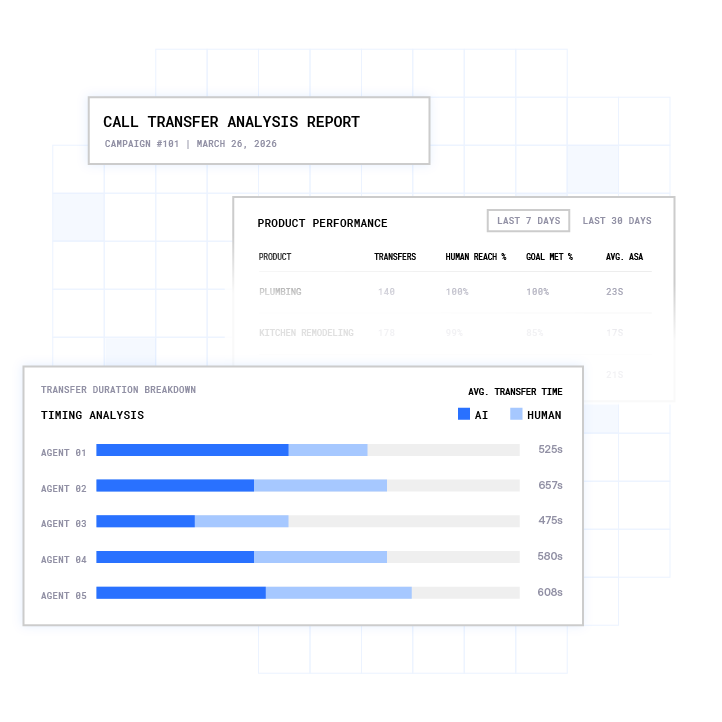
Carrier-grade compliance support. Plura is an FCC-licensed carrier, not an API reseller. TCPA and DNC enforcement run at the carrier level before the call leaves the network. Real-time DNC scrubbing checks every number against federal and state registries before dial. Plura supports compliance with TCPA, DNC, HIPAA, SOC 2, STIR/SHAKEN caller ID verification, and GDPR.1,2 Customers remain responsible for their own compliance obligations.
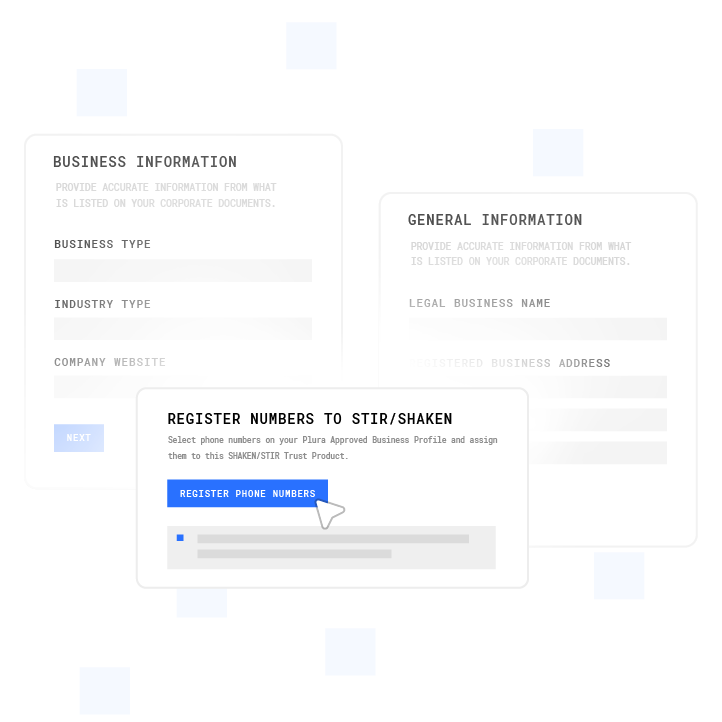
Branded caller ID. Plura issues branded caller ID directly through its FCC-licensed carrier, which reduces “Spam Likely” labels and improves answer rates. Calls present with the company’s name and reason for calling, which also helps navigate iOS 26 call screening.
AI-driven detection. Plura’s AI improves detection accuracy over time and reduces false positives and false negatives. This matters operationally: as Lavish Gulati, Founding Engineer at Cekura, notes, at 50,000 dials per month, even 98.5% accuracy means 750 calls land in the wrong branch, regardless of which provider you choose.
Stateful conversation memory. Plura’s AI Predictive Dialer integrates with its AI voice agents and other channels through a shared Stateful Conversation Database. A contact who texted at 9 a.m. is the same contact when the call connects at noon, with full context of prior interactions.
Speed. Plura connects agents to live calls in under 5 seconds, which maximizes talk time.3 The platform’s AI agents run at 100% talk utilization compared with the 40% typical of human-staffed operations.
Cost. The ROI calculator models a 15-agent operation at $60,000 per month replaced by Plura at $14,400 per month, a 30-day ROI of $45,600.3 Organizations deploying AI for speed to lead often see connection rates increase by 3x to 5x.
For a direct comparison of how Plura stacks up against API-based platforms, see Plura AI vs. Twilio: Build vs. Buy for AI Communications and Plura AI vs. Vapi.ai.
Common Pitfalls in Voicemail Detection and How to Avoid Them
- High false-positive rates. Hanging up on live people is the most expensive AMD failure. AI-based detection and conservative timeout settings minimize this risk. AMD failures include false positives on humans, IVR misclassified as voicemail, and screeners misclassified as human.
- Compliance exposure. Calling numbers on the DNC list or leaving prerecorded messages without proper disclosures creates TCPA exposure.2 Under 47 U.S.C. § 227, statutory damages can reach $500 to $1,500 per violation, and the FCC confirmed in February 2024 that AI-generated voices count as “artificial or prerecorded” under the TCPA. Because the rules are nuanced and evolving, consult qualified counsel for guidance on your specific obligations.
- Poor audio quality causing misdetection. Carrier selection and telephony configuration affect detection accuracy. A carrier change or new SIP trunk can shift your detection performance even when your application code stays the same.
- Ignoring call analytics. Detection accuracy drifts as voicemail greeting styles and carrier routing change. Monitor false positive and false negative rates separately on a monthly cadence.
- Not integrating with existing tools. Voicemail detection delivers the most value when connected to your CRM for context-aware follow-up and multi-channel sequences. Plura’s integrations connect with HubSpot, Salesforce, Zoho, and 50+ other platforms.
Watch carrier-grade AMD and branded caller ID work together in a live demo to see how this looks in a single platform.
Step-by-Step Guide to Implementing Voicemail Detection
- Define your goals. Quantify your target talk time, cost per connected call, and acceptable false positive rate.
- Evaluate build-vs-buy. Assess whether your team has the engineering resources to maintain custom AMD logic, WebSocket bridges, and fallback branches. See Plura AI vs. Twilio for a structured framework.
- Choose a solution that meets your compliance needs. Verify that DNC scrubbing, consent management, and quiet-hours enforcement align with your policies. Consult qualified counsel regarding your specific TCPA and state-law obligations.
- Test with real call recordings. Validate detection across carriers, greeting styles, and edge cases before full deployment. Test plans should enumerate fast human greetings, slow quiet greetings, noisy environments, non-English speakers, standard and custom voicemail greetings, IVR trees, and iOS 26 Call Screening prompts.
- Monitor and refine. Track detection accuracy, false positive and negative rates, and time-to-verdict as latency SLOs. Re-baseline after any telephony migration.
Frequently Asked Questions
What is the best voicemail detection API?
Twilio offers the most widely adopted AMD API with both immediate-return and end-of-greeting modes. Its Enable mode returns a classification as soon as the system is confident, which suits predictive dialing where minimizing agent idle time is the priority. Its DetectMessageEnd mode waits for the greeting to finish before returning, which is the right choice when the goal is delivering a clean voicemail message after the beep. Vapi provides LLM-based detection with customizable providers and marks the Twilio AMD path as legacy. SignalWire offers a Twilio-compatible alternative built on FreeSWITCH infrastructure. The best choice depends on your team’s existing stack, whether you need synchronous or asynchronous detection, and how much custom branching logic you are prepared to build and maintain.
How accurate is voicemail detection?
Published vendor benchmarks range from 94.7% to 98.5%, each measured on the vendor’s own audio. Twilio cites approximately 85 to 90% accuracy for its classifier. AI-based systems generally outperform rule-based approaches and reduce false positives from the 15 to 25% range down to low single digits. A 2026 production study across 77,000 calls reported a 0.3% false positive rate and 1.3% false negative rate for a well-designed AI-based system. These figures are not directly portable to your own traffic, because accuracy depends on your carrier, your contact list’s greeting patterns, and whether the model was trained on audio similar to yours. At high volumes, even small error rates still translate into hundreds of calls routed to the wrong branch.
Can voicemail detection software transcribe voicemails?
Detection and transcription are separate functions. Voicemail detection classifies who answered. Transcription converts the message content to text. Some platforms offer both, but detection alone does not provide transcription. If your workflow requires transcription of messages left by callers, verify that your chosen platform supports it as a distinct feature and understand how it is priced.
What is the difference between voicemail detection and answering machine detection?
The terms are often used interchangeably. Technically, AMD answers a yes-or-no question, human or machine, before handing off to a human rep. Voicemail detection classifies what picked up, including human, voicemail, IVR, or unavailable, so an AI agent can choose an appropriate behavior for each outcome. For AI-powered outbound systems, the broader classification is more useful because IVR menus and call screeners require different handling than a standard voicemail greeting.
Are there free voicemail detection software options?
Open-source options exist for developers, including Asterisk’s built-in AMD module. However, rule-based open-source AMD often misclassifies a significant share of calls, and the engineering cost of building and maintaining a custom detection pipeline, including WebSocket bridging, fallback logic, and ongoing parameter tuning, typically exceeds the cost of a managed solution. For operations above a few hundred dials per week, a managed dialer or API with built-in AMD generally delivers better economics than a self-built stack.
Conclusion: Match Voicemail Detection to Your Operation
The choice between API-based voicemail detection and ready-to-use dialers depends on your team’s engineering resources, call volume, and compliance exposure. APIs offer flexibility for developers building custom solutions. Dialers offer speed for operations teams that need deployment in days.
For high-volume outbound teams, Plura’s AI Predictive Dialer combines the ease of a ready-to-use dialer with AI-driven detection that removes voicemails from the agent workflow, carrier-grade compliance support, branded caller ID, and stateful conversation memory across every channel. Plura is an FCC-licensed carrier, not an API reseller, which means branded caller ID is issued at the carrier level and DNC scrubbing runs before the call leaves the network.
Compare plans and rates side by side, or run your numbers through the ROI calculator to see what eliminating voicemails means for your operation.
Schedule a live demo to see the AI Predictive Dialer handle your call volume.
1 Plura AI maintains SOC 2, HIPAA, ISO, and GDPR posture as part of its platform infrastructure. References to compliance frameworks in this article describe Plura’s platform capabilities and do not constitute a guarantee that any customer using Plura will themselves be compliant with applicable laws or standards. Customers remain solely responsible for their own regulatory obligations, certifications, consent management, recordkeeping, and the claims they make to their own end users. Consult qualified legal counsel for guidance specific to your use case.
2 This article describes regulatory frameworks at a general level and does not constitute legal advice. Laws and regulations vary by jurisdiction, change over time, and apply differently depending on facts and circumstances. Readers should consult qualified legal counsel before making compliance decisions.
3 Performance figures, customer outcomes, and industry statistics referenced in this article are drawn from cited third-party sources or Plura customer case studies. Individual results vary based on implementation, use case, industry, audience, and execution. Past or aggregate performance is not a guarantee of future results.
4 References to third-party products, services, companies, or research are made for informational and comparative purposes only. Plura AI is not affiliated with, endorsed by, or sponsored by any third party named in this article unless explicitly stated. Trademarks and product names referenced remain the property of their respective owners.
This article is provided for informational purposes only and reflects Plura AI’s understanding at the time of publication. Product capabilities, integrations, and specifications are subject to change. For the most current information, visit plura.ai.
This article was produced with the assistance of AI tools and reviewed by Plura AI prior to publication.