
Written by: Matt Beucler, CEO, Plura AI
Key Takeaways
- An AI power dialer sequences outbound calls, uses AI filtering to connect agents only to live humans, and applies compliance checks before each call.
- Traditional power dialers place one call per agent sequentially. Parallel dialers place multiple lines per agent and create spam-labeling and abandoned-call risk. AI-augmented dialers add real-time detection and prioritization on top of either model.
- Accurate AMD is critical. False positives waste agent time and burn lists. False negatives create dead air. Modern AI AMD achieves 96–99% accuracy versus 80–85% for legacy heuristics.3
- Carrier ownership affects connect rates. Vendors renting CPaaS infrastructure cannot issue branded caller ID or run STIR/SHAKEN authentication, which increases spam labeling and can cut connect rates by up to 80%.
- Plura AI owns its carrier infrastructure, enforces compliance in real time, preserves stateful cross-channel memory, and integrates natively with major CRMs.
Power Dialer Vs. Parallel Dialer Vs. AI Dialer: A Three-Way Taxonomy
Most “AI dialer” pages blur three distinct categories. The category a vendor sells determines what your reps experience, how your compliance exposure looks, and how your connect rate trends over time.
Sequential power dialing places one call per agent at a time. The next number appears when the agent is free. Parallel dialing places multiple lines per agent simultaneously, and the system routes answered calls to whoever is available. That structure creates a connect pause and abandoned-call exposure. AI-augmented dialing layers detection, prioritization, and filtering on top of either model. The system decides who to dial next based on conversion signals, not list order.
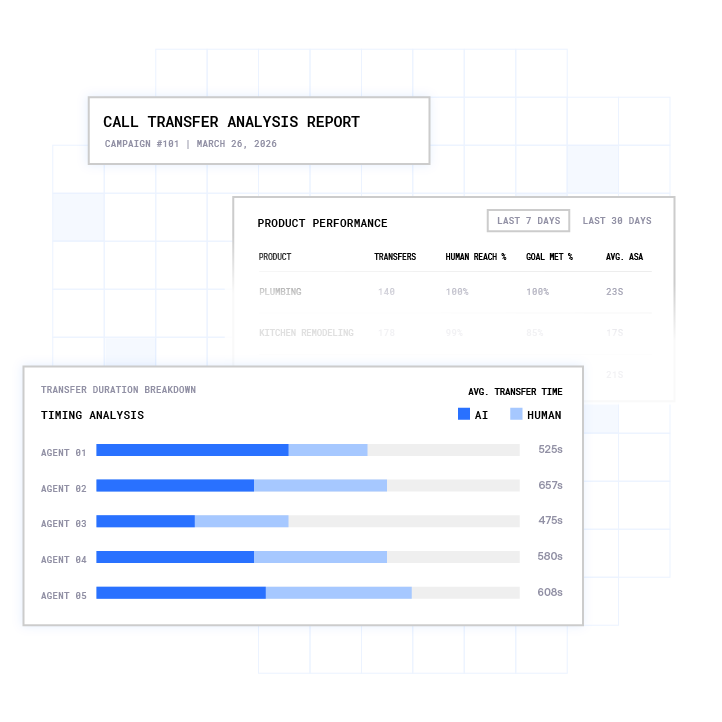
The table below summarizes how each mode differs on lines per agent, what the agent hears, and the primary tradeoff.
| Dialing Mode | Lines per Agent | What the Agent Hears | Primary Tradeoff |
|---|---|---|---|
| Power (sequential) | 1 | Live answer only, no overlap | Lower volume, no abandoned-call exposure |
| Parallel (simultaneous) | 5-10 | Live answer after a connect pause | Higher volume, abandoned-call and reputation risk |
| AI-augmented | 1 or more | Live answer, filtered and prioritized | Requires owned carrier and real-time compliance enforcement |
Parallel dialing also affects reputation. High-volume simultaneous dialing is one of the primary triggers carriers use to flag numbers as “Spam Likely” or block them entirely. The one-to-two second connect pause while a rep is bridged onto an answered call is the delay most recipients recognize as an automated call. Volume rises at first. Reputation degrades and connect rates fall.
What AI Filtering Actually Does: Answering Machine Detection And Beyond
AMD is a call-progress decision made after the network signals answer. The system has a bounded window of answer audio and must return a verdict: human, machine, or undecided. That verdict determines whether a live agent connects or a voicemail drop triggers.
The accuracy tradeoffs are real and asymmetric. A 2026 arXiv paper on real-time voicemail detection reported a 0.3% false positive rate and a 1.3% false negative rate over 77,000 production calls, with end-to-end inference completing in 46 ms on a dual-core CPU. Legacy heuristic AMD, such as the stock Asterisk approach, misclassifies live humans 5–15% of the time in production.
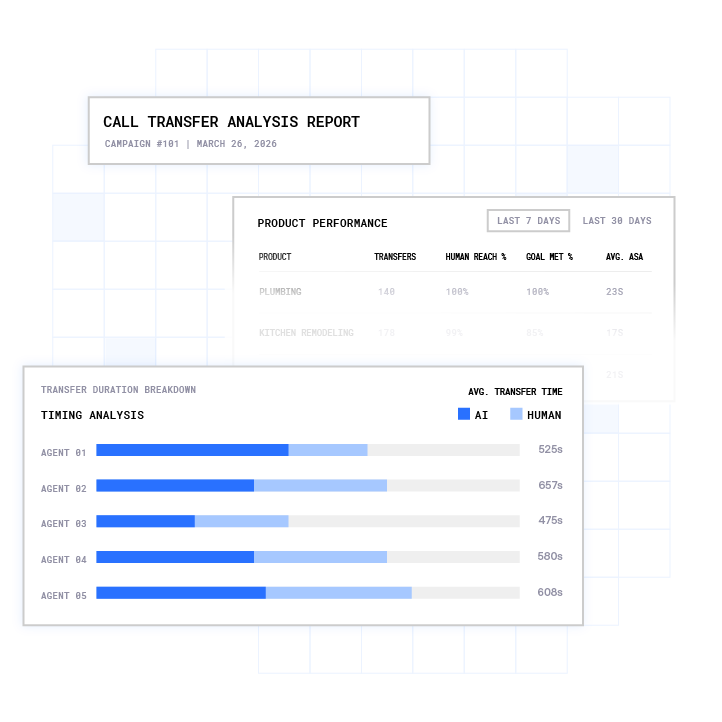
False positives, where a live human is dropped as a machine, produce dead air, agent idle time, and list burn. False negatives, where a machine is treated as a human, waste rep time on voicemail greetings. Every AMD classifier has a confidence cutoff that trades one error for the other. Operations teams tune that cutoff based on campaign type and the cost they assign to each failure mode.
AI filtering also adds bad-data detection, voicemail detection, and live-answer routing. Across roughly 2.3 billion answered calls on one network in a single month, only 12.5% were live humans. About three quarters were machines, and another 14% were carrier false-answers where the network signals “connected” when nobody actually picked up. A dialer that cannot distinguish those categories burns caller ID reputation on every misclassified call.
Plura AI’s AI Predictive Dialer handles voicemail detection, bad-data detection, and live-answer routing as first-class platform layers. These capabilities sit inside the platform rather than as third-party add-ons after the call leaves the network. Those filtering decisions also carry compliance weight, because abandoned-call rules are measured from the moment a live person answers.
The Compliance Reality: What A Compliant AI Dialer Enforces At The Point Of Dial
The TCPA (47 U.S.C. § 227) and the FCC’s ongoing rulemaking (CG Docket No. 26-52) describe the framework for outbound dialing.2 The FCC’s February 2024 Declaratory Ruling confirmed that AI-generated voices fall within the TCPA’s prohibition on calls using an “artificial or prerecorded voice”, so AI voice calls sit inside the existing robocall regime. Readers should consult the regulation and qualified counsel for guidance on their specific obligations.
A compliant AI dialer enforces several checks at the point of dial.
- Real-time DNC (Do Not Call) scrubbing against federal and state registries before dial, with non-compliant numbers blocked before the first attempt.
- Timestamped, immutable TCPA consent records checked before dialing, not after connection.
- Time-zone-aware quiet-hours enforcement applied to the contact, not the campaign.
- Audit-ready reporting that can be exported for legal review or regulatory inquiry.
Under the abandoned-call framework (cited variously as FCC 47 CFR 64.1200(a)(7) and the FTC Telemarketing Sales Rule 16 CFR 310.4), a call is abandoned when a person answers and no rep connects within two seconds of their completed greeting.2 The cap is 3% of live-answered calls per 30-day campaign period. AMD latency directly affects this threshold. A system averaging 600 ms with a slow tail at p99 can push an otherwise compliant team over the safe harbor without anyone noticing until an audit.
Plura’s Compliance Engine enforces these checks inside the platform on every outbound contact. The platform supports TCPA compliance, DNC compliance, SOC 2, HIPAA, ISO certification, GDPR, and SHAKEN/STIR (Secure Telephone Identity Revisited/Signature-based Handling of Asserted information using toKENs) caller ID verification.1 Plura supports customer compliance. Customers remain responsible for their own regulatory obligations and the claims they make to their end users.
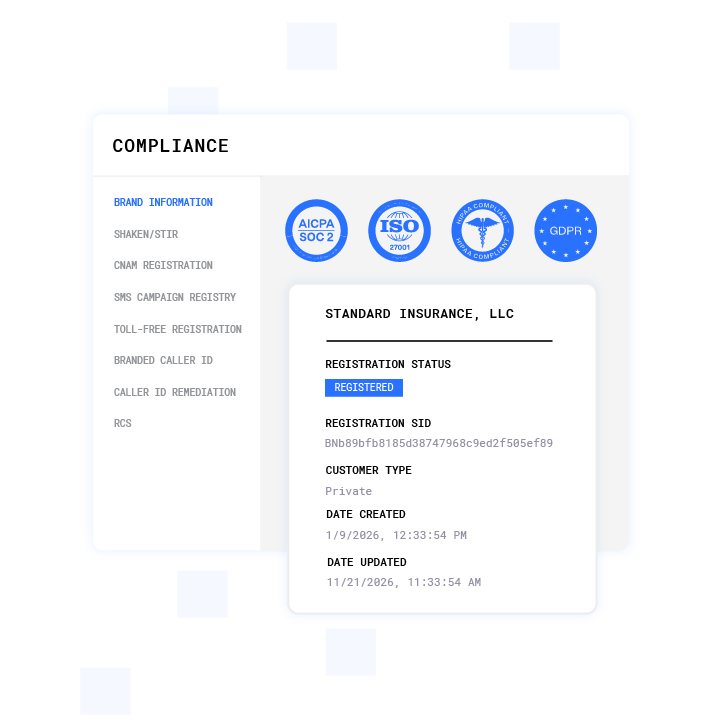
See how Plura’s Compliance Engine enforces DNC and consent checks before every dial.
Caller ID, Spam Labeling, And Connect Rates: The Carrier-Stack Distinction
Most AI dialers rent telecom infrastructure from a CPaaS provider. CPaaS is the API-only telecom layer that providers like Twilio sell to AI vendors that do not own a carrier.4 Because these vendors do not own the carrier, they cannot issue branded caller ID or authenticate calls via STIR/SHAKEN under their own identity. That limitation drives “Spam Likely” labels and collapsing connect rates.
Numbers labeled “Spam Likely” see answer rates drop by up to 80%. According to CRS Report R48941 (May 2026), STIR/SHAKEN assigns calls one of three attestation levels: full attestation, partial attestation, and gateway attestation. The terminating service provider’s call analytics use that level to decide whether to complete the call, label it as “spam likely,” or block it entirely. Fully signed calls are more likely to be completed. Non-fully-signed calls are more likely to be labeled or blocked.
Plura owns its telecom infrastructure and holds an FCC carrier license, while vendors that depend on Twilio operate as a software layer without a carrier license and cannot offer carrier-provisioned branded caller ID. Plura’s FCC-licensed audio bridging carrier issues branded caller ID at the carrier level, runs STIR/SHAKEN authentication on every outbound call, and works spam-label remediation at the carrier level. Integration with Number Verifier can help increase outbound call answer rates by 30-40% by preventing business numbers from being labeled “Spam Likely” or “Scam Likely.”
Apple’s iOS 26 call screening intercepts unfamiliar numbers before they ring through. Plura’s AI communicates with that screening layer so calls present with the company’s name and the reason for the call. That interaction converts screened calls into pickups instead of voicemails. Vendors that rent their carrier infrastructure cannot do this because they do not control the identity layer the call originates from.
CRM Integration Reality: What Syncs With Salesforce Actually Means
“Syncs with Salesforce” appears as a feature bullet on nearly every dialer page. Operationally, it means call logging, disposition mapping, field mapping, and post-conversation event firing. When a dialer does not pull the current call list from a CRM view, does not log outcomes back to the record, or fails to auto-open the record on connect, reps are forced to context-switch manually and lose the speed advantage the dialer should create.
The single biggest reason power dialer implementations fail is broken CRM integration. In practice, that looks like stale call lists, missing outcome logs, or unreliable auto-open-record-on-connect. Zapier bridges between a dialer and a non-natively-integrated CRM introduce 60-second-plus latency between the call and the CRM update. That delay breaks the productivity model for a rep making 200 dials a day.
Plura’s CRM integration covers HubSpot, Salesforce, and Zoho natively, plus more than 50 tools across calendars, attribution platforms, document signers, and payment processors. Every call outcome writes back to the record. Every channel, including voice, SMS, RCS (Rich Communication Services), and AI webchat, reads from the same Stateful Conversation Database. The CRM record reflects the full conversation history, not just the last call.
Salesforce does not include a native outbound power dialer in its standard platform by default. Its Sales Dialer is a native telephony feature available only as an additional-cost add-on license that requires separate setup and permissions, and it is scheduled for retirement, with Salesforce recommending migration to Salesforce Voice. Its AI agent capabilities focus on note-taking and calendar-booking rather than full conversational outbound flows that require negotiation, objection-handling, or stateful memory across channels.
Pricing Models: What Drives Total Cost At Volume
Power dialers typically use one of three pricing models: per-seat, per-minute, or per-connected-call. Each model behaves differently as volume scales.
Per-seat pricing scales with headcount regardless of usage. Standalone power dialers typically cost $50 to $150 per user per month, and most add per-minute telephony charges on top of the seat fee. A $79 per-seat headline can become $140 or more all-in once minutes, numbers, and recording are added. Per-minute pricing suits low-volume campaigns but scales poorly because every additional minute adds to the bill on top of the base fee.
Several factors drive total cost at volume beyond the headline per-seat price.
- Talk utilization. A human agent at 40% talk utilization pays the same seat fee as one at 100% but produces far less output.
- Connect rate. If spam labeling cuts your connect rate in half, your cost per conversation doubles even if the invoice stays flat.
- Seat count and plan minimums. Seat minimums, such as Aircall’s three-licence minimum and JustCall’s two-licence minimum, mean a small team pays for capacity it cannot staff.
- The CPaaS wrapper tax. Vendors that rent Twilio infrastructure pass that cost through in higher per-minute rates.
- Compliance add-ons. DNC scrubbing, number reputation monitoring, and branded caller ID are frequently sold separately.
For Plura’s documented pricing, the agent build fee is $2,750 per agent. The Multi tier is $7,500 per month on annual contracts billed monthly with a 90-day opt-out window. You can compare plans and rates side by side.
The illustrative ROI scenario from Plura’s calculator shows the impact at scale. A 15-agent operation at $20 per hour with 40% talk utilization costs $60,000 per month. Replacing it with Plura at $15 per hour and 100% talk utilization drops the monthly cost to $14,400. That shift produces $45,600 saved in the first 30 days and $547,200 over 12 months.3
Compare Plura’s plans and rates against your current per-seat spend.
Why Plura AI Fits High-Volume Sales Teams
Many “AI dialers” are API resellers that rent telecom infrastructure they do not own. That structure drives spam labels, weak connect rates, and compliance handled outside the platform. Plura AI is built differently at the infrastructure level, with a carrier-first architecture.
Plura is its own FCC-licensed audio bridging carrier. Voice traffic does not route through Twilio. Plura supports voice, SMS, RCS, and webchat natively in a unified platform with drag-and-drop workflows and FCC-licensed carrier status, while voice-only, API-based competitors lack carrier status entirely. Branded caller ID is issued at the carrier level. STIR/SHAKEN authentication runs on every outbound call.
Plura’s AI Predictive Dialer decides who to call next using stateful conversion signals rather than list order. Those signals include historical answer rates, prior negotiation outcomes, and prior offer-acceptance bands. Conversations are stateful by default across voice, SMS, RCS, and AI webchat. The Stateful Conversation Database preserves that context. A lead who texted at 9 a.m. is the same lead when the call comes at noon. No other category of competitor preserves that context across channels by default.
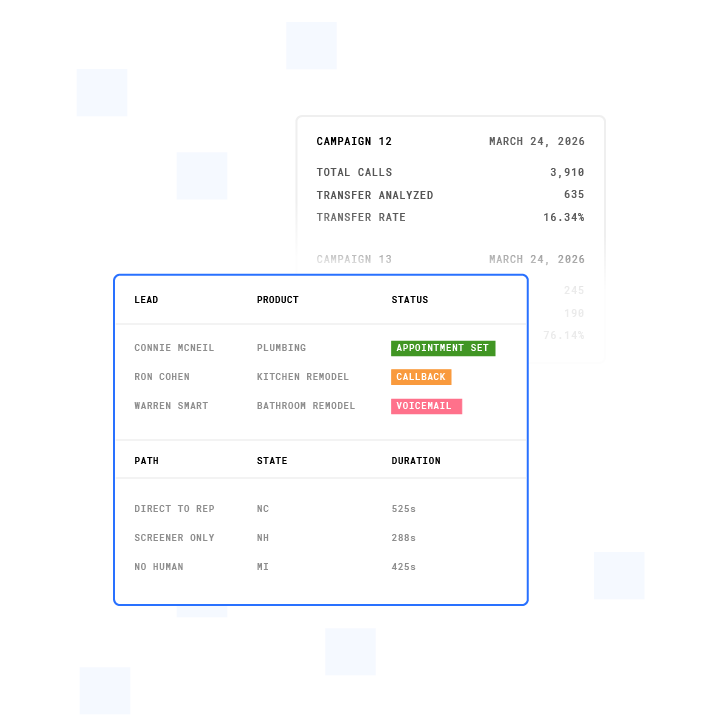
The platform’s documented proof points include:
- Under 5 seconds to first AI-powered contact, versus an industry standard of 47+ hours.3
- 3x average ROI in 90 days.
- 47% average pipeline growth.
- 90% faster lead-response time.
- 88% of outbound effort goes unanswered without the platform.
- 99.9% uptime SLA with automatic failover.
- 100% U.S. infrastructure by architecture.
Plura’s AI SMS contacts leads in under 5 seconds and qualifies them before a voice call is placed. Organizations deploying AI for speed to lead see response times drop from hours to seconds, and AI-using companies are 60% more likely to meet the 15-minute response standard than manual teams, with Hatch seeing 4x more booked appointments when response rates rose from 20% to 80%. The no-code workflow builder lets operators design memory-driven conversation pathways without engineering. Conversation intelligence surfaces what scripts close, what objections recur, and what conversion paths win, automatically across every channel.
Teams evaluating Plura against other platforms can use the comparison hub for a deeper structural breakdown. You can also run your numbers through Plura’s calculator and review plans and rates side by side.
Frequently Asked Questions
Is There An AI Dialer Specifically For Sales Teams?
An AI power dialer for sales teams is outbound calling software that sequences contacts, filters out voicemails and bad numbers using answering machine detection, and routes only live human answers to available agents. The AI layer adds prioritization based on conversion signals such as historical answer rates, prior engagement, and offer-acceptance history rather than dialing a list in order. Plura’s AI Predictive Dialer is purpose-built for high-volume outbound sales floors, with branded caller ID issued at the carrier level, real-time DNC scrubbing, and stateful memory across voice, SMS, RCS, and webchat.
Are Power Dialers Illegal?
Power dialers operate within a framework of federal and state rules that govern consent, calling hours, abandoned-call rates, and caller identification. The TCPA (47 U.S.C. § 227) describes consent requirements for calls using an autodialer or an artificial or prerecorded voice. The FTC’s Telemarketing Sales Rule (16 CFR 310.4) describes abandoned-call limits and connection timing. As covered earlier, the abandoned-call framework sets a 3% cap and a two-second connection window. The FCC’s February 2024 Declaratory Ruling confirmed that AI-generated voices fall within the TCPA’s existing restrictions. Readers should consult the relevant regulations and qualified legal counsel for guidance on their specific obligations and calling programs.
How Much Does A Power Dialer Cost?
Standalone power dialers typically run $50 to $150 per user per month for the seat license, with per-minute telephony charges added on top. AI-augmented parallel dialers from vendors like Orum run $250 or more per user per month on annual contracts. The headline per-seat price rarely reflects the actual monthly outlay. Minutes, phone numbers, recording, CRM integration, compliance tools, and number reputation monitoring are frequently gated to higher tiers or billed separately. Total cost at volume is driven by talk utilization, connect rate, seat count, plan minimums, and whether the vendor rents telecom infrastructure and passes the wrapper tax through. Plura’s Multi tier is $7,500 per month on annual contracts billed monthly with a 90-day opt-out window, with an agent build fee of $2,750 per agent. The ROI calculator shows the full cost comparison against a human agent operation at your specific volume.
Does Salesforce Have A Dialer?
Salesforce includes calling capabilities within its Sales Cloud and Einstein products, but these are not a standalone outbound power dialer. Salesforce’s AI agent capabilities focus on note-taking, calendar-booking, and CRM record management rather than high-volume outbound dialing with AMD, DNC scrubbing, branded caller ID, and stateful cross-channel memory. Teams running outbound at call-center scale typically integrate a dedicated dialer platform with Salesforce rather than relying on Salesforce’s native calling features. Plura integrates natively with Salesforce, with bidirectional sync that logs call outcomes back to the contact and opportunity record automatically.4
Is A Dialer A CRM?
A dialer and a CRM (Customer Relationship Management system) serve different functions. A CRM stores contact records, tracks deal stages, and manages customer data. A dialer automates the outbound calling workflow, sequences contacts, detects voicemails, routes live answers to agents, and logs call outcomes. Most dialers integrate with a CRM rather than replacing one. Integration depth matters operationally. A dialer that pulls the current call list from a CRM view, logs dispositions back to the record in real time, and auto-opens the contact record on connect delivers a very different experience from one that requires manual CSV exports and re-imports. Plura integrates with HubSpot, Salesforce, and Zoho natively, plus more than 50 additional tools.
What Is Answering Machine Detection?
Answering machine detection is a call-progress analysis decision made after the telephony network signals that a call has been answered. The detector has a bounded window of answer audio and must return a verdict: human, machine, or undecided. It bases that verdict on acoustic features. These include how soon after connect speech begins, how long the first utterance runs, where silences fall, and whether the audio carries the signature of a recorded greeting or a live voice. The two error types carry different costs. A false positive, where a live person is classified as a machine, produces dead air, potential abandoned-call exposure, and list burn. A false negative, where a machine is classified as a person, wastes a rep’s time on a voicemail greeting. As noted earlier, modern AI-based AMD reaches accuracy in the 96–99% range in production. AMD is distinct from voicemail drop, spam labeling, and caller ID. It only classifies the answering party.
What Is The Difference Between A Power Dialer And A Parallel Dialer?
A power dialer places one call per agent at a time and presents the next number when the agent is free. The agent hears only live answers with no overlap, and there is no abandoned-call exposure from simultaneous dialing. A parallel dialer places multiple lines per agent simultaneously, typically 5 to 10, and routes the first live answer to an available rep while dropping the other connections. Parallel dialing increases raw dial volume but introduces a connect pause that prospects recognize as an automated call. High-volume simultaneous dialing is one of the primary triggers carriers use to flag numbers as “Spam Likely.” An AI-augmented dialer layers detection, prioritization, and filtering on top of either model and decides who to dial next based on conversion signals rather than list order. As described in the taxonomy section, the key difference is the connect pause and the associated abandoned-call and reputation exposure.
Test Plura’s AI Predictive Dialer on your own list before you commit.
1 Plura AI maintains SOC 2, HIPAA, ISO, and GDPR posture as part of its platform infrastructure. References to compliance frameworks in this article describe Plura’s platform capabilities and do not constitute a guarantee that any customer using Plura will themselves be compliant with applicable laws or standards. Customers remain solely responsible for their own regulatory obligations, certifications, consent management, recordkeeping, and the claims they make to their own end users. Consult qualified legal counsel for guidance specific to your use case.
2 This article describes regulatory frameworks at a general level and does not constitute legal advice. Laws and regulations vary by jurisdiction, change over time, and apply differently depending on facts and circumstances. Readers should consult qualified legal counsel before making compliance decisions.
3 Performance figures, customer outcomes, and industry statistics referenced in this article are drawn from cited third-party sources or Plura customer case studies. Individual results vary based on implementation, use case, industry, audience, and execution. Past or aggregate performance is not a guarantee of future results.
4 References to third-party products, services, companies, or research are made for informational and comparative purposes only. Plura AI is not affiliated with, endorsed by, or sponsored by any third party named in this article unless explicitly stated. Trademarks and product names referenced remain the property of their respective owners.
This article is provided for informational purposes only and reflects Plura AI’s understanding at the time of publication. Product capabilities, integrations, and specifications are subject to change. For the most current information, visit plura.ai.
This article was produced with the assistance of AI tools and reviewed by Plura AI prior to publication.