
Written by: Matt Beucler, CEO, Plura AI
Updated September 14, 2026
The Cost Of Over-Aggressive Predictive Dialer Pacing
Over-aggressive pacing is the single most expensive predictive dialer mistake. The FTC’s Telemarketing Sales Rule caps abandoned calls at 3% of calls answered by a live person, measured per campaign over each successive 30-day period, and the FCC’s TCPA rules carry the same 3% threshold.2 Each abandoned call above that ceiling is a separate violation. FTC civil penalties run up to $53,088 per violation as of 2026, and TCPA statutory damages range from $500 to $1,500 per call. A single misconfigured campaign can generate hundreds of violations before the day ends.
See Plura AI pacing and abandonment controls in a live demo.
Key Takeaways
- Most predictive dialer issues start as configuration problems with clear symptoms and direct fixes.
- A smaller set of structural problems involve carrier-level deliverability, consent, and vendor infrastructure.
- Pacing and agent-count decisions drive abandonment exposure and determine whether predictive mode makes sense.
- List, consent, and caller ID reputation practices shape both compliance risk and connection rates.
- Monitoring, reporting, and vendor selection choices decide whether these risks stay visible and manageable.
Mistake 1: Over-Aggressive Dial Ratio And The Abandon Cap
Symptom: Abandon rate creeping toward or past the regulatory cap, agents reporting dead air on connected calls, and rolling campaign logs showing bursts of unanswered connections.
Root cause: The dial ratio is set to maximize talk time instead of matching the list’s actual connect rate. At a 1.5:1 dial-to-agent ratio abandonment may run around 1%, but pushing the ratio to 3:1 or higher can spike abandonment into the 8–12% range depending on call duration variability and agent availability.3 A predictive dialer calibrated for a list connecting at 12–15% will over-dial on a cold list connecting at 4–6%, which generates more answered calls than agents can handle.
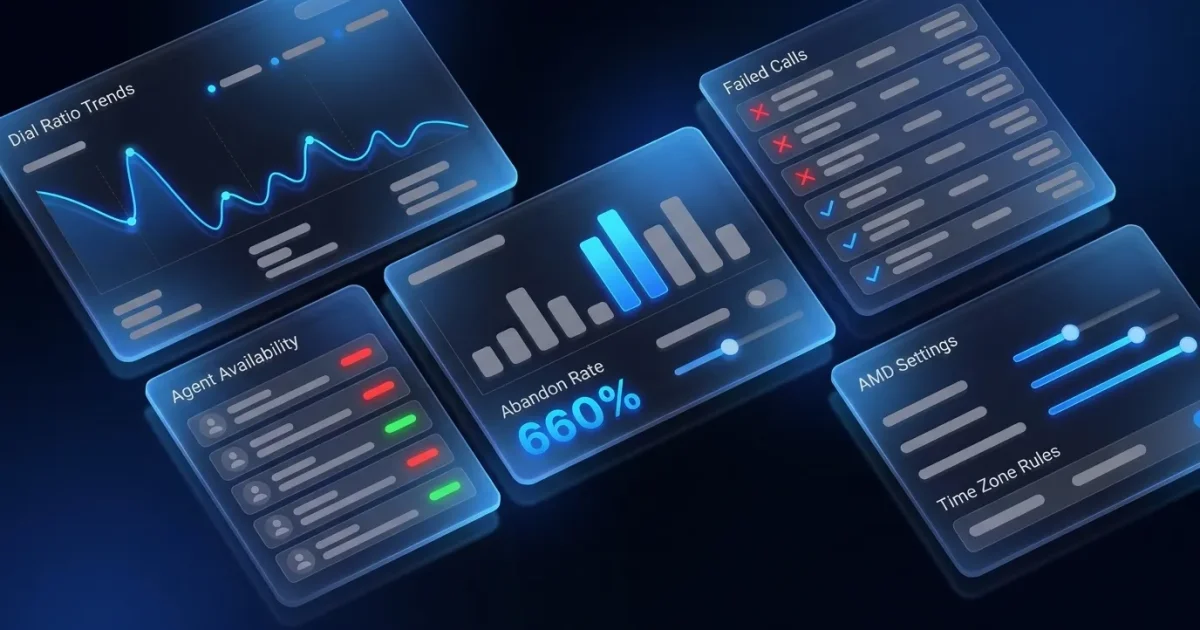
Fix: Start by lowering the dial ratio, because that input most directly drives over-dialing. If the campaign still needs more talk time than the list can support at that ratio, add agents or extend wrap-up time so the model has more available capacity. For list segments where those options are not practical, move that segment to progressive dialing. Set an internal abandonment alert below the regulatory ceiling so the system throttles before the campaign breaches the cap. The FTC’s TSR safe harbor describes conditions for abandonment rate, minimum ring time, recorded identification messages, and recordkeeping. Operators can review those conditions directly with qualified counsel.
Mistake 2: Running Predictive Dialing With Too Few Agents
Symptom: High abandonment, long hold times, agents alternating between idle and slammed, and pacing that looks correct in configuration but produces erratic results in practice.
Root cause: Predictive pacing is a statistical estimation problem. Below roughly 8–15 concurrent outbound agents, predictive pacing statistics do not have enough call volume to stabilize, so a team carries predictive compliance exposure without the throughput gain that is supposed to justify it. With three agents, a single unusually long call represents a third of the floor and skews the average, which causes over-dialing and abandon spikes.
Fix: For teams below this agent-count threshold, move to a power dialer or progressive dialing. A power dialer places one call per available agent and structurally avoids the abandonment pattern that predictive mode creates at small scale. The comparison table later in this article lays out the agent-count expectations and abandonment profiles for each dialing mode.
Mistake 3: Answering Machine Detection (AMD) Misconfiguration
Symptom: Dead air on live connects, agents talking to voicemail greetings, wasted agent time, and ghost abandonment that does not appear in standard reporting.
Root cause: AMD sensitivity is set too aggressively or too loosely. Stock Asterisk AMD runs false-positive rates in the 15–25% range in many production environments, so roughly one in five live contacts can be misclassified as a machine and receive dead air. These ghost calls accelerate caller ID flagging and quietly consume abandonment headroom.
Fix: Tune AMD thresholds against labeled recordings from the actual campaign, carrier mix, and calling hours. Change one variable at a time so the impact stays clear. Track false-positive and false-negative rates separately, not just overall accuracy. Key Asterisk AMD variables include initial_silence, greeting, after_greeting_silence, total_analysis_time, and maximum_number_of_words. AI-based AMD engines that use acoustic fingerprints instead of silence timing can reduce false positives compared with heuristic defaults.
Mistake 4: List Hygiene And DNC/Consent Failures
Symptom: Rising blocked or flagged numbers, consumer complaints, compliance escalations, and carrier spam labels appearing on previously clean numbers.
Root cause: Stale lists, missing real-time DNC scrubbing, and consent records that are not timestamped or auditable. The National Do Not Call Registry holds more than 249 million active registered phone numbers, and telemarketers are expected to access and scrub their call lists against it at least every 31 days2. A list with a high percentage of disconnected or wrong numbers also inflates the dial-to-abandon ratio and can push a campaign over the abandonment threshold even when pacing looks correct.
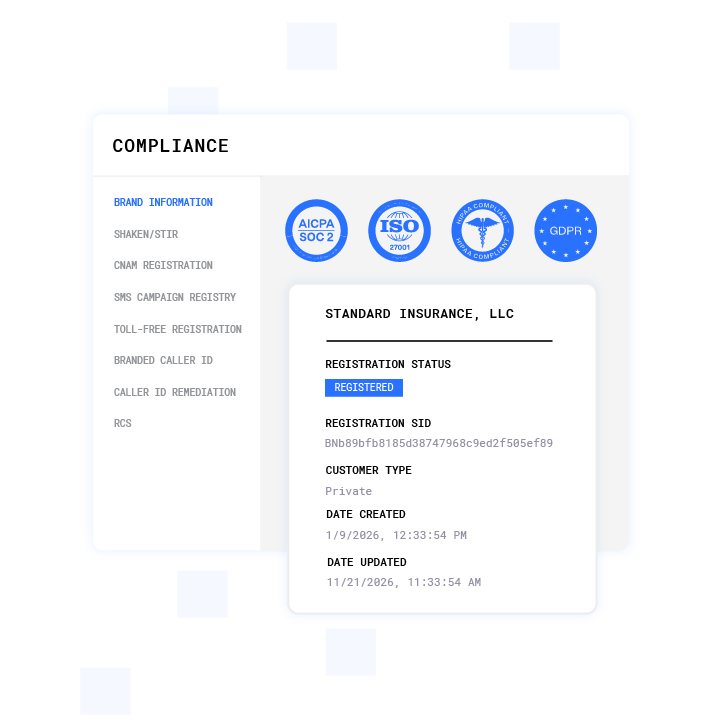
Fix: Scrub against federal and state DNC registries before each dial session. Maintain immutable, timestamped consent records and remove numbers that have opted out. Review the FTC’s TSR guidance and FCC TCPA rules directly, and work with qualified counsel on consent standards for each campaign. Treat list validation as a core campaign cost so it receives the same attention as media and staffing.
Mistake 5: Wrap-Up Time And Pacing Mismatch
Symptom: Abandonment spikes even though agents appear available on the dashboard, and pacing looks correct in configuration but behaves unpredictably during live sessions.
Root cause: The dialer treats agents as free the moment a call ends, while agents are still in after-call work (ACW) documenting the conversation. If ACW averages four minutes but the dialer assumes two minutes, the pacing model is structurally wrong from the start. The algorithm dials ahead expecting agents who are not actually available, which produces abandoned calls that look like a pacing issue but originate in bad handle-time inputs.
Fix: Audit after-call work time by campaign type and agent cohort. Feed actual ACW averages into the dialer configuration. Measure handle time alongside talk time, and recalibrate pacing inputs whenever campaign type or agent mix changes. Automated disposition sync can cut post-call wrap time from 45–90 seconds to under 10 seconds, which improves pacing accuracy and agent capacity.
Mistake 6: Time-Zone And Calling-Window Violations
Symptom: Consumer complaints clustered around early morning or late evening calls, attention from state attorneys general, and lower answer rates on specific geographic segments.
Root cause: Calling-window rules are applied based on the call center’s time zone instead of the contact’s location. The TSR’s time-of-day rule describes quiet hours using the consumer’s local time zone. A call center in Eastern time that dials Pacific contacts at 8:00 a.m. Eastern is reaching those contacts at 5:00 a.m. local time.
Fix: Enforce quiet hours using the contact’s time zone derived from the number, not the call center’s location. State-level rules add another layer. Pennsylvania’s Act No. 47 of 2026, for example, limits telemarketing solicitations on Sundays and tightens weekday calling windows. Operators should review state-specific calling windows with qualified counsel and configure the dialer to apply the most restrictive applicable rule per contact.
Mistake 7: Deliverability Failure, Spam Labeling, STIR/SHAKEN, And iOS 26 Screening
Symptom: Connect rates collapse regardless of pacing configuration, calls display as “Spam Likely” or “Scam Risk” on recipient devices, and unfamiliar numbers are screened before they ring through.
Root cause: Caller ID reputation and authentication issues at the carrier level, combined with device-level screening. When a business phone number displays as “Spam Likely,” answer rates typically drop 40 to 60 percent, and the drop often happens overnight after a labeling event4. STIR/SHAKEN authentication does not prevent spam labeling on its own. A significant share of spam-labeled traffic carries A-level STIR/SHAKEN attestation, which shows that fully authenticated calls can still be flagged. iOS 26’s “Ask Reason for Calling” feature answers unknown calls, asks the caller to identify themselves, and shows the reply on screen before the recipient decides whether to pick up. Predictive dialers cannot respond to that prompt because no live caller is present at the moment of screening.
Fix: Use branded caller ID issued at the carrier level, A-level STIR/SHAKEN attestation on every outbound call, and active number-reputation management across AT&T, Verizon, T-Mobile, and major analytics providers. Work with carriers that explicitly provide A-level attestation for business customers and maintain direct carrier relationships instead of reselling services. This deliverability landscape requires control at the carrier layer, which point tools built on third-party CPaaS infrastructure cannot fully provide because they do not issue branded caller ID under their own carrier identity.
Mistake 8: Monitoring And Measurement Gaps
Symptom: Leaders chase higher talk time while conversion and connection rates fall, and managers cannot see whether pacing, list quality, AMD, or deliverability is driving the problem.
Root cause: Teams track a single metric, often calls-per-agent-hour or total dials, instead of viewing abandonment rate, connection rate, right-party contact rate, and handle time together. Measuring abandonment rate by hour instead of only as a daily average exposes compliance drift before it becomes a campaign-level issue. A campaign that looks compliant on a daily rollup can be running at double the target abandonment rate during peak hours.
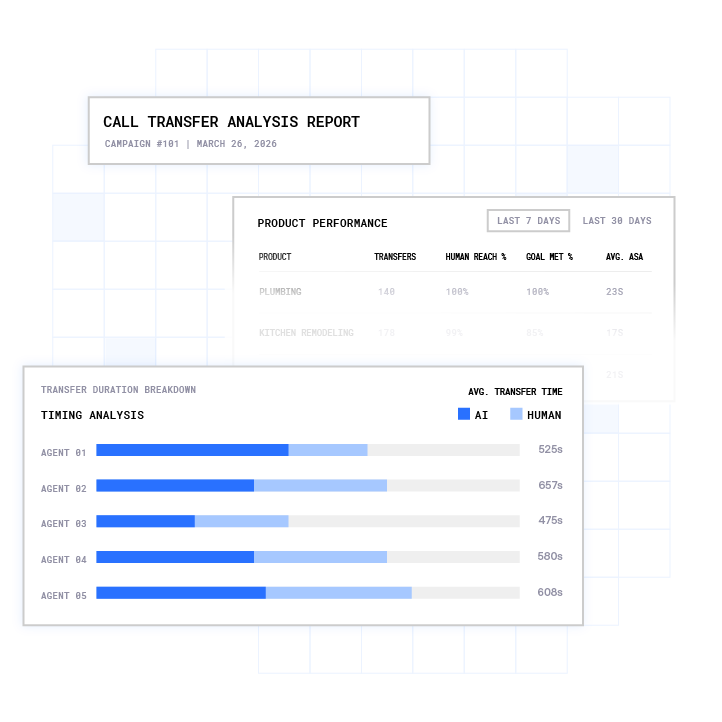
Fix: Build a dashboard that tracks abandonment rate per hour, connection rate, right-party contact rate, and cost per qualified outcome. Review this dashboard while campaigns are live so leaders can intervene in real time. Configure automated alerts using the abandonment threshold described in Mistake 1, and assign clear disposition codes to every call outcome so the underlying counts stay accurate enough for those alerts to matter.
Mistake 9: Overlooking Regulatory Risk In Vendor Selection
Symptom: An outbound stack that depends on offshore infrastructure or third-party telecom resellers, with no clear view into where voice originates, where data is stored, or how compliance controls apply before dial.
Root cause: The FCC’s Notice of Proposed Rulemaking (CG Docket No. 26-52) proposes capping offshore customer-service calls. It also proposes restricting offshore handling of sensitive consumer data such as passwords, Social Security numbers, and payment data. Companion legislation includes the Keep Call Centers in America Act (S.2495) and the Foreign Robocall Elimination Act (S.2666). State laws in New York, New Jersey, Connecticut, Missouri, and Florida already address offshore handling of medical, financial, and consumer data. Outbound stacks with foreign infrastructure dependencies now face a different regulatory landscape than they did two years ago.
Fix: Evaluate vendors on where voice originates, where data resides, and how compliance controls apply inside the platform before dial. Ask whether the vendor is an FCC-licensed carrier or a reseller operating on a third-party CPaaS. That answer determines whether branded caller ID, real-time DNC scrubbing, and STIR/SHAKEN authentication function as core platform capabilities or external add-ons. Work with qualified counsel to interpret the FCC NPRM and state laws for your specific operations.
Review Plura AI’s carrier-level architecture and compliance controls in a live session.
Choosing Predictive, Progressive, Or Power Dialing For Your Team
Dialing mode should match agent count, list quality, and compliance tolerance. The comparison below highlights why agent count often becomes the deciding factor: predictive dialing carries inherent abandon risk that only stabilizes at higher team sizes.
| Mode | Minimum Agents | Abandon Risk | Best Fit |
|---|---|---|---|
| Predictive | Commonly cited minimum of 8–15 concurrent agents | Inherent at higher dial ratios, requires real-time monitoring and throttling to stay under regulatory caps | High-volume B2C campaigns with prior express written consent, large agent pools, and dedicated compliance monitoring |
| Progressive | Works at any scale, including very small teams | Near zero, one call placed per available agent by design | Mid-size teams, compliance-sensitive campaigns, and high-value lists where each contact matters |
| Power | No statistical minimum, suitable for small SDR teams | Zero at a 1:1 ratio, with some risk at multi-line ratios if more than one call answers at once | Small outbound teams under roughly 15 agents, structured prospecting, and B2B campaigns with variable list quality |
Predictive dialing can produce roughly 70% more contacts per hour than progressive but consumes leads much faster and expects a larger agent pool. Mobile answer rates for unknown numbers in the US have fallen from roughly 25–30% in 2015 to between 8% and 12% in 2026.3 That shift compresses predictive’s productivity advantage and raises the compliance cost of aggressive pacing. Teams considering a move from predictive to progressive or power dialing should model abandonment exposure against expected talk-time gains before deciding.
The Structural Fix With Plura AI
The nine mistakes in this article fall into two groups. Configuration problems have visible symptoms and specific fixes. Structural problems involve deliverability, consent, and pacing at the carrier and infrastructure level, where point tools can only patch around limitations they do not control.
Plura AI is its own FCC-licensed audio bridging carrier, so voice does not route through a third-party CPaaS. That distinction affects every issue described above. Plura issues branded caller ID at the carrier level and runs STIR/SHAKEN authentication on every outbound call, which addresses deliverability failures that pacing changes cannot solve. The platform supports compliance with real-time DNC scrubbing, TCPA-litigator screening, automated quiet hours by contact time zone, and immutable consent logging inside the platform before dial.
Plura’s AI Predictive Dialer shares a Stateful Conversation Database with AI Voice, AI SMS, AI RCS, and AI Webchat, so context follows each customer across channels. An agent who texted a lead at 9 a.m. can take the noon call with full history in view. The platform runs on 100% U.S. infrastructure by architecture, which addresses vendor-selection risk under the FCC NPRM and state onshoring laws for stacks that depend on foreign infrastructure.
For teams evaluating CRM integration and compliance posture together, Plura’s compliance engine functions as a core layer of the platform. Leaders can compare plans and rates side by side to understand the structural cost of carrier-grade controls versus point-tool alternatives.
Frequently Asked Questions
Are Predictive Dialers Illegal?
Predictive dialers operate within a regulatory framework that includes the FTC’s Telemarketing Sales Rule, the FCC’s TCPA rules, and multiple state statutes. The TCPA’s autodialer classification, abandoned-call limits, consent standards, and calling-window rules can all apply depending on campaign type, list source, and jurisdiction. The landscape has grown more complex in 2026 with new state laws and pending federal rulemaking. Operators should review the FTC’s TSR guidance, the FCC’s TCPA rules, and work with qualified telemarketing counsel to understand how these frameworks apply to their specific operations.
How Should You Audit An Existing Predictive Dialer Configuration?
Start with a focused review of pacing, agent-count assumptions, and wrap-up time. Compare configured dial ratios and ACW settings against actual connect rates and handle times from recent campaigns. Next, pull a sample of recorded calls to evaluate AMD behavior, looking for dead air on live connects and misclassified voicemail. Then, review list-management workflows, including DNC scrubbing cadence, consent record storage, and opt-out handling. Finally, inspect monitoring dashboards and alert thresholds to confirm that abandonment, connection rate, and right-party contact rate are visible by hour, not only as daily averages.
What Documentation Should You Retain For A Compliance Review?
Contact centers often retain several categories of records for potential review. These can include dialer configuration snapshots, pacing and ACW settings by campaign, and historical abandonment and connection reports. Many teams also store DNC-scrub logs, consent records with timestamps and source detail, and recordings or transcripts that show how disclosures and opt-outs are handled. Quiet-hours configuration by time zone and vendor contracts describing carrier relationships and data locations can also be relevant. Counsel can advise which records matter most for a specific regulatory framework.
How Often Should You Recalibrate Pacing Inputs?
Recalibration typically follows changes in campaign type, list source, or agent mix. When a new list source comes online, leaders can run a short pilot to measure connect rate, handle time, and AMD performance, then adjust dial ratios and ACW assumptions accordingly. Seasonal shifts in answer behavior or staffing changes on the floor can also justify a fresh calibration. Many teams schedule a quarterly pacing review that compares configuration settings against observed performance and checks that abandonment and alert thresholds still align with current risk tolerance.
How Does Caller ID Reputation Affect Connect Rates?
Caller ID reputation now ranks among the primary drivers of whether an outbound call reaches a live person. Carrier analytics engines at AT&T, Verizon, and T-Mobile score outbound numbers on five signals: call volume, average call duration, answer rates, complaint data, and STIR/SHAKEN attestation level. The overnight answer-rate drop described in Mistake 7 often follows a spam-label event, and the decline can reinforce itself as lower answer rates further damage reputation. Calls authenticated at A-level (Full Attestation) generally see better delivery than calls at B-level or C-level, although attestation alone does not prevent labeling when behavioral signals look risky. Branded caller ID, which displays a company name and call reason on the recipient’s screen, improves recognition but typically requires a direct carrier relationship to implement.
Conclusion: Fix Configuration First, Then Address Structure
Most predictive dialer mistakes trace back to configuration choices that show up clearly in dashboards and recordings. The nine failure modes in this guide cover the bulk of abandoned-call issues, connect-rate drops, and compliance escalations that leaders see in daily operations. Each has a recognizable symptom, a root cause, and a configuration change that addresses it.
A smaller set of failures sit at the structural layer. Deliverability problems tied to spam labeling and weak STIR/SHAKEN attestation, consent and DNC gaps, and offshore or reseller infrastructure all live below the dialer interface. These issues require carrier-level control and architectural decisions, not only pacing tweaks.
Plura AI focuses on that structural layer. As an FCC-licensed carrier, Plura issues branded caller ID, runs STIR/SHAKEN authentication at the carrier level, supports compliance with real-time DNC scrubbing and TCPA-litigator screening before dial, and operates on 100% U.S. infrastructure by design. The AI Predictive Dialer sits alongside AI Voice, AI SMS, AI RCS, and AI Webchat in a shared Stateful Conversation Database so every contact carries context across channels.
Walk through Plura’s pacing controls, carrier architecture, and reporting in a live demo.
Compare plans and rates side by side, or check your ROI with your own numbers.
1 Plura AI maintains SOC 2, HIPAA, ISO, and GDPR posture as part of its platform infrastructure. References to compliance frameworks in this article describe Plura’s platform capabilities and do not constitute a guarantee that any customer using Plura will themselves be compliant with applicable laws or standards. Customers remain solely responsible for their own regulatory obligations, certifications, consent management, recordkeeping, and the claims they make to their own end users. Consult qualified legal counsel for guidance specific to your use case.
2 This article describes regulatory frameworks at a general level and does not constitute legal advice. Laws and regulations vary by jurisdiction, change over time, and apply differently depending on facts and circumstances. Readers should consult qualified legal counsel before making compliance decisions.
3 Performance figures, customer outcomes, and industry statistics referenced in this article are drawn from cited third-party sources or Plura customer case studies. Individual results vary based on implementation, use case, industry, audience, and execution. Past or aggregate performance is not a guarantee of future results.
4 References to third-party products, services, companies, or research are made for informational and comparative purposes only. Plura AI is not affiliated with, endorsed by, or sponsored by any third party named in this article unless explicitly stated. Trademarks and product names referenced remain the property of their respective owners.
This article is provided for informational purposes only and reflects Plura AI’s understanding at the time of publication. Product capabilities, integrations, and specifications are subject to change. For the most current information, visit plura.ai.
This article was produced with the assistance of AI tools and reviewed by Plura AI prior to publication.