
Written by: Matt Beucler, CEO, Plura AI
Key Takeaways
- Call center software reviews in 2026 split between human-seat CCaaS platforms and AI-agent platforms that replace seats.
- Legacy review sites focus on UI and uptime but skip cost-per-conversation economics and carrier-level deliverability metrics.
- Plura AI owns its FCC-licensed carrier stack, which changes how caller ID and compliance are handled.
- Per-conversation pricing at 100% utilization can reduce monthly operating costs compared with traditional human-seat staffing at similar volume.
- See how the AI-agent model handles your call volume in a live demo tailored to your operation.
What Call Center Software Reviews Actually Tell You in 2026
G2’s contact center category and Capterra’s call center software listings aggregate thousands of reviews written by users of human-seat platforms. TrustRadius and SoftwareReviews do the same. The feedback is real, but the framework no longer matches how these platforms are bought and sold.
The dominant 2026 listicles recycle 2024 feature descriptions and pre-AI pricing logic. They describe support responsiveness, UI quality, and uptime. They leave out several core buying questions:
- What the platform costs per conversation
- What happens to seat-based pricing when AI handles the majority of contacts
- Whether the platform issues branded caller ID at the carrier level or rents it from a third-party CPaaS (Communications Platform as a Service: the API-only telecom layer that providers like Twilio sell to AI vendors who do not own their own carrier)
- Whether compliance enforcement happens before dial or as a paperwork layer after the fact
That gap drives this article. Two questions decide most purchases: what each option costs per conversation, and whether calls reliably connect. Those questions are absent from every top-ranking review page on the SERP today.
The Category Split: Human-Seat CCaaS vs AI-Agent Platforms
The table below organizes the category by operating model, not star ratings. Every data point is cited inline.
| Attribute | Human-Seat CCaaS | AI-Agent Platforms |
|---|---|---|
| Pricing unit | Per agent seat per month, with Talkdesk publishing $85-$225/user/month across four tiers (verified June 2026) | Per conversation or per hour of AI talk time that scales with volume, not headcount |
| Talk utilization | Around 40% for human agents because of idle time, breaks, and after-call work | 100% because AI agents run continuously with no idle time |
| Annual agent turnover | 30-45% industry average | 0% attrition, with no ramp time and no retraining cost |
| Carrier stack | Typically rented from a third-party CPaaS, with caller ID issued by the CPaaS rather than the platform | Plura owns its FCC-licensed audio bridging carrier and issues branded caller ID at the carrier level |
| Compliance enforcement | Varies by vendor and often sits as a post-dial layer | Real-time DNC scrubbing before dial, TCPA consent logging, and automated quiet-hours enforcement |
Legacy CCaaS vendors such as Zendesk, Talkdesk, Five9, Nextiva, Aircall, LiveAgent, Genesys, NICE CXone, and RingCentral operate on the human-seat model.4 They were built for human agents and later added AI features. That architecture defines how they fit into a selection process.
Plura’s ICP (ideal customer profile) floor is at least 500 daily customer interactions or at least $5,000 per month in paid-media spend. Below that volume, an AI-agent platform of this depth rarely generates enough ROI to justify the build.
See the AI-agent operating model on real call center volume in a live Plura demo.
What the Reviews Do Not Cover: Cost Per Conversation
The category split above shows that pricing units differ fundamentally. To compare them, buyers need a common metric: cost per conversation. Plura’s ROI calculator publishes the unit economics the rest of the SERP omits. The illustrative 15-agent scenario at default inputs shows the following:
- Human agents: 15 agents at $20/hour, 25% taxes, benefits, and commissions, and 40% talk utilization, which totals $60,000/month3
- Plura agents: 6 AI agents at $15/hour and 100% talk utilization handling equivalent volume, which totals $14,400/month3
- 30-day savings: $45,600
- 12-month savings: $547,200
- 60-month savings: $2,736,000
For higher-volume operations, Plura’s TCO of $700,000 replaces traditional contact-center economics of $7 million on equivalent volume. According to Gartner’s Customer Service Cost Optimization research and cost-to-serve benchmarks, agent labor accounts for 60-70% of operating costs and 60-75% of total cost-to-serve.4 Workforce strategy is therefore the primary lever for cost reduction.
For competitor pricing, published per-seat list pricing remains the only reliable reference. Talkdesk’s four tiers run $85-$225/user/month as of June 2026. Published 2026 CCaaS per-seat pricing ranges from $30 at Aircall Essentials to $225 at Talkdesk Industry Experience Clouds, with Five9 Digital at $119 and Core at $159 with a 50-seat minimum. Seat-based pricing cannot directly answer cost per conversation because it ties cost to headcount rather than completed interactions.
Run your numbers through Plura’s cost savings calculator to check ROI in real time. Then compare pricing plans and rates side by side at your actual volume.
Compliance and Deliverability as Selection Criteria
No top-ranking call center software review treats compliance and deliverability as a core selection criterion. For regulated verticals such as healthcare, insurance, financial services, and legal, this factor often carries the most weight.
The mechanics affect daily operations. Calls that present as “Spam Likely” or an unfamiliar number rarely get answered. Operators see answer rates on cold lists of 12-15% with A-level STIR/SHAKEN attestation. With B-level attestation, rates drop to 6-8%, and with C-level they fall under 3%, where campaigns effectively die. Platforms that rent their carrier layer from a third-party CPaaS cannot issue caller ID under their own identity and have limited control over attestation level.
Plura owns its FCC-licensed audio bridging carrier, which enables a connected set of capabilities that directly affect answer rates and audit readiness. Branded caller ID is issued at the carrier level so calls present with the company’s name instead of “Unknown” or “Spam Likely”. STIR/SHAKEN (Secure Telephone Identity Revisited/Signature-based Handling of Asserted information using toKENs) authentication runs on every outbound call, and as of September 18, 2025, every voice service provider with a STIR/SHAKEN implementation obligation must sign calls with its own digital certificate, which Plura satisfies through its own FCC carrier license. Real-time DNC scrubbing blocks non-compliant numbers before dial. TCPA (Telephone Consumer Protection Act, 47 U.S.C. § 227) consent logging is timestamped and immutable, with audit-ready records on demand. Automated quiet-hours enforcement applies state and federal calling-window rules by time-zone detection.2 Voice origination, model hosting, data storage, and call recording all run on 100% U.S. infrastructure by architecture.
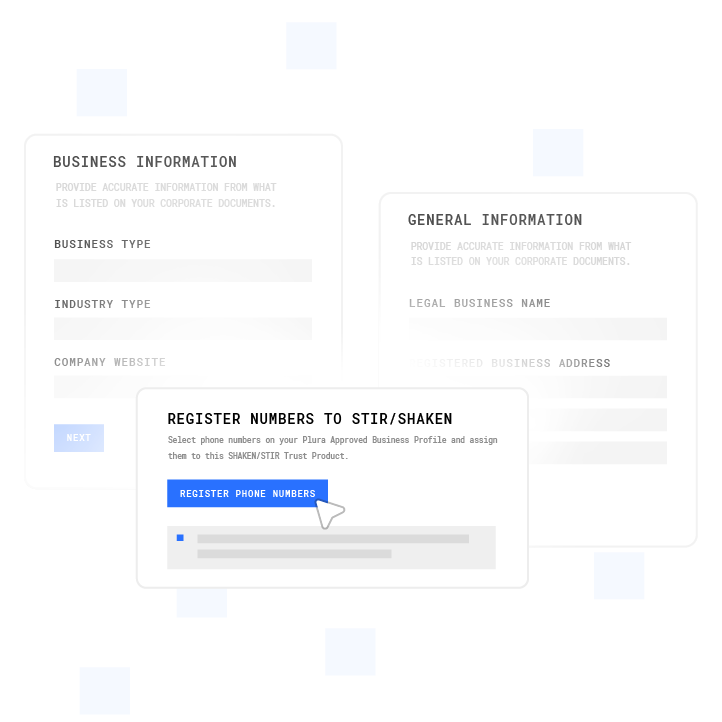
Plura supports compliance with TCPA, DNC, HIPAA (Health Insurance Portability and Accountability Act), SOC 2, and GDPR (General Data Protection Regulation).1 Customers remain responsible for their own regulatory obligations and should consult qualified counsel on their specific compliance posture. Plura provides infrastructure that supports compliance workflows; downstream compliance remains the customer’s responsibility.
The FCC’s October 2025 Further Notice of Proposed Rulemaking (FNPRM) under CG Docket Nos. 17-59, 02-278, and 25-307 describes a direction where terminating providers transmit verified caller name information whenever A-level STIR/SHAKEN attestation is present. That direction rewards platforms with genuine carrier-level identity and disadvantages CPaaS resellers. Buyers should consult the Federal Register and qualified counsel for current obligations.
Plura’s integrations connect the compliance layer to the CRM record so consent status, DNC flags, and quiet-hours rules travel with the customer record across every channel.
Will Call Centers Be Replaced by AI?
Compliance and deliverability determine whether calls connect. The next question is who or what handles those calls. For a software buyer, the more useful question is which parts of the volume an AI-agent platform should absorb first, such as inbound qualification, missed-call recovery, after-hours coverage, and follow-up cadences, and which parts stay human.
Forrester’s May 2026 report “AI Agents Reshape the Customer Service Workforce in Dramatic Ways” (RES195008) predicts AI will cut the number of customer service jobs in half by 2030, with organizations that receive high volumes of lower-complexity inquiries seeing the greatest staff reductions.5 The same source notes that Gartner expects that among organizations planning to severely reduce contact center headcount due to AI, half will drop such plans by 2027. Many teams instead reduce headcount through attrition.
The buying decision often turns on agent attrition as a cost driver. Customer support agent attrition averages 38-45% annually industry-wide, a rate roughly three to four times higher than the broader U.S. workforce, per ICMI’s Contact Center Benchmark Report (2025). Replacing a single agent costs $10,000-$20,000 in direct costs and up to $46,000 fully loaded, per SHRM’s 2024 Benchmarking Report. Seat-based pricing hides that cost, while per-conversation pricing makes it visible.
Plura’s AI voice agent handles inbound qualification, 24/7 call answering, and outbound follow-up cadences. Because it runs at 100% talk utilization, it delivers these workflows with zero attrition. The AI Predictive Dialer replaces legacy outbound infrastructure with stateful conversion signals and branded caller ID on every dial.
CRM Integrations That Actually Support Call Center Operations
The right CRM for a call center depends on integration depth rather than brand. The key distinction sits between screen-pop, one-way sync, and native two-way sync. Screen-pop opens the caller record automatically before the agent answers. One-way sync logs call data to the CRM after the call. Native two-way sync lets the AI agent read and write the customer record mid-conversation with real-time bidirectional data flow.
Native CRM integrations connect directly to the CRM with sub-60-second sync time and full field mapping, while bridge-based integrations route data through middleware such as Zapier or Make, adding 5-30 minutes of sync delay and limiting field mapping depth, per FreJun’s 2026 buyer’s guide. Teams that deploy bridge-based CRM integrations report CRM data quality degradation within 60 days, per G2 buyer reviews from Q1 2026.
Plura integrates with more than 50 tools across CRMs, calendars, attribution platforms, document signers, payment processors, and data enrichment providers. Supported CRMs include HubSpot, Salesforce, and Zoho. Connect your CRM and the AI agent reads and writes the customer record mid-conversation, including pricing offers made, objections raised, and qualification status, across every channel through the Stateful Conversation Database.
Migration and Time-to-Live for AI-Agent Deployments
Switching platforms consumes weeks and often introduces downtime that vendor marketing rarely quantifies. Mid-market CCaaS migrations from on-premise systems typically take 3-4 months, and enterprise migrations from Avaya Aura, Cisco UCCE, or legacy Genesys Engage run 9-12 months elapsed, per ContactCenterNation’s 2026 CCaaS implementation timeline guide. Number porting takes four to eight weeks per region, and implementation services consume 50-100% of Year-1 license cost for mid-market migrations.
Plura’s onboarding sequence follows a consistent pattern across deployments:
- Discovery audit of the customer’s business and call economics
- Intake of sample calls, SOPs, and existing scripts
- Overnight build of a dynamic conversation mockup
- Walkthrough and iteration meeting
- Engineering build of the production workflow
- Pilot test on a subset of real calls
- Full go-live
Simple inbound qualification flows are typically built in days. Complex multi-step intake, such as a 25-question health-history survey, runs closer to one to two months because the workflow logic itself takes time to design and validate. Annual contracts include a 90-day opt-out window so operators can exit if the deployment does not deliver.
Operators migrating from legacy outbound infrastructure can use Plura’s Vici Dial alternative to replace the dialer layer without rebuilding the entire contact center stack.
Walk through the migration sequence for your specific call center setup in a live Plura demo.
How to Run This Evaluation Yourself
Use these six questions to separate operating models before you book a single demo:
- Do you clear the volume threshold? Count daily interactions and monthly paid-media spend. Plura’s ICP floor is 500 daily interactions or $5,000/month in paid-media spend.
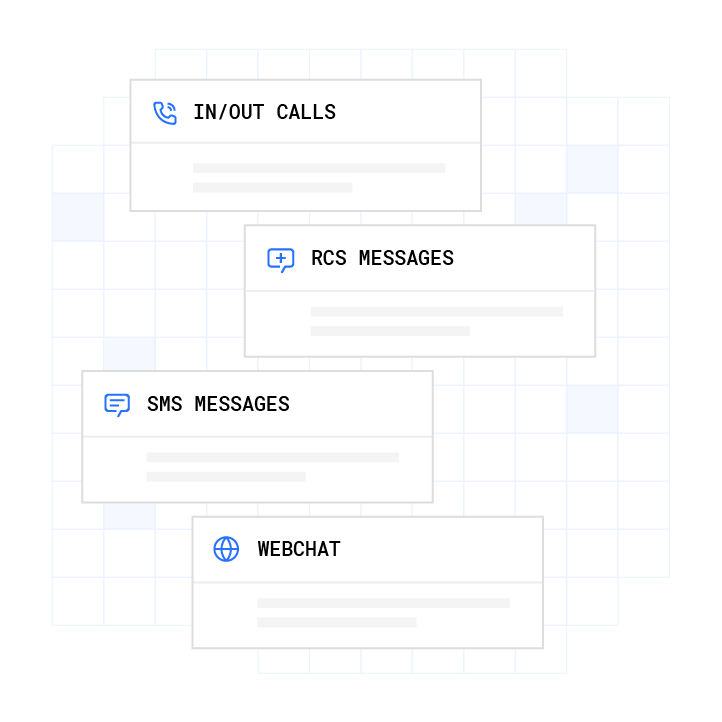
- What is your channel mix? Map voice, SMS, RCS, and webchat, and decide whether you need shared memory across them so a customer who texted at 9 a.m. is recognized when the call comes at noon.
- What is your compliance exposure by state and vertical? List TCPA, DNC, HIPAA, and state-specific calling-window obligations. Consult qualified counsel on your specific posture.
- Does the platform issue branded caller ID under its own carrier identity, or does it rent from a CPaaS? Ask for the FCC carrier license number.
- What is the cost per conversation rather than cost per seat? Model both sides of the comparison using the same volume inputs.
- What happens to pricing when AI handles the majority of volume? Seat-based pricing scales with headcount, while per-conversation pricing scales with outcomes.
After running the six-question evaluation, buyers tend to raise the same follow-up questions when comparing call center software. The FAQ below addresses those patterns directly.
Frequently Asked Questions
What Is the Best Call Center Software?
The answer depends on operating model. Human-seat CCaaS platforms such as Zendesk, Talkdesk, Five9, Nextiva, Aircall, LiveAgent, Genesys, NICE CXone, and RingCentral fit operations that require large human agent teams and seat-based workforce management. For high-volume operators at 500 or more daily interactions, the AI-agent category usually fits better. Within that category, Plura AI combines carrier ownership, stateful memory across voice, SMS, RCS, and webchat, and per-conversation pricing.
How Much Does Call Center Software Cost Per Agent?
Human-seat CCaaS platforms publish per-seat list pricing ranging from $30 to $225 per user per month depending on vendor and tier. Those figures exclude PSTN minutes, AI add-on consumption, implementation services, and storage overages, and they do not answer cost per conversation. As shown in the cost-per-conversation section above, Plura’s published calculator illustrates an example scenario where per-conversation pricing yields a substantial reduction in monthly operating costs. The full breakdown is available in Plura’s ROI calculator.
What Are the Four Types of Call Centers?
The four standard types are inbound (handling incoming customer calls), outbound (placing calls to prospects or customers), blended (handling both inbound and outbound in the same operation), and contact center or omnichannel (handling voice plus digital channels such as SMS, RCS, webchat, and email in a unified platform). AI-agent platforms operate across all four types simultaneously with shared conversation memory across every channel.
Does Call Center Software Handle TCPA and DNC Compliance?
Coverage depends on the platform’s architecture. Many platforms treat compliance as a paperwork layer after the fact. Plura’s compliance engine sits in the platform before dial. Every outbound contact is checked against federal and state DNC registries in real time before the call is placed. TCPA consent records are timestamped and immutable. Quiet-hours rules enforce automatically through time-zone detection. The dashboard exports audit-ready reports in one click. Customers remain responsible for their own regulatory obligations and should consult qualified counsel on TCPA, DNC, and state-specific calling rules before deploying any outbound campaign.
How Long Does It Take to Migrate from a Legacy Dialer?
With Plura, simple inbound qualification flows are typically built in days. Complex multi-step intake workflows run closer to one to two months. The onboarding sequence covers discovery audit, sample call intake, overnight mockup build, iteration meeting, production workflow engineering, pilot test, and full go-live. Annual contracts include a 90-day opt-out window. For context, mid-market migrations between traditional CCaaS platforms typically take 3-4 months, and enterprise migrations from legacy on-premise systems run 9-12 months elapsed.
Conclusion: How to Compare Call Center Platforms in 2026
Call center software reviews in 2026 still rank platforms by star ratings while the real decision turns on cost per conversation and whether calls connect. The G2 and Capterra leaderboards aggregate feedback from a human-seat staffing era and do not address either question directly.
For high-volume operators, Plura sits in the AI-agent category with carrier ownership, branded caller ID at the carrier level, STIR/SHAKEN authentication on every outbound call, and real-time DNC scrubbing and TCPA-litigator screening before dial. Stateful conversation memory runs across voice, SMS, RCS, and webchat through a single Stateful Conversation Database. The 90-day opt-out window in every annual contract aligns the platform’s performance with the operator’s outcomes.
The cost-per-conversation model changes how buyers evaluate vendors. Instead of comparing seat prices in isolation, operators can compare total cost at their actual volume. Plura’s published calculator and pricing pages make that comparison concrete.
Compare plans and rates side by side using your current call volume and staffing mix.
Then run your own assumptions through Plura’s ROI calculator to quantify cost per conversation.
Schedule a live Plura demo to see the AI-agent operating model on your call center volume.
1 Plura AI maintains SOC 2, HIPAA, ISO, and GDPR posture as part of its platform infrastructure. References to compliance frameworks in this article describe Plura’s platform capabilities and do not constitute a guarantee that any customer using Plura will themselves be compliant with applicable laws or standards. Customers remain solely responsible for their own regulatory obligations, certifications, consent management, recordkeeping, and the claims they make to their own end users. Consult qualified legal counsel for guidance specific to your use case.
2 This article describes regulatory frameworks at a general level and does not constitute legal advice. Laws and regulations vary by jurisdiction, change over time, and apply differently depending on facts and circumstances. Readers should consult qualified legal counsel before making compliance decisions.
3 Performance figures, customer outcomes, and industry statistics referenced in this article are drawn from cited third-party sources or Plura customer case studies. Individual results vary based on implementation, use case, industry, audience, and execution. Past or aggregate performance is not a guarantee of future results.
4 References to third-party products, services, companies, or research are made for informational and comparative purposes only. Plura AI is not affiliated with, endorsed by, or sponsored by any third party named in this article unless explicitly stated. Trademarks and product names referenced remain the property of their respective owners.
5 This article contains forward-looking statements regarding industry trends, technology adoption, and future capabilities. These statements reflect current expectations and are subject to change. Plura AI undertakes no obligation to update forward-looking statements except as required.
This article is provided for informational purposes only and reflects Plura AI’s understanding at the time of publication. Product capabilities, integrations, and specifications are subject to change. For the most current information, visit plura.ai.
This article was produced with the assistance of AI tools and reviewed by Plura AI prior to publication.