

Written by: Matt Beucler, CEO, Plura AI | Last updated: August 25, 2026
Key Takeaways for High-Volume Contact Centers
- AI call center automation tools in 2026 fall into four categories, and only FCC-licensed carrier platforms meet compliance, infrastructure, and cross-channel requirements at the same time.
- Carrier ownership enables real-time DNC and TCPA enforcement, branded caller ID at origination, and STIR/SHAKEN authentication before calls leave the network.
- Stateful cross-channel memory keeps customers from repeating themselves across voice, SMS, RCS, and webchat.
- 100% U.S. infrastructure reduces regulatory exposure under the FCC NPRM in CG Docket No. 26-52 and state onshoring laws.
- Plura AI delivers all four criteria through its FCC-registered carrier and unified AI platform, helping high-volume operators cut costs by up to 75% while supporting compliance operations.3
1. How AI Call Center Automation Tools Work in 2026
AI call center automation tools are software platforms that replace or augment human agents in inbound and outbound operations. They handle voice calls, SMS (Short Message Service), RCS (Rich Communication Services), and webchat using large language models, speech recognition, and voice synthesis. The category spans four distinct solution types in 2026, each with different infrastructure ownership, compliance posture, and cross-channel capabilities.
Volume sets the bar for when these tools make sense. Operators running fewer than 500 daily interactions rarely generate enough conversation data to justify a full AI agent platform. At 500 or more daily interactions, the economics shift decisively. Domestic contact center agents cost $15 to $25 per hour before benefits and overhead, while AI agents run at a fraction of that cost with 100% talk utilization and zero attrition.
The critical distinction in 2026 is not whether a platform uses AI. Every platform in this category uses AI. The distinction is whether the platform owns the carrier infrastructure underneath the AI or rents that infrastructure from a third-party CPaaS (Communications Platform as a Service) provider like Twilio.
2. Decision Framework: Four Evaluation Criteria for Leaders
High-volume U.S. operators evaluating AI call center automation tools in 2026 should apply four criteria before any other consideration.
Carrier ownership. The first question is whether the platform holds its own FCC carrier license or routes voice through a third-party CPaaS. Carrier ownership determines whether branded caller ID can be issued at the origination layer, whether STIR/SHAKEN (Secure Telephone Identity Revisited / Signature-based Handling of Asserted information using toKENs) authentication runs natively, and whether compliance enforcement happens before a call leave the network.
Real-time DNC and TCPA enforcement. The platform should scrub every outbound contact against federal and state DNC registries before dial, not as a bolt-on layer applied after the fact. TCPA statutory damages range from $500 to $1,500 per call, with no aggregate cap. At production volume, pre-dial enforcement becomes a financial safeguard, not a nice-to-have feature.
Stateful cross-channel memory. The platform should maintain a single conversation record across voice, SMS, RCS, and webchat. Each channel should draw from the same history. A customer who texted at 9 a.m. should not have to re-explain their situation when the call comes at noon. Platforms without a shared stateful database cannot deliver that continuity.
100% U.S. infrastructure. Leaders should confirm whether voice origination, model hosting, data storage, and call recording sit on domestic infrastructure. This matters because the FCC NPRM in CG Docket No. 26-52 proposes limiting offshore handling of sensitive consumer data, including passwords, MFA (multi-factor authentication) credentials, bank account numbers, and card data. Any platform with offshore infrastructure dependency carries regulatory exposure that U.S.-only architecture reduces by design.

3. Market Map: Four AI Call Center Solution Types in 2026
The AI call center automation market in 2026 organizes into four solution types. Each solves part of the problem, and only the carrier-owned platform addresses all four evaluation criteria at once.
Twilio-based API resellers. This is the largest category by vendor count. These platforms wrap Twilio or another CPaaS with a thin AI layer. They do not own the carrier, cannot issue branded caller ID at the origination layer, and cannot enforce compliance before the call leaves the network. Synthflow, for example, depends on Twilio and operates as a software layer without a carrier license4. Vapi is developer-first and requires engineering resources to build and maintain compliance guardrails4.
CCaaS (Contact Center as a Service) platforms. Established platforms like Five9 and Zendesk offer omnichannel coordination and enterprise integrations.4 Five9 typically requires 3 to 6 months for enterprise setup, compared with days to weeks for AI-native platforms. CCaaS platforms are built for human agents with AI features added. They are not designed for autonomous AI agent operations at scale.
Offshore BPO (Business Process Outsourcing) operators. The $400 billion offshore BPO industry is losing its regulatory cover. The FCC’s March 2026 onshoring proposal would require providers to disclose when a call is handled outside the U.S., grant customers the right to transfer to a U.S.-based representative, and mandate U.S.-only handling of sensitive transactions. State laws in New York, New Jersey, Connecticut, Missouri, and Florida already restrict offshore handling of medical, financial, and consumer data.
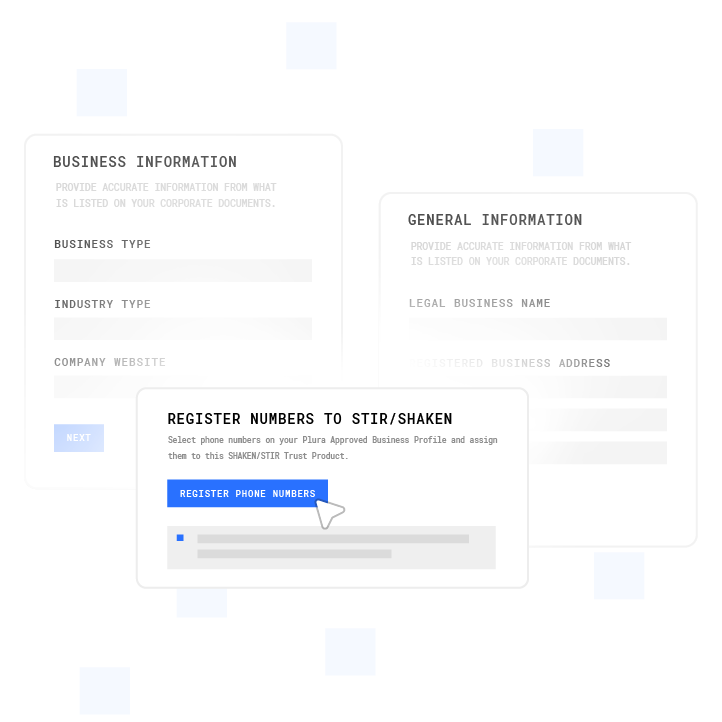
FCC-licensed carrier platforms. Plura AI owns an FCC-registered carrier through Plura Connect, LLC. Voice originates on Plura’s domestic infrastructure, not a third-party CPaaS. Branded caller ID is issued at the carrier level. Real-time DNC scrubbing, TCPA compliance support, and STIR/SHAKEN authentication operate as core layers of the platform, not third-party add-ons.
Run your numbers through Plura’s ROI calculator to see how the carrier-owned model changes your cost per conversation.
4. Regulatory Exposure for AI Call Centers and BPOs
The FCC adopted FCC 26-16 on March 26, 2026, titled “Improving Customer Service and Protecting Consumers through Onshoring.”2 The NPRM seeks comment on limiting the share of inbound and outbound customer-service calls routed to foreign call centers, with 30% floated as an illustrative threshold. It also proposes mandatory disclosure when a call is handled outside the U.S., a consumer right to transfer to a domestic agent, English-proficiency expectations for offshore staff, and restrictions on offshore handling of sensitive transactions.
Under Section 217 of the Communications Act, common carriers remain liable for the acts and omissions of their agents, including third-party offshore call center contractors. Contracts cannot fully shift that responsibility to a vendor.
The federal regulatory perimeter extends beyond the FCC NPRM. Two bills currently active in Congress, the Keep Call Centers in America Act (S.2495) and the Foreign Robocall Elimination Act (S.2666), would codify similar offshore restrictions into law. State governments are moving in parallel. New York’s Call Center Jobs Act carries penalties up to $10,000 per day, while New Jersey, Connecticut, Missouri, and Florida have enacted companion restrictions on offshore handling of sensitive consumer data.
The FCC’s February 2024 Declaratory Ruling classified AI-generated voices as “artificial or prerecorded voice” under the TCPA, which triggers full consent, identification, and opt-out obligations.2 DNC registry violations carry separate FTC fines of up to $53,088 per call, independent of TCPA per-call damages. One rep making 50 bad calls in a week can expose a company to $75,000 in statutory TCPA damages at the $1,500 willful-violation rate.
Plura’s compliance engine pre-loads TCPA, DNC, HIPAA (Health Insurance Portability and Accountability Act), SOC 2 (System and Organization Controls 2), and 50+ state rule sets. Every outbound contact is checked against federal and state DNC registries in real time before dial. Consent records are timestamped and immutable. Quiet-hours rules enforce automatically through time-zone detection. Plura supports SOC 2, HIPAA, ISO certification, GDPR, SHAKEN/STIR caller ID verification, TCPA compliance, and DNC compliance.1 Customers remain responsible for their own regulatory obligations and should consult qualified counsel. Plura provides infrastructure that supports compliance operations.
5. Total Cost of Ownership for AI vs Human and Offshore Teams
The default scenario on Plura’s ROI calculator uses a 15-agent operation paying $20 per hour with standard taxes, benefits, and commissions. A 40% talk-utilization rate, typical of human contact-center work, brings the monthly cost to $60,000. Replacing that team with Plura at $15 per hour, 100% talk utilization, and 6 Plura agents doing the work of 15 humans drops the monthly cost to $14,400. Savings reach $45,600 in the first 30 days, $547,200 over 12 months, and $2,736,000 over 60 months.3
For higher-volume operations, Plura’s TCO of $700,000 per year replaces traditional contact-center economics of $7 million on equivalent volume. That gap is structural. Contact centers allocate 60 to 70% of operating costs to agent labor, and AI agents carry none of the taxes, benefits, commissions, real estate, or 30 to 45% annual attrition that inflate human-agent TCO.
Plura AI voice agents cost $0.35 to $0.85 per completed conversation including intelligence, versus $5 to $15 fully loaded for offshore call centers3. A 50-seat offshore team costs approximately $1.2 million annually fully loaded in the insurance industry, while Plura handling equivalent volume costs $180,000 to $300,000 annually.
The median cost per contact is $1.84 for self-service channels and $13.50 for assisted channels, per Gartner’s customer service benchmarks. AI-handled contacts at Plura’s per-conversation rates fall well below both benchmarks at production volume. The table below summarizes how each of the four solution types performs against the evaluation criteria in Section 2, showing which platforms meet the carrier ownership, compliance, cross-channel memory, and infrastructure requirements that drive these cost differences.
6. Comparison Table: Four Solution Types
| Solution Type | Carrier Ownership | Real-Time DNC/TCPA Enforcement | Stateful Cross-Channel Memory | 100% U.S. Infrastructure |
|---|---|---|---|---|
| Twilio-based API resellers (e.g., Synthflow, Vapi) | No FCC carrier license, routes through Twilio CPaaS | Bolt-on, customer responsible for DNC and TCPA guardrails | Single-channel or requires custom integration | Depends on Twilio’s infrastructure footprint, no domestic-only guarantee |
| CCaaS platforms (e.g., Five9, Zendesk) | No owned FCC carrier, resells or partners with telecom providers | Compliance tools available, enforcement is configuration-dependent | Omnichannel context available within platform, depth varies by tier | Cloud infrastructure, data residency varies by contract |
| Offshore BPO operators | Not applicable, human-staffed model | Subject to FCC NPRM offshore restrictions, sensitive-data limitations proposed | CRM-dependent, no native cross-channel AI memory | No, offshore by definition, exposure under CG Docket No. 26-52 |
| Plura AI (FCC-licensed carrier platform) | Yes, owns FCC-licensed audio bridging carrier, branded caller ID at origination | Real-time DNC scrubbing before every dial, immutable TCPA consent ledger, automated quiet hours | Unified stateful database across voice, SMS, RCS, and webchat, full cross-channel memory by default | 100% U.S. infrastructure by architecture, voice origination, model hosting, data storage, and call recording all domestic |
7. Deploying AI to Automate Phone Calls
AI phone-call automation requires four components working together. Leaders need a voice AI agent that can understand natural speech and generate contextually appropriate responses, a telephony layer that originates and terminates calls, a compliance engine that enforces DNC and TCPA rules before each dial, and a stateful database that carries conversation context across sessions.
Most operators start with an AI voice agent on inbound flows. The AI handles intake and qualification, then performs a warm transfer to a human agent when a workflow gate triggers. Outbound automation usually follows once leaders trust the inbound performance. An AI Predictive Dialer then prioritizes contacts based on historical answer rates and prior conversation outcomes.
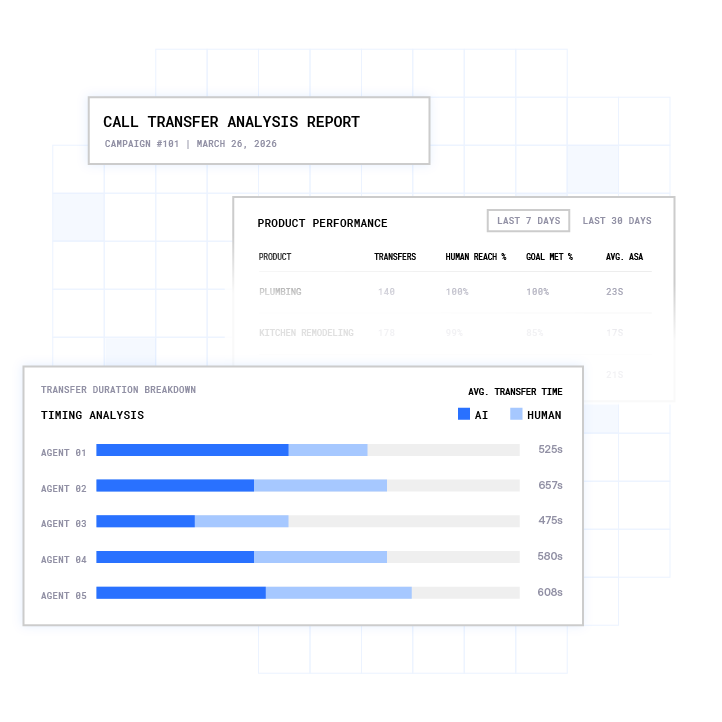
The telephony layer is where most platforms fall short. Platforms that route calls through a third-party CPaaS cannot issue branded caller ID at the origination layer, so calls present as unfamiliar numbers and are more likely to be screened or ignored. Plura originates calls on its own FCC-licensed carrier, issues branded caller ID directly, and authenticates every outbound call through STIR/SHAKEN.
8. AI Tools That Support Call Center Compliance
AI tools that support call center compliance enforce DNC and TCPA rules at the carrier layer, not as a post-dial audit. This distinction matters because TCPA statutory damages of $500 to $1,500 per call apply to each non-compliant contact individually, with no aggregate cap. A platform that scrubs DNC lists after the fact, or that relies on the customer to configure compliance guardrails, shifts that exposure back to the operator.
Plura’s compliance engine checks every outbound contact against federal and state DNC registries in real time before dial. Consent records are timestamped, immutable, and audit-ready. Quiet-hours rules enforce automatically through time-zone detection on the contact. The compliance dashboard exports audit-ready reports in one click. Plura supports SOC 2, HIPAA, ISO certification, GDPR, SHAKEN/STIR caller ID verification, TCPA compliance, and DNC compliance. Customers are responsible for their own regulatory obligations and should consult qualified counsel on their specific compliance posture. Plura provides the infrastructure that supports compliance operations.
9. Comparing AI Call Centers to Offshore BPO
Plura AI voice agents cost $0.35 to $0.85 per completed conversation, versus $5 to $15 fully loaded for offshore call centers. Beyond per-conversation cost, offshore BPO carries three structural liabilities that AI does not.
First, regulatory exposure. The FCC NPRM proposes a 30% cap on offshore customer-service calls and restrictions on offshore handling of sensitive consumer data. State laws in New York, New Jersey, Connecticut, Missouri, and Florida already restrict offshore handling of medical, financial, and consumer data. Every offshore contract a covered entity holds now functions as a compliance risk that requires legal review.
Second, attrition. Offshore BPO contact centers report 30 to 45% annual attrition in 2026, which creates a permanent ramp-and-retrain tax and quality inconsistency across churn cycles. AI agents carry 0% attrition.
Third, scalability. Offshore BPO typically requires 4 to 8 weeks to recruit, license, and ramp a new team to full productivity. AI scales instantly into peak season without advance hiring.
10. Stateful Cross-Channel Memory in Practice
Stateful cross-channel memory means that every interaction a customer has with an AI agent, across any channel, is stored in a single database keyed to that customer’s identity. When the customer calls after texting, the AI already knows what was said, what was offered, and what remains unresolved.
Most AI call center platforms do not have this capability. They operate separate AI agents per channel, each with its own memory, so a customer who texted at 9 a.m. has to re-explain their situation when the call comes at noon. Plura uses stateful AI architecture that remembers previous interactions, preferences, and outcomes across channels for better personalization and follow-ups.
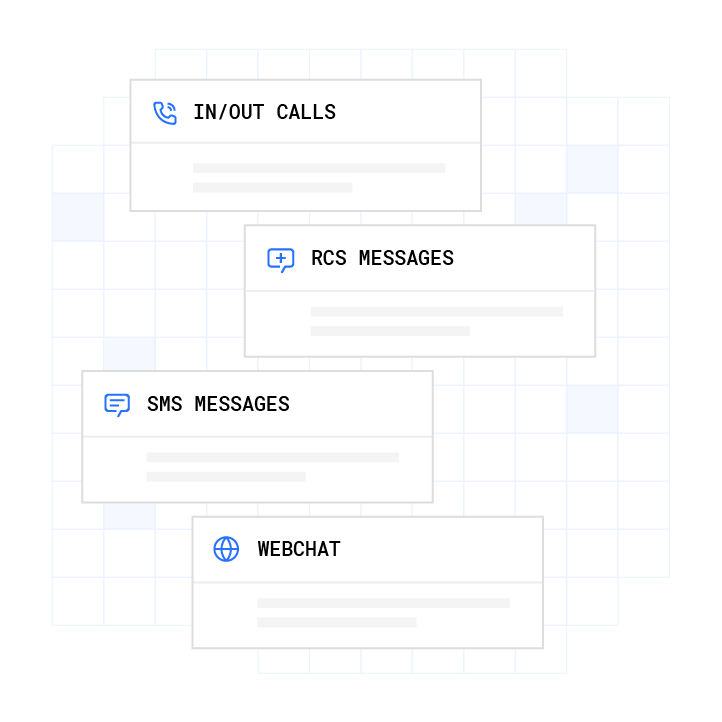
Plura’s AI Voice, AI SMS, AI RCS, and AI Webchat all share a Stateful Conversation Database. Every interaction is tokenized to the customer by phone, email, or ID. Every channel inherits the full memory of every prior touchpoint, including pricing offers made, objections raised, qualification status, and sensitive-data redactions.
11. Why FCC Carrier Ownership Matters for AI Voice Platforms
FCC carrier ownership means the platform holds its own FCC license to originate and terminate voice traffic on the public switched telephone network (PSTN). Most AI voice platforms do not hold this license. They operate as software layers built on top of Twilio or another CPaaS, which means the CPaaS is the actual carrier and the AI platform is a reseller.
The operational consequences are significant. A platform that does not own the carrier cannot issue branded caller ID under its own carrier identity. It cannot enforce compliance at the origination layer. It inherits the CPaaS provider’s caller-ID reputation rather than its own. It also faces pressure from proposed foreign-infrastructure restrictions and may need to restructure its entire telecom stack.
Plura owns its telecom infrastructure and holds an FCC carrier license, whereas Synthflow depends on Twilio and operates as a software layer without a carrier license. Bland AI is voice-only, API-based, requires developers, and lacks carrier status. Plura’s FCC carrier license took approximately two years to obtain, which creates a structural moat that API resellers cannot replicate by updating their software.
12. Go-Live Timelines for AI Call Center Automation
Plura deploys in 2 to 4 weeks from contract to live AI conversations across all channels, compared with Five9’s 3 to 6 months for typical enterprise setups. A simple inbound qualification flow is typically built in days. A complex multi-step intake, such as a 25-question health-history survey, runs closer to one to two months because the workflow logic requires design and validation.
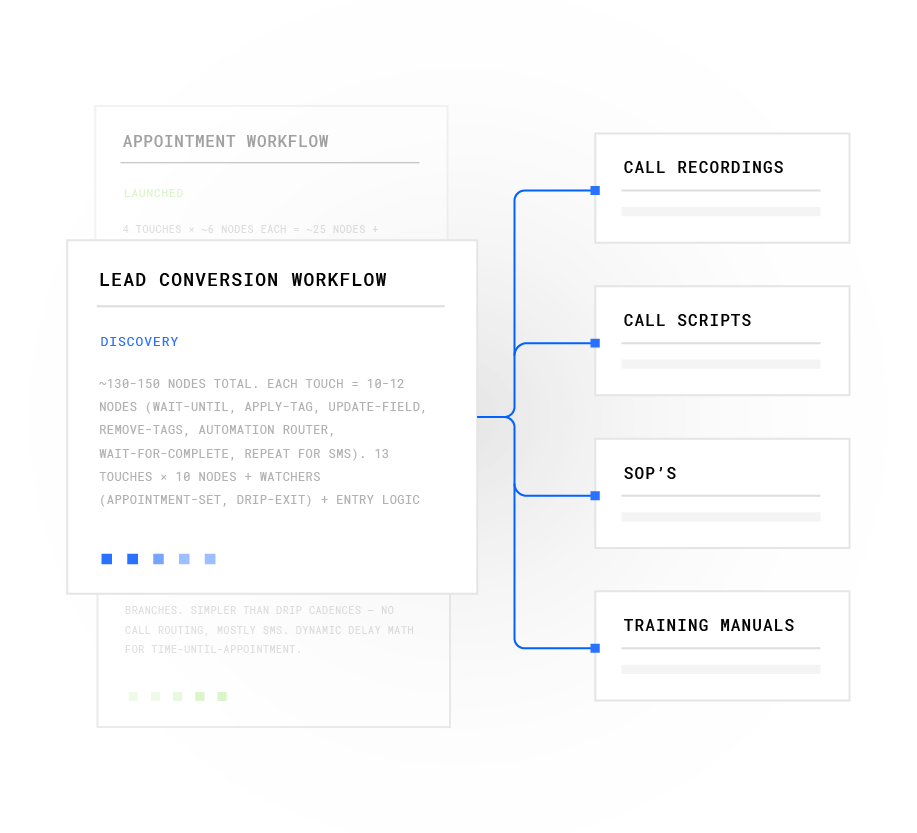
Plura’s onboarding sequence covers a discovery audit of the customer’s business and call economics, intake of sample calls and existing scripts, an overnight build of a dynamic conversation mockup, a review meeting to iterate on the mockup, engineering build of the production workflow, a pilot test on a subset of real calls, and full go-live. Annual contracts include a 90-day opt-out window. If the deployment is not delivering, the customer is not held to the annual term.
Offshore BPO typically requires 4 to 8 weeks to recruit, license, and ramp a new team, with no opt-out window and no performance guarantee.
13. Risks of AI Call Center Tools Without Carrier Ownership
The risks fall into three categories: compliance, operational, and regulatory.
On compliance, platforms that route through a third-party CPaaS cannot enforce DNC scrubbing at the carrier layer. They cannot issue branded caller ID under their own identity. They cannot authenticate calls through STIR/SHAKEN natively. Vendor due-diligence for conversational AI tools should evaluate consent management at the contact level, immutable and tamper-evident audit logging, and data residency policies. Platforms without carrier ownership struggle to satisfy carrier-layer requirements in that checklist.
On operations, the absence of branded caller ID means calls present as unfamiliar numbers and are more likely to be screened. Compliant AI calling workflows should perform real-time DNC suppression with automated opt-out processing targeting under 2 seconds response time. Platforms that bolt DNC scrubbing on after the fact have difficulty meeting that standard.
On regulation, the FCC NPRM’s proposed foreign-infrastructure restrictions apply to covered providers and their vendors. A platform with any offshore infrastructure dependency, including a CPaaS provider with foreign data centers, carries exposure that 100% U.S. infrastructure reduces by architecture.
14. Conclusion: Four Solution Types, One Carrier-Owned Model
The AI call center automation market in 2026 is not a single category. It is four distinct solution types with different infrastructure ownership, compliance posture, and cross-channel capabilities. Twilio-based API resellers, CCaaS platforms, and offshore BPO operators each solve part of the problem. None of them owns the carrier, enforces compliance at the origination layer, maintains stateful memory across all channels, and runs on 100% U.S. infrastructure at the same time.
Plura AI meets all four criteria through its FCC-registered carrier and unified platform. It issues branded caller ID at the origination layer. It enforces real-time DNC scrubbing and supports TCPA compliance before every dial. Its Stateful Conversation Database carries full cross-channel memory across voice, SMS, RCS, and webchat. It runs on 100% U.S. infrastructure by architecture, which reduces exposure under the FCC NPRM and state onshoring laws.
The economics are clear. The 15-to-6 agent replacement scenario detailed above delivers $547,200 in first-year savings and continues compounding over a five-year horizon.
Review Plura plans and rates side by side on the pricing page.
Frequently Asked Questions
What makes Plura AI different from other AI call center automation tools?
Plura AI owns an FCC-registered carrier through Plura Connect, LLC. Platforms built on Twilio or another CPaaS rent the carrier layer, which means they cannot issue branded caller ID under their own identity, cannot enforce compliance at the origination layer, and may need to restructure their telecom stack to address proposed foreign-infrastructure restrictions. Plura issues branded caller ID directly, authenticates every outbound call through STIR/SHAKEN, and enforces real-time DNC scrubbing before every dial. Its Stateful Conversation Database carries full cross-channel memory across voice, SMS, RCS, and webchat, so a customer who texted at 9 a.m. is the same customer when the call comes at noon. It also runs on 100% U.S. infrastructure by architecture, which reduces exposure under the FCC NPRM in CG Docket No. 26-52 and state onshoring laws in New York, New Jersey, Connecticut, Missouri, and Florida.
How does Plura AI support TCPA and DNC compliance for outbound calling?
Plura’s compliance engine checks every outbound contact against federal and state DNC registries in real time before dial. Non-compliant numbers are blocked before the first attempt. TCPA consent records are timestamped, immutable, and audit-ready, with express written consent tracked per contact. Quiet-hours rules enforce automatically through time-zone detection on the contact, applying state and federal calling-window restrictions to every campaign. The compliance dashboard exports audit-ready reports in one click for legal review, carrier requirements, or regulatory inquiries. Plura supports SOC 2, HIPAA, ISO certification, GDPR, SHAKEN/STIR caller ID verification, TCPA compliance, and DNC compliance. Customers are responsible for their own regulatory obligations and should consult qualified counsel on their specific compliance posture. Plura provides the infrastructure that supports compliance operations and does not absolve customers of their own obligations.
1 Plura AI maintains SOC 2, HIPAA, ISO, and GDPR posture as part of its platform infrastructure. References to compliance frameworks in this article describe Plura’s platform capabilities and do not constitute a guarantee that any customer using Plura will themselves be compliant with applicable laws or standards. Customers remain solely responsible for their own regulatory obligations, certifications, consent management, recordkeeping, and the claims they make to their own end users. Consult qualified legal counsel for guidance specific to your use case.
2 This article describes regulatory frameworks at a general level and does not constitute legal advice. Laws and regulations vary by jurisdiction, change over time, and apply differently depending on facts and circumstances. Readers should consult qualified legal counsel before making compliance decisions.
3 Performance figures, customer outcomes, and industry statistics referenced in this article are drawn from cited third-party sources or Plura customer case studies. Individual results vary based on implementation, use case, industry, audience, and execution. Past or aggregate performance is not a guarantee of future results.
4 References to third-party products, services, companies, or research are made for informational and comparative purposes only. Plura AI is not affiliated with, endorsed by, or sponsored by any third party named in this article unless explicitly stated. Trademarks and product names referenced remain the property of their respective owners.
This article is provided for informational purposes only and reflects Plura AI’s understanding at the time of publication. Product capabilities, integrations, and specifications are subject to change. For the most current information, visit plura.ai.
This article was produced with the assistance of AI tools and reviewed by Plura AI prior to publication.