

Written by: Matt Beucler, CEO, Plura AI | Last updated: August 28, 2026
Key cost and revenue takeaways for 2026 healthcare call centers
- Healthcare call-center total cost of ownership in 2026 centers on labor, HIPAA-related technology overhead, and missed-call revenue loss.
- In-house U.S. agents average $10–$17 per contact and $66,000–$97,000 per FTE annually.3 Offshore outsourcing drops cost to $1.50–$3.50 per call but introduces FCC NPRM offshore-PHI exposure.
- AI voice agents reduce per-contact cost to $0.35–$2.00, remove agent turnover, and avoid offshore regulatory risk on fully domestic infrastructure.3
- HIPAA-aligned controls add roughly 20–40% to technology build cost, and missed calls can drain $144,000–$240,000 or more in annual appointment revenue for a typical practice.
- See how Plura AI can cut your contact-center costs and capture missed revenue, then book a live demo.
2026 healthcare call center cost per call benchmarks
Fully-loaded cost per contact varies sharply by operating model. In-house agents create the highest fixed-cost floor. Outsourced models convert some fixed cost to variable expense but add vendor-management and compliance overhead. AI voice-agent platforms reduce per-contact cost by roughly an order of magnitude. The table below uses only verified 2026 figures.
| Model | Fully-loaded cost per contact | Annual FTE or platform cost | Source |
|---|---|---|---|
| In-house (U.S. domestic agent) | approximately $10–$17 per contact at typical volumes | ~$66,000–$97,000 per FTE/yr | Actigy, 2026 |
| Outsourced U.S.-based | $7–$14 per call | roughly $35,000 to $55,000 per FTE/yr, compared to lower nearshore rates | Contact Center USA, 2026; SkyCom, 2026 |
| Outsourced offshore | AI-assisted outsourced offshore fully-loaded cost per contact for inbound calls is $1.50–$3.50 per interaction in 2026 | $16,800–$29,100 per FTE/yr (Philippines/India) | Stealth Agents, 2026; SignalsCV, 2026 |
| AI voice agent (healthcare-grade) | $0.50–$2.00 per call | $60,000–$150,000/yr ongoing (mid-market) | Linear Health, 2026 |
The cross-industry median cost per contact sits at $13.50 for assisted channels per Gartner’s customer service benchmarks.4 Healthcare and life sciences typically run above that median. The 2026 CMP Customer Contact Benchmarking dataset places the healthcare median cost per contact at $6.90, with patient access, billing, and care-coordination work pushing individual contacts higher. Healthcare and insurance voice support runs $12–$22 per contact fully loaded in 2026 benchmarks from The Office Gurus. Those baseline costs, however, do not include the compliance overhead that healthcare operations must layer on top, a cost driver that non-healthcare contact centers do not carry.
HIPAA-driven technology overhead in healthcare call centers
HIPAA (the Health Insurance Portability and Accountability Act, 45 CFR Parts 160, 162, and 164) sets technical safeguards for entities that process protected health information on behalf of covered entities.2 These safeguards translate directly into technology and operational line items that non-healthcare contact centers typically avoid. Organizations should consult qualified counsel for guidance on their specific obligations under 45 CFR.
| Category | HIPAA adder | Non-HIPAA baseline | Source |
|---|---|---|---|
| Encryption (AES-256 at rest, TLS 1.2+ in transit) | Overall HIPAA-compliant call tracking platform implementation costs range from $5,000–$15,000 and include AES-256 encryption at rest plus TLS 1.2+ in transit | Minimal or none | Improvado, 2026 |
| Audit logging and SIEM (immutable PHI trails) | $12,000–$240,000/yr depending on data volume | Standard logging only | AccountableHQ, 2026 |
| Access control (RBAC, MFA, IAM) | $2–$6 per user/month | Basic password management | AccountableHQ, 2026 |
| Annual risk assessment and penetration testing | For mid-sized organizations, annual HIPAA risk assessment and penetration testing together typically cost $10,000–$30,000 as part of ongoing compliance | Optional or periodic | Halkwinds, 2026 |
| Overall HIPAA compliance premium on build cost | 20–40% above non-regulated build | Base build cost | Pharos Production, 2026 |
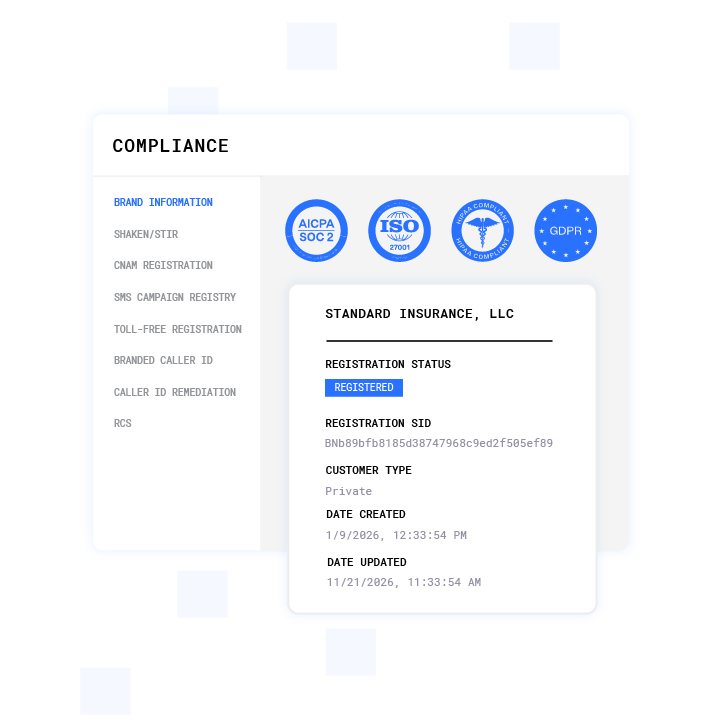
Reputable medical answering service vendors include HIPAA compliance and a signed BAA in the base rate rather than charging it as a separate monthly add-on. Retrofitting HIPAA controls into a platform not built for them from the start costs 40–80% of the original build cost, according to multiple industry estimates. Plura AI supports customer compliance efforts through end-to-end encryption, access controls, and audit logging for PHI across voice, SMS, RCS, and webchat. Customers remain responsible for their own regulatory obligations and certifications.
1
TCO comparison under FCC onshoring rules for 2026
The FCC’s Notice of Proposed Rulemaking (NPRM, CG Docket No. 26-52) proposes capping offshore customer-service calls at 30% and restricting offshore handling of sensitive consumer data.2 State laws in New York, New Jersey, Connecticut, Missouri, and Florida already limit offshore handling of medical and consumer data. Every offshore call-center contract a covered entity holds now functions as a compliance exposure that belongs in the TCO calculation. Organizations should consult qualified counsel to understand their exposure under CG Docket No. 26-52 and applicable state statutes.
| Line item | Traditional (in-house or outsourced) | Plura AI | Source |
|---|---|---|---|
| Annual labor or platform cost (100-seat equivalent) | $4M–$7M/yr | $300,000–$700,000/yr | Plura AI Communications Strategy Guide |
| Per-contact cost (healthcare voice) | $12–$22 fully loaded | $0.35–$0.85 per completed conversation | The Office Gurus, April 2026; Plura AI comparison page |
| FCC NPRM offshore PHI exposure (CG Docket No. 26-52) | Present for any offshore vendor handling PHI | Zero: 100% U.S. infrastructure by architecture | Plura AI Communications Strategy Guide |
| Agent turnover and retraining cost | 35–45% annual agent attrition | None: no human agent seats | Plura AI Communications Strategy Guide |
| Talk utilization rate | ~40% for human agents | 100% for AI agents | Plura ROI calculator |
Plura AI’s AI voice agent runs on 100% U.S. infrastructure by architecture, not by promise. Voice origination, model hosting, data storage, and call recording all sit on domestic infrastructure, which keeps Plura clients outside the offshore PHI prohibition proposed under FCC NPRM CG Docket No. 26-52. Plura operates as its own FCC-licensed audio bridging carrier and issues branded caller ID at the carrier level, with STIR/SHAKEN authentication on every outbound call. The platform supports 24/7 call answering and missed-call recovery without offshore exposure.
Daily revenue loss from missed calls in appointment-based practices
Missed calls function as a direct revenue line item in healthcare, not just a service metric. The figures below use sourced 2026 data to build a daily-revenue-loss framework that operators can apply to their own call volumes.
Missed-call daily revenue loss calculator framework (appointment-based practices):
A typical medical practice misses 20–30% of inbound calls during business hours and 100% of calls after hours without a live answering solution.4 That miss rate converts directly into lost appointment revenue. A practice missing 10 calls per day, with 40% appointment-related, loses 4 appointments daily at an average $150 visit value, or $600/day, $12,000/month, and $144,000/year, excluding follow-up care or lifetime patient value. A 5-physician primary care practice missing 5 new patient calls per day can lose $240,000 annually in direct first-appointment revenue, assuming an average of $200 per visit with full conversion to appointments, again excluding lifetime value, procedures, and referrals. For mid-to-large systems, up to 29% of inbound calls to healthcare providers go unanswered, wasting as much as $383,827 per month on lost patient conversions. Each missed new-patient call can therefore represent significant revenue at risk once first-year revenue, 5-year lifetime value, and average referral value enter the model.
To apply this framework, multiply your daily call volume by your miss rate, then by your scheduling conversion rate, then by your average visit revenue. For a primary care practice receiving 180 calls per day with a 25% miss rate, 35% scheduling conversion, and $180 average visit revenue, the monthly revenue leak totals $59,535. For a specialty practice at $350 average visit revenue under the same assumptions, the monthly revenue leak can be substantially higher.
Plura’s AI voice agent answers every call on the first ring, 24/7, with no after-hours gap. Plura also achieves up to 40% improvement in no-shows for healthcare operators. Run your numbers through Plura’s calculator to quantify your missed-call revenue leakage and projected savings.
Frequently Asked Questions
What are the three largest 2026 cost drivers in healthcare call centers?
The three largest cost drivers in 2026 healthcare call centers are fully-loaded agent labor, HIPAA-driven technology and compliance overhead, and missed-call revenue leakage.
Agent labor accounts for 60–70% of total contact center operating costs, with in-house U.S. agents carrying the fully-loaded FTE cost cited earlier before accounting for 35–45% annual turnover and the perpetual retraining cycle that turnover forces. Healthcare and insurance voice support runs $12–$22 per contact fully loaded in 2026 benchmarks, well above the cross-industry median.
HIPAA compliance adds 20–40% above a non-regulated build in technology costs alone, covering encryption at rest and in transit, immutable audit logging, access control infrastructure, and annual risk assessments. Vendors that do not build these controls in from the start face retroactive remediation costs of 40–80% of the original build.
Missed-call revenue leakage is the cost driver most practices undercount. A practice missing 10 calls per day loses an estimated $144,000 annually in direct appointment revenue before accounting for lifetime patient value, procedures, or referrals. After-hours gaps, hold abandonment, and voicemail drop-off compound the figure for practices without 24/7 coverage.
Does the FCC NPRM (CG Docket No. 26-52) affect offshore handling of patient data?
The FCC’s Notice of Proposed Rulemaking (CG Docket No. 26-52) proposes capping offshore customer-service calls at 30% of total volume and restricting offshore handling of sensitive consumer data. Patient data, including information that qualifies as protected health information under HIPAA (45 CFR Parts 160, 162, and 164), falls within the category of sensitive consumer data the NPRM addresses. Companion federal legislation, including the Keep Call Centers in America Act (S.2495) and the Foreign Robocall Elimination Act (S.2666), extends the regulatory perimeter further. State laws in New York, New Jersey, Connecticut, Missouri, and Florida already restrict offshore handling of medical and consumer data under existing statutes. Healthcare organizations with offshore call-center contracts or AI vendors running on foreign infrastructure should consult qualified counsel to assess their exposure under CG Docket No. 26-52 and applicable state law.
How does Plura AI support HIPAA-aligned operations without guaranteeing compliance?
Plura provides the infrastructure layer that supports customer compliance efforts. The platform includes end-to-end encryption for PHI across voice, SMS, RCS, and webchat, access controls and audit logging, and 100% U.S. infrastructure by architecture, meaning voice origination, model hosting, data storage, and call recording all sit on domestic infrastructure with no offshore exposure. Plura is SOC 2 Type II certified, HIPAA-aligned, and ISO certified.1 Every patient call handled through the platform can be covered by a Business Associate Agreement.
Customers remain responsible for their own regulatory obligations, certifications, and the compliance claims they make to their own end users. Plura does not guarantee compliance with HIPAA or any other standard, and using the platform does not substitute for an organization’s own risk assessment, workforce training, or legal review. Organizations should consult qualified counsel to determine whether Plura’s infrastructure supports their specific compliance posture.
Where can I run my own healthcare call center TCO numbers?
Plura’s ROI calculator at plura.ai/calculator accepts inputs for agent headcount, hourly wage, benefits load, and talk utilization rate, then outputs a side-by-side monthly and multi-year cost comparison between a traditional human-agent model and Plura’s AI agent model. The default scenario uses a 15-agent operation at $20 per hour with standard overhead, producing a 30-day savings of $45,600 and a 12-month savings of $547,200. Healthcare operators can adjust inputs to reflect their actual FTE count, specialty-specific call volumes, and after-hours coverage requirements. The calculator does not require a form submission or sales contact to run.
Conclusion: three levers for 2026 healthcare contact-center TCO
The three tables in this report isolate the numbers healthcare contact-center leaders need to make a defensible TCO decision in 2026. The benchmarks in the opening table show in-house agents at $10–$17 per contact, outsourced U.S.-based at $7–$14, and offshore at $1.50–$3.50, with offshore carrying FCC NPRM exposure under CG Docket No. 26-52. AI voice-agent platforms compress per-contact cost to $0.35–$2.00 while eliminating the turnover cycle and, on domestic infrastructure, offshore regulatory liability. HIPAA compliance adds 20–40% to technology build cost regardless of model, which makes a platform’s built-in compliance infrastructure a direct TCO variable, not a feature footnote. Missed-call revenue leakage, at $144,000–$240,000 or more annually for a typical multi-provider practice, remains the cost driver most operators have not yet quantified.
Plura AI runs on its own FCC-licensed carrier, with HIPAA-aligned encryption, SOC 2 Type II certification, and the domestic infrastructure described earlier. The AI voice agent answers every call on the first ring, 24/7, with no offshore exposure and no after-hours gap. Combined with the no-show reduction cited earlier, Plura addresses both sides of the revenue equation: capturing missed calls and helping booked appointments convert.
1 Plura AI maintains SOC 2, HIPAA, ISO, and GDPR posture as part of its platform infrastructure. References to compliance frameworks in this article describe Plura’s platform capabilities and do not constitute a guarantee that any customer using Plura will themselves be compliant with applicable laws or standards. Customers remain solely responsible for their own regulatory obligations, certifications, consent management, recordkeeping, and the claims they make to their own end users. Consult qualified legal counsel for guidance specific to your use case.
2 This article describes regulatory frameworks at a general level and does not constitute legal advice. Laws and regulations vary by jurisdiction, change over time, and apply differently depending on facts and circumstances. Readers should consult qualified legal counsel before making compliance decisions.
3 Performance figures, customer outcomes, and industry statistics referenced in this article are drawn from cited third-party sources or Plura customer case studies. Individual results vary based on implementation, use case, industry, audience, and execution. Past or aggregate performance is not a guarantee of future results.
4 References to third-party products, services, companies, or research are made for informational and comparative purposes only. Plura AI is not affiliated with, endorsed by, or sponsored by any third party named in this article unless explicitly stated. Trademarks and product names referenced remain the property of their respective owners.
This article is provided for informational purposes only and reflects Plura AI’s understanding at the time of publication. Product capabilities, integrations, and specifications are subject to change. For the most current information, visit plura.ai.
This article was produced with the assistance of AI tools and reviewed by Plura AI prior to publication.