

Written by: Matt Beucler, CEO, Plura AI
Key Takeaways for 2026 Contact-Center Strategy
- In 2026, U.S. contact centers choose among three scaling models: human onshore agents at 3–4× baseline cost, offshore BPOs at 1.5–2× with rising regulatory exposure, and carrier-owned AI platforms at 0.1–0.2× baseline.
- Traditional linear cost models tie every volume increase to proportional headcount, training, and payroll, which locks 60–70% of spend into agent labor.
- Offshore BPOs now face FCC caps, state onshoring laws, and limits on handling sensitive consumer data, so prior cost advantages now carry compliance risk.
- Plura AI replaces $4M–$7M annual spend with $300K–$700K TCO by owning its FCC-licensed carrier and Stateful Conversation Database while supporting SOC 2, HIPAA, ISO, GDPR, SHAKEN/STIR, TCPA, and DNC compliance.1
- See how Plura AI reshapes your contact-center economics by scheduling a tailored demo.
The Problem: Linear Spend Under Regulatory Pressure
Traditional contact-center economics follow a simple and punishing rule: more volume requires proportional headcount. The U.S. contact-center industry spends $25–$50 billion annually, with 60–70% of operating costs locked into agent labor.3 Every new campaign, every peak season, and every market expansion triggers another hiring cycle, another training ramp, and another payroll line. For a 100-seat operation, that math produces $4M–$7M in annual spend before compliance overhead enters the picture.3
Offshore BPOs absorbed much of that cost pressure for two decades through wage arbitrage. That model now sits under converging regulatory forces. The FCC’s (Federal Communications Commission) Notice of Proposed Rulemaking, CG Docket No. 26-52, proposes capping offshore customer-service calls at 30% of total volume and restricting offshore handling of sensitive consumer data, including passwords, multi-factor authentication codes, Social Security numbers, and banking and card data.2 Companion federal legislation, the Keep Call Centers in America Act (S.2495) and the Foreign Robocall Elimination Act (S.2666), extends that regulatory perimeter.2
State-level exposure compounds the federal picture. New York’s Call Center Jobs Act carries penalties up to $10,000 per day.2 New Jersey, Connecticut, Missouri, and Florida each impose restrictions on offshore handling of medical, financial, or consumer data. Every offshore contract a covered entity holds now functions as a compliance liability that sits on the balance sheet whether finance has priced it in or not.
Human onshore agents avoid offshore regulatory exposure but carry the full cost structure that made offshore arbitrage attractive in the first place. Payroll, taxes, benefits, commissions, real estate, and 35–45% annual agent turnover all drive recurring spend and constant retraining. Neither model bends the cost curve as volume grows, so both scale linearly.
Per-Contact Benchmarks and Usage-Based Pricing Impact
Domestic contact-center agents cost $15–$25 per hour before benefits and overhead. At a 40% talk-utilization rate typical of human contact-center work, a significant portion of every paid hour produces no customer contact. Benefits, commissions, and management overhead stack on top of the base wage. The true fully loaded cost per hour for offshore call centers, including turnover, training, QA, management, and technology, runs $14–$22.
At the per-conversation level, the gap becomes sharper. Offshore call centers cost $5–$15 fully loaded per completed conversation, while Plura AI voice agents cost $0.35–$0.85 per completed conversation including intelligence.3 As volume scales from hundreds to thousands of daily contacts, that per-conversation delta compounds into the annual TCO gap described earlier.
Usage-based pricing models, where operators pay per minute or per contact rather than per seat, expose the same structural problem. When volume doubles, cost doubles. The pricing model reflects the underlying labor model: linear inputs, linear outputs, and linear spend. Breaking this linear relationship requires a different infrastructure approach.
The Solution: Logarithmic Scaling with Carrier-Owned AI
Plura’s architecture breaks the linear relationship between volume and cost by owning the entire communications stack. The platform runs on its own FCC-licensed audio bridging carrier, not a third-party CPaaS (Communications Platform as a Service) like Twilio.4 Voice originates on Plura’s domestic infrastructure, which yields lower per-minute economics, direct issuance of branded caller ID, and compliance infrastructure enforced at the carrier level rather than bolted on later.
The Stateful Conversation Database sits underneath every channel: AI Voice, AI SMS, AI RCS (Rich Communication Services), and AI Webchat. Every interaction is keyed to a customer token, so the AI agent that texted a lead at 9 a.m. can pick up the call at noon already holding the full context of that prior exchange. Customers avoid re-introducing themselves, repeating qualification, and paying a penalty for channel switching.
For a 50-seat equivalent contact center, traditional offshore operations cost $35,000–$50,000 monthly, while AI contact centers cost $8,000–$15,000 monthly. At this 100-seat scale, Plura reduces annual TCO to $300,000–$700,000, which reflects the cost reduction detailed earlier.
| Metric | Human Onshore | Offshore BPO | Plura (Carrier-Owned AI) |
|---|---|---|---|
| Per-agent-hour cost (fully loaded) | $15–$25 base, higher fully loaded | $14–$22 fully loaded | $15/hour equivalent, 100% talk utilization |
| Talk utilization | ~40% of paid hours | ~40–50% of paid hours | 100% talk utilization |
| Regulatory exposure | TCPA, DNC, state rules, no offshore exposure | FCC NPRM CG Docket No. 26-52, NY, NJ, CT, MO, FL state laws, sensitive-data restrictions | 100% U.S. infrastructure by architecture; supports TCPA compliance, DNC compliance, HIPAA, SOC 2, SHAKEN/STIR caller ID verification |
| Infrastructure ownership | Third-party telecom and vendor stack | Foreign infrastructure and third-party carrier dependency | FCC-licensed carrier, Stateful Conversation Database, 100% U.S. infrastructure |
Run your own volume through Plura’s ROI model in a live walkthrough.
Infrastructure Ownership and Compliance Posture
Most AI voice platforms operate as API resellers that wrap Twilio or another CPaaS. This architectural choice forces them to inherit that carrier’s caller ID reputation and bolt compliance tooling on after the fact. When the FCC’s foreign-infrastructure prohibitions take effect under CG Docket No. 26-52, those inherited dependencies become direct liability for every operator running on them.
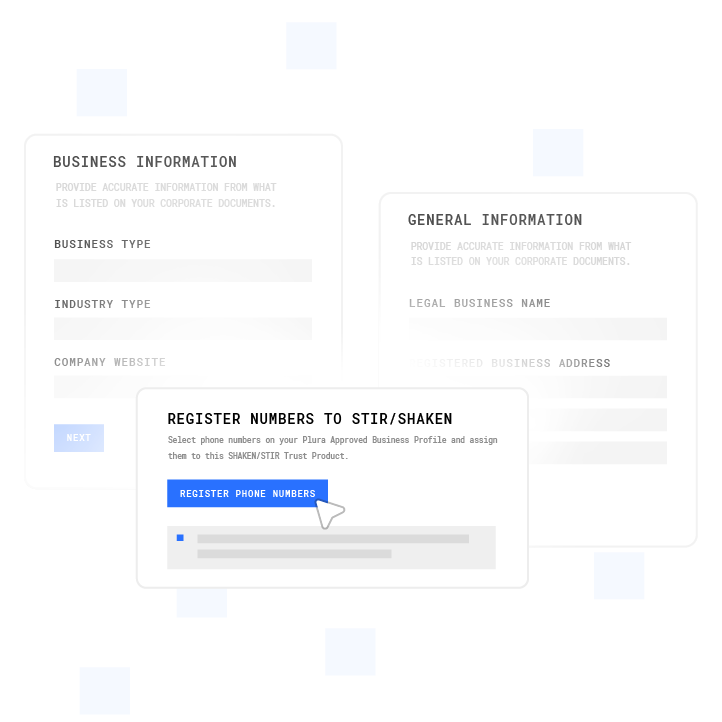
Plura owns the full stack. Voice origination, model hosting, data storage, and call recording all sit on domestic U.S. infrastructure. Branded caller ID is issued at the carrier level, not through a third-party reseller. STIR/SHAKEN (Secure Telephone Identity Revisited/Signature-based Handling of Asserted information using toKENs) authentication runs on every outbound call. Real-time DNC (Do Not Call) scrubbing checks every number against federal and state registries before dial. TCPA (Telephone Consumer Protection Act) consent records are timestamped, immutable, and exportable for audit review.
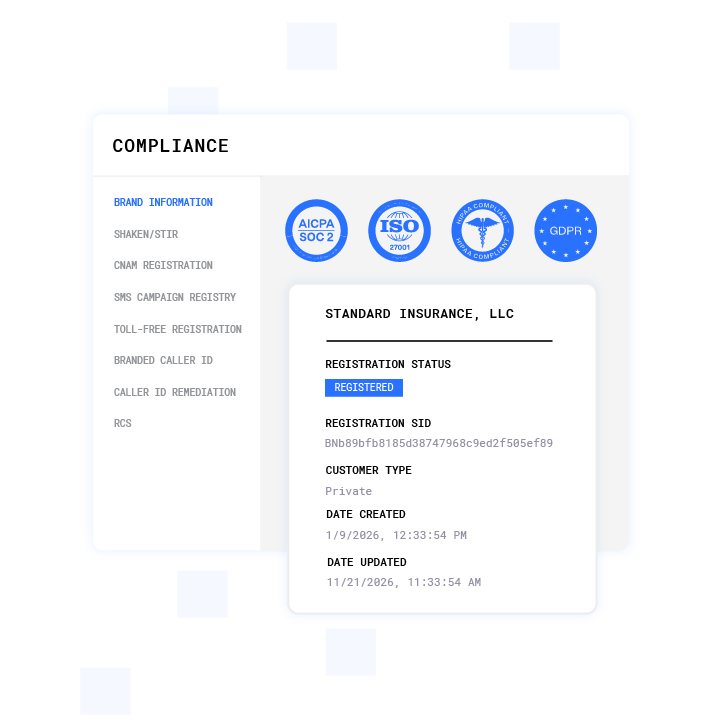
Plura’s infrastructure supports customer compliance with SOC 2, HIPAA, ISO certification, GDPR, SHAKEN/STIR caller ID verification, TCPA compliance, and DNC compliance.1 Customers remain responsible for their own certifications, regulatory obligations, and the claims they make to their end users. Plura provides the infrastructure, and compliance posture downstream of that remains the customer’s responsibility. Operators in regulated verticals, including healthcare, financial services, insurance, and legal, should consult qualified counsel on their specific obligations under applicable law.
The practical operational result is straightforward. Plura clients report “100% U.S.-handled” in their broadband consumer label disclosures and carry no offshore infrastructure exposure under the FCC NPRM, state onshoring laws, or sensitive-data restrictions.
Review Plura’s infrastructure and compliance support in a technical demo.
FAQ: Economics, Regulation, and Implementation
What is the per-hour cost difference between human, offshore, and Plura agents in 2026?
Human onshore agents cost $15–$25 per hour at the base wage rate, with fully loaded costs rising significantly when taxes, benefits, commissions, and management overhead are included. Offshore agents run $14–$22 per hour fully loaded, a figure that accounts for turnover, training, QA, and technology costs that are often excluded from headline BPO rates. Both models operate at roughly 40–50% talk utilization, so a large share of every paid hour produces no customer contact.
Plura agents run at 100% talk utilization with no taxes, benefits, commissions, or turnover overhead. The illustrative scenario on Plura’s ROI calculator shows a 15-agent operation at $20 per hour costing $60,000 per month, versus Plura at $14,400 per month for equivalent volume, which produces $45,600 in 30-day savings and $547,200 over 12 months. At higher volumes, the annual TCO comparison aligns with the $300,000–$700,000 Plura range against $4M–$7M for a traditional 100-seat operation referenced above.
How does regulatory exposure differ across the three scaling models?
Human onshore operations carry TCPA, DNC, and state-level compliance obligations but no offshore regulatory exposure. Offshore BPOs now face a materially different risk profile. The proposed FCC rule described earlier would cap offshore customer-service calls at 30% and restrict offshore handling of sensitive consumer data. Companion federal legislation (S.2495 and S.2666) extends these restrictions further. State laws in New York, New Jersey, Connecticut, Missouri, and Florida add additional limits on offshore handling of medical, financial, and consumer data, with penalties in New York reaching $10,000 per day.
Plura runs on 100% U.S. infrastructure by architecture. Voice origination, model hosting, data storage, and call recording are all domestic. Operators using Plura carry no offshore infrastructure dependency and are not exposed to the offshore disclosure mandates or foreign-adversary-nation infrastructure prohibitions described in the proposed rule. Operators should consult qualified counsel to assess their specific obligations under applicable federal and state law.
What is the typical implementation timeline for Plura?
Implementation timelines depend on conversation complexity. A straightforward inbound qualification flow typically goes live in days. A multi-step intake, such as a 25-question health-history survey with field-level redaction and conditional routing, runs closer to one to two months because the workflow logic requires design, validation, and pilot testing before full deployment.
Plura’s onboarding sequence is consistent across deployments. Teams start with a discovery audit of the customer’s business and call economics, followed by intake of sample calls, SOPs, and existing scripts. Plura then completes an overnight build of a dynamic conversation mockup and runs a review meeting to iterate on that mockup. Engineering builds the production workflow, a pilot test runs on a subset of real calls, and then the deployment moves to full go-live. Every annual contract includes a 90-day opt-out window, so if the deployment is not delivering, customers are not held to the annual term.
Conclusion: Moving from Linear Spend to Logarithmic TCO
Three scaling models define the 2026 contact-center landscape. Human onshore agents deliver reliability at 3–4× baseline cost with no offshore exposure. Offshore BPOs offer 1.5–2× baseline cost with rising regulatory liability under the FCC NPRM, companion federal legislation, and five active state onshoring laws. Carrier-owned AI platforms deliver 0.1–0.2× baseline cost with 100% U.S. infrastructure and no linear relationship between volume and spend.
Plura AI is the only platform in the third category that owns its FCC-licensed carrier and Stateful Conversation Database. That ownership is not a marketing claim. It is the architectural reason Plura can issue branded caller ID at the carrier level, enforce real-time DNC scrubbing before every dial, authenticate every outbound call through STIR/SHAKEN, and hold conversation context across voice, SMS, RCS, and webchat without routing through a third-party CPaaS. The result is the 10–20× TCO reduction detailed above, on infrastructure built for the regulatory reality of 2026.
See Plura’s cost model applied to your operation in a live demo.
1 Plura AI maintains SOC 2, HIPAA, ISO, and GDPR posture as part of its platform infrastructure. References to compliance frameworks in this article describe Plura’s platform capabilities and do not constitute a guarantee that any customer using Plura will themselves be compliant with applicable laws or standards. Customers remain solely responsible for their own regulatory obligations, certifications, consent management, recordkeeping, and the claims they make to their own end users. Consult qualified legal counsel for guidance specific to your use case.
2 This article describes regulatory frameworks at a general level and does not constitute legal advice. Laws and regulations vary by jurisdiction, change over time, and apply differently depending on facts and circumstances. Readers should consult qualified legal counsel before making compliance decisions.
3 Performance figures, customer outcomes, and industry statistics referenced in this article are drawn from cited third-party sources or Plura customer case studies. Individual results vary based on implementation, use case, industry, audience, and execution. Past or aggregate performance is not a guarantee of future results.
4 References to third-party products, services, companies, or research are made for informational and comparative purposes only. Plura AI is not affiliated with, endorsed by, or sponsored by any third party named in this article unless explicitly stated. Trademarks and product names referenced remain the property of their respective owners.
This article is provided for informational purposes only and reflects Plura AI’s understanding at the time of publication. Product capabilities, integrations, and specifications are subject to change. For the most current information, visit plura.ai.
This article was produced with the assistance of AI tools and reviewed by Plura AI prior to publication.