Enterprise Lead Scoring Automation for High-Volume Teams
ON THIS PAGE
Written by: Matt Beucler, CEO, Plura AI | Last updated: August 28, 2026
Key Takeaways for High-Volume Lead Scoring
Enterprise lead scoring automation ranks prospects by conversion readiness, then routes qualified leads to AI Voice, SMS, and RCS agents in under 5 seconds.
High-volume operators run TCPA and DNC checks at scoring time, before routing, to reduce regulatory risk and protect their compliance posture.
Real-time scoring with stateful cross-channel memory captures intent signals as they happen and supports 391% higher conversion rates for leads contacted within one minute.3
Negative scoring and score decay cut low-quality MQL volume, improve connect rates, and lower cost per qualified conversation by filtering out poor-fit or stale leads before they reach agents.
A production-grade enterprise lead scoring architecture runs four layers in sequence, and the full chain must resolve in under 5 seconds. Each layer completes before the next one fires to keep routing decisions accurate and economically viable.
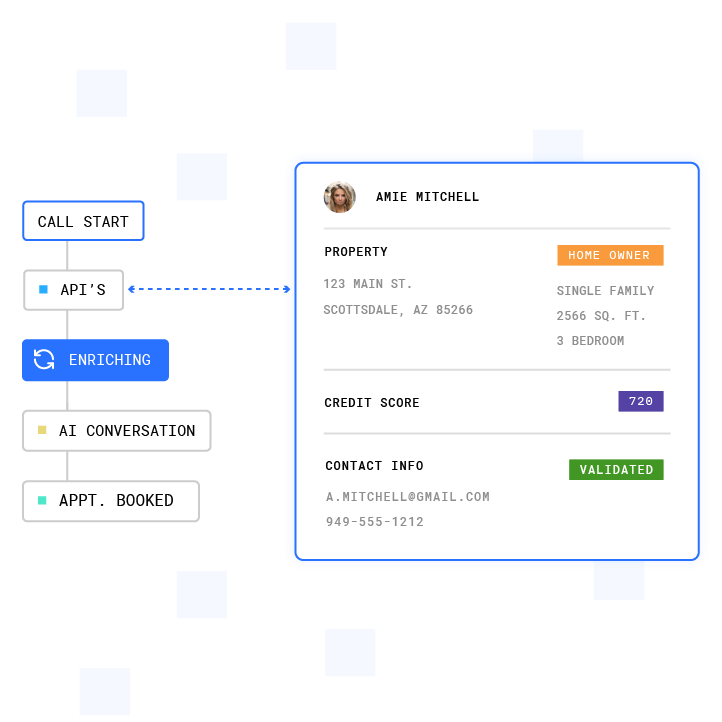
The first layer is the CRM record layer. Deduplication checks by email or phone run before record creation to prevent duplicate contacts, with E.164 phone formatting and required-field enforcement applied at entry. The second layer is real-time enrichment. After record creation, the scoring engine pings enrichment APIs to append firmographic, demographic, and intent data to the lead profile. Plura AI’s AI Lead Intelligence enriches every lead with 30+ data sources, including IP data, email validation, contact data, intent signals, and business firmographics, during the live interaction rather than in a downstream batch job.
Plura Lead Intelligence enriches customer data with AI-powered insights, validation, and lead qualification to improve conversion performance.
The third layer is the scoring engine, where fit and intent signals combine into a composite score. The fourth layer is automated routing. The score triggers a deterministic routing rule that assigns the lead to a nurture sequence, an SDR queue, or an immediate AI agent handoff. Plura’s Business Intelligence treats every interaction as a data point for scoring before calls and learning after, instead of treating communications as a pure cost center.
The predictive lead scoring software market is projected to expand from USD 2.07 billion in 2025 to USD 6.28 billion by 2031, registering a 20.62% CAGR, with large enterprises accounting for 61.34% of 2025 revenue.4 High-volume operators are driving that growth because batch scoring cannot keep pace with behavioral signals that change faster than traditional models can capture. This timing gap makes real-time enrichment a non-negotiable layer in the architecture, because routing quality depends on fresh data, not yesterday’s batch.
Real-Time Scoring and Stateful Memory vs Batch CRM Scoring
High-volume operators run compliance checks at scoring time, not after routing. Checks must execute before any outbound contact fires. TCPA (Telephone Consumer Protection Act) violations can reach $500 to $1,500 per text or call, and DNC (Do Not Call) exposure compounds at volume.2 Batch CRM scoring, which recalculates scores on a nightly or weekly schedule, cannot close that gap. By the time a score updates, the lead’s intent has already shifted.
The layer existing CRM and MAP tools cannot replicate is stateful cross-channel memory. When a lead texts at 9 a.m. and calls at noon, most platforms treat those as two separate records. Plura’s Stateful Conversation Database keys every interaction to a customer token such as phone number, email, or ID and persists context across voice, SMS, RCS, and webchat. The scoring engine reads from and writes to the same database, so the AI agent that picks up the noon call already knows what was said, what was offered, and what objections were raised. Cross-channel memory is available through Plura’s integrations with HubSpot, Salesforce, Zoho, and 50+ other tools.
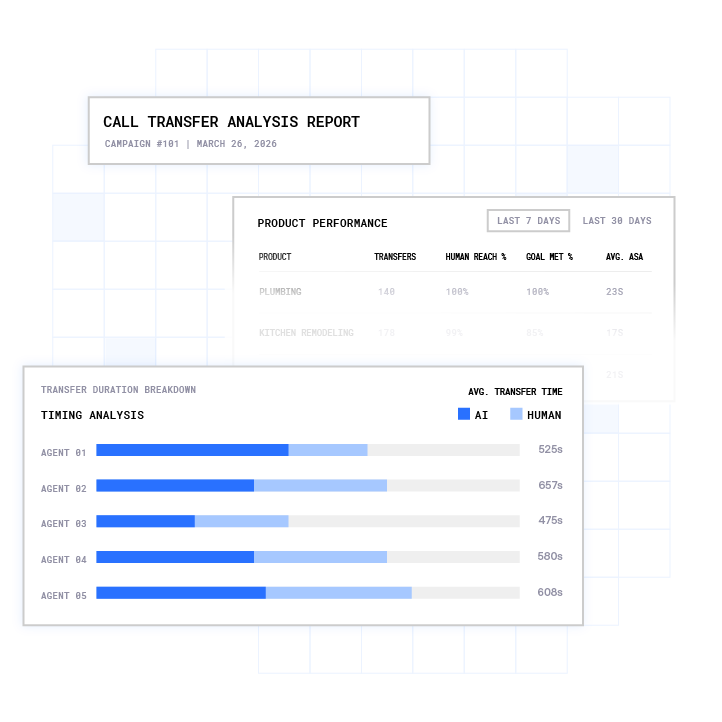
Plura Conversation Intelligence gives businesses AI-powered analytics, call transfer tracking, and customer interaction insights across every conversation.
Negative Scoring and Score Decay for Cleaner Pipelines
A scoring model without negative signals will surface competitor employees, job seekers, and out-of-territory records as top-ranked leads. Negative scoring deducts points for attributes and behaviors that predict a lead will not buy. This pulls poor-fit records below the MQL threshold before they reach a rep or an AI agent.
Standard negative scoring deductions for enterprise B2B operators include the following categories:
Fit deductions: competitor domain (-25 pts), out-of-territory location (-10 pts), company size below serviceable floor (-15 pts), role with no purchasing influence (-10 pts)
Behavior deductions: careers or support page visits only (-10 pts), email unsubscribe (-20 pts), hard email bounce (-15 pts), no activity for 30+ days (-10 pts)
Disqualification signals: spam complaint (immediate disqualification), student or intern title (-20 pts), personal or free email domain for enterprise products (-15 pts)
A workable decay setup deducts 1 point per week of inactivity after a four-week grace period, halves the value of old positive actions after 90 days, expires them after 180 days, and resets the entire score to zero after 12 months of no activity. Behavioral intent signals receive a short half-life of 1 to 3 months. Firmographic fit signals have a long half-life and are refreshed via enrichment rather than decayed automatically.
Teams that introduce time decay and negative scoring for the first time often see their active MQL volume decrease as stale or disengaged leads are removed from the list. That reduction is the goal. Fewer leads reaching AI agents means higher connect rates, lower cost per qualified conversation, and a cleaner compliance posture on every outbound contact.
Negative scoring rules should be validated by pulling leads sales rejected over a full quarter and checking where they scored. If rejected leads cluster at high scores, that pattern reveals missing deduction attributes in the model and highlights signals that should have disqualified those leads before they reached sales.
Score Bands and Threshold Triggers for AI Handoffs
Score bands translate a numeric score into a routing decision. A standard three-band architecture for high-volume operators maps as follows:
0-20 points: Nurture only. Lead enters an automated drip sequence. No outbound AI agent contact fires.
21-50 points: SDR or AI-assisted qualification. Lead is assigned to a rep queue or an AI qualification flow for further enrichment before escalation.
51+ points: Immediate AI agent handoff. Threshold trigger fires within 5 seconds, routing the lead to an AI voice agent, an AI SMS thread, or an RCS outbound sequence depending on channel preference and time-of-day rules.
The threshold trigger must be wired into the routing rule as a condition layer evaluated inside the CRM workflow, not as a separate parallel system. This integration enables dynamic re-routing. When a lead’s score changes after initial assignment, such as a jump from 35 to 82 after a pricing-page visit, the system can automatically escalate the lead to a higher-priority queue without manual intervention.
Compliance Checks at Scoring Time for TCPA and DNC
High-volume operators run compliance checks at scoring time, not after routing. Checks must execute before any outbound contact fires. TCPA (Telephone Consumer Protection Act) violations can reach $500 to $1,500 per text or call, and DNC (Do Not Call) exposure compounds at volume.
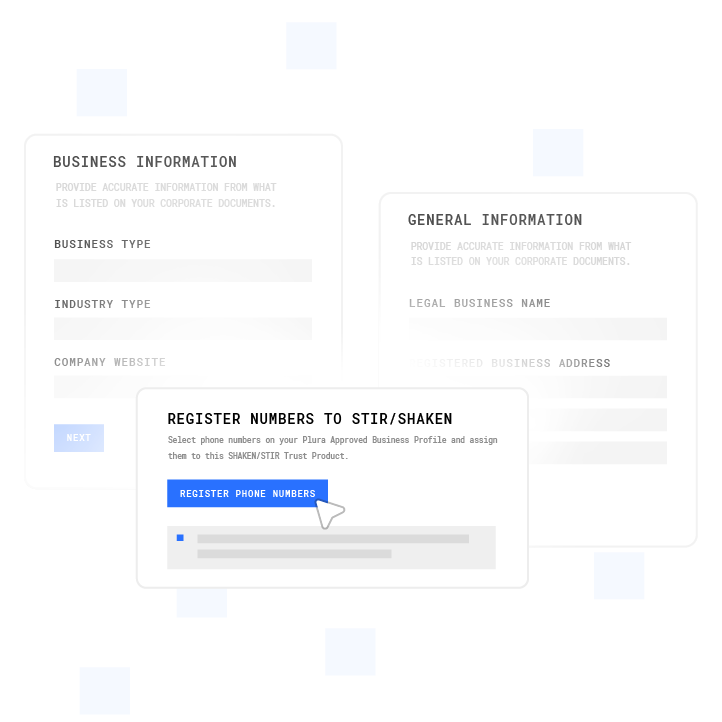
Plura’s FCC-licensed AI communications platform simplifies compliant business registration and phone number provisioning for AI Voice, SMS, RCS, and Webchat workflows.
Plura’s compliance engine executes the following checks as part of the scoring-to-routing sequence:
Real-time DNC scrubbing against federal and state DNC registries before every outbound dial or text
TCPA consent verification with timestamped, immutable consent records checked per contact before routing fires
Quiet-hours enforcement through automatic time-zone detection, applying state and federal calling-window restrictions to every campaign
SHAKEN/STIR caller ID verification on every outbound voice call
Plura’s compliance dashboard supports SOC 2, HIPAA, ISO certification, GDPR, SHAKEN/STIR caller ID verification, TCPA compliance, and DNC compliance.1 Audit-ready reports export in one click for legal review or carrier requirements. Plura provides the infrastructure, and operators remain responsible for their own regulatory obligations and the claims they make to their end users.
Hybrid Rule-Based and Predictive Scoring in Practice
The choice between rule-based, predictive, and hybrid scoring depends on data maturity. Rules-based scoring fits operators with limited closed-won data. As data volume increases to hundreds or thousands of closed deals, a hybrid approach becomes practical. Mature teams with very large datasets across multiple segments often use full predictive scoring with rules-based overrides.
Model Type
Transparency
Accuracy Ceiling
Minimum Data Required
Rule-Based
High: every score has a readable breakdown
Traditional rule-based lead scoring typically achieves 48-75% accuracy, depending on the source, metric, and implementation details.
No historical conversion data required
Predictive (ML)
Variable: requires built-in factor analysis to avoid black-box scores
A production hybrid architecture runs three layers. A rule-based gate handles ICP fit and disqualifiers. A predictive layer ranks only the leads that pass the gate. An operator override layer captures context the model cannot see. The predictive layer should be retrained quarterly. Grade thresholds should be recalibrated weekly against fresh win and loss outcomes. Without recalibration, hybrid models lose 30 to 40% of their accuracy within six months.
ROI Metrics and the 7-Step Speed-to-Lead Workflow
The speed-to-lead research cited earlier, showing 100x higher connect rates within five minutes and 391% higher conversion within one minute, defines the economic case for sub-5-second routing. Every minute of delay creates a measurable reduction in connect likelihood and conversion rate.
Additional benchmarks from the research base:
Leads contacted within the first hour are roughly 7 times more likely to qualify than those contacted an hour later and more than 60 times more likely than those contacted after 24 hours.
Sales teams using AI lead scoring report spending 80% of their time on qualified or customer-facing activities, compared to 48% with manual or traditional scoring.
The 7-step enterprise workflow that ties these metrics to an operational sequence:
Lead capture and deduplication: Record enters CRM with E.164 formatting and required-field enforcement. Duplicate check runs by email and phone before creation.
Real-time enrichment: Scoring engine executes real-time enrichment to append firmographic, intent, and contact data to the lead profile within the live session.
Compliance gate: DNC scrubbing and TCPA consent verification execute before any score-to-route decision. Non-compliant records are suppressed before the first contact attempt.
Hybrid scoring: Rule-based gate evaluates ICP fit and disqualifiers. Predictive layer ranks leads passing the gate. Composite score is written to the CRM record.
Negative scoring and decay check: Decay schedule and negative signal deductions are applied. Score is adjusted before threshold evaluation.
Threshold trigger: Score band determines routing outcome: nurture sequence (0-20), SDR or AI qualification flow (21-50), or immediate AI agent handoff (51+).
AI agent handoff and stateful memory: Qualified lead routes to AI Voice, AI SMS, or RCS agent in under 5 seconds. Stateful Conversation Database passes full prior context to the agent before first contact.
Conclusion: Turning Scores into Sub-5-Second Actions
Enterprise lead scoring automation that stops at the CRM is incomplete. High-volume operators running 500+ daily interactions need a seven-layer architecture that combines real-time enrichment, hybrid rule-based and predictive scoring, negative signal handling, score decay, compliance enforcement at scoring time, threshold-triggered routing, and stateful cross-channel memory. Each layer supports the next. Remove any one of them and the sub-5-second routing guarantee breaks down.
Plura’s AI Lead Intelligence, Stateful Conversation Database, and compliance engine supply the layers that existing CRM and MAP tools cannot. The scoring model determines which leads qualify. Plura determines what happens in the 5 seconds after they do.
What is enterprise lead scoring automation and how does it differ from standard CRM lead scoring?
Enterprise lead scoring automation is a real-time architecture that evaluates every lead against fit, intent, negative signal, and compliance criteria the moment a record enters the system, then routes qualified leads to AI Voice, SMS, or RCS agents in under 5 seconds. Standard CRM lead scoring typically runs on a batch schedule, recalculating scores nightly or weekly against a static set of demographic fields. The gap between those two approaches is where leads go cold. Enterprise-grade automation adds real-time enrichment from 30+ data sources, score decay schedules that reduce stale scores automatically, negative scoring rules that suppress poor-fit records before they reach an agent, and compliance checks that execute before any outbound contact fires. The result is a scoring system that reflects a lead’s current intent rather than their profile at the time of form submission.
How does Plura’s stateful conversation database improve lead scoring accuracy across channels?
Most scoring systems evaluate a lead once at entry and do not update the score as the lead interacts across channels. Plura’s Stateful Conversation Database keys every interaction to a customer token and persists context across voice, SMS, RCS, and webchat. When a lead texts at 9 a.m. and calls at noon, the scoring engine reads the full prior conversation history before the second contact fires. Objections raised, offers made, qualification signals captured, and channel preferences expressed all feed back into the score in real time. This means the AI agent handling the noon call already knows the lead’s status, which reduces redundant qualification steps, shortens handle time, and increases the probability of a qualified handoff to a human closer.
What score thresholds should high-volume operators use to trigger AI agent handoffs?
The specific thresholds depend on the operator’s ICP definition, average deal size, and the volume of leads flowing through the system. A widely used starting framework maps three bands: 0 to 20 points for nurture-only sequences with no outbound AI contact, 21 to 50 points for SDR assignment or AI-assisted qualification flows, and 51 or above for immediate AI agent handoff across voice, SMS, or RCS. These bands should be calibrated against actual conversion data from the prior 90 days. Operators with tighter ICP definitions and higher average deal sizes typically raise the handoff threshold to reduce wasted AI agent minutes on leads unlikely to close. The threshold should also be wired into a dynamic re-routing rule that monitors score changes after initial assignment, so a lead that moves from 35 to 82 after a pricing-page visit is escalated automatically rather than remaining in a nurture sequence.
How does Plura support TCPA and DNC compliance within the lead scoring and routing workflow?
Plura’s compliance engine executes DNC scrubbing against federal and state registries and verifies TCPA consent records before any threshold trigger fires an outbound contact. Consent records are timestamped and immutable. Quiet-hours rules enforce automatically through time-zone detection on the contact record, applying state and federal calling-window restrictions to every campaign. SHAKEN/STIR caller ID verification runs on every outbound voice call. The compliance dashboard supports audit-ready report exports for legal review or carrier requirements. Plura provides this infrastructure as a first-class layer of the platform. Operators remain responsible for their own regulatory obligations, the consent language they use with their end users, and the claims they make about their own compliance posture. Operators with specific questions about TCPA or DNC obligations should consult qualified legal counsel.
When should a high-volume operator add a predictive ML layer to their lead scoring model?
A predictive machine learning layer becomes reliable only after an operator has accumulated 500 to 1,000 closed deals with clean outcome labels. Below that threshold, a predictive model risks fitting to noise rather than true conversion patterns, and a well-tuned rule-based model will often outperform it. The recommended maturity path starts with a simple rule-based fit-plus-intent model in months one through three, adds negative scoring and decay in months three through nine, introduces channel-aware rules in months nine through eighteen, and layers in a predictive model retrained quarterly in year two and beyond. Any new predictive model should run in parallel with the existing rule-based system for at least one full sales cycle before production cutover, so conversion rates by score tier can be compared before the switch is made.
1 Plura AI maintains SOC 2, HIPAA, ISO, and GDPR posture as part of its platform infrastructure. References to compliance frameworks in this article describe Plura’s platform capabilities and do not constitute a guarantee that any customer using Plura will themselves be compliant with applicable laws or standards. Customers remain solely responsible for their own regulatory obligations, certifications, consent management, recordkeeping, and the claims they make to their own end users. Consult qualified legal counsel for guidance specific to your use case.
2 This article describes regulatory frameworks at a general level and does not constitute legal advice. Laws and regulations vary by jurisdiction, change over time, and apply differently depending on facts and circumstances. Readers should consult qualified legal counsel before making compliance decisions.
3 Performance figures, customer outcomes, and industry statistics referenced in this article are drawn from cited third-party sources or Plura customer case studies. Individual results vary based on implementation, use case, industry, audience, and execution. Past or aggregate performance is not a guarantee of future results.
4 References to third-party products, services, companies, or research are made for informational and comparative purposes only. Plura AI is not affiliated with, endorsed by, or sponsored by any third party named in this article unless explicitly stated. Trademarks and product names referenced remain the property of their respective owners.
5 This article contains forward-looking statements regarding industry trends, technology adoption, and future capabilities. These statements reflect current expectations and are subject to change. Plura AI undertakes no obligation to update forward-looking statements except as required.
This article is provided for informational purposes only and reflects Plura AI’s understanding at the time of publication. Product capabilities, integrations, and specifications are subject to change. For the most current information, visit plura.ai.
This article was produced with the assistance of AI tools and reviewed by Plura AI prior to publication.