

Written by: Matt Beucler, CEO, Plura AI | Last updated: August 29, 2026
Updated August 2026
Key Takeaways for High-Volume Teams
- Carrier-grade AI appointment schedulers deliver sub-5-second speed-to-lead, real-time TCPA/DNC controls, and cross-channel memory that generic tools cannot sustain at 500+ daily interactions.
- Plura AI owns its FCC-licensed carrier, which enables A-level SHAKEN/STIR caller ID, branded caller ID at origination, and compliance checks before every contact leaves the network.1
- Stateful conversation memory across voice, SMS, RCS, and webchat removes re-identification overhead, so leads contacted within 1 minute convert far more often than those reached after 24 hours.
- Plura replaces 15 human agents with 6 AI agents at 100% talk utilization, cutting monthly costs from $60,000 to $14,400 and delivering up to 40% fewer no-shows through automated reminders.3
- High-volume teams can see the carrier-grade voice and SMS stack in a live demo.
Carrier-Level Voice Scheduling Performance
Plura AI’s AI voice agent answers inbound and outbound calls on its own FCC-licensed carrier. Every call presents with branded caller ID and authenticates through SHAKEN/STIR caller ID verification at the carrier level before it reaches the recipient. The agent qualifies leads, checks calendar availability, books appointments, and warm-transfers to a U.S. agent when a workflow gate triggers. This runs 24/7 with no human ramp time.
The carrier distinction affects pickup rates, compliance posture, and cost. Most AI voice tools route calls through a third-party Communications Platform as a Service (CPaaS) layer such as Twilio. In those setups, branded caller ID is not issued at the carrier level, SHAKEN/STIR attestation is typically B-level rather than A-level, and compliance enforcement sits outside the platform. A-level STIR/SHAKEN attestation, where the carrier verifies the number is assigned to the caller, improves call completion rates compared to the B-level attestation typically provided by CPaaS platforms using shared number pools.
Retell AI and Synthflow AI provide voice agents but route through third-party carriers without carrier-level compliance enforcement.4 Vapi is developer-first and ships API documentation rather than a managed onboarding, so conversation design and telecom integration fall on the customer.4 None of these platforms issue branded caller ID under their own FCC carrier identity.
Plura’s AI voice agent also communicates with Apple’s iOS 26 call-screening layer. Calls that would otherwise be intercepted before they ring through can present a recognizable identity to the recipient. That capability depends on carrier-level identity rather than a software-only feature.
See how A-level SHAKEN/STIR attestation and branded caller ID perform in a live environment.
SMS Scheduling With Shared Conversation Memory
Plura’s AI SMS agent responds in seconds, qualifies leads from 50+ data sources, and converts conversations to live transfers or calendar bookings. Every SMS thread shares the same stateful conversation database as Plura’s voice channel, so a lead who texted at 9 a.m. is recognized by name and context when the call comes at noon.
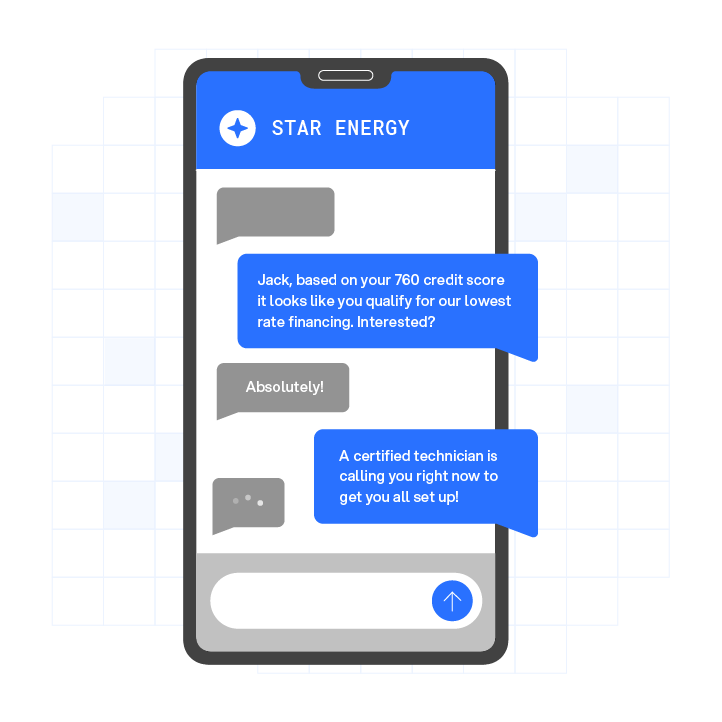
The platform runs on 10DLC-registered phone numbers with real-time DNC scrubbing and per-state quiet-hours rules applied before every outbound message.1 Effective April 11, 2025, under the FCC’s revocation rule, a consumer can revoke consent for AI voice or SMS appointment outreach in any reasonable manner, and the business must honor it within no more than 10 business days.2 The requirement for suppression across both channels is delayed until April 11, 2026. Plura’s compliance engine applies that suppression across voice and SMS from a single consent record, while customers remain responsible for their own regulatory posture.
Appointwise and Setter AI focus on text-based outreach but lack voice handoff and real-time DNC scrubbing at carrier scale.4 They also do not maintain stateful memory across channels, so a lead who switches from SMS to a phone call must re-explain their situation from the beginning.
Plura enables lead response times under 60 seconds, multichannel engagement via voice, SMS, RCS, and webchat, real-time AI lead scoring, 7 to 12 follow-up touches, full conversation transcripts, and cost per qualified lead of $25 to $60. That cost structure is achievable when voice and SMS share a single intelligence layer rather than operating as separate point tools.
Unified Voice and SMS for High-Volume Operations
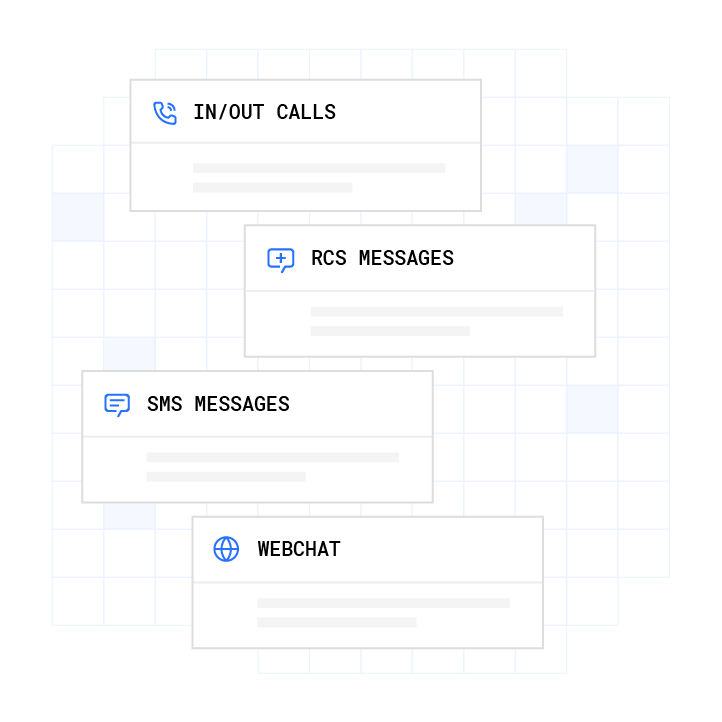
Plura combines voice and SMS on a single stateful conversation database, which keeps context consistent across channels without repetition. For teams handling 500+ daily interactions, that architecture removes the re-identification overhead that inflates average handle time in multi-vendor setups.
The speed-to-lead numbers at this volume create a material conversion gap. The speed-to-lead advantage described earlier, where sub-minute response times drive 391% higher conversion, compounds at scale.3 Contacting a lead within 5 minutes makes them up to 100x more likely to connect.3 At 500+ daily interactions, the difference between a 5-second AI response and a 47-minute human queue separates a functioning pipeline from a leaking one.
The scheduling software market reflects this shift toward AI agents. Gartner predicts that 40% of enterprise applications will include task-specific AI agents by 2026, up from less than 5% in 2025, with scheduling emerging as a leading use case.4,5 The global appointment scheduling software market is projected to grow from $635.6 million in 2026 to over $1.9 billion by 2034 at a 14.70% CAGR, driven by AI integration and conversational, agent-driven booking.5
Plura supports logarithmic cost scaling instead of the linear headcount growth that human staffing requires. Six Plura agents handle the volume of 15 human agents at 100% talk utilization, compared to the 40% talk utilization typical of human contact-center work. The no-show reduction mentioned earlier adds operational value beyond cost savings.
Carrier-Grade Compliance Checklist for AI Scheduling
High-volume operators face a compliance surface that generic AI schedulers are not built to handle. To address this gap, Plura supports the standards in the checklist below at the carrier level before every contact.1 While Plura provides this infrastructure, customers remain responsible for their own regulatory obligations and should consult qualified counsel on their specific compliance posture.
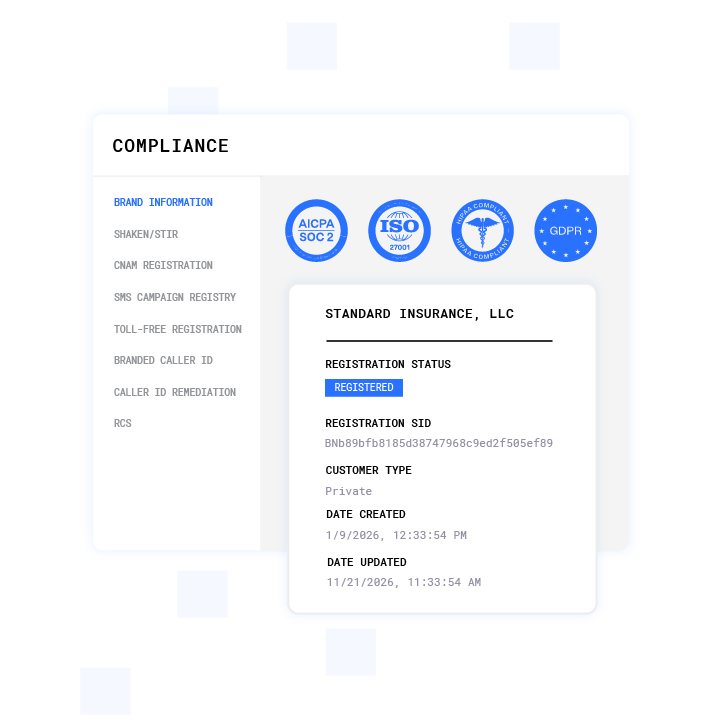
- SOC 2 – continuous monitoring, penetration testing, and third-party audits on the underlying infrastructure
- HIPAA – end-to-end encryption, access controls, and audit logging for protected health information across all four channels
- ISO certification – independently verified security management controls
- GDPR – coverage for European operations and data subject rights
- SHAKEN/STIR caller ID verification – A-level attestation on every outbound voice call, issued at the carrier level
- TCPA compliance – immutable consent records, quiet-hours rules via time-zone detection, and pre-dial consent validation
- DNC compliance – real-time scrubbing against federal and state Do Not Call registries before every outbound contact
Generic AI scheduling tools often bolt compliance on after the fact as a third-party integration or a policy document. The FCC’s February 2024 Declaratory Ruling confirmed that AI-generated and voice-cloned calls are treated as an “artificial or prerecorded voice” under the TCPA with no exception for dynamic back-and-forth responses.2 That ruling applies to every AI voice agent used for appointment booking or lead follow-up, regardless of whether the vendor has built compliance into the platform.
A single TCPA violation can result in penalties of $500 to $1,500 per call or text, and large-scale outreach programs often involve millions of contacts across multiple channels. At 500+ daily interactions, the exposure compounds quickly. Plura’s compliance engine enforces these controls as a first-class layer of the platform, with one-click audit-ready exports for legal review or carrier requirements.
Cost-per-Booked-Appointment Math for AI vs Human Teams
The unit economics of AI appointment scheduling at scale become clear when the inputs stay realistic. The default scenario on Plura’s ROI calculator uses a 15-agent operation paying $20 per hour with standard taxes, benefits, and commissions, and a 40% talk-utilization rate typical of human contact-center work. That configuration costs $60,000 per month.
The cost reduction outlined earlier, from $60,000 to $14,400 monthly, comes from three factors. First, Plura runs at $15 per hour equivalent with 100% talk utilization. Second, six Plura agents handle the work of 15 humans. Third, the platform removes idle time, ramp time, and schedule gaps that inflate human labor costs.
For higher-volume operations, the same model produces a total cost of ownership of $700,000 per year against a traditional contact-center benchmark of $7 million. That difference reflects a structural cost advantage that compounds as volume grows.
Industry benchmarks on cost per contact for human-handled phone interactions average roughly $7 per call. Human-handled calls in contact centers typically cost $5 to $15 each, while AI-handled calls often run under $1 when including platform fees, API costs, voice minutes, and infrastructure. At 500 daily interactions, that gap translates to $1,500 to $7,000 per day in avoidable cost.
No-show reduction adds another layer to the math. The 40% no-show improvement translates directly to revenue, because every no-show prevented becomes a booked slot that generates revenue instead of a calendar gap.
Compare plans and rates side by side or run your numbers through the ROI calculator to see the cost impact for your operation.
Why High-Volume Operators Choose Plura
Plura AI is the only platform in this comparison that owns its FCC-licensed carrier, maintains stateful memory across voice and SMS on a single conversation database, and passes the full carrier-grade compliance checklist while proving lower cost-per-booked-appointment for 500+ daily interactions.
These five factors work together as the core value proposition for high-volume operators:
- The carrier stack. Every other AI voice tool rents from a third-party CPaaS. Plura owns its FCC-licensed audio bridging carrier, which means lower per-minute cost, branded caller ID issued at origination, and controls enforced before the call leaves the network.
- Stateful conversation memory. Voice, AI SMS, RCS, and AI webchat all share one conversation database. A customer who texted at 9 a.m. is recognized by context when the call comes at noon, with no re-identification overhead.
- Compliance as infrastructure. TCPA and DNC controls, SOC 2, HIPAA, ISO certification, GDPR, and SHAKEN/STIR caller ID verification are supported at the carrier level before each contact, with an immutable consent ledger and one-click audit exports.
- 100% U.S. infrastructure by architecture. Voice origination, model hosting, data storage, and call recording all sit on domestic infrastructure, which aligns with the FCC NPRM (CG Docket No. 26-52) and state onshoring laws in New York, New Jersey, Connecticut, Missouri, and Florida.
- Continuous conversation engineering. Plura iterates each customer’s conversation workflow after launch, with a 90-day opt-out window in every annual contract.
The AI contact center model that Plura operates replaces the linear cost scaling of human staffing with logarithmic economics. More volume does not require proportional headcount. It requires a platform built to handle it from the carrier layer up.
Frequently Asked Questions
What is an AI appointment scheduler?
An AI appointment scheduler is a conversational software agent that handles the full booking lifecycle without human intervention. It receives an inbound inquiry or initiates an outbound contact, qualifies the lead against defined criteria, checks real-time calendar availability, confirms a time slot, and sends reminders or follow-ups across voice, SMS, or other channels. Modern AI appointment schedulers differ from legacy form-based booking tools because they conduct natural-language conversations, maintain context across a multi-turn interaction, and can hand off to a human agent mid-conversation when a workflow gate triggers. For high-volume operators handling 500 or more daily interactions, the platform underneath the AI agent matters as much as the AI itself. Carrier-grade infrastructure influences whether branded caller ID reaches the recipient, whether DNC scrubbing happens before the call leaves the network, and whether conversation context persists across channels without requiring the customer to repeat themselves.
How does Plura AI handle TCPA compliance and DNC compliance?
Plura’s compliance engine operates as a first-class layer of the platform, not a third-party add-on. Every outbound contact is checked against federal and state DNC registries in real time before dial, and non-compliant numbers are blocked before the first attempt. TCPA consent records are timestamped, immutable, and audit-ready, with consent tracked per contact and per channel. Quiet-hours rules apply automatically through time-zone detection on the contact, aligning state and federal calling-window restrictions with every campaign. The compliance dashboard exports audit-ready reports in one click for legal review or carrier requirements. Customers remain responsible for their own regulatory obligations and should consult qualified counsel on their specific compliance posture. Plura provides the infrastructure, and customers manage their downstream compliance posture.
Does Plura AI support both voice and SMS channels?
Plura supports four channels: AI voice, AI SMS, AI RCS (Rich Communication Services), and AI webchat. All four share a single Stateful Conversation Database, which means every interaction is keyed to the same customer token across channels. A lead who receives an SMS at 9 a.m. is recognized by full conversation history when the voice call comes at noon. The AI does not ask the customer to re-explain their situation. This cross-channel memory functions as an architectural feature of the platform, not a CRM integration. It is built into the data layer that every channel reads from and writes to on every interaction. For appointment scheduling, a booking started via SMS can be confirmed by voice without context loss, and a no-show follow-up can reach the customer on whichever channel they are most likely to respond to.
How does Plura AI scale beyond 500 interactions per day?
Plura scales logarithmically rather than linearly. Human staffing requires proportional headcount increases as volume grows. Plura’s AI agents run at 100% talk utilization with no taxes, benefits, commissions, or ramp time. Six Plura agents handle the volume of 15 human agents at the default calculator inputs. As volume increases beyond that baseline, the cost-per-interaction continues to fall instead of holding flat. The platform supports peak-season surges, such as Medicare Annual Enrollment Period, tax season, or Black Friday, without advance hiring. The FCC-licensed carrier infrastructure underneath the platform handles concurrent call volume at scale, with a 99.9% uptime SLA and automatic failover. Operators can expand from hundreds to thousands of daily interactions without changing the underlying platform configuration.
What are the limitations of non-carrier-grade AI schedulers?
Non-carrier-grade AI schedulers share several structural limitations that become operationally significant at 500+ daily interactions. First, they route voice through a third-party CPaaS layer, which means branded caller ID is not issued at the carrier level and SHAKEN/STIR attestation is typically B-level rather than A-level. That affects pickup rates and spam-label exposure. Second, they apply DNC scrubbing as a software check rather than a carrier-level control, so the compliance layer sits outside the call path instead of inside it. Third, most non-carrier-grade tools treat voice and SMS as separate products with separate conversation histories, so a customer who switches channels must re-identify themselves. Fourth, they cannot communicate with Apple’s iOS 26 call-screening layer to present a recognizable caller identity, because that capability requires a carrier-level identity, not a software integration. At low volumes, these gaps stay manageable. At 500+ daily interactions, they compound into measurable revenue loss, compliance exposure, and cost inefficiency.
Conclusion: Carrier-Grade AI for Appointment-Driven Teams
High-volume operators need more than a form-based booking widget or a single-channel SMS tool. The gap between what generic AI schedulers deliver and what 500+ daily interactions require involves carrier infrastructure, stateful cross-channel memory, real-time compliance controls, and cost-per-booked-appointment economics that withstand scrutiny.
Plura AI delivers all four from a single platform built on an FCC-licensed carrier. The compliance checklist, the cost math, and the speed-to-lead benchmarks are all verifiable. The 90-day opt-out window in every annual contract keeps the performance commitment on the line, not just in the pitch deck.
Calculate your specific cost savings or review the pricing structure to move forward.
1 Plura AI maintains SOC 2, HIPAA, ISO, and GDPR posture as part of its platform infrastructure. References to compliance frameworks in this article describe Plura’s platform capabilities and do not constitute a guarantee that any customer using Plura will themselves be compliant with applicable laws or standards. Customers remain solely responsible for their own regulatory obligations, certifications, consent management, recordkeeping, and the claims they make to their own end users. Consult qualified legal counsel for guidance specific to your use case.
2 This article describes regulatory frameworks at a general level and does not constitute legal advice. Laws and regulations vary by jurisdiction, change over time, and apply differently depending on facts and circumstances. Readers should consult qualified legal counsel before making compliance decisions.
3 Performance figures, customer outcomes, and industry statistics referenced in this article are drawn from cited third-party sources or Plura customer case studies. Individual results vary based on implementation, use case, industry, audience, and execution. Past or aggregate performance is not a guarantee of future results.
4 References to third-party products, services, companies, or research are made for informational and comparative purposes only. Plura AI is not affiliated with, endorsed by, or sponsored by any third party named in this article unless explicitly stated. Trademarks and product names referenced remain the property of their respective owners.
5 This article contains forward-looking statements regarding industry trends, technology adoption, and future capabilities. These statements reflect current expectations and are subject to change. Plura AI undertakes no obligation to update forward-looking statements except as required.
This article is provided for informational purposes only and reflects Plura AI’s understanding at the time of publication. Product capabilities, integrations, and specifications are subject to change. For the most current information, visit plura.ai.
This article was produced with the assistance of AI tools and reviewed by Plura AI prior to publication.